Skarp
Skarp
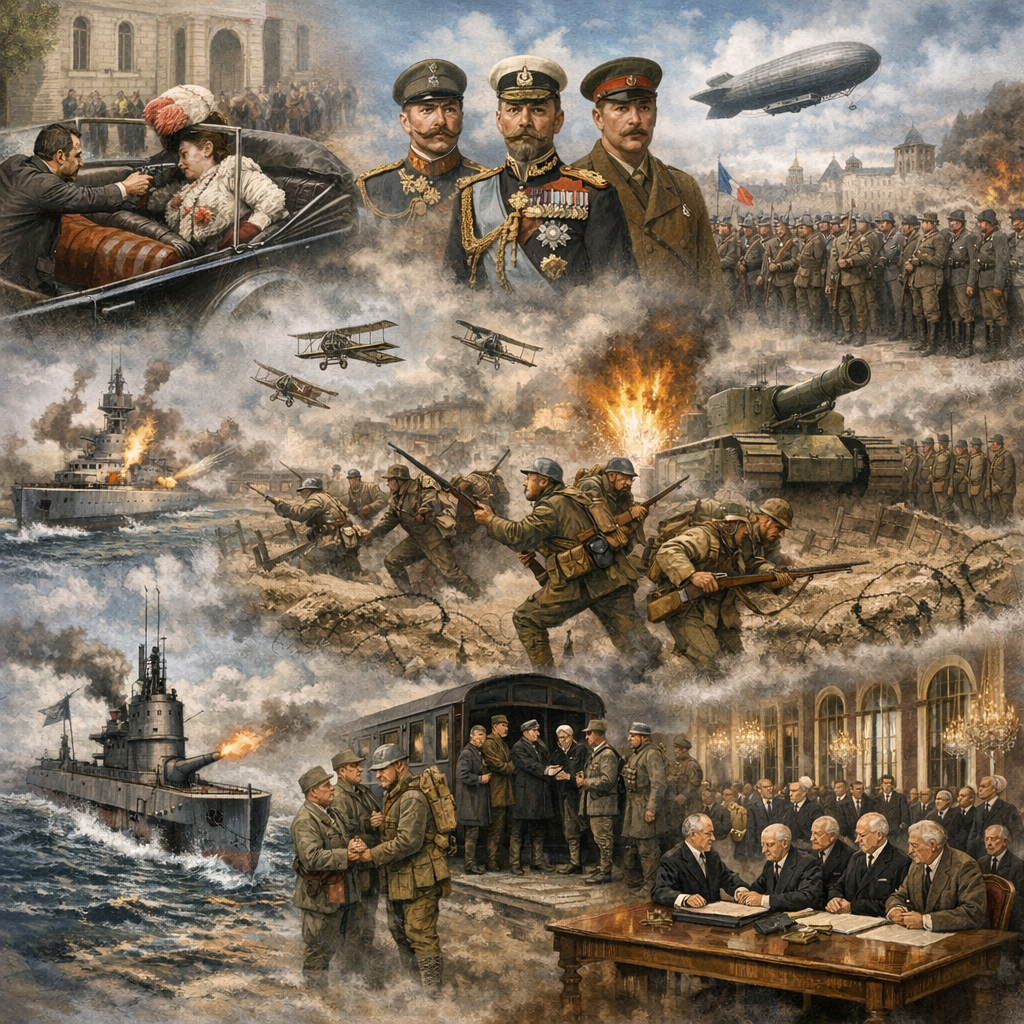
World War I: A Global War and Its Lasting Aftermath
Trace how a regional crisis in 1914 became a worldwide struggle involving empires, colonies, soldiers, and civilians across several continents. The course examines industrialized warfare, total war, imperial collapse, contested peace settlements, and the conflict’s enduring political, social, and cultural consequences.
The first lecture plays free — no account needed.
What you'll learn
- Students will be able to distinguish between the long-term causes and immediate trigger of World War I.
- Students will understand how decisions made during the July Crisis transformed a regional dispute into a European war.
- Students will be able to evaluate why the outbreak of war was not caused by a single factor.
- Students will be able to identify the principal alliances and major global theaters of World War I.
- Students will understand how imperial networks expanded the geographic and human scale of the conflict.
- Students will be able to describe contributions made by soldiers and workers from colonies and dominions.
- Students will be able to explain why trench warfare developed on the Western Front.
- Students will understand how industrial technology changed military strategy and soldiers’ experiences.
- Students will be able to compare the purposes and limitations of major wartime technologies.
- Students will be able to explain the meaning of total war.
Prerequisites
- Long-term causes of World War I
- The July Crisis
- European alliance systems
- Major alliances
- Global theaters of war
- Industrialized warfare
Course Content
8 modules · 54 min total
Europe on the Brink
A political assassination in Sarajevo ignited a crisis, but the explosives had been accumulating for decades. Rival alliances, nationalism, imperial competition, and military planning made the summer of 1914 dangerously unstable.
How a European War Became Global
The fighting quickly crossed oceans and continents as imperial powers mobilized territories, resources, and people around the world. Campaigns in Africa, Asia, the Pacific, and the Middle East reveal why this conflict truly became a world war.
The Machinery of Industrialized War
Machine guns, heavy artillery, barbed wire, poison gas, submarines, aircraft, and tanks transformed battlefields into landscapes of unprecedented destruction. Military innovation promised breakthroughs but often produced stalemate and mass casualties.
Total War: Societies Under Pressure
The battlefront reached deep into homes, factories, farms, and occupied communities. Governments reorganized economies, shaped public opinion, and demanded extraordinary sacrifices while civilians faced shortages, displacement, persecution, and violence.
The War Turns, 1917–1918
Revolution removed Russia from the conflict while the United States brought new resources to the Allied side. Germany’s final offensives, Allied counterattacks, domestic unrest, and collapsing partners brought the fighting to a dramatic end.
Empires Fall and New States Rise
Victory did not simply restore the prewar world. The Russian, German, Austro-Hungarian, and Ottoman empires fractured, unleashing revolutions, border conflicts, independence movements, and competing claims to territory.
Making an Uneasy Peace
Peacemakers gathered in Paris promising a safer international order, yet defeated powers and colonized peoples had limited influence over the negotiations. The resulting treaties created new borders, mandates, reparations, and grievances alongside the League of Nations.
The Long Shadow of the Great War
The guns fell silent, but grief, disability, economic instability, border violence, and political radicalization continued. Remembrance, anticolonial movements, fragile democracies, and unresolved grievances shaped the decades that followed.
Read the Textbook
Read every chapter for free, right here in your browser.
Europe on the Brink
World War I did not begin because of one assassination alone. The murder of Archduke Franz Ferdinand on 28 June 1914 was the immediate trigger. It set off a diplomatic crisis between Austria-Hungary and Serbia.
But Europe had become unstable over decades. Nationalism, imperial rivalry, military expansion, alliance commitments, and rigid war planning made a local conflict far more likely to spread.
Study Flashcards
Key concepts from this course as flashcard pairs.
Europe on the Brink
Nationalism
Strong identification with a nation or national group; in 1914 it could inspire unity, independence movements, territorial claims, and hostility toward rivals.
Militarism
The growth of military power and influence, including arms races and the belief that military force was a normal tool of policy.
Security dilemma
A situation in which one state's defensive military buildup makes another state feel threatened, prompting both to arm further.
Triple Entente
The prewar alignment of Britain, France, and Russia; it was a series of agreements and understandings rather than one unified automatic alliance treaty.
Blank cheque
The strong German assurance of support for Austria-Hungary around 5-6 July 1914, even if action against Serbia risked a wider war.
July Crisis
The diplomatic and military escalation from the Sarajevo assassination in late June 1914 to the outbreak of general European war in early August.
How a European War Became Global
Dominion
A self-governing territory within the British Empire, such as Canada, Australia, New Zealand, or South Africa. Dominions mobilized forces and resources for the war.
Colonial troops
Soldiers recruited from a colony or imperial possession to serve an imperial power. They fought in multiple theaters, not only in their home regions.
Carrier labor
The transport of military supplies by people, especially where roads and railways were limited. It was central to African campaigns and often involved coercion.
Sea lane
A regularly used maritime route for ships. Control of sea lanes determined whether states could move troops, food, raw materials, and weapons.
Blockade
A naval strategy intended to prevent an enemy from importing goods or receiving supplies. Britain's blockade of Germany had major economic and civilian effects.
The Machinery of Industrialized War
Trench warfare
Combat organized around fortified, interconnected defensive lines. It developed when firepower and defensive preparation made rapid movement extremely costly.
Creeping barrage
An artillery barrage that advanced on a schedule just ahead of infantry, intended to suppress defenders while attackers moved forward.
No man's land
The dangerous, contested ground between opposing trench systems, often marked by shell craters, wire, mud, and destroyed infrastructure.
U-boat
A German submarine used to attack military and merchant shipping. U-boat warfare challenged British naval power and global supply lines.
Combined arms
Coordinated use of different forces and weapons, such as infantry, artillery, engineers, tanks, and aircraft, to offset one another's weaknesses.
Mustard gas
A blistering chemical warfare agent that injured skin, eyes, and lungs. It contaminated terrain and forced soldiers to use protective equipment.
Total War: Societies Under Pressure
Total war
War in which states mobilize extensive military, economic, political, and civilian resources, blurring the line between front and home front.
Economic mobilization
Organizing industry, labor, transport, food, and finance to meet wartime needs.
Rationing
Government limits on access to scarce goods so supplies can be distributed or prioritized for the war effort.
Propaganda
Communication designed to influence public attitudes and behavior, often in support of a political or military goal.
Censorship
Restriction or control of information, speech, or publication by authorities.
Occupation
Control of territory and its population by a foreign military power.
+1 more flashcards
The War Turns, 1917–1918
February Revolution, 1917
The revolution that forced Tsar Nicholas II to abdicate. It brought in a Provisional Government that continued Russia's war effort.
October Revolution, 1917
The Bolshevik seizure of power in Russia. The new government sought peace and led Russia out of the war.
Treaty of Brest-Litovsk
The March 3, 1918 treaty that ended Russia's war with the Central Powers and imposed severe territorial losses on Soviet Russia.
US entry into the war
The United States declared war on Germany on April 6, 1917, adding financial, industrial, naval, and military resources to the Allied side.
German Spring Offensive
German attacks from March to July 1918 intended to win in the West before US power became decisive. They gained ground but exhausted Germany's remaining offensive strength.
Hundred Days Offensive
A series of Allied offensives from August 8 to November 11, 1918 that drove German forces back and helped force the armistice.
+1 more flashcards
Empires Fall and New States Rise
National self-determination
The principle that peoples should be able to choose their political status and government. After World War I, applying it was difficult because populations were mixed.
Successor state
A state that emerged from the territory or political collapse of an earlier state or empire, such as Austria, Hungary, or Czechoslovakia.
Minority population
A group that differs by ethnicity, language, religion, or nationality from the majority within a state and may seek legal protection or political change.
Mandate
A League of Nations arrangement that placed former German or Ottoman territories under administration by another power, supposedly as temporary supervision.
Plebiscite
A direct vote by residents on a political question, often used to determine sovereignty or a border.
Weimar Republic
Germany's republican government from 1918 to 1933, created after the fall of the German Empire.
Making an Uneasy Peace
Paris Peace Conference
The 1919-1920 gathering that negotiated the post-First World War settlement, dominated by the victorious powers.
Treaty of Versailles
The treaty signed with Germany on 28 June 1919; it included territorial changes, military restrictions, reparations provisions, and the League Covenant.
Reparations
Payments demanded from Germany to compensate for war damage. The 1921 total was set at 132 billion gold marks.
Collective security
The principle that states should act together to deter or respond to aggression, central to the League of Nations.
Mandate system
League-supervised administration of former German and Ottoman territories, presented as temporary trusteeship but often experienced as continued colonial rule.
Treaty of Lausanne
The 1923 treaty that replaced the unimplemented Treaty of Sevres and established the international settlement with the Republic of Turkey.
The Long Shadow of the Great War
Reparations
Payments imposed on a defeated state for war damage or costs. After World War I, reparations were part of a wider, unstable system of debts and international finance.
Shell shock
A contemporary term for some psychological and neurological war injuries. Historians should not treat it as an exact synonym for the modern diagnosis of PTSD.
Self-determination
The principle that peoples should determine their political status. After 1918, it was applied unevenly, especially to colonized peoples.
League of Nations mandate
A former German or Ottoman territory administered by another power under League supervision. Mandates were presented as trusteeship but commonly continued imperial control.
Hyperinflation
Extremely rapid price increases that severely reduce a currency's purchasing power. Germany's 1923 crisis is a prominent example.
Contingency
The idea that historical outcomes are not predetermined. Conditions constrain choices, but decisions and chance can lead to different results.
More in History
See all →
The Origin Story of the English Alphabet
Yhdysvaltain sisällissota: syyt, kulku ja seuraukset
Första världskriget för åk 8: Från skottet i Sarajevo till Versaillesfreden
Decisive Battles of the American Civil War

The Space Race: Rockets, Rivalry, and the Road to the Moon