 Skarp
Skarp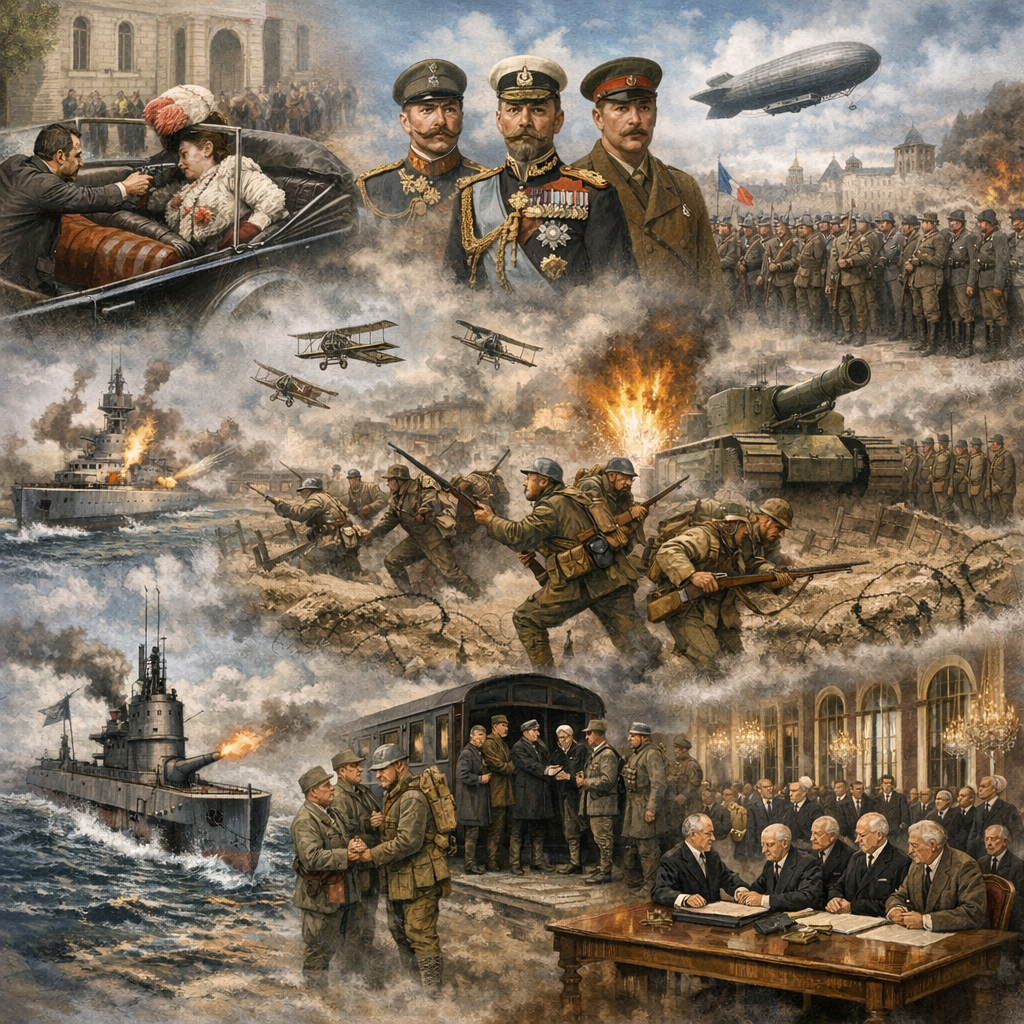
World War I for Grade 8: From the Shot in Sarajevo to the Treaty of Versailles
This course takes students on a journey from the tense years before 1914 through the assassination in Sarajevo, the global trench war, and finally the peace negotiations at Versailles. Students connect causes, key events, and consequences of the First World War to understand how this conflict reshaped Europe and still affects our world today.
The first lecture plays free — no account needed.
What you'll learn
- Students will be able to describe how nationalism, imperialism and militarism increased tensions between the great powers before 1914.
- Students will understand how the alliance systems (Triple Alliance and Triple Entente) created a fragile balance of power that could quickly escalate a crisis into a major war.
- Students will be able to recount the main events of the assassination in Sarajevo on 28 June 1914 and identify the key actors involved.
- Students will understand how the July Crisis and the alliance system transformed the assassination into a wider European and then global conflict.
- Students will be able to compare the war on the Western and Eastern fronts and explain why the Western Front became a static trench war.
- Students will understand how technological developments such as machine guns, poison gas, tanks, aircraft and submarines changed the nature and scale of warfare.
- Students will be able to describe how total war affected civilian life through rationing, work in factories and changing roles for women.
- Students will understand how propaganda was used to influence opinions and how soldiers and resources from colonies made the war truly global.
- Students will be able to identify and explain key turning points in 1917–1918, including the Russian Revolution and the entry of the United States into the war.
- Students will understand why Germany and its allies were forced to accept an armistice in November 1918 and how military and social factors combined to end the war.
Prerequisites
- Nationalism and imperialism
- Alliance systems in pre-war Europe
- Assassination of Franz Ferdinand in Sarajevo
- The July Crisis and mobilization
- Trench warfare and everyday life at the front
- New weapons: machine guns, gas, tanks, aircraft and submarines
Course Content
8 modules · 2h total
Europe on a Powder Keg: Tensions before 1914
Picture a Europe armed to the teeth, divided into rival camps and competing for colonies – a world where one spark could set everything ablaze. This module sets the stage for 1914 by uncovering the rivalries, fears and ambitions that made war increasingly likely.
The Shot in Sarajevo: From Assassination to World War
A royal visit, a nervous young assassin and a single gunshot in a crowded street—this dramatic moment in Sarajevo triggered a chain reaction across Europe. Follow how a local crisis on the Balkans turned into a world war within just a few weeks.
From Movement to Stalemate: Trench Warfare and New Weapons
What began as a war of fast-moving armies soon froze into a landscape of mud, barbed wire and trenches stretching from the North Sea to Switzerland. Step into the world of the Western and Eastern fronts and see how new technology turned war into industrial slaughter.
Beyond the Battlefields: Home Front, Propaganda and a Global War
While soldiers fought in the trenches, millions of civilians worked, starved and worried at home—and people from colonies were shipped across oceans to fight in a European war. Discover how World War I reached far beyond Europe’s borders and into factories, kitchens and minds around the world.
Turning Points and War’s End: 1917–1918
Mutinies, revolutions and fresh American troops turned the tide in a war that many thought would never end. Trace the crucial turning points that broke the stalemate and led exhausted leaders to finally seek an armistice.
From Ceasefire to Peace Talks: Competing Visions for a New Europe
When the guns fell silent, politicians and diplomats rushed to redraw borders and repair a shattered world—but they disagreed sharply on how to treat the defeated. Step inside the peace conferences and meet the leaders who tried, and partly failed, to build a lasting peace.
The Treaty of Versailles: Punishment, Borders and the League of Nations
In a glittering palace outside Paris, the victors dictated harsh terms to Germany that would echo through the rest of the century. Unpack the Treaty of Versailles, its new borders, war guilt clause and the birth of the League of Nations—and why many contemporaries feared it sowed the seeds of a new conflict.
Lasting Scars: Consequences of World War I
Collapsed empires, new nations, mass graves and political extremism—the aftermath of World War I reshaped maps and minds alike. In this final module, connect the war’s outcomes to later events, including the rise of dictatorships and the road toward World War II.
Read the Textbook
Read every chapter for free, right here in your browser.
Imagine Europe around 1914 as a basement filled with gunpowder barrels. Each barrel is a source of tension: nationalism, imperialism, militarism, and rigid alliances. The room is crowded, everyone is nervous, and many people are holding matches.
In this module, you will: See how nationalism and imperialism made rivalries sharper. Understand how militarism and the arms race made war more likely. Learn how the alliance systems turned local disputes into a possible continent-wide conflict.
Keep in mind: We are looking at the period roughly 1870–1914. There was no single cause of war. Instead, several long-term trends interacted. The assassination at Sarajevo in June 1914 was the spark, but the "powder keg" had been prepared for decades.
Study Flashcards
Key concepts from this course as flashcard pairs.
Europe on a Powder Keg: Tensions before 1914
Nationalism
Belief that people sharing language, culture, or history should form their own nation-state, and that this nation deserves loyalty and often superiority over others.
Imperialism
Policy of extending a country's power by gaining control over other regions or peoples, often overseas, for resources, markets, bases, or prestige.
Militarism
Belief that a state must keep a strong military and be ready to use it; gives the army and navy high status and often significant influence over politics.
Arms race
Competitive buildup of military forces and weapons between rival states, such as the Anglo-German naval race before 1914.
Triple Alliance
Defensive alliance formed in 1882 between Germany, Austria-Hungary, and Italy, aimed at mutual support if one member was attacked.
Triple Entente
Network of agreements linking France, Russia, and Britain by 1907, creating a powerful counterweight to the Triple Alliance.
+2 more flashcards
The Shot in Sarajevo: From Assassination to World War
Archduke Franz Ferdinand
Heir to the Austro-Hungarian throne whose assassination in Sarajevo on 28 June 1914 triggered the July Crisis and helped spark World War I.
Gavrilo Princip
A 19-year-old Bosnian Serb nationalist and member of Young Bosnia who shot and killed Franz Ferdinand and his wife Sophie in Sarajevo.
The Black Hand
A secret Serbian nationalist organization (Union or Death) led by army officers; it supported and armed the Sarajevo assassins.
Young Bosnia
A loose group of mainly young Bosnian Serb (and some Croat and Muslim) nationalists who opposed Austro-Hungarian rule and included Gavrilo Princip.
July Crisis
The tense period between the assassination on 28 June 1914 and the outbreak of general war in early August, marked by ultimatums, diplomacy, and mobilizations.
Ultimatum
A final set of demands backed by a threat; in July 1914, Austria-Hungary sent Serbia an ultimatum with very harsh terms after the assassination.
+2 more flashcards
From Movement to Stalemate: Trench Warfare and New Weapons
Western Front
The main fighting zone in France and Belgium where Allied and German forces faced each other in a dense line of trenches from the North Sea to Switzerland.
Eastern Front
The long, more mobile front stretching from the Baltic Sea through Eastern Europe to the Balkans, where lines moved more and continuous trenches were less common.
Trench Warfare
A form of warfare in which opposing armies fight from long, dug-out defensive positions, often leading to stalemate and high casualties for small territorial gains.
No Man’s Land
The exposed area of ground between opposing trench lines, often filled with craters, barbed wire, and corpses, and extremely dangerous to cross.
Machine Gun
A rapid-firing automatic gun that could fire hundreds of rounds per minute, greatly strengthening defensive positions in World War I.
Artillery Barrage
Intense, continuous shelling of enemy positions by heavy guns, used to destroy defenses and demoralize troops before infantry attacks.
+4 more flashcards
Beyond the Battlefields: Home Front, Propaganda and a Global War
Home front
The civilian side of a war: people, work, shortages and emotions in areas away from the actual battlefields.
Total war
A type of conflict in which governments mobilize whole societies, including civilians and economies, for the war effort.
Rationing
A system that limits how much of certain goods (such as food or fuel) people can buy or use, often through ration cards.
Propaganda
One-sided, emotional information used to promote a cause, shape opinions or influence behavior.
Censorship
Control or suppression of information, such as news, letters or images, often by the state during wartime.
Colonial troops
Soldiers recruited from colonies, who fought for imperial powers such as Britain, France or Germany.
+2 more flashcards
Turning Points and War’s End: 1917–1918
Russian Revolution (1917)
A pair of revolutions (February and October, by the old calendar) that overthrew the Tsar, brought the Bolsheviks to power, and led to Russia leaving World War I.
Treaty of Brest-Litovsk (March 1918)
Peace treaty between Soviet Russia and the Central Powers. Russia left the war but lost large territories in Eastern Europe and the Baltic region.
Unrestricted submarine warfare
German policy of using submarines to sink ships (including neutral ones) without warning in certain zones, a key factor pushing the US toward war.
American Expeditionary Forces (AEF)
The US army sent to Europe in World War I, commanded by General John J. Pershing, which fought mainly in 1918.
Mutiny
A collective refusal by soldiers or sailors to obey orders. In 1917–1918, mutinies signaled deep war-weariness and forced governments to change course.
Operation Michael
The main German spring offensive launched in March 1918 on the Western Front, which made major gains but exhausted Germany’s best troops.
+2 more flashcards
From Ceasefire to Peace Talks: Competing Visions for a New Europe
Armistice (11 November 1918)
A ceasefire agreement that stopped the fighting in WWI but was not a full peace treaty. It ended combat but left the legal state of war until peace treaties were signed.
Fourteen Points
A set of principles announced by U.S. President Woodrow Wilson in January 1918, promoting open diplomacy, free trade, arms reduction, self-determination, and a League of Nations.
Self-determination
The idea that peoples should, as far as possible, be able to choose their own government and form states that match their national identity. Applied unevenly after WWI.
Paris Peace Conference (1919)
A meeting of Allied victors in Paris after WWI to draft peace treaties. Real power lay with the Big Four: Wilson, Clemenceau, Lloyd George, and Orlando.
Treaty of Versailles
The 1919 peace treaty with Germany. It imposed territorial losses, military restrictions, reparations, and a war guilt clause, and created the League of Nations.
League of Nations
An international organization created in 1919 to promote cooperation and prevent war. It had some successes but was weakened by the absence of major powers like the USA.
The Treaty of Versailles: Punishment, Borders and the League of Nations
Treaty of Versailles (1919)
The main peace treaty between the Allies and Germany after World War I. It imposed war guilt, reparations, military limits, territorial losses, and created the League of Nations framework.
Article 231 (War Guilt Clause)
Clause stating that Germany and its allies accepted responsibility for the war and its damage. Used as the legal basis for reparations, but felt by many Germans as a moral condemnation.
Reparations
Payments and deliveries (money, coal, ships, etc.) demanded from Germany to compensate for war damage. Set at 132 billion gold marks in 1921 and politically very controversial.
Demilitarized Rhineland
Region in western Germany where Versailles banned German troops and fortifications, intended as a security buffer for France.
Polish Corridor
Strip of land taken from Germany to give the new Poland access to the Baltic Sea, separating East Prussia from the rest of Germany.
Free City of Danzig
Port city (now Gdańsk) made a semi-independent Free City under League of Nations protection with special ties to Poland.
+3 more flashcards
Lasting Scars: Consequences of World War I
Reparations
Payments demanded from a defeated country to compensate for war damage. After World War I, Germany was required to pay large reparations, mainly to France and Belgium.
Hyperinflation
An extreme, rapid rise in prices that destroys the value of money. Germany experienced hyperinflation in 1923, wiping out many people's savings.
National self-determination
The idea that people who share a national identity should have their own state. Peace settlements after World War I tried to apply this but often created new minority problems.
League of Nations
An international organization created after World War I to maintain peace through collective security and negotiation. It lacked real power and failed to stop major aggression in the 1930s.
Fascism
A far-right political ideology that rejects democracy, glorifies the nation and leader, and often uses violence. Mussolini's Italy and later Nazi Germany are key examples, though Nazism added extreme racism and antisemitism.
Stab-in-the-back myth
A false claim spread in post-war Germany that the army had not truly been defeated in 1918, but was betrayed by civilians, especially democrats and Jews. Nazis used this myth to attack the Weimar Republic.
More in History
See all →
The Origin Story of the English Alphabet
Yhdysvaltain sisällissota: syyt, kulku ja seuraukset
Första världskriget för åk 8: Från skottet i Sarajevo till Versaillesfreden
Decisive Battles of the American Civil War

World War I: A Global War and Its Lasting Aftermath
