Skarp
Skarp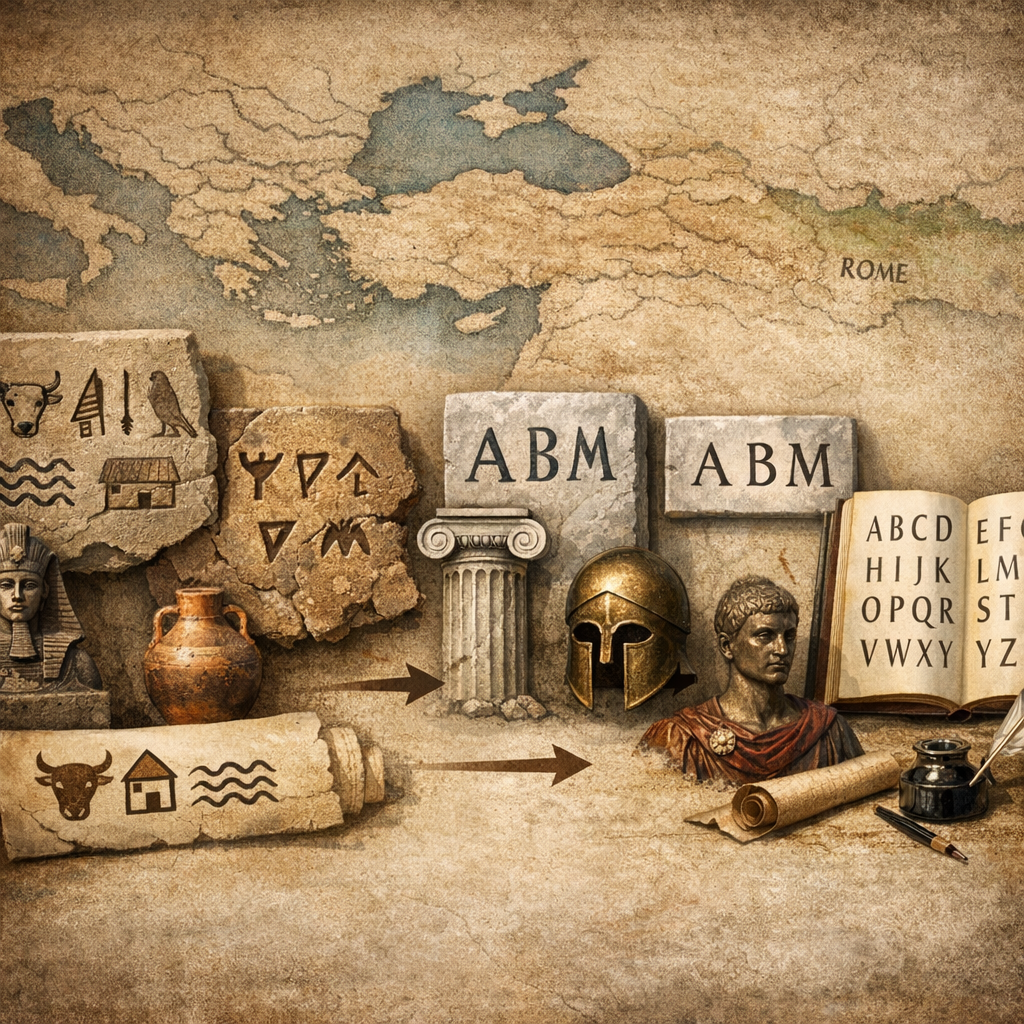
The Origin Story of the English Alphabet
Explore how our 26 English letters grew from ancient pictures and symbols into the modern alphabet we use today. You will trace the journey from early Near Eastern signs through Phoenician, Greek, and Latin scripts to Old English runes and the final shape of the English alphabet.
The first lecture plays free — no account needed.
What you'll learn
- Students will be able to explain the difference between picture‑based writing and alphabetic writing.
- Students will understand why representing sounds with a small set of symbols was a major innovation.
- Students will be able to describe Proto‑Sinaitic as an early step toward true alphabets.
- Students will be able to identify the Phoenician alphabet as a key ancestor of the English alphabet.
- Students will understand how trade networks helped spread writing systems.
- Students will be able to give examples of later alphabets influenced by Phoenician (Greek, Hebrew, Latin).
- Students will be able to explain why adding vowel letters was a revolutionary step in alphabet history.
- Students will understand how Greek letters and their order relate to earlier Phoenician signs.
- Students will be able to recognize that many English letter shapes (A, B, E, etc.) trace back through Greek forms.
- Students will be able to describe the path from Greek to Etruscan to Latin alphabets.
Prerequisites
- pictograms vs. alphabets
- basic idea of Proto‑Sinaitic and sound‑based symbols
- Phoenician alphabet and its spread
- concept of consonant‑only scripts
- Greek innovations in the alphabet
- basic Mediterranean geography and cultures
Course Content
8 modules · 2h total
From Pictures to Sounds: Why Alphabets Were Invented
Introduce early writing systems and the big shift from picture‑based writing to symbols that stand for sounds, setting the stage for the English alphabet’s story.
The Phoenician Breakthrough: A Portable Alphabet
Explore how Phoenician traders spread a 22‑letter consonant alphabet around the Mediterranean and why this script became the ancestor of many modern alphabets, including English.
Greek Innovations: Adding Vowels and Shaping the Alphabet
See how the Greeks adapted the Phoenician script, added written vowels, and created one of the first true alphabets that would later influence Latin and English.
From Etruscan to Latin: The Roman Alphabet Takes Shape
Trace how the alphabet passed from Greek to Etruscan to Latin, and how the Romans shaped the letter set that would eventually become the basis of English writing.
Runes and Romans: Writing Old English Before and After Christianization
Examine how early English (Anglo‑Saxon) was first written with runes (futhorc) and later switched to a modified Latin alphabet after Christian missionaries arrived.
Special Old English Letters: Thorn, Eth, Wynn, and Ash
Discover the extra letters used in Old English writing and how they eventually disappeared or were replaced in the move toward the modern English alphabet.
Arriving at 26 Letters: J, U, W, and the Modern Alphabet
Follow the final steps from medieval Latin script to the 26‑letter English alphabet, focusing on how letters like J, U, and W were added and standardized in print.
Shapes, Order, and Impact: How the Alphabet Shapes English Today
Connect the historical journey of the alphabet to modern English, looking at letter shapes, alphabetical order, and how this writing system influences literacy, technology, and culture.
Read the Textbook
Read every chapter for free, right here in your browser.
Writing is a technology humans invented to save and share information.
For most of human history, people relied on memory, speech, and images (like cave paintings). Around 5,000–5,300 years ago in places like Mesopotamia (modern Iraq) and Egypt, people began to create formal writing systems.
In this module you will: Compare picture‑based writing and alphabetic writing See why alphabets were a big breakthrough Meet Proto‑Sinaitic, an early sound‑based script that helped lead to later alphabets (including those that influenced English)
Study Flashcards
Key concepts from this course as flashcard pairs.
From Pictures to Sounds: Why Alphabets Were Invented
Pictogram
A simple picture that represents an object or concept by its appearance, such as a drawing of a fish meaning “fish.”
Logographic writing
A writing system in which many signs represent whole words or morphemes (meaningful units), rather than individual sounds.
Phoneme
The smallest unit of sound that can change the meaning of a word in a language (e.g., /p/ vs. /b/ in “pat” vs. “bat”).
Alphabet
A writing system where symbols (letters) primarily represent individual phonemes, usually requiring only a few dozen symbols.
Rebus principle
Using a picture for the sound of the word it names, rather than for its meaning (e.g., a picture of an eye to represent the sound “I”).
Acrophonic principle
Using a symbol to represent the first sound of the word for the pictured object (e.g., a picture of an ox, ‘ʔalp’, used for the sound /ʔa/).
+2 more flashcards
The Phoenician Breakthrough: A Portable Alphabet
Phoenicians
Ancient seafaring traders from the Eastern Mediterranean (around modern Lebanon, coastal Syria, and northern Israel) active from about 1200 BCE, who helped spread a 22-letter consonant alphabet.
Abjad
A writing system that mainly records consonants and usually leaves most vowels unwritten, like the ancient Phoenician and Hebrew scripts.
Phoenician Alphabet
A 22-letter consonant-only script developed around 1200–1000 BCE that became a major ancestor of Greek, Hebrew, and Latin alphabets.
Portable Alphabet
A description of the Phoenician script highlighting that it was simple, compact, and easy to carry and adapt across different cultures via trade.
Greek Alphabet
An alphabet adapted from Phoenician around the 8th century BCE, which added distinct vowel letters and later influenced the Latin alphabet.
Latin Alphabet
The alphabet used by the Romans, adapted from Greek (through the Etruscans), and the direct ancestor of the modern English alphabet.
Greek Innovations: Adding Vowels and Shaping the Alphabet
Abjad
A writing system that mainly marks consonants and leaves most vowels unwritten (e.g., Phoenician, early Hebrew). Readers supply vowels from context.
Alphabet (full alphabet)
A writing system where both consonants and vowels are represented by separate letters. Greek is one of the earliest clear examples.
Phoenician script
A consonant-based writing system (abjad) used by Phoenician traders around the eastern Mediterranean, ancestor of Greek and many other scripts.
Greek vowel innovation
The Greek practice of turning some Phoenician consonant signs into letters that stand for vowel sounds, creating a more precise alphabet.
Boustrophedon
An early Greek writing style where lines alternate direction (left-to-right, then right-to-left), like the path of an ox ploughing a field.
Alpha, Beta, Gamma…
The first Greek letters, adapted from Phoenician ʾālep, bēt, gīmel. Their order is the ancestor of our A, B, C…
+1 more flashcards
From Etruscan to Latin: The Roman Alphabet Takes Shape
Etruscans
An ancient people of central Italy (c. 800–300 BCE) whose Greek-derived alphabet was adapted by the Romans to write Latin.
Euboean / Western Greek alphabet
A variant of the Greek alphabet used by settlers from Euboea in southern Italy; it was the main source for the Etruscan alphabet.
Early Latin alphabet (21–23 letters)
The set of letters used in early Roman times, initially without G, J, U, W, and Y, and later expanded to a 23-letter form that is the ancestor of modern English A–Z.
Roman capitals
The all-uppercase, carved letterforms used in official Roman inscriptions, characterized by clear geometry, straight lines, and some controlled curves.
Function of V and I in Latin
In classical Latin, V represented both vowel /u/ and consonant /w/ or /v/, and I represented both vowel /i/ and consonant /j/.
Boustrophedon
A writing style in which lines alternate direction (left-to-right, then right-to-left), used in some early Greek and Etruscan inscriptions.
+1 more flashcards
Runes and Romans: Writing Old English Before and After Christianization
Old English
The early form of the English language spoken in Anglo‑Saxon England (roughly 5th–11th centuries), written first in runes and later mainly in a modified Latin alphabet.
Elder Futhark
The earliest known runic alphabet used by Germanic peoples (about 150–700 CE), with around 24 runes; ancestor of the Anglo‑Saxon futhorc.
Anglo‑Saxon futhorc
The runic alphabet used in early medieval England, expanded from the Elder Futhark to about 28–33 runes to represent Old English sounds.
Latin alphabet (in Anglo‑Saxon England)
The writing system introduced with Christianity, adapted from the Roman alphabet and modified with extra letters (like þ, ð, æ, ƿ) to write Old English.
Christianization of England
The gradual process, starting strongly from 597 CE, by which Anglo‑Saxon kingdoms adopted Christianity, bringing Latin literacy, monasteries, and the widespread use of the Latin script.
Thorn (þ) and eth (ð)
Special letters used in Old English writing (based on Latin script) to represent 'th' sounds, partly inherited from runic traditions.
+2 more flashcards
Special Old English Letters: Thorn, Eth, Wynn, and Ash
þ (thorn)
Old English letter for th‑sounds (as in 'thin' and 'this'). Largely replaced by 'th' after the Middle English period, especially with the spread of printing.
ð (eth)
Old English letter, visually like a crossed 'd', also used for th‑sounds. Disappeared from English spelling in favor of 'th'; still used in modern Icelandic.
ƿ (wynn)
Letter for the /w/ sound in Old English, borrowed from runes. Replaced by 'w' (originally written as 'uu', i.e., double u/v).
æ (ash)
Vowel letter representing a front /æ/ sound in Old English (similar to the vowel in 'cat'). Later replaced by spellings with 'a' or 'e'; survives mainly in historical and specialist contexts.
ȝ (yogh)
Letter mainly used in Middle English for sounds like /j/, /g/, and velar fricatives. Replaced by 'g', 'y', and 'gh' in modern spelling (e.g., 'niȝt' → 'night').
Why th instead of þ and ð?
Norman scribes and later printers were used to Latin/French spelling and types that included 't' and 'h' but not þ or ð. 'th' became the practical, standardized choice.
+2 more flashcards
Arriving at 26 Letters: J, U, W, and the Modern Alphabet
Medieval I/J relationship
In medieval Latin script, I and J were not separate letters; J was a stylistic variant of I, often used in certain positions, not a distinct alphabet entry.
Medieval U/V relationship
U and V were two shapes of one letter. Shape often depended on position in the word, and both could represent vowel /u/ or consonant /v/.
Role of printing
The printing press (introduced in England in 1476) pushed printers to choose consistent spellings and letter-forms, helping separate J from I and U from V by sound.
Emergence of J
J gradually became a distinct letter used mainly for the consonant /dʒ/ in English, especially from the 1600s onward, and took its place between I and K in the alphabet.
Emergence of U and V
By around the 1700s, U was used mainly for vowel sounds and V for the consonant /v/, becoming distinct letters in the English alphabet.
Origin of W
W developed from writing the /w/ sound as 'uu' after Old English ƿ (wynn) fell out of use; this 'double u' became a single letter W.
+2 more flashcards
Shapes, Order, and Impact: How the Alphabet Shapes English Today
Capital (uppercase) letters
Larger letter forms (A, B, C …) historically based on Roman stone-carved shapes; used at the start of sentences and for proper nouns in modern English.
Lowercase letters
Smaller letter forms (a, b, c …) that grew out of faster, rounded handwriting; paired with capitals to form the modern 26-letter English alphabet.
Alphabetical order (A–Z)
The traditional fixed sequence of letters used to organize lists, dictionaries, indexes, contact lists, file names, and many digital searches.
Font
A specific design of letters, numbers, and symbols in print or on screens (e.g., Times New Roman, Arial, Consolas), based on the same underlying alphabet shapes.
Lexicographic order
A technical term for dictionary-style ordering of words, where items are compared letter by letter using alphabetical order.
Unicode
A modern standard for encoding text in computers, assigning a numeric code point to each character, including the 26 English letters and many other writing systems.
More in History
See all →
Yhdysvaltain sisällissota: syyt, kulku ja seuraukset
Första världskriget för åk 8: Från skottet i Sarajevo till Versaillesfreden
Decisive Battles of the American Civil War

World War I: A Global War and Its Lasting Aftermath

The Space Race: Rockets, Rivalry, and the Road to the Moon