Skarp
Skarp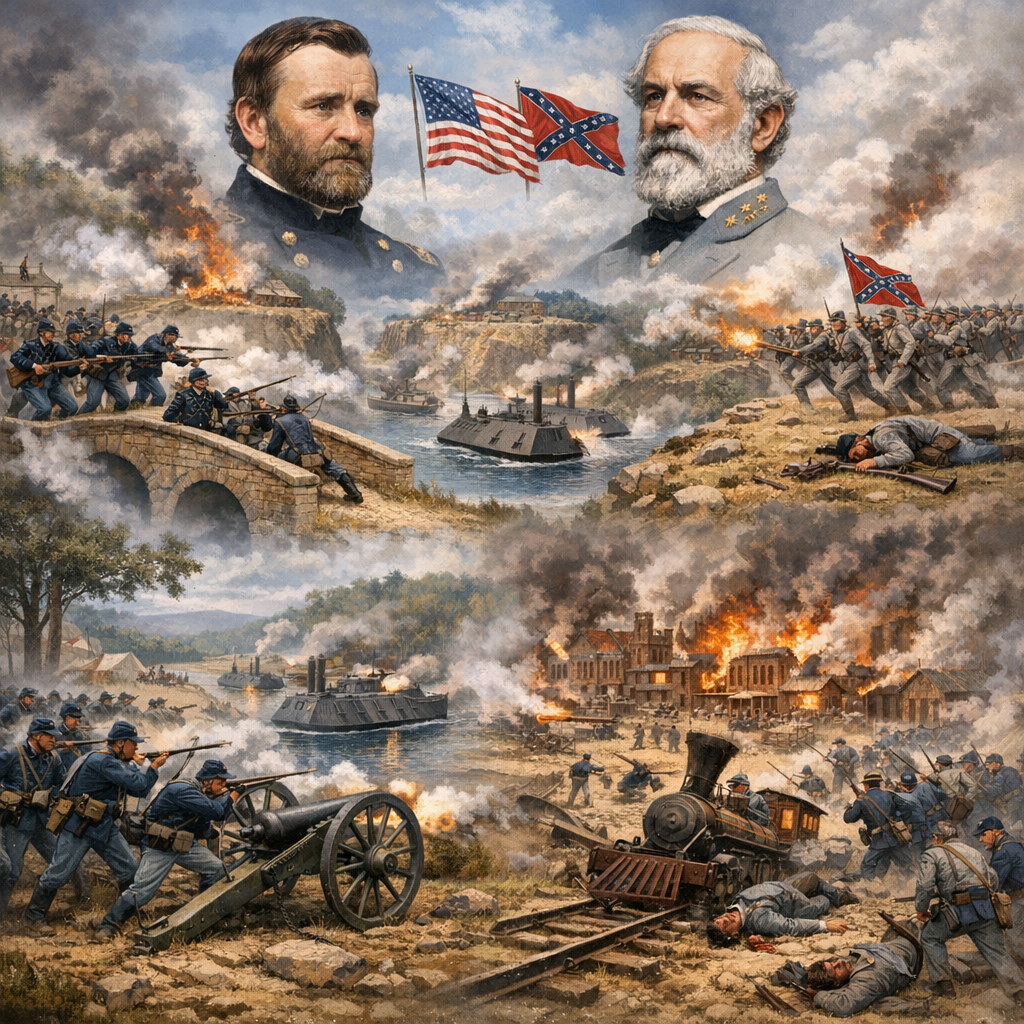
Decisive Battles of the American Civil War
This course traces the major battles and turning points of the American Civil War, showing how strategy, leadership, and geography shaped the war’s outcome. Students follow the conflict from its opening shots to final surrender, examining why specific battles mattered far beyond the battlefield.
The first lecture plays free — no account needed.
What you'll learn
- Students will be able to summarize the key political and sectional tensions that led to the outbreak of the Civil War.
- Students will understand how Fort Sumter functioned as the war’s opening confrontation and why it galvanized both North and South.
- Students will be able to describe the key events and outcome of the First Battle of Bull Run.
- Students will understand how early battles like Bull Run influenced public opinion, recruitment, and military planning in 1861–1862.
- Students will be able to outline the main phases of the Battle of Antietam and identify why it is remembered as the bloodiest single day of the war.
- Students will understand how the Union’s performance at Antietam enabled Lincoln to issue the Emancipation Proclamation, shifting the war’s goals toward ending slavery.
- Students will be able to explain why control of the Mississippi River and Western rail hubs was strategically vital to both sides.
- Students will understand how early Western victories, especially Shiloh, signaled a long and costly war and elevated Grant’s role in Union strategy.
- Students will be able to describe the main phases and outcome of the Battle of Gettysburg.
- Students will understand why many historians and the public regard Gettysburg as a crucial turning point in the Civil War and how it affected Confederate offensive capabilities.
Prerequisites
- Causes of the Civil War and secession crisis
- Union and Confederate objectives in 1861
- Early Eastern Theater campaigns and leadership challenges
- First major land battles and early war expectations
- Eastern Theater campaigns leading up to 1863
- Antietam and the Emancipation Proclamation as earlier turning points
Course Content
10 modules · 2h 30m total
From Crisis to War: Setting the Stage for the First Shots
Before cannons roared at Fort Sumter, political tensions, secession, and rival strategies set the Civil War on its fateful course. This module drops you into the moment when a divided nation turned from argument to arms.
First Blood: Bull Run and the Shock of Modern War
Crowds came to picnic and watch what many thought would be a quick, glorious battle—then the reality of mass warfare shattered those illusions. Step onto the fields of Bull Run and see how early fighting reshaped both sides’ expectations.
Clash in the East: Antietam and the Bloodiest Day
A single day along Antietam Creek produced the bloodiest day in American military history and opened the door to a revolution in the war’s purpose. Walk the Cornfield and the Sunken Road to see why this battle still looms so large.
War on the Rivers: Shiloh, Western Campaigns, and Emerging Union Strategy
Far from the capitals, brutal fighting along rivers and rail lines in the West quietly reshaped the balance of power. Follow Grant’s early campaigns to see how control of the Mississippi Valley became a key to victory.
High-Water Mark: Gettysburg and the Turning of the Tide
For three days in July 1863, a small Pennsylvania town became the stage for the war’s most famous clash. Trace the decisions, mistakes, and heroism that made Gettysburg a symbol of the Confederacy’s ‘high-water mark.’
Vicksburg and the Mississippi: Splitting the Confederacy in Two
While Gettysburg raged in the East, a grind of sieges and maneuvers along the Mississippi quietly strangled the Confederacy’s heartland. Enter the trenches around Vicksburg to see how geography and persistence reshaped the map of the war.
Total War Comes South: Sherman’s Atlanta Campaign and March to the Sea
As Union armies pushed deeper into Confederate territory, warfare spilled into cities, farms, and rail lines in ways that shocked contemporaries. Follow Sherman from the gates of Atlanta to the sea to see how ‘total war’ helped break the Confederacy’s will.
Grant vs. Lee: Overland Campaign, Petersburg, and the War of Attrition
In the war’s brutal final act, two determined commanders locked into a grinding contest of attrition across Virginia. Trace the path from the Wilderness to Petersburg to see how relentless pressure finally cornered Lee’s army.
The Final Act: Appomattox and the Meaning of Victory
As Confederate lines crumbled and armies surrendered, the war’s last battles raised urgent questions about reunification, freedom, and memory. Stand in the parlor at Appomattox to consider how the conflict ended—and what its turning points ultimately achieved.
Debating Turning Points: How Historians Interpret the Civil War
Was Gettysburg truly the decisive turning point—or do Antietam, Vicksburg, or even political events deserve that title? Enter the historians’ debate and test your own judgment about when the war’s outcome became inevitable.
Read the Textbook
Read every chapter for free, right here in your browser.
In the year and a half before the Civil War began in April 1861, the United States moved from angry debate to open conflict. To understand Fort Sumter, you first need a quick snapshot of what the country looked like on the edge of war.
By late 1860, the nation was deeply divided over slavery, states' rights, and political power. The immediate trigger was the election of Abraham Lincoln in November 1860. He won without carrying a single Southern state, convincing many white Southerners that they had lost their voice in the national government.
Between December 1860 and early 1861, several Southern states voted to secede (formally leave the Union) and created a new government: the Confederate States of America, with Jefferson Davis as president. At the same time, many Northerners believed secession was illegal and that the Union had to be preserved.
Study Flashcards
Key concepts from this course as flashcard pairs.
From Crisis to War: Setting the Stage for the First Shots
Sectional tensions
Long-standing political, economic, and social disagreements between different regions (especially North and South) that strained the Union before the Civil War.
Secession
The act of a state formally withdrawing from the United States; Southern states claimed this right when they left to form the Confederacy.
Confederate States of America
The government formed in 1861 by seceding Southern states, with Jefferson Davis as president and an initial capital in Montgomery, later Richmond.
States' rights
The idea that U.S. states hold certain powers and can resist or challenge federal authority; in this period, often used to defend slavery and justify secession.
Fort Sumter
A U.S. fort in Charleston Harbor, South Carolina, where Confederate forces fired the first shots of the Civil War on April 12, 1861, after a supply crisis.
Upper South
Border and Southern states like Virginia, North Carolina, Tennessee, and Arkansas that initially stayed in the Union but seceded after Lincoln called for troops.
+2 more flashcards
First Blood: Bull Run and the Shock of Modern War
First Battle of Bull Run / First Manassas
The first major land battle of the Civil War, fought July 21, 1861, in northern Virginia. A Confederate victory that shattered the "short war" myth and exposed the inexperience of both armies.
Short war myth
The widespread early belief that the Civil War would be decided quickly by one or a few big battles. Bull Run’s scale and chaos helped destroy this illusion.
Stonewall Jackson
Confederate General Thomas J. Jackson, who earned the nickname "Stonewall" at Bull Run for holding firm on Henry House Hill, becoming a symbol of Southern resolve.
Henry House Hill
Key high ground at Bull Run where Confederates regrouped and, with reinforcements, turned back Union attacks, helping secure victory.
Mobilization
The process of preparing a country for war, including raising, training, and equipping armies. After Bull Run, both the Union and Confederacy expanded mobilization for a long conflict.
Public opinion
What the general population believes about the war. Reports from Bull Run shifted Northern views from overconfidence to determination and Southern views toward confidence, sometimes overconfidence.
+1 more flashcards
Clash in the East: Antietam and the Bloodiest Day
Maryland Campaign (1862)
Confederate General Robert E. Lee's first major invasion of the North, moving into Maryland in September 1862, which led directly to the Battle of Antietam.
Antietam Creek / Sharpsburg
The stream and nearby town in Maryland where Union and Confederate forces fought on September 17, 1862, producing the bloodiest single day in American military history.
Miller's Cornfield
A farm field on the northern part of the Antietam battlefield where intense, close-range fighting in the morning caused massive casualties and frequent shifts in control.
Sunken Road (Bloody Lane)
An eroded farm lane used by Confederates as a defensive position; later became a killing ground when Union troops gained higher ground and fired into the packed road.
Burnside Bridge
A narrow stone bridge over Antietam Creek on the southern flank, where a small Confederate force held off Union attacks for hours due to strong terrain advantages.
Tactical Stalemate
A battlefield outcome where neither side achieves a clear, decisive victory, even though both may suffer heavy casualties; describes the direct military result at Antietam.
+4 more flashcards
War on the Rivers: Shiloh, Western Campaigns, and Emerging Union Strategy
Western Theater
The Civil War region between the Appalachian Mountains and the Mississippi River, including states like Kentucky, Tennessee, and Mississippi, where control of rivers and rail lines was crucial.
Mississippi River (Civil War importance)
A major north-south waterway whose control allowed movement of troops and supplies and could physically split the Confederacy, central to Union strategy.
Fort Henry and Fort Donelson
Confederate river forts in Tennessee captured by Grant in February 1862, opening the Tennessee and Cumberland Rivers and forcing Confederate retreat from much of Tennessee and Kentucky.
Pittsburg Landing / Shiloh
Site of a major April 1862 battle on the Tennessee River where Grant's Union army survived a surprise attack, counterattacked with reinforcements, and suffered massive casualties.
Corinth, Mississippi
A vital Confederate rail junction near Shiloh; its railroads connected the eastern and western parts of the Confederacy, making it a prime Union target.
Casualties at Shiloh
Around 23,000 combined killed, wounded, and missing, making Shiloh the bloodiest battle in U.S. history up to that point and signaling a long, costly war.
+2 more flashcards
High-Water Mark: Gettysburg and the Turning of the Tide
Gettysburg Campaign
Lee's June–July 1863 offensive into Pennsylvania, his second invasion of the North, ending with the three-day Battle of Gettysburg and a Confederate retreat to Virginia.
Fishhook Line
The strong Union defensive position at Gettysburg, curving from Culp's Hill and Cemetery Hill down Cemetery Ridge to Little Round Top, resembling a fishhook.
Little Round Top
A rocky hill on the Union left flank. Its successful defense, including the 20th Maine's stand and bayonet charge, helped prevent the Union line from being rolled up.
The Wheatfield
A farm field southwest of Cemetery Ridge where intense back-and-forth fighting on July 2 caused heavy casualties but did not decisively break the Union line.
Pickett's Charge
The massive Confederate infantry assault on July 3, 1863, against the Union center on Cemetery Ridge. It was repulsed with heavy losses and is closely linked to the "High-Water Mark" idea.
The Angle
A bend in the stone wall on Cemetery Ridge where Confederate troops briefly broke into the Union line during Pickett's Charge, later called the "High-Water Mark of the Confederacy."
+3 more flashcards
Vicksburg and the Mississippi: Splitting the Confederacy in Two
Vicksburg
A Confederate fortress city on high bluffs above the Mississippi River in Mississippi. Its capture by Union forces on July 4, 1863, gave the Union full control of the river and split the Confederacy.
Vicksburg Campaign
A series of maneuvers and battles in late 1862 and 1863, led by Ulysses S. Grant, using joint army-navy operations, a bold river crossing south of the city, inland battles, and a final siege to capture Vicksburg.
Riverine warfare
Military operations that use naval forces on rivers to support land campaigns. At Vicksburg, Union gunboats and transports helped move troops, supply them, and attack Confederate river defenses.
Siege
A method of warfare where an army surrounds a place, cuts off supplies and reinforcements, and slowly forces surrender. Grant’s siege of Vicksburg lasted from late May until July 4, 1863.
Ulysses S. Grant
Union general who led the Vicksburg Campaign. His persistence, use of joint operations, and bold decision to cross south of Vicksburg were central to Union victory in the West.
Admiral David D. Porter
Union naval commander whose gunboats and ironclads supported Grant at Vicksburg, including running past Confederate batteries and ferrying troops across the Mississippi.
+2 more flashcards
Total War Comes South: Sherman’s Atlanta Campaign and March to the Sea
Atlanta Campaign
A series of Union operations in northern Georgia (May–September 1864) led by William T. Sherman, using maneuver and selective battles to push Confederate forces back and capture the vital city of Atlanta.
March to the Sea
Sherman's campaign from Atlanta to Savannah (November–December 1864) in which Union troops cut loose from supply lines, lived off the land, and systematically destroyed Confederate infrastructure and resources in Georgia.
Hard War
A Civil War strategy that targeted the enemy's economic base, infrastructure, and will to fight, while stopping short of deliberate mass killing of civilians; Sherman's campaigns in Georgia are a key example.
Sherman's Neckties
Twisted railroad rails created by Union troops who heated and bent them around trees, making Confederate rail lines unusable without major industrial repair.
Total War (in Civil War context)
A term often used (sometimes loosely) to describe war that mobilizes entire societies and blurs the line between civilian and military targets; historians usually see Sherman's approach as 'hard war' rather than pure total war.
Joseph E. Johnston
Confederate general who initially defended northern Georgia against Sherman using retreat and fortified positions, before being replaced by John Bell Hood in July 1864.
+2 more flashcards
Grant vs. Lee: Overland Campaign, Petersburg, and the War of Attrition
War of attrition
A strategy that aims to wear down the enemy’s manpower and resources over time, accepting heavy losses to exploit long-term advantages in population, industry, and supplies.
Overland Campaign
Grant’s series of 1864 battles against Lee in Virginia (Wilderness, Spotsylvania, Cold Harbor), marked by continuous movement south toward Richmond and heavy casualties on both sides.
Mule Shoe Salient / Bloody Angle
A bulging section of Confederate trenches at Spotsylvania Court House where intense, close-quarters fighting on May 12, 1864, caused massive casualties and symbolized the brutality of trench warfare.
Siege of Petersburg
The prolonged trench warfare around Petersburg and Richmond from June 1864 to April 1865, where Grant used superior logistics and extended lines to cut Confederate railroads and supplies.
Battle of the Crater
A failed Union attempt on July 30, 1864, to break Petersburg’s defenses by exploding a mine under Confederate lines; poor execution turned the crater into a trap for attacking Union troops.
Five Forks
An April 1, 1865, Union victory southwest of Petersburg that cut key Confederate roads and helped force Lee to abandon Petersburg and Richmond.
+1 more flashcards
The Final Act: Appomattox and the Meaning of Victory
Appomattox Court House (April 9, 1865)
The Virginia village where Robert E. Lee surrendered the Army of Northern Virginia to Ulysses S. Grant, effectively signaling the collapse of major Confederate resistance.
Evacuation of Richmond
The Confederate government's hurried departure from its capital on the night of April 2–3, 1865, after Union breakthroughs around Petersburg made holding the city impossible.
Parole (Civil War context)
A promise by captured or surrendered soldiers not to take up arms again until formally exchanged. At Appomattox, Confederate soldiers were paroled and allowed to go home.
Grant's Surrender Terms
Conditions Grant offered Lee: parole for soldiers, surrender of weapons, but permission to keep personal horses and sidearms, designed to ease transition to peace and avoid guerrilla war.
Joseph E. Johnston's Surrender
The April 1865 surrender of Confederate forces in North Carolina to Sherman, the largest Confederate surrender by troop numbers, following Lee's example at Appomattox.
Thirteenth Amendment
The 1865 constitutional amendment that abolished slavery in the United States, ensuring that Union victory would permanently end legal slavery.
+2 more flashcards
Debating Turning Points: How Historians Interpret the Civil War
Turning point (in historical analysis)
An event or sequence after which the overall direction of a conflict changes in a lasting way, often involving strategic, political, resource, or social shifts.
Antietam (Sharpsburg), 1862
Bloodiest single day of the Civil War; checked Lee’s first invasion of the North and gave Lincoln the opening to issue the Preliminary Emancipation Proclamation.
Emancipation Proclamation
Order by Lincoln, effective Jan 1, 1863, declaring enslaved people in rebelling areas free; reframed the war around ending slavery and allowed Black enlistment.
Gettysburg, 1863
Three-day battle in Pennsylvania that ended Lee’s second invasion of the North, inflicted huge casualties, and is often cited as a major military turning point.
Vicksburg, 1863
Union victory that secured control of the Mississippi River, splitting the Confederacy and strengthening Union logistics and strategy in the West.
Atlanta and the 1864 election
The fall of Atlanta boosted Northern morale and helped secure Lincoln’s re-election on a platform of continuing the war and emancipation.
+2 more flashcards
More in History
See all →
The Origin Story of the English Alphabet
Yhdysvaltain sisällissota: syyt, kulku ja seuraukset
Första världskriget för åk 8: Från skottet i Sarajevo till Versaillesfreden

World War I: A Global War and Its Lasting Aftermath

The Space Race: Rockets, Rivalry, and the Road to the Moon