 Skarp
SkarpChapter 13 of 23
Payload, Balance, Stability, and Center of Gravity
A payload may be within the aircraft’s weight limit yet still make the aircraft difficult or impossible to control. This chapter follows forces and moments from payload placement to stability, propulsion demand, and emergency handling.
Weight Is Not the Whole Loading Decision
Two separate questions
A payload must pass both tests: Is total takeoff weight within the applicable limit, and is the aircraft loaded within its manufacturer-approved balance and operating limits?
The Part 107 definition includes everything on board or attached: aircraft, battery, payload, mount, guards, and external equipment. A legal total mass alone does not prove controllability.
Use the approved configuration
Check approved payload mass, mounting points, CG range, battery and propeller requirements, and mode restrictions. Do not substitute guesswork for manufacturer limitations.
The causal chain
Placement affects CG; CG affects control and stability; weight and drag affect thrust and energy demand; lower margins reshape the emergency plan.
Center of Gravity, Arms, and Moments
CG is a location
The center of gravity is the effective point where total aircraft weight acts. It shifts when an item is installed, removed, or moves during flight.
Datum and arm
A datum is the reference point for measurement. An arm is an item's signed distance from that datum. Keep the same datum and sign convention for every item.
Moment
`moment = weight × arm` describes turning effect. More weight or a longer distance creates more moment. A small payload far from CG can matter greatly.
Use approved data
Compute `total moments ÷ total weight` only when manufacturer data supports it. Never invent an allowable CG range from the airframe's visual center.
A Repeatable Preflight Loading Workflow
Inventory the whole system
Count aircraft, battery, payload, mount, cables, guards, and release hardware. The relevant weight is the fully configured takeoff weight, not the payload label alone.
Verify, then calculate
First confirm that the configuration is approved. Then weigh it and evaluate CG using the manufacturer's procedure or supported arm-and-moment data.
Inspect more than balance
Inspect attachment security, propeller clearance, cable routing, vents, sensors, antennas, and ground clearance. A balanced load can still be aerodynamically or mechanically unsafe.
Exam decision rule
"Under the maximum weight" is incomplete reasoning. A safe answer also requires compliance with operating limitations, secure attachment, and controllability.
Worked Example: Calculating a New CG
Given data
Aircraft with battery: `4.0 lb` at `10.0 in`. Camera plus mount: `0.50 lb` at `16.0 in`. Approved CG range: `9.0-11.0 in` aft of the nose datum.
Find moments
Aircraft moment: `4.0 × 10.0 = 40.0 lb-in`. Payload moment: `0.50 × 16.0 = 8.0 lb-in`. Total moment is `48.0 lb-in`.
Find loaded CG
Total weight is `4.50 lb`. Loaded CG is `48.0 ÷ 4.50 = 10.67 in`. This is within the stated 9.0-11.0-in CG range.
Do not stop at the math
A CG inside the range does not approve an unapproved mount or unsafe installation. Verify attachment, clearance, sensor effects, and all manufacturer limitations.
Balance on Three Axes
Longitudinal: front to back
Forward CG usually demands more nose-up control and may reduce flare or climb margin. Aft CG generally reduces pitch stability. Exact effects depend on the approved aircraft design.
Lateral: left to right
An off-center load creates a roll moment. Compensation consumes control authority, leaving less margin for gusts, maneuvers, and abnormal conditions.
Vertical: high to low
A high load can add leverage and unstable-looking roll response. A low load can swing or strike the ground. Evaluate clearance, restraint, and the approved installation.
Automation is not approval
A flight controller may hide mild imbalance in a calm hover, but it has finite thrust and control authority. Wind and lower battery reserve can expose the deficit.
Static Stability, Dynamic Stability, and Control Margin
Static stability
Static stability is the initial tendency after a disturbance. Positive static stability creates a restoring tendency toward the original attitude or flight condition.
Dynamic stability
Dynamic stability describes motion over time: smooth return, damped oscillation, sustained oscillation, or divergence. It determines how manageable the response becomes.
CG and recovery margin
Aft CG can feel responsive but reduce restoring tendency and recovery margin. Forward CG can increase required control force and drag. Neither extreme is acceptable.
Control authority is finite
A multirotor compensates for CG offset with unequal rotor thrust. That uses finite control authority needed for gusts, maneuvers, and declining battery voltage.
Quiz: Identify the Best Loading Decision
Check Your Reasoning
A remote pilot installs a package that keeps the aircraft below its maximum takeoff weight. The package uses an improvised bracket not listed by the manufacturer, sits near one propeller arc, and partially blocks a downward sensor. What is the best decision?
What should the remote pilot do?
- Fly because the total takeoff weight is below the maximum.
- Fly only in calm conditions because the flight controller can correct the imbalance.
- Reject the configuration until attachment, clearance, sensor effects, and manufacturer limitations are verified.
- Fly a brief hover and proceed if the aircraft appears level.
Show Answer
Answer: C) Reject the configuration until attachment, clearance, sensor effects, and manufacturer limitations are verified.
Total weight is only one constraint. An improvised mount, possible propeller interference, and sensor obstruction create unverified hazards. A brief hover cannot validate a configuration outside manufacturer instructions or guarantee adequate control margin.
Added Weight Changes Performance and Energy Demand
Baseline thrust rises
A heavier multirotor needs more rotor thrust just to hover. A heavier fixed-wing aircraft needs more lift. Both begin the mission with less performance reserve.
Operational consequences
More weight reduces acceleration, climb, stopping margin, and maneuverability. It also increases energy use, especially when wind, heat, or density altitude add demand.
Drag is a separate penalty
An external box, cable, or mount may add parasite drag even if it is light. Drag raises forward-flight power demand and can create asymmetric handling effects.
Plan reserve, not optimism
Payload rating does not guarantee endurance in mission conditions. Use conservative battery planning and retain a landing reserve for changing wind and abnormal conditions.
Load Factor: Why Turning Multiplies Weight
Load Factor: Why Turning Multiplies Weight
In a level banked turn, lift must both hold the aircraft up and pull it around the turn. The structure therefore carries more than the aircraft's weight. That multiplier is the load factor — the ratio of the load the structure supports to the aircraft's actual weight, expressed in Gs.
For a level, coordinated turn the relationship depends only on bank angle:
| Bank angle | Load factor |
|---|---|
| 0° | 1.00 |
| 30° | 1.15 |
| 45° | 1.41 |
| 60° | 2.00 |
Worked example (the exam's own numbers): an unmanned airplane weighing 33 pounds in a 30° banked level turn loads its structure with 33 × 1.15 ≈ 38 pounds. At 60° of bank the same aircraft would load about 66 pounds — double its weight — without gaining an ounce.
For sUAS this matters twice. Structurally, aggressive banked turns with a heavy payload stack load factor on top of the payload the airframe is already carrying. Aerodynamically, the extra load raises the power demanded from the motors and steepens battery drain — the same effect you have seen from added payload weight, arriving in the middle of a maneuver.
On the knowledge test, expect to read the load factor chart (testing supplement Figure 2): find the bank angle, take the factor, multiply by the aircraft's weight.
Practical Example: The Shifting Package
Weight can stay constant while CG moves
A package sliding rearward changes CG even though total weight is unchanged. Braking can shift it forward again, creating a changing pitch moment.
Why shifting loads are severe
The controller must continuously compensate. Gusts, low battery, swinging motion, cable snags, propeller contact, or detachment can quickly exhaust safety margin.
Secure attachment means more than a strap
Evaluate attachment strength against vibration, acceleration, and landing shock. Confirm the load cannot move in any axis or interfere with aircraft components.
In-flight response
Stabilize, avoid aggressive maneuvers, reduce exposure, and land as soon as safely practicable. A changed CG is a controllability problem, not a mission inconvenience.
Flashcards: Loading and Stability Recall
Build Fast Recall
Flip each card, answer aloud, then compare your answer. Focus on the relationship between terms rather than memorizing isolated definitions.
- Center of gravity (CG)
- The point at which the aircraft's total weight can be treated as acting. It changes when mass is added, removed, or shifted.
- Arm
- The signed distance from a selected datum to an item's center of gravity.
- Moment
- Turning effect of a weight about a datum: `moment = weight × arm`.
- Loaded CG calculation
- When manufacturer data supports the method: `total moments ÷ total weight`.
- Static stability
- The initial tendency after a disturbance. Positive static stability creates a restoring tendency.
- Dynamic stability
- The aircraft's motion over time after a disturbance, such as damping, sustained oscillation, or divergence.
- Control authority
- The remaining ability of control surfaces or motors to change or hold aircraft attitude and flight path. CG offset consumes it.
- Key loading rule
- Total weight compliance is necessary but not sufficient. The configuration must also follow manufacturer limitations and remain securely attached and controllable.
Quiz: Calculate and Decide
Moment Check
An aircraft weighs 3.0 lb with a CG at 8.0 in aft of the datum. An approved 1.0-lb payload is installed at 14.0 in. The manufacturer states that the loaded CG must remain between 8.0 and 9.5 in. What is the correct conclusion?
Calculate the loaded CG and select the best conclusion.
- 8.0 in; the payload has no effect because it is approved.
- 9.5 in; it is at the aft limit, so all other limitations and installation checks must still be satisfied.
- 10.0 in; it is acceptable because the total weight is only 4.0 lb.
- 11.0 in; it is outside the forward limit.
Show Answer
Answer: B) 9.5 in; it is at the aft limit, so all other limitations and installation checks must still be satisfied.
Aircraft moment is `3.0 × 8.0 = 24 lb-in`; payload moment is `1.0 × 14.0 = 14 lb-in`. Total moment is `38 lb-in` and total weight is `4.0 lb`, so loaded CG is `38 ÷ 4.0 = 9.5 in`. It is exactly at the stated aft limit, not beyond it. The pilot must still verify all other operating limitations, attachment security, clearance, and controllability.
Figure 2 — Load factor chart
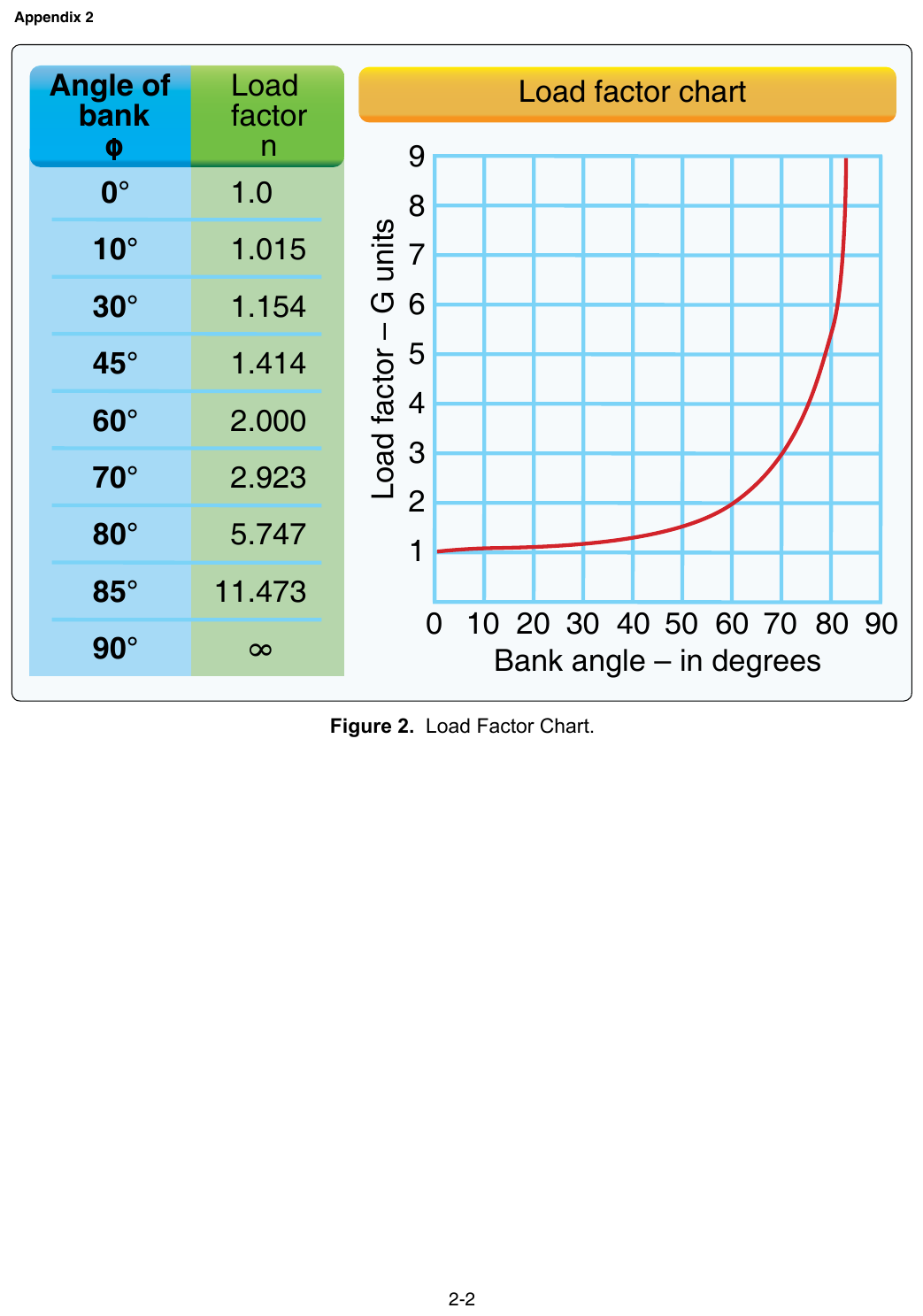
FAA-CT-8080-2H Figure 2. Load factor multiplies effective weight in a banked turn — at 30 degrees a 33-lb aircraft loads its structure with about 38 lb. The exam asks exactly this.
Key Terms
- arm
- The signed distance from the datum to the center of gravity of an item.
- datum
- A selected reference point from which arms are measured for a weight-and-balance calculation.
- moment
- The turning effect of a weight about a datum, calculated as weight multiplied by arm.
- payload
- Equipment or material carried by the aircraft in addition to its basic required components, such as a camera, sensor, package, mount, or release device.
- parasite drag
- Aerodynamic resistance caused by external shapes or surfaces that do not contribute to lift, such as a box, mount, or exposed cable.
- lateral balance
- Left-right distribution of mass that affects roll behavior and required roll correction.
- static stability
- The initial tendency of an aircraft after a disturbance to return toward, remain away from, or diverge from its original condition.
- vertical balance
- Vertical distribution of mass that can affect leverage, ground clearance, swinging, and roll response.
- control authority
- The remaining ability of motors or control surfaces to hold or change the aircraft's attitude and flight path.
- dynamic stability
- The behavior of an aircraft over time after a disturbance, including damping, oscillation, or divergence.
- longitudinal balance
- Fore-and-aft distribution of mass that affects pitch behavior and longitudinal stability.
- center of gravity (CG)
- The point at which an aircraft's total weight can be treated as acting.
- small unmanned aircraft
- An unmanned aircraft weighing less than 55 pounds on takeoff, including everything that is on board or otherwise attached to the aircraft.