 Skarp
SkarpChapter 15 of 23
Aviation Radio Communications and Phraseology
Remote pilots normally monitor rather than transmit, but understanding the radio picture can reveal an approaching aircraft long before it becomes visible. Authentic calls and phraseology build a mental traffic display around towered and non-towered airports.
1. Build the Radio Picture Before You Fly
Radio as an audio traffic display
Remote pilots normally monitor, rather than transmit. Calls can reveal an aircraft's position, altitude, destination, and intentions before it can be seen.
Two airport environments
At a towered airport, ATC issues clearances and instructions. At a non-towered airport, pilots self-announce on the published CTAF.
Do not infer authority
Listening provides awareness, not permission. A radio call gives no clearance and no right-of-way. Continue visual scanning and yield to manned aircraft.
2. Towered Airports: Who Talks to Whom?
Typical towered flow
Pilots commonly obtain ATIS, then use Ground for taxi and Tower for runway operations. Arrivals may be handed from Approach to Tower, then to Ground.
Listen for sequence and conflict
A Tower call such as "number two following the Cherokee on left base" signals multiple aircraft converging near the traffic pattern.
Clearance is aircraft-specific
A clearance addressed to a manned aircraft does not authorize a UAS flight. If the tower closes, pilots may instead self-announce on the published CTAF.
3. Non-Towered Airports and CTAF
Published frequency, not a universal channel
A CTAF supports advisory or self-announced traffic procedures at an airport without an operating tower. Always use the airport's published frequency.
Decode a self-announce call
Listen for identification, position, altitude, intention, runway, and airport name: "five miles southeast... inbound... left downwind runway one eight."
CTAF does not control traffic
No one on CTAF provides ATC clearance or guaranteed separation. Silence means traffic is unknown, not absent; continue scanning and yield early.
4. UNICOM and Airport Advisory Services
UNICOM is advisory
UNICOM may provide wind, runway, airport-condition, or service information. It is not ATC and does not issue air traffic clearances.
Airport Advisory Service
A Flight Service Station may provide Airport Advisory Service at certain airports. It can report known traffic and conditions, but does not provide separation or clearance.
Translate advice into a safety decision
Extract wind, runway, and known-traffic facts. A "favored" runway is a recommendation, not a command, guarantee, or authorization for a UAS operation.
5. Decode an ATIS Broadcast
ATIS purpose
ATIS continuously broadcasts routine airport and weather information. Its phonetic code, such as Information Kilo, identifies the current recording.
Decode the essentials
In the example, wind is from 240 degrees at 12 knots, visibility is 10 miles, altimeter is 29.92, and runway 27 is active.
Information, not clearance
ATIS never authorizes an operation. When asked to confirm it, pilots state the code letter; a new letter means essential information has changed.
6. Call Signs, Phonetics, and Spoken Numbers
Registration and abbreviation
`N123AB` is commonly spoken "November One Two Three Alpha Bravo." ATC may later abbreviate it, but pilots should not abbreviate first.
Phonetics prevent confusion
Use ICAO words such as Alpha, Bravo, Charlie and November. They distinguish letters clearly when reception is noisy or workload is high.
Numbers are spoken precisely
Say `090` as "zero niner zero," `122.8` as "one two two point eight," and 1430 UTC as "one four three zero Zulu."
7. Turn Calls into a Traffic Picture
Establish runway geometry
Runway 18 is oriented approximately south. In a standard left pattern, aircraft on left downwind for runway 18 generally fly northbound.
Sequence the calls
The Cessna moves from downwind to base to final. The Cherokee joins left downwind behind it, then is likely to follow the same landing sequence.
Use uncertainty conservatively
Traffic can extend downwind, go around, or change course. Treat clustered calls as a reason to pause or relocate, while continuing visual scanning.
8. Traffic-Picture Practice
Put the calls in operational order
A non-towered airport is using runway 27. Read these calls:
- "Mooney Eight Delta, three miles east, inbound for landing, Riverton."
- "Skyhawk Two Four Lima, departing runway two seven, Riverton."
- "Mooney Eight Delta, entering left downwind runway two seven, Riverton."
- "Skyhawk Two Four Lima, left crosswind runway two seven, Riverton."
Your task
- Which aircraft is likely farther from the airport at the start?
- Which aircraft is climbing after departure?
- What is the likely conflict point as the Mooney enters the pattern?
- What conservative action would you take if operating a UAS near the airport?
Reveal
The Mooney begins three miles east and inbound. The Skyhawk is departing and then reaches left crosswind, meaning it is climbing and turning into the pattern. The Mooney's planned entry to left downwind may conflict with or require spacing behind the Skyhawk as it continues toward downwind. Expect changing altitude and direction from both aircraft. A prudent remote pilot pauses, lands, or remains well clear of the likely pattern area; radio monitoring cannot establish separation.
9. Quiz: CTAF Authority
Choose the best answer
A remote pilot monitoring a CTAF hears, "Piper Seven Two Echo, final runway one eight." No other aircraft calls are heard. What is the best conclusion?
What does the call mean for the remote pilot?
- The Piper has been cleared to land and other aircraft are guaranteed to be absent.
- The Piper is likely aligned with and approaching runway 18; the remote pilot should continue scanning and yield or land if a conflict is possible.
- The remote pilot has authority to continue because CTAF calls establish right-of-way.
- The airport is towered because a pilot made a position report.
Show Answer
Answer: B) The Piper is likely aligned with and approaching runway 18; the remote pilot should continue scanning and yield or land if a conflict is possible.
A final call indicates a likely landing approach to runway 18. CTAF is self-announce/advisory communication, not ATC clearance or separation. Silence does not prove that no other traffic exists. Continue visual scanning and take conservative action to avoid a conflict.
10. Quiz: ATIS and Phraseology
Choose the best answer
An ATIS says: "Information Delta. Wind zero six zero at one five. Visibility six. Landing runway zero nine." Which interpretation is correct?
What information should you extract?
- Wind is toward 060 degrees at 15 knots, and runway 09 is closed.
- Wind is from 060 degrees at 15 knots, visibility is 6 statute miles, and runway 09 is being used for landing.
- The airport is using CTAF and Delta is an aircraft call sign.
- The controller has cleared all aircraft, including UAS, to use runway 09.
Show Answer
Answer: B) Wind is from 060 degrees at 15 knots, visibility is 6 statute miles, and runway 09 is being used for landing.
Wind direction in an ATIS is the direction the wind is coming from. "Zero six zero at one five" means wind from 060 degrees at 15 knots. "Landing runway zero nine" identifies the runway in use for arrivals. ATIS provides information, not a clearance for any aircraft or UAS.
11. Rapid Recall: Radio Terms
Flip each card, answer aloud, then review any miss. These terms are especially useful when building a mental traffic picture.
- CTAF
- Common Traffic Advisory Frequency: the published frequency used for airport advisory and/or self-announce procedures at an airport without an operating control tower.
- UNICOM
- A non-government communication facility that may provide airport, wind, service, or local-condition information. It is not ATC.
- ATIS
- Automatic Terminal Information Service: a continuous recorded broadcast of routine terminal information, identified by a phonetic code such as Kilo.
- What does "final runway 27" mean?
- The aircraft is aligned with and approaching runway 27 for landing. It may be descending and is close to the runway environment.
- How is 090 spoken?
- Zero niner zero.
- How is N123AB commonly spoken?
- November One Two Three Alpha Bravo. After ATC abbreviates it and no confusion results, an abbreviated form may be used.
- Does monitoring CTAF grant authority or right-of-way?
- No. It improves situational awareness only. It does not grant clearance, separation, authority, or right-of-way.
- Zulu time
- Zulu is the aviation term for Coordinated Universal Time (UTC). For example, 1430 UTC is spoken "one four three zero Zulu."
Figure 22 — Sectional chart excerpt (CTAF)
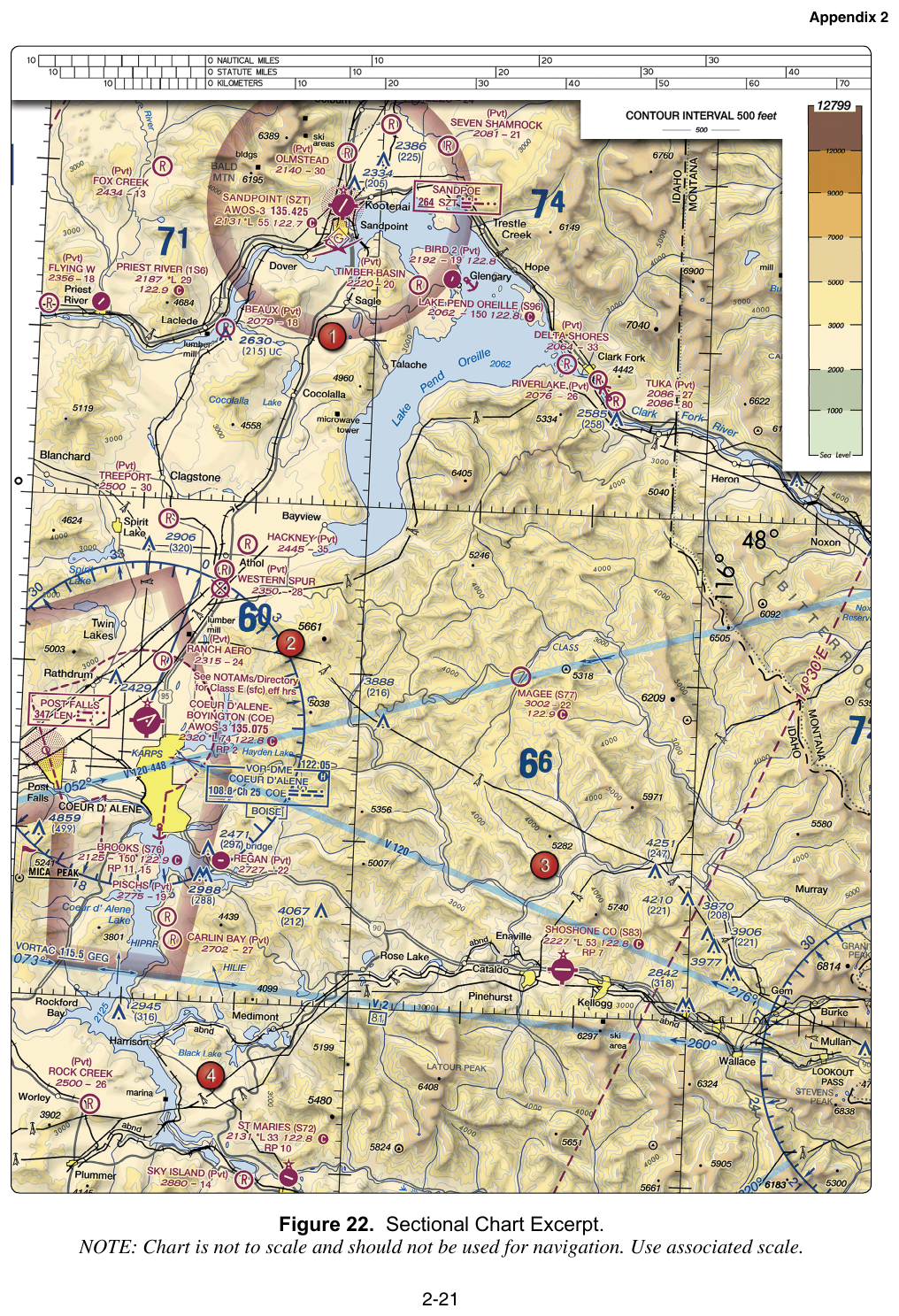
FAA-CT-8080-2H Figure 22. Read the CTAF frequency from the airport data block — the exam asks this for Coeur d'Alene.
Key Terms
- Zulu
- The aviation term for Coordinated Universal Time (UTC).
- final
- The segment of a traffic pattern in which an aircraft is aligned with the landing runway and approaching to land.
- UNICOM
- A non-government communication facility that may provide airport, wind, service, or local-condition information; it is not air traffic control.
- call sign
- The spoken identification used to address an aircraft, such as a registration number, manufacturer/model and registration, or approved company designator.
- traffic pattern
- The standardized path aircraft commonly fly near an airport, consisting of upwind, crosswind, downwind, base, and final legs.
- ICAO phonetic alphabet
- The standardized alphabet used in aviation radio communication: Alpha, Bravo, Charlie through Zulu.
- Airport Advisory Service
- An advisory service, provided at certain airports by a Flight Service Station, that can supply known traffic, weather, runway, and airport-condition information without providing ATC clearance or separation.
- Common Traffic Advisory Frequency (CTAF)
- The published frequency used for airport advisory and/or self-announce procedures at an airport without an operating control tower.
- Automatic Terminal Information Service (ATIS)
- A continuous recorded broadcast of routine terminal information, including a phonetic information code, weather, runway use, and other operational information.