Skarp
Skarp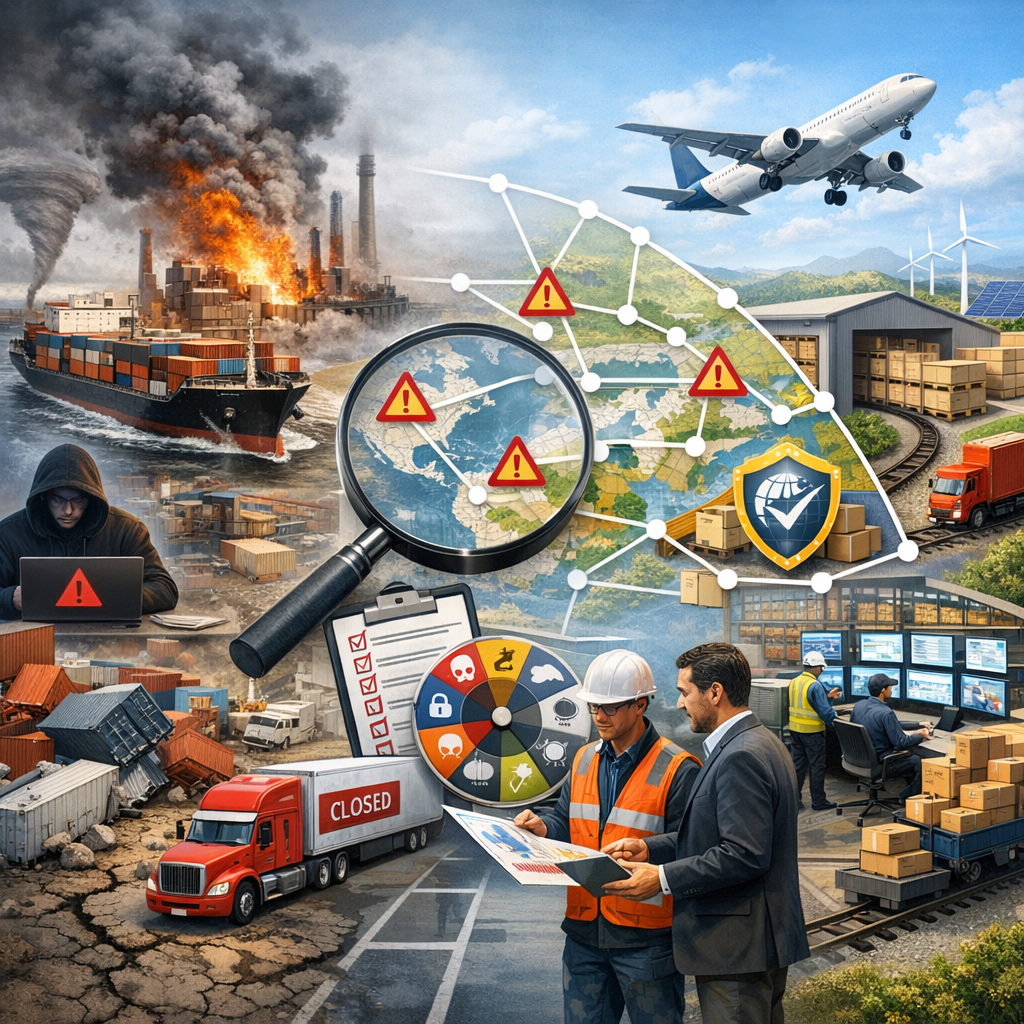
Supply Chain Risk Management: From Vulnerabilities to Resilience
This course gives you a structured, practical overview of how modern supply chains identify, assess, and mitigate risks in a world of pandemics, wars, cyberattacks, and tightening regulations. You will connect classic risk management concepts with the latest standards, digital tools, and policy trends shaping how organizations build resilient, compliant supply chains today.
The first lecture plays free — no account needed.
What you'll learn
- Students will be able to describe the basic structure of a supply chain and where risks typically originate.
- Students will understand how recent disruptions such as COVID-19, geopolitical conflicts, and semiconductor shortages exposed structural vulnerabilities and reshaped risk priorities.
- Students will be able to categorize common supply chain risks (operational, financial, cyber, ESG, geopolitical) and relate them to real-world examples.
- Students will be able to sketch an end-to-end supply chain map for a simple product, highlighting key nodes and flows.
- Students will understand how risks propagate upstream and downstream through suppliers, logistics, and customers.
- Students will be able to apply basic risk identification techniques such as brainstorming, checklists, and review of incident histories to a sample supply chain.
- Students will be able to distinguish between risk likelihood and impact and explain why both matter for prioritization.
- Students will understand how to construct and interpret a simple risk matrix or heat map for supply chain risks.
- Students will be able to compare qualitative scoring with basic quantitative metrics such as expected loss or downtime for selected risks.
- Students will be able to outline the main risk treatment strategies and give supply chain examples of each.
Prerequisites
- Basic supply chain structure and risk categories
- End-to-end supply chain mapping
- Risk identification techniques
- Risk likelihood and impact assessment concepts
- Risk treatment strategies
- Basic understanding of supplier risk management
Course Content
10 modules · 2h 30m total
Why Supply Chain Risk Matters More Than Ever
Pandemics, wars, cyberattacks, and new regulations have turned supply chains into board-level concerns; this module pulls back the curtain on why familiar products and services now depend on sophisticated risk management behind the scenes.
Mapping Risks Across the End-to-End Supply Chain
Instead of treating disruptions as random bad luck, this module shows how to systematically map where and how things can go wrong from raw materials to the end customer.
Assessing Likelihood, Impact, and Exposure
Not all risks deserve the same attention; this module walks through practical ways to judge which threats are most likely to hurt your supply chain and by how much.
Designing Risk Responses and Building Resilience
When a critical supplier fails or a key corridor closes, some companies stumble while others bounce back; this module reveals the strategies that turn risk analysis into real resilience.
Managing Supplier Risk and Multi-Tier Dependencies
Hidden vulnerabilities often lurk not in your first-tier suppliers but several layers deeper; this module uncovers how organizations now rethink supplier selection, monitoring, and collaboration.
Regulations and Standards Shaping Supply Chain Risk
From due diligence laws to security standards, this module shows how governments and standard-setters are turning supply chain risk management from a ‘nice to have’ into a legal and contractual necessity.
Cyber and Software Supply Chain Risk
As attacks increasingly target suppliers’ code, hardware, and cloud services, this module exposes how digital dependencies turn every supply chain into a cybersecurity challenge.
Data, Analytics, and Industry 4.0 for Risk Monitoring
Sensors, platforms, and predictive analytics promise early warning of trouble; this module highlights how digital tools are reshaping the way organizations see and respond to supply chain risk.
Crisis Response, Business Continuity, and Learning from Disruptions
When a disruption hits, plans meet reality; this module walks through how organizations activate continuity strategies, coordinate responses, and turn crises into long-term improvements.
Governance, Metrics, and Embedding SCRM in the Organization
Beyond one-off projects, this module reveals how leading organizations embed supply chain risk management into governance, performance metrics, and everyday decision-making.
Read the Textbook
Read every chapter for free, right here in your browser.
At its core, a supply chain is the network that moves a product or service from raw materials to the final customer. In 2026, this usually spans multiple countries, companies, and digital systems.
A simple physical product (like a smartphone) typically involves: Upstream (suppliers): Mining firms, component manufacturers, logistics providers. Midstream (production and assembly): Factories, contract manufacturers, quality control. Downstream (distribution and customers): Wholesalers, retailers, e‑commerce platforms, end users. Reverse flows: Returns, repairs, recycling, and disposal.
Supply chains handle three main flows: Material flows: Raw materials, components, finished goods. Information flows: Orders, forecasts, tracking data, design specs. Financial flows: Payments, credit terms, insurance, duties and taxes.
Study Flashcards
Key concepts from this course as flashcard pairs.
Why Supply Chain Risk Matters More Than Ever
Supply chain
The network of organizations, activities, resources, and technologies that move a product or service from raw materials to the final customer, including reverse flows like returns and recycling.
Material, information, and financial flows
The three core flows in a supply chain: physical goods (material), data such as orders and tracking (information), and payments, credit, and duties (financial).
Operational risk (in supply chains)
Risks that directly disrupt day‑to‑day operations, such as equipment failures, quality problems, strikes, pandemics, or port congestion.
ESG and compliance risk
Risks arising from environmental, social, and governance issues, including forced labor, unsafe conditions, pollution, and violations of due‑diligence regulations.
Geopolitical risk
Risks tied to international politics and policy: sanctions, export controls, trade wars, conflicts, and sudden regulatory changes that affect cross‑border flows.
Single point of failure
A component, supplier, facility, or system whose failure can halt an entire supply chain because there is no adequate backup or alternative.
+2 more flashcards
Mapping Risks Across the End-to-End Supply Chain
End-to-end supply chain mapping
The process of visually representing key nodes (suppliers, plants, warehouses, customers) and flows (materials, information, money) from raw materials to end customer.
Risk propagation
The way a disruption at one node or link in the supply chain spreads upstream or downstream, affecting other nodes through material, information, or financial connections.
Supply-side risk
Risk arising from suppliers and their operations, such as capacity loss, quality issues, financial distress, or geographic concentration of supply.
Brainstorming (for risk identification)
A structured group technique where participants generate many possible risks for parts of the supply chain, then cluster and prioritize them without initial criticism.
Checklist (for risk identification)
A predefined list of common risk items, often grouped by category, used to systematically check each node or process step for potential vulnerabilities.
Incident history
Records of past disruptions, internally and in the wider industry, analyzed to understand where they started, how they propagated, and whether similar events could affect the current supply chain.
+1 more flashcards
Assessing Likelihood, Impact, and Exposure
Risk likelihood
The probability that a specific risk event occurs in a given time window (for example, per year), often expressed as categories like Rare to Almost Certain or as a percentage.
Risk impact
The severity of consequences if a risk event occurs, typically measured in financial loss, operational downtime, customer service impact, and compliance or reputational damage.
Risk exposure
The extent of the organization affected by a risk, such as the share of revenue, number of sites, or percentage of volume dependent on a vulnerable supplier, facility, or route.
Risk matrix (heat map)
A visual tool that plots risks on a grid of likelihood versus impact, often color-coded, to highlight which risks are low, medium, or high priority.
Qualitative risk assessment
An approach that uses descriptive categories or scores (for example, 1–5, High/Medium/Low) without precise numerical probabilities or loss amounts.
Quantitative risk assessment
An approach that estimates numerical probabilities, losses, and downtime, enabling calculations such as expected loss and cost–benefit analysis of mitigation options.
+1 more flashcards
Designing Risk Responses and Building Resilience
Risk Avoidance
A treatment option where the organization stops or does not start an activity to eliminate the source of risk (for example, exiting a highly unstable sourcing region).
Risk Mitigation (Reduction)
Actions that lower the likelihood or impact of a risk while continuing the activity (for example, dual sourcing, safety stock, stronger quality controls).
Risk Transfer (or Sharing)
Shifting part of the financial consequences of a risk to another party, such as through insurance, penalty clauses, or shared-risk contracts.
Risk Acceptance
A conscious decision to retain a risk, often because the cost of further treatment is higher than the expected loss, typically with monitoring and contingency plans.
Redundancy
Extra resources beyond normal needs (inventory, capacity, suppliers, routes) that allow operations to continue when something fails.
Flexibility
The ability of a supply chain to change what it does, such as switching products, suppliers, processes, or routes when conditions change.
+2 more flashcards
Managing Supplier Risk and Multi-Tier Dependencies
Supplier criticality
A measure of how essential a supplier is to your operations and objectives, considering revenue impact, uniqueness, switching time and cost, and regulatory or ESG sensitivity.
Multi-tier visibility
Understanding not only your direct (tier-1) suppliers, but also sub-tier suppliers (tier 2, 3, etc.), their locations, and how they connect to your critical products and suppliers.
Critical risk supplier
A supplier that scores high on both criticality and risk exposure, and therefore requires intensive management, monitoring, and joint resilience planning.
Cascading disruption
A failure that begins at one node (often a sub-tier supplier) and propagates through multiple tiers of the supply chain, eventually affecting final products or services.
Multi-layered resilience
An approach that combines prevention, absorption (buffers), adaptation (flexibility, alternatives), and recovery/learning to handle supply disruptions.
Supplier segmentation
The process of grouping suppliers into categories (for example, critical, strategic, watch-list, transactional) based on factors like criticality and risk, to guide management intensity.
Regulations and Standards Shaping Supply Chain Risk
ISO 28000:2022
An international standard for security and resilience management systems, focused on managing security-related risks in supply chains and integrating with other ISO management system standards.
NIST C-SCRM (SP 800-161 Rev. 1)
U.S. guidance on Cybersecurity Supply Chain Risk Management that outlines practices for managing cyber risks from suppliers across the system lifecycle.
NIS2 Directive
An EU cybersecurity directive that expands obligations to more sectors and explicitly requires organizations to address supply chain security and incident reporting.
EU Cyber Resilience Act
EU regulation setting cybersecurity requirements for products with digital elements, including lifecycle vulnerability management and attention to supply chain components.
Corporate Sustainability Due Diligence Directive (CSDDD)
EU directive requiring large companies to conduct human-rights and environmental due diligence across their operations and value chains, integrating it into risk management.
Deforestation-free Products Regulation (EU)
EU regulation that requires certain commodities and products to be proven deforestation-free and legally produced, with traceability back to the plot of land.
+2 more flashcards
Cyber and Software Supply Chain Risk
Cyber supply chain
The network of organizations, software, hardware, and services that deliver digital capabilities, where compromise at one point can affect many downstream users.
Software supply chain
The end-to-end process and set of dependencies involved in planning, developing, building, testing, distributing, and updating software.
C-SCRM (Cybersecurity Supply Chain Risk Management)
A structured approach to identifying, assessing, and mitigating cybersecurity risks that arise from reliance on external ICT products and services, integrated into overall risk management.
SBOM (Software Bill of Materials)
A machine-readable list of all components in a software product, such as open-source libraries and their versions, used to support vulnerability management and compliance.
NIST SP 800-161 Rev. 1
A NIST publication providing detailed practices for Cybersecurity Supply Chain Risk Management for systems and organizations.
NIST SSDF (SP 800-218)
The NIST Secure Software Development Framework, which consolidates secure development practices that organizations can adopt and require from suppliers.
+2 more flashcards
Data, Analytics, and Industry 4.0 for Risk Monitoring
Real-time visibility
The ability to see current status of orders, shipments, inventory, and key suppliers using live data feeds (e.g., tracking, portals, IoT) rather than delayed reports.
External risk feeds
Data sources outside the firm (news, weather, geopolitical, ESG, cyber threat intelligence) that provide early signals of disruptions affecting suppliers or logistics.
Predictive analytics
Use of statistical and machine learning methods to estimate the likelihood of future events (e.g., late deliveries, stockouts) based on historical and real-time data.
Scenario modeling / simulation
Techniques (such as Monte Carlo or digital twin simulations) that explore what could happen under different disruption or demand scenarios to stress-test the supply chain.
Industry 4.0
The integration of cyber-physical systems, IoT, cloud computing, and AI into manufacturing and supply chains, enabling continuous, data-driven operations and risk management.
Digital twin
A virtual model of a physical asset or network that is kept up-to-date with real-time data, used to monitor performance and run what-if analyses.
+1 more flashcards
Crisis Response, Business Continuity, and Learning from Disruptions
Business Continuity Plan (BCP)
A documented plan that describes how an organization will continue to operate its critical activities during and after a disruption, including roles, procedures, and resources.
Business Impact Analysis (BIA)
A structured assessment that identifies critical processes, their dependencies, and the potential impact of downtime, forming the basis for continuity priorities and objectives.
Crisis Management Team
A cross-functional group activated during disruptions to coordinate decisions, allocate resources, and manage communication at strategic, tactical, and operational levels.
Single Point of Failure (SPOF)
A component (such as a sole-source supplier, system, or facility) whose failure can stop a critical process because no adequate backup or alternative exists.
Post-Incident Review
A structured analysis conducted after a disruption to understand what happened, what worked, what failed, and what changes are needed for improved resilience.
Resilience Investment
A deliberate allocation of resources (e.g., dual sourcing, extra capacity, better monitoring) aimed at reducing the impact or duration of future disruptions.
Governance, Metrics, and Embedding SCRM in the Organization
Supply Chain Risk Management (SCRM)
A structured approach to identifying, assessing, mitigating, and monitoring risks across the end-to-end supply chain, integrated with daily operations and strategic decisions.
Governance (in SCRM)
The structures, roles, policies, and decision rights that define who owns supply chain risks, how they are escalated, and how trade-offs are made.
Key Risk Indicator (KRI)
A metric that provides early warning about increasing exposure to risk, such as single-source dependency or concentration in a high-risk region.
Key Performance Indicator (KPI)
A metric that measures performance outcomes, including resilience outcomes like on-time in-full (OTIF) during disruptions or cost of supply interruptions.
Enterprise Risk Management (ERM)
An organization-wide process for identifying, assessing, and managing all major risks in an integrated way, often using frameworks like COSO ERM or ISO 31000.
Risk Appetite
The amount and type of risk an organization is willing to accept in pursuit of its objectives, for example, acceptable levels of single-source dependency.
+1 more flashcards
More in Business
See all →
Practical Ways to Make Money with AI (2026 Edition)
Entrepreneurship: From Idea to Startup Launch

Professional Scrum Master I (PSM I) Exam Power Prep
EU:s arbete med produktsäkerhet: institutioner, nätverk och standardisering (Cloned)

Cybersecurity That Sells: Building Trust in ICT Sales Pitches