Skarp
Skarp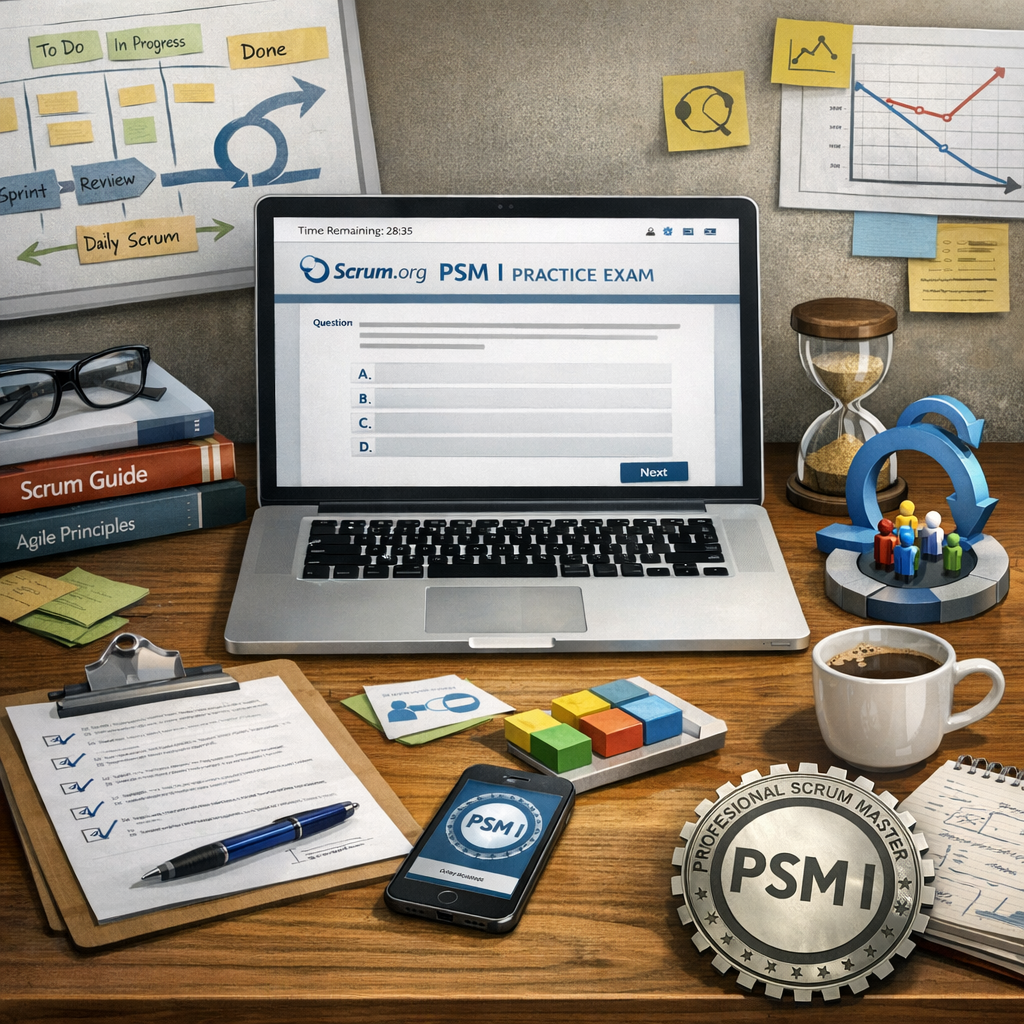
Professional Scrum Master I (PSM I) Exam Power Prep
A focused, exam-level preparation course for the Scrum.org Professional Scrum Master I (PSM I) certification. You will master the Scrum framework, the Scrum Master accountabilities, and the subtle exam traps so you can confidently reach or exceed the required 85% passing score.
The first lecture plays free — no account needed.
What you'll learn
- Students will be able to describe the PSM I exam format, including number of questions, timebox, passing score, and allowed tools.
- Students will understand the difference between Scrum.org’s canonical view of Scrum and common real-world practices that can cause exam confusion.
- Students will be able to outline a personal study plan that leverages the Scrum Guide, Scrum Open assessments, and high-quality practice questions.
- Students will be able to explain empiricism and how transparency, inspection, and adaptation work together in Scrum.
- Students will understand why Scrum is designed for complex, adaptive problems rather than simple or merely complicated work.
- Students will be able to identify how the Scrum values (Commitment, Focus, Openness, Respect, Courage) influence decisions and behaviors in exam scenarios.
- Students will be able to describe the Scrum Team as a cohesive unit, including recommended size and shared accountability for value.
- Students will understand the distinct accountabilities of the Scrum Master, Product Owner, and Developers according to the Scrum Guide 2020.
- Students will be able to distinguish between self-managing and self-organizing and correctly apply these ideas in exam questions.
- Students will be able to articulate how the Scrum Master serves the Product Owner, Developers, and the wider organization.
Prerequisites
- PSM I exam structure, scoring, and logistics
- Empirical process control (transparency, inspection, adaptation)
- Complex vs. complicated work and why Scrum fits
- Scrum Team characteristics and size
- Scrum Master, Product Owner, Developers accountabilities
- Sprint as a container event and its rules
Course Content
10 modules · 2h 5m total
Scrum.org PSM I at a Glance: Exam, Mindset, and Strategy
Step behind the 60-minute, 80-question PSM I exam and see exactly what it demands from you—not just what Scrum is, but how precisely you must think to score 85% or higher on your first attempt.
Scrum Theory: Empiricism, Complexity, and the Scrum Values
Enter the world of complex work where prediction fails and empiricism rules, and see why Scrum’s simple rules and five values are non‑negotiable for both the exam and real teams.
Scrum Team Deep Dive: Roles, Responsibilities, and Self‑Management
Meet the Scrum Team as a small, self-managing unit and uncover the subtle boundaries of each accountability that the exam loves to test.
The Scrum Master: Stances, Service, and Anti‑Patterns
Step into the Scrum Master’s shoes and see how subtle shifts—from servant leader to process cop or project manager—can make or break both your team and your exam score.
Scrum Events Part 1: Sprint, Sprint Planning, and Daily Scrum
Walk through the heartbeat of Scrum—from the overarching Sprint to the daily 15‑minute inspection—and uncover the exact timeboxes, participants, and goals that exam questions will probe.
Scrum Events Part 2: Sprint Review and Sprint Retrospective
Follow a Sprint from Increment inspection with stakeholders to team introspection, and see how mixing up Review and Retrospective is an easy way to lose points on the exam.
Artifacts and Commitments: Product Backlog, Sprint Backlog, Increment
Look inside the three Scrum artifacts and their commitments, and discover why Product Goal, Sprint Goal, and Definition of Done are among the most heavily tested concepts on PSM I.
Scrum Guide 2020 Nuances and Frequently Tested Details
Zoom in on the fine print of the Scrum Guide 2020—the wording changes, removed roles, and subtle clarifications that often separate an 80% score from the 90%+ you’re aiming for.
Scrum Beyond the Basics: Scaling, Leadership, and the Organization
See how Scrum behaves when multiple teams, managers, and organizational constraints come into play, and learn how to pick the answer that matches Scrum.org’s lean, minimalistic stance.
PSM I Question Patterns, Tricky Scenarios, and Time Management
Sit in the virtual exam seat, decode how questions are written, and practice the mental shortcuts that keep you accurate and calm under a tight 60‑minute timebox.
Read the Textbook
Read every chapter for free, right here in your browser.
In this module, you will look behind the Professional Scrum Master I (PSM I) exam and learn how to think like Scrum.org, not just like your current team.
As of today (mid 2026), PSM I is a 60-minute, 80-question, online, non-proctored assessment offered globally by Scrum.org. It is designed to test your understanding of the Scrum Guide and how well you can apply its principles.
Key facts about Scrum.org and PSM I: Scrum.org maintains a single, canonical view of Scrum based on the latest Scrum Guide (November 2020 version). The PSM I exam is independent of any class. You do not have to attend a course to sit the exam. The certificate does not expire. There is no mandatory renewal fee or continuing education requirement. The exam is scenario-heavy: many questions describe a situation and ask what the Scrum Guide-consistent answer is.
Study Flashcards
Key concepts from this course as flashcard pairs.
Scrum.org PSM I at a Glance: Exam, Mindset, and Strategy
PSM I: number of questions and time limit
80 questions, 60 minutes (about 45 seconds per question).
PSM I passing score
85% (at least 68 correct answers out of 80).
Three Scrum accountabilities (Scrum Guide 2020)
Scrum Master, Product Owner, Developers.
Five Scrum events
Sprint, Sprint Planning, Daily Scrum, Sprint Review, Sprint Retrospective.
Three Scrum artifacts and their commitments
Product Backlog (Product Goal), Sprint Backlog (Sprint Goal), Increment (Definition of Done).
Main purpose of the Daily Scrum
For Developers to inspect progress toward the Sprint Goal and adapt their plan for the next 24 hours.
+4 more flashcards
Scrum Theory: Empiricism, Complexity, and the Scrum Values
Empiricism
A way of working where decisions are based on observation, experience, and evidence rather than detailed prediction; in Scrum it relies on transparency, inspection, and adaptation.
Transparency
Making the true state of the product, work, and process visible and understandable to those inspecting it; a pillar of empirical process control.
Inspection
Frequent checks of Scrum artifacts and progress toward goals to detect undesirable variances; must not be so frequent that it disrupts work.
Adaptation
Adjusting plans, scope, or processes as soon as possible when inspection shows that aspects of the work are outside acceptable limits.
Complex Work
Work where cause and effect are only clear in hindsight, requirements change often, and prediction is unreliable; Scrum is designed for this environment.
Scrum Values
Five values described in the Scrum Guide: Commitment, Focus, Openness, Respect, Courage; they guide behavior and enable effective use of Scrum.
+1 more flashcards
Scrum Team Deep Dive: Roles, Responsibilities, and Self‑Management
Scrum Team
A small, self-managing, cross-functional team of **Product Owner, Scrum Master, and Developers** focused on one Product Goal and accountable for creating valuable, useful Increments.
Product Owner
The **one person** accountable for **maximizing product value** and managing the **Product Backlog** (Product Goal, ordering, clarity, transparency).
Scrum Master
The person **accountable for the Scrum Team’s effectiveness** by coaching and helping everyone understand and apply Scrum; a **leader who serves**, not a task manager.
Developers
The people in the Scrum Team who are **committed to creating a usable Increment** each Sprint. They own the **Sprint Backlog** and decide who does what, when, and how.
Self-managing Team
A team that decides **who does what, when, and how** to do the work, within the boundaries of Scrum and the Product Goal. Introduced explicitly in the 2020 Scrum Guide.
Cross-functional
The Scrum Team has **all the skills** needed to create a usable Increment each Sprint **without depending on others** outside the team for critical work.
+2 more flashcards
The Scrum Master: Stances, Service, and Anti‑Patterns
Primary description of the Scrum Master (Scrum Guide 2020)
A **leader who serves** the Scrum Team and the organization by enabling Scrum and empiricism.
Scrum Master service to Product Owner
Coaches on Product Goal and backlog, facilitates collaboration with Developers, teaches stakeholder engagement; does not own the backlog or priorities.
Scrum Master service to Developers
Coaches on self-management, facilitates Scrum events, helps remove impediments, supports quality and transparency; does not assign tasks or manage individuals.
Scrum Master service to the organization
Leads, trains, and coaches in Scrum adoption, removes organizational impediments, supports cultural change; not a Scrum police officer.
Helpful Scrum Master stances
Servant leader, coach, facilitator, change agent.
Harmful Scrum Master stances
Traditional project manager, secretary/scribe, boss/team manager, proxy Product Owner.
+2 more flashcards
Scrum Events Part 1: Sprint, Sprint Planning, and Daily Scrum
Sprint
A fixed‑length event of one month or less that acts as a container for all other Scrum events and should produce at least one usable, valuable Increment.
Sprint Goal
The single objective for the Sprint that provides focus and flexibility in scope. Scope may change, but the Sprint Goal should remain stable.
Sprint Planning
Event at the start of the Sprint where the Scrum Team defines why the Sprint is valuable, what can be done, and how the work will be achieved, producing a Sprint Goal and Sprint Backlog.
Sprint Cancellation
An action that only the Product Owner can take, and only when the Sprint Goal becomes obsolete. Done work is reviewed; remaining items are re‑estimated and reordered.
Daily Scrum
A 15‑minute event held every working day for Developers to inspect progress toward the Sprint Goal and adapt the plan for the next 24 hours.
Daily Scrum Anti‑Pattern
Misuse of the Daily Scrum, such as treating it as a status report to the Scrum Master, exceeding the 15‑minute timebox, or turning it into a problem‑solving session.
Scrum Events Part 2: Sprint Review and Sprint Retrospective
Sprint Review – main purpose
Inspect the Increment and progress toward the Product Goal with stakeholders and **adapt the Product Backlog** to maximize future value.
Sprint Retrospective – main purpose
Inspect how the last Sprint went (people, interactions, processes, tools, Definition of Done) and create **improvement actions** to increase quality and effectiveness.
Sprint Review – typical attendees
Scrum Team (Product Owner, Scrum Master, Developers) **plus relevant stakeholders** such as customers, users, and sponsors.
Sprint Retrospective – typical attendees
**Scrum Team only**: Product Owner, Scrum Master, Developers. External stakeholders usually do not attend.
Sprint Review – timebox (1‑month Sprint)
Maximum **4 hours** for a 1‑month Sprint. Shorter Sprints usually have proportionally shorter Reviews.
Sprint Retrospective – timebox (1‑month Sprint)
Maximum **3 hours** for a 1‑month Sprint. Shorter Sprints usually have proportionally shorter Retrospectives.
+2 more flashcards
Artifacts and Commitments: Product Backlog, Sprint Backlog, Increment
Product Backlog
The single ordered list of all work known for the product. Emergent, living artifact, managed by the Product Owner.
Product Goal
The long‑term objective for the product. Provides direction to the Product Backlog; one active Product Goal per product at a time.
Sprint Backlog
The plan for the current Sprint, created by Developers. Includes the Sprint Goal, selected Product Backlog items, and a plan for delivering the Increment.
Sprint Goal
The single objective for the Sprint. Provides focus and flexibility; scope may change as long as the Sprint Goal remains achievable.
Increment
A concrete step toward the Product Goal. A usable piece of the product that meets the Definition of Done and includes all previous Increments.
Definition of Done (DoD)
Formal description of the state of the Increment when it meets required quality measures. Shared understanding of what "done" means.
+1 more flashcards
Scrum Guide 2020 Nuances and Frequently Tested Details
Scrum Team (2020)
A single, small team of professionals, typically 10 or fewer people, consisting of a Product Owner, Scrum Master, and Developers. It is cross-functional and self-managing.
Accountabilities (not roles)
Product Owner, Scrum Master, and Developers are described as accountabilities in the 2020 Guide, emphasizing what they are responsible for rather than job titles.
Developers
Members of the Scrum Team committed to creating any aspect of a usable Increment. They create and adapt the Sprint Backlog and uphold the Definition of Done.
Self-managing
The Scrum Team chooses who does the work, how to do it, and how to turn Product Backlog items into value. Stronger autonomy than the older term self-organizing.
Product Goal
The commitment for the Product Backlog. A longer-term objective for the product that the Scrum Team works toward. There is one Product Goal at a time.
Sprint Goal
The commitment for the Sprint Backlog. A single objective for the Sprint that provides coherence to the work and guides the Developers.
+2 more flashcards
Scrum Beyond the Basics: Scaling, Leadership, and the Organization
One product, one Product Backlog
In Scrum, a single product has one Product Backlog and one Product Owner. Multiple Scrum Teams can share this backlog and Product Owner.
Multi-team Sprint Planning
The Product Owner presents the ordered Product Backlog; each Scrum Team selects work and crafts its own Sprint Goal that supports the shared Product Goal.
Scrum events in scaling
Sprint, Sprint Planning, Daily Scrum, Sprint Review, and Sprint Retrospective remain the only official Scrum events, even with many teams.
Organizational impediment
A structural, policy, or cultural issue in the organization that slows or prevents Scrum Teams from delivering value and self-managing.
Scrum Master as change agent
The Scrum Master works with leadership and the organization to make impediments visible, coach in Scrum, and support structural changes that enable empiricism.
Scrum.org’s lean stance
Prefers minimal roles, artifacts, and events; extra layers from scaling frameworks are optional practices, not part of the core Scrum framework.
PSM I Question Patterns, Tricky Scenarios, and Time Management
Most Scrum Answer
When several options seem correct, choose the one that best reflects Scrum values, empiricism, self-management, and the exact wording of the Scrum Guide 2020.
Extreme Language Trap
Be cautious of options with ALWAYS, NEVER, ONLY, MUST. Check whether the Scrum Guide 2020 truly states such absolutes.
Roles vs Accountabilities (2020)
Scrum now emphasizes accountabilities: Scrum Master, Product Owner, Developers. Old terms like Development Team or Project Manager hint at weaker options.
Time Strategy
Aim for ~45 seconds per question. Use a 3-pass method: quick answers first, then flagged questions, then a final 5-minute sanity check.
Scenario Question Habit
In scenario questions, ask: Which action increases transparency, inspection, and adaptation and respects each Scrum accountability?
More in Business
See all →
Practical Ways to Make Money with AI (2026 Edition)

Entrepreneurship: From Idea to Startup Launch
EU:s arbete med produktsäkerhet: institutioner, nätverk och standardisering (Cloned)

Cybersecurity That Sells: Building Trust in ICT Sales Pitches

Supply Chain Risk Management: From Vulnerabilities to Resilience