Skarp
Skarp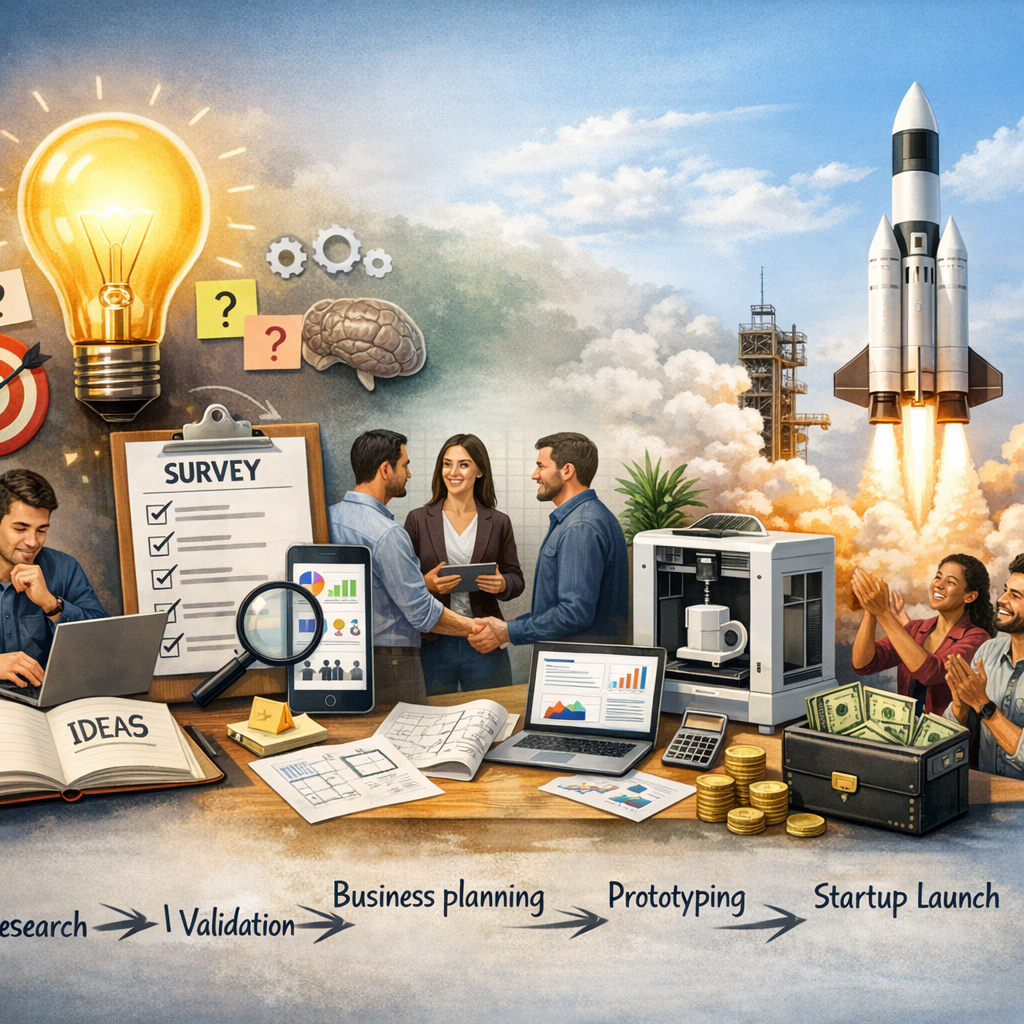
Entrepreneurship: From Idea to Startup Launch
This course guides you step by step from identifying a viable startup idea through validating it with real customers, shaping a business model, and preparing for launch. You will learn modern, practical startup tools used by founders today, including lean validation, MVP design, and basic financial and legal considerations.
The first lecture plays free — no account needed.
What you'll learn
- Students will be able to distinguish between a startup and a traditional small business.
- Students will understand the difference between a raw idea and a validated business opportunity.
- Students will be able to describe the core principles of the lean startup approach (build–measure–learn, experimentation, validated learning).
- Students will be able to frame startup ideas around specific customer problems rather than solutions.
- Students will understand how to define and describe a target customer segment using simple personas.
- Students will be able to perform a basic scan of competitors and alternatives to assess whether a problem is already being solved and how.
- Students will be able to design and run simple customer discovery interviews that avoid leading questions.
- Students will understand the difference between validating the problem and pitching a solution too early.
- Students will be able to turn observations and interview notes into key insights and updated assumptions about their idea.
- Students will be able to write a concise value proposition that clearly states the customer, problem, solution, and key benefit.
Prerequisites
- definition of entrepreneurship and types of ventures
- idea vs opportunity
- problem-first thinking
- customer segments and personas
- customer discovery interviews
- problem interviews vs solution interviews
Course Content
11 modules · 2h 45m total
From Spark to Startup: What Entrepreneurship Really Is
Introduce what entrepreneurship means today, different types of startups, and how ideas become businesses using modern lean and agile approaches.
Finding Problems Worth Solving
Focus on identifying real customer problems, analyzing markets, and selecting an idea with genuine potential before building anything.
Customer Discovery: Talking to Users Before You Build
Learn how to validate assumptions by interviewing potential customers, observing behavior, and extracting insights that guide your idea.
Crafting a Clear Value Proposition
Translate customer insights into a sharp value proposition that explains who your product is for, what it does, and why it is better than alternatives.
Designing a Lean Business Model
Use a simple business model framework to map out how your startup creates, delivers, and captures value, including revenue streams and cost structure.
Minimum Viable Product (MVP): Building the Right Thing First
Explore what an MVP is (and is not), different MVP types for digital and non-digital products, and how to design fast experiments around them.
Go-to-Market Basics: Getting Your First Users
Learn how to reach early adopters, choose initial marketing channels, and craft simple messaging that resonates with your target audience.
Startup Numbers 101: Money, Metrics, and Runway
Cover the essential financial concepts and metrics every founder needs: basic budgeting, cash flow, runway, and key startup KPIs.
Legal and Regulatory Basics for New Startups
Introduce common early-stage legal and regulatory topics such as choosing a business structure, basic contracts, and data/privacy considerations, with an emphasis on knowing when to seek professional advice.
Funding Options and Investor Readiness
Explore different ways to finance a startup, from bootstrapping to external funding, and what investors look for at early stages.
Planning Your First Launch and Iteration Cycle
Bring everything together into a simple, time-bound launch plan, including milestones, risks, and how you will learn and iterate after launch.
Read the Textbook
Read every chapter for free, right here in your browser.
Entrepreneurship today is broader than the stereotype of a lone tech founder in a hoodie.
Working definition (2026 context): Entrepreneurship is the process of creating and capturing value by assembling resources (people, capital, technology, data) to solve a problem under conditions of uncertainty.
Key points: Value can be economic (revenue, profit), social (impact, inclusion), or environmental (sustainability). Uncertainty means you don’t yet know if customers will care, if the solution will work, or if the model will scale. Entrepreneurs can be: Founders of new ventures (startups, small businesses) Innovators inside existing organizations (intrapreneurs) Social entrepreneurs in NGOs or hybrid organizations
Study Flashcards
Key concepts from this course as flashcard pairs.
From Spark to Startup: What Entrepreneurship Really Is
Entrepreneurship
The process of creating and capturing value by assembling resources to solve problems under conditions of uncertainty.
Startup
A temporary organization designed to search for a repeatable and scalable business model, typically operating under high uncertainty.
Traditional Small Business
A business that operates with a known business model, focusing on stable execution, local customers, and steady profit rather than rapid scale.
Business Idea
A possible product or service concept that has not yet been validated against real customer needs, feasibility, and viability.
Business Opportunity
A favorable set of circumstances where a real customer need can be met in a feasible and economically viable way, supported by evidence.
Lean Startup
A methodology for building new products and businesses that emphasizes rapid experimentation, validated learning, and iterative development.
+4 more flashcards
Finding Problems Worth Solving
Problem-first thinking
An approach where you start by deeply understanding a real customer problem and who experiences it, before deciding what solution to build.
Customer segment
A group of people or organizations that share similar characteristics and needs, and who experience a problem in a similar way.
Persona
A simple, realistic description of a typical customer in your target segment, used to guide product and research decisions.
TAM / SAM / SOM
Total Addressable Market (everyone who could use a solution), Serviceable Available Market (the part you can realistically reach), and Serviceable Obtainable Market (the share you might realistically capture).
Direct competitor
A product or service that solves the same problem for the same customer segment in a very similar way.
Indirect competitor / alternative
Any other way customers solve the problem today, including different types of products, generic tools, or manual workarounds.
Customer Discovery: Talking to Users Before You Build
Customer Discovery
An early-stage process of talking to potential customers and observing their behavior to test assumptions about the customer, problem, and context *before* building a full solution.
Problem Interview
A conversation focused on the customer’s context, past behavior, pains, and current workarounds, without pitching or detailing a specific solution.
Solution Interview
An interview where you show a concept, prototype, or product and explore how well it fits the customer’s needs, behavior, and context.
Hypothesis (in startups)
A clear, testable statement about customers, problems, or behavior that you expect to be true and seek to validate or invalidate through evidence.
Leading Question
A question that suggests or pressures a particular answer (e.g., assuming a problem exists or a solution is good), which can bias interview results.
Qualitative Insight
A non-numerical learning (e.g., patterns in stories, quotes, emotions) that helps you understand *why* customers behave a certain way.
+2 more flashcards
Crafting a Clear Value Proposition
Value Proposition Statement
A concise description of who your product is for, what problem it solves or job it helps with, what key benefit it delivers, and why it is better than current alternatives.
Customer Pains
Specific frustrations, risks, or obstacles that customers experience while trying to get a job done. Examples: wasted time, confusion, extra cost, stress.
Customer Gains
Desired outcomes and benefits customers want, such as saving time, earning more money, feeling in control, or looking competent to others.
Early Adopters
The first group of customers who feel the problem strongly, are actively looking for a solution, and are willing to try a new product earlier than the mainstream.
Differentiation vs. Competition
Explaining how your product is meaningfully better than what customers do today (including direct competitors, manual workarounds, and doing nothing) in terms of speed, convenience, accuracy, cost, focus, or experience.
Job-To-Be-Done
The underlying task or goal a customer is trying to achieve in a specific context, independent of your product. Example: 'submit a polished assignment on time' rather than 'use a text editor'.
Designing a Lean Business Model
Lean Business Model
A concise, one-page description of how a startup creates, delivers, and captures value, focusing on key assumptions rather than a long static business plan.
Customer Segment
A clearly defined group of people or organizations with similar needs, behaviors, and willingness to pay that your startup aims to serve.
Revenue Streams
The specific ways your startup earns money from each customer segment (e.g., subscriptions, transactions, freemium upgrades, advertising).
Cost Structure
The major categories of costs your startup incurs to operate, including both fixed costs (e.g., salaries) and variable costs (e.g., per-user hosting).
Unit Economics
Financial metrics calculated on a per-customer or per-unit basis, such as revenue per customer, variable cost per customer, and contribution margin.
CAC (Customer Acquisition Cost)
The average cost of acquiring one paying customer, including marketing, sales, and related expenses.
+2 more flashcards
Minimum Viable Product (MVP): Building the Right Thing First
Minimum Viable Product (MVP)
The smallest thing you can build to reliably test one key assumption about your idea with real users; a learning tool, not a low-quality final product.
Riskiest Assumption
The assumption that, if wrong, would most seriously damage or invalidate your business idea (e.g., demand, willingness to pay, or feasibility).
Concierge MVP
An MVP where you manually deliver the service that your product is supposed to automate, to test problem–solution fit and willingness to pay.
Wizard of Oz MVP
An MVP where the front-end looks like a finished product but the back-end is run manually, used to test demand and behavior without building complex systems.
No-Code MVP
A functional version of your product built with visual tools (e.g., Webflow, Bubble, Airtable) instead of custom code, to quickly test end-to-end workflows.
Build–Measure–Learn Loop
A cycle where you build an MVP, measure user behavior with clear metrics, and learn whether to pivot, persevere, or pause.
+1 more flashcards
Go-to-Market Basics: Getting Your First Users
Go-to-Market (GTM) Strategy
A focused plan for how a product will reach and acquire its target customers, including who it’s for, which channels you’ll use, what you’ll say (messaging), and what actions you want users to take.
Early Adopters
The first group of users who feel the problem strongly, actively look for solutions, and are willing to try a new, imperfect product and give feedback.
Acquisition Channel
A path or platform through which potential users first discover and engage with your product (e.g., social media, communities, email, partnerships).
Positioning
How you define your product in the mind of a specific user segment: who it’s for, what problem it solves, and how it’s different from alternatives.
Messaging
The specific words, phrases, and stories you use to communicate your value to your target audience (e.g., one-liner, elevator pitch, website copy).
Call-to-Action (CTA)
A clear, specific instruction that tells the user what to do next (e.g., “Sign up,” “Book a 15-min call,” “Join the waitlist”).
Startup Numbers 101: Money, Metrics, and Runway
Burn Rate (Net Burn)
The **net cash lost per month**: total cash outflows minus cash inflows (if negative). Example: if you spend $10k and make $3k, your net burn is $7k/month.
Runway
How many **months you can operate** before running out of cash, assuming current burn. Formula: Runway = Current Cash / Monthly Burn.
Customer Acquisition Cost (CAC)
The **average cost to acquire one new paying customer**. Formula: CAC = Total Sales & Marketing Spend / # of New Customers in that period.
Lifetime Value (LTV)
An estimate of the **total revenue** (or profit) you will earn from a customer over the entire relationship. Simple subscription formula: LTV ≈ Avg Monthly Revenue per Customer × Avg Months Retained.
Conversion Rate
The **percentage of people** who move from one step to another (e.g., visitor → signup, signup → paid). Formula: Conversion Rate (%) = (Conversions / Total Visitors) × 100.
Churn Rate
The percentage of customers who **cancel or stop using** your service in a given period. Formula: Customer Churn Rate (%) = (Customers Lost / Customers at Start) × 100.
+2 more flashcards
Legal and Regulatory Basics for New Startups
Limited Liability
A legal feature where owners are generally not personally responsible for the business’s debts or liabilities beyond what they invested, assuming laws and formalities are followed.
Founder Agreement
A contract among co-founders that sets out equity splits, vesting, roles, decision-making, IP ownership, and what happens if someone leaves.
Vesting (with Cliff)
A mechanism where equity is earned over time. A common pattern is 4-year vesting with a 1-year cliff, meaning no equity vests until the end of year one, then it vests gradually.
Trademark
IP protection for brand identifiers like names, logos, and slogans that distinguish your goods or services from others.
Copyright
IP protection for original creative works (e.g., code, text, images, music). Often arises automatically when the work is created, though registration can provide extra benefits.
Trade Secret
Valuable business information (like algorithms, recipes, or customer lists) that is kept confidential and gains protection through secrecy measures.
+4 more flashcards
Funding Options and Investor Readiness
Bootstrapping
Building a startup mainly using the founders’ own resources and revenue, without significant external investment.
Non-dilutive funding
Funding that does not require giving up equity (ownership), such as grants, prizes, and some forms of crowdfunding.
Angel investor
A wealthy individual who invests their own money in early-stage startups, often providing mentorship and connections.
Venture capital (VC)
Institutional investment from funds that back high-growth startups in exchange for equity, aiming for large returns.
Traction
Evidence that your startup is making progress with real users or customers (e.g., sign-ups, revenue, pilots, engagement).
Total Addressable Market (TAM)
The total revenue opportunity available if your product or service achieved full market adoption in a defined market.
+2 more flashcards
Planning Your First Launch and Iteration Cycle
Launch cycle
A short, defined period (often 2–6 weeks) during which you launch to users, collect feedback, and then review what you learned before planning the next cycle.
Milestone
A specific, observable checkpoint in your plan with a clear owner and date (e.g., “First 10 users onboarded by March 1”).
Desirability risk
The risk that users do not actually want or use the product, even if you can build it.
Feedback loop
A structured process for collecting data from users, interpreting it, and deciding what to change in your product or strategy.
End-of-cycle review
A planned meeting at the end of a launch cycle to examine metrics, user feedback, and risks, and to decide what to stop, start, and continue in the next cycle.
Founder resilience
The ability of founders to maintain energy, focus, and mental health over time by managing workload, expectations, and stress.
More in Business
See all →
Practical Ways to Make Money with AI (2026 Edition)

Professional Scrum Master I (PSM I) Exam Power Prep
EU:s arbete med produktsäkerhet: institutioner, nätverk och standardisering (Cloned)

Cybersecurity That Sells: Building Trust in ICT Sales Pitches

Supply Chain Risk Management: From Vulnerabilities to Resilience