Skarp
Skarp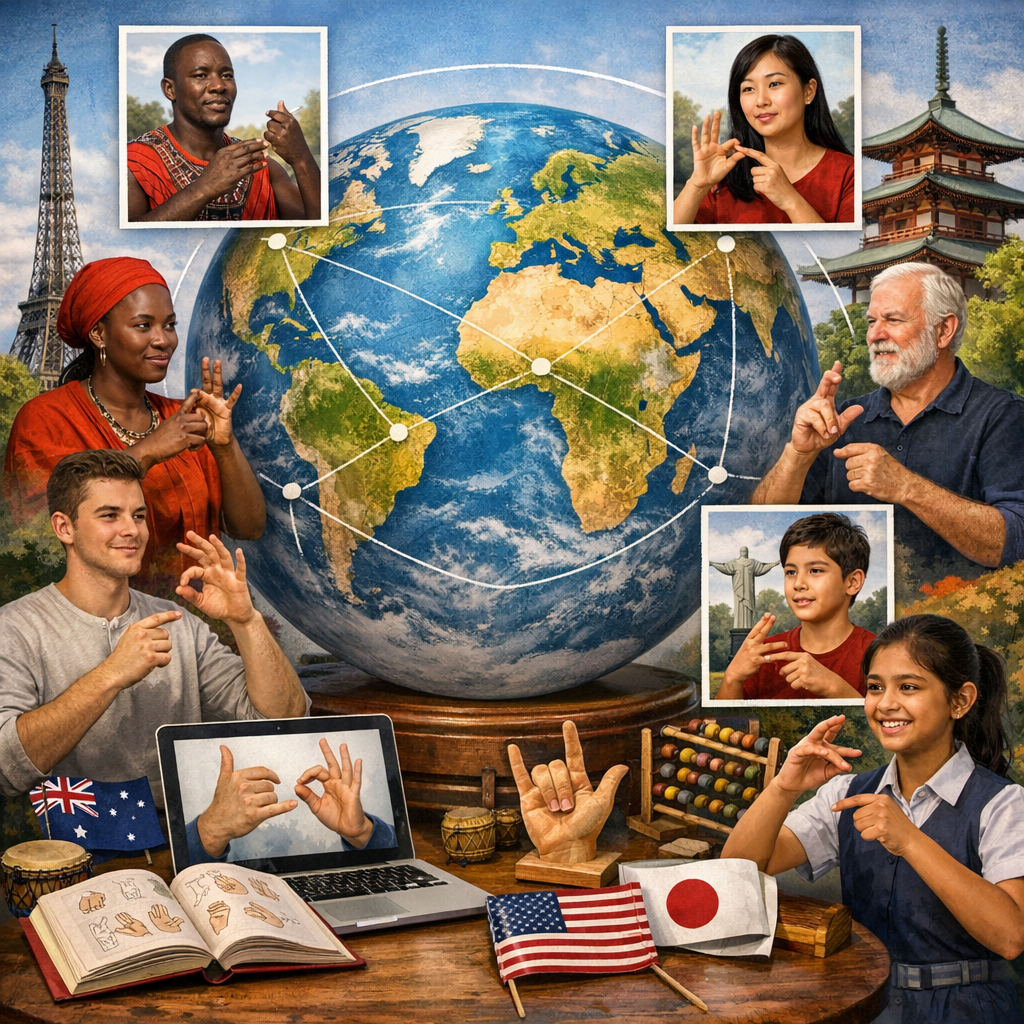
Exploring the World of Sign Languages: A Global Perspective
This course introduces you to the incredible diversity of sign languages around the world, how they function as full natural languages, and why they matter for human rights and culture. You will compare major national sign languages, learn about International Sign, and explore current global movements for sign language recognition and inclusion.
The first lecture plays free — no account needed.
What you'll learn
- Students will be able to explain why sign languages are considered full natural languages rather than simplified gesture systems.
- Students will be able to describe current estimates of how many sign languages and signers exist worldwide and why these numbers vary.
- Students will be able to debunk the idea that there is one universal sign language.
- Students will be able to distinguish between medical and cultural views of deafness.
- Students will understand how sign languages and shared experiences form the basis of Deaf culture and identity.
- Students will be able to give examples of how Deaf communities differ across countries and regions.
- Students will be able to identify key components of a sign (handshape, location, movement, orientation, facial expression).
- Students will understand that sign languages have their own grammars that differ from surrounding spoken languages.
- Students will be able to explain what is meant by visual-spatial modality in language.
- Students will be able to name several major sign languages and identify where they are used.
Prerequisites
- Sign languages as natural languages
- Basic global statistics about sign language users
- Basic understanding of Deaf culture and identity
- Visual-spatial modality and basic sign structure
- Overview of major national and regional sign languages
- Basic understanding of visual-spatial language structure
Course Content
8 modules · 1h 55m total
What Are Sign Languages? Busting the “Universal Sign” Myth
Discover what sign languages are, how many exist globally, and why they are not universal. This module sets the foundation by framing sign languages as full, natural languages used by millions of people worldwide.
Deaf Communities, Culture, and Identity Around the World
Explore how sign languages are rooted in Deaf communities and cultures, and how Deaf identity is shaped by shared experiences, values, and art rather than by hearing status alone.
Inside a Sign Language: How Visual Grammars Work
Take a closer look at how sign languages are structured, including their use of handshapes, movement, facial expressions, and space to create grammar and meaning.
A Tour of Major Sign Languages: ASL, BSL, IPSL and Beyond
Compare some of the world’s most widely used sign languages, including American Sign Language, British Sign Language, Indo-Pakistani Sign Language, and others across different regions.
International Sign and Global Deaf Communication
Learn how Deaf people communicate across language borders using International Sign and other strategies, and why International Sign is not a fully standardized universal language.
Language Rights: Laws and Recognition of Sign Languages
Examine how sign languages are recognized (or not) in national laws, and how international human rights instruments support sign language rights and access.
Education, Access, and the Global Signing Ecosystem
Explore how sign languages function within education systems and broader societies, including interpreter training, accessibility, and the emerging idea of a global signing ecosystem.
Future Directions: Technology, Documentation, and Preserving Sign Languages
Look ahead at how technology, research, and advocacy are shaping the future of sign languages, from documentation of small village sign languages to apps and AI tools for learning and accessibility.
Read the Textbook
Read every chapter for free, right here in your browser.
In about 15 minutes, you will: Understand what sign languages are (and what they are not). Learn current estimates for how many sign languages and how many signers there are worldwide. Be able to debunk the myth that there is one universal sign language.
As of early 2026, researchers, Deaf communities, and organizations like the World Federation of the Deaf (WFD) and Ethnologue agree on two big ideas: Sign languages are full, natural human languages, not “broken” versions of spoken languages. There is no single universal sign language. Instead, there are hundreds of distinct sign languages around the world.
Keep these guiding questions in mind as you go: What makes a system of communication a “language” rather than just gestures? Why would it be unrealistic to expect one universal sign language, when we don’t expect one universal spoken language?
Study Flashcards
Key concepts from this course as flashcard pairs.
What Are Sign Languages? Busting the “Universal Sign” Myth
Sign language
A natural human language that uses the visual–gestural modality (hands, face, body, space) with its own grammar and vocabulary, used primarily by Deaf communities.
Natural language
A language that develops spontaneously in human communities over time (like ASL, English, BSL, Libras), as opposed to an artificially constructed code.
Visual–gestural modality
The channel of communication used by sign languages, involving visual perception of movements, handshapes, facial expressions, and spatial patterns.
Universal sign language (myth)
The incorrect belief that there is one single sign language used worldwide; in reality, there are hundreds of distinct sign languages.
International Sign (IS)
A contact variety used mainly at international Deaf events; draws on widely recognizable signs and gestures but is not a standardized native language for most people.
Manually coded language (e.g., Signed English)
A system that represents a spoken language’s grammar and words using signs; created for education and not a natural language that arose in a community.
Deaf Communities, Culture, and Identity Around the World
deaf (lowercase d)
An audiological term describing a person with significant hearing loss. Focuses on hearing status, not on culture or language.
Deaf (capital D)
A cultural identity for people who use sign language, participate in Deaf communities, and share Deaf cultural values and experiences.
Deaf culture
The shared values, norms, histories, and visual ways of living found in Deaf communities, usually centered around sign language.
Deafhood
A concept describing the ongoing journey of becoming and being Deaf, including discovering sign language, community, and pride, and resisting oppression.
Sign language recognition
When a government officially acknowledges a sign language in law or policy, often linked to rights in education, media, and public services.
International Sign (IS)
A contact signing system used in some international Deaf events. It is not a full natural language like ASL or BSL but helps communication across sign language boundaries.
+1 more flashcards
Inside a Sign Language: How Visual Grammars Work
Visual–spatial modality
A way of using language that relies on vision and space (hands, face, body, signing space, and eyes) instead of sound and hearing.
Sign phonology
The study of how the basic visual units of signs (handshape, location, movement, orientation, non-manuals) are organized and contrast with each other.
Non-manual signals (NMS)
Facial expressions, head movements, body posture, and eye gaze that carry grammatical or lexical meaning in sign languages.
Topic–comment structure
A sentence pattern where the topic (what you’re talking about) is presented first, followed by a comment that says something about that topic; common in many sign languages.
Signing space
The three-dimensional area in front of and around the signer’s upper body where signs are produced and where locations can be set up to represent people, places, or things.
Directional verb
A verb sign whose movement path changes to show who is doing what to whom, often by moving from one location in signing space to another.
A Tour of Major Sign Languages: ASL, BSL, IPSL and Beyond
American Sign Language (ASL)
A natural sign language used primarily in the USA and Anglophone Canada; historically related to French Sign Language (LSF), not to BSL, even though all are used in English-speaking contexts.
British Sign Language (BSL)
The natural sign language of Deaf communities in the UK; part of the BSL–Auslan–NZSL (BANZSL) family and not mutually intelligible with ASL.
Indo-Pakistani Sign Language (IPSL)
A large sign language (or cluster of closely related varieties) used across India, Pakistan, Bangladesh, and nearby regions, with strong regional and school-based variation.
Libras
Brazilian Sign Language, officially recognized in Brazil; an independent language with its own grammar, distinct from both Portuguese and European Portuguese Sign Language.
Chinese Sign Language (CSL)
A sign language used in mainland China, with notable regional variants such as Shanghai and Beijing varieties; distinct from sign languages used in Hong Kong and Taiwan.
SASL (South African Sign Language)
The sign language used in South Africa, recently recognized as an official language of the country’s Constitution (in 2023), with multiple school-based dialects.
+2 more flashcards
International Sign and Global Deaf Communication
International Sign (IS)
A flexible, evolving contact / pidgin sign language used mainly in international contexts, drawing on iconic signs, gestures, and elements from multiple sign languages; not a fully standardized universal language.
Contact Sign Language
A type of signing that emerges when users of different sign languages (or a sign language and a spoken language) interact, mixing features from the different systems to communicate.
Gestuno
An early attempt (promoted by WFD in the mid-20th century) to create a standardized international sign vocabulary; it influenced later International Sign practices but was never widely followed as a strict system.
Iconic Sign
A sign whose form visually resembles its meaning (e.g., miming drinking from a cup to mean DRINK), often used heavily in International Sign to support cross-border understanding.
Cross-border Communication Strategies
Ways Deaf people communicate across language borders, including adapting their own sign language, using International Sign, borrowing signs, fingerspelling, writing, gestures, and drawing.
Language Rights: Laws and Recognition of Sign Languages
CRPD (Convention on the Rights of Persons with Disabilities)
A UN human rights treaty (in force since 2008) that protects the rights of persons with disabilities. It explicitly recognizes sign languages as languages and links them to rights such as accessibility, education, and participation in public life.
Legal recognition of a sign language
When a country’s law (constitution, language act, education law, etc.) names a sign language and gives it some formal status or rights, such as use in courts, education, or public services.
Official language status
A strong form of recognition where a language is given high legal standing in a country’s constitution or main laws, often used in Parliament, courts, and public administration (e.g., SASL in South Africa, NZSL in New Zealand).
International Day of Sign Languages (IDSL)
A UN-recognized day on 23 September each year, focusing on the importance of sign languages for human rights, visibility, and inclusion of Deaf people worldwide.
International Week of Deaf People (IWDP)
An annual week-long global campaign, usually the last full week of September, led by Deaf organizations to promote Deaf rights, including language rights, education, and participation.
Deaf linguistic rights
The rights of Deaf people to use, learn, and develop their sign languages, and to access education, information, and services through those languages.
+1 more flashcards
Education, Access, and the Global Signing Ecosystem
Oralism
A Deaf education approach that focuses on spoken language only (speech, lip‑reading, hearing technology) and typically discourages or bans the use of sign language in the classroom.
Sign Bilingual Education
An education model where a natural sign language is used as a main language of instruction and the majority spoken/written language is taught as a second language.
Mainstreaming (Inclusion)
Educating Deaf students in regular schools with hearing peers, often with support such as sign language interpreters, captioning, or resource teachers.
Interpreter Professionalization
The process of developing training, accreditation, ethical standards, and professional associations so that sign language interpreting is a recognized, high‑quality profession.
WFD–WASLI
The World Federation of the Deaf and the World Association of Sign Language Interpreters; they collaborate to improve interpreting standards and Deaf people’s access to qualified interpreters worldwide.
Signing Ecosystem
The interconnected network of Deaf people, families, schools, interpreters, communities, media, laws, and technologies that shape how sign languages are used and valued in a society.
+2 more flashcards
Future Directions: Technology, Documentation, and Preserving Sign Languages
Village Sign Language
A sign language that develops in a small community (often rural) with a higher-than-average number of Deaf people, used by both Deaf and hearing community members.
Emerging Sign Language
A new sign language that is developing as Deaf people begin to interact regularly, building shared vocabulary and grammar over time.
Corpus (Sign Language Corpus)
A structured collection of video recordings of sign language use, often annotated, used for research, teaching, and documentation.
Community-Led Research
Research where members of the community (here, Deaf signers) design, guide, and control the project, including how data is collected, stored, and used.
Sign Language Avatar
A computer-generated character that produces signs on screen, often using pre-programmed movements or AI, instead of a human signer.
Preservation vs. Revitalization
Preservation focuses on documenting and maintaining a language; revitalization focuses on increasing active use and transmission to new generations.
More in Arts & Culture
See all →
Introduction to Philosophy: Big Questions and Key Thinkers
Mastering The Wheel of Time: A Comprehensive Expert Course
Advanced Tarot: Archetypes, Symbolism, and the Narrative Web of the Arcana
Tarot Card Deep Dive: Symbolism, History, and Story Across the Arcana
Foundations of Tarot: History, Structure, and the Major Arcana Journey