Skarp
Skarp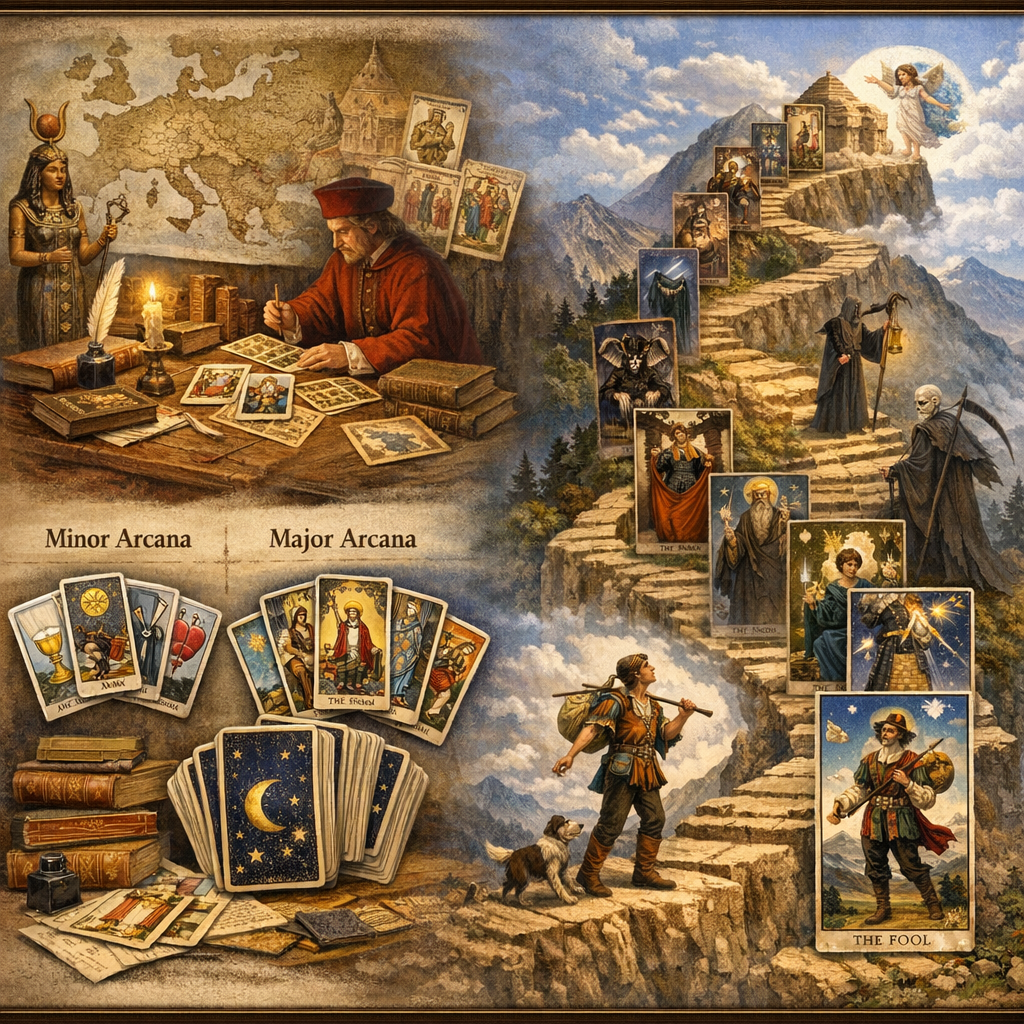
Foundations of Tarot: History, Structure, and the Major Arcana Journey
This course introduces the historical roots of tarot, the 78-card deck structure, and the symbolic story told by the Major Arcana from The Fool to The World. You will connect core symbolic systems—elements, numerology, and archetypes—to clear, accessible interpretations of each Major Arcana card, so you can see how the whole sequence forms a coherent narrative.
The first lecture plays free — no account needed.
What you'll learn
- Students will be able to describe the historical origins of tarot in the context of European playing cards.
- Students will understand the difference between documented tarot history and later occult or mystical origin stories.
- Students will be able to outline how tarot shifted from a card game to a symbolic system used for divination and self-reflection.
- Students will be able to label and distinguish between Major Arcana and Minor Arcana cards in a standard 78-card deck.
- Students will understand the role of the four suits and court cards in relation to the Major Arcana.
- Students will be able to explain why the 78-card structure has become the standard in most modern tarot decks.
- Students will be able to connect the four elements to suits and to common themes in tarot imagery.
- Students will understand how basic numerology (especially 0–10) informs the sense of progression or intensity in cards.
- Students will be able to identify archetypal patterns and recurring visual motifs that support card meanings.
- Students will be able to summarize the idea of the Fool’s Journey as a narrative framework for the Major Arcana.
Prerequisites
- Early playing cards in Europe and the birth of tarot in 15th‑century Italy
- Tarot as a trick‑taking game versus tarot as a divinatory tool
- 78-card structure: 22 Major Arcana and 56 Minor Arcana
- Four suits and their everyday focus (Wands, Cups, Swords, Pentacles or local equivalents)
- Four elements (fire, water, air, earth) as a core symbolic system
- Basic numerology from 0 to 10 and how numbers suggest stages or intensity
Course Content
8 modules · 2h total
From Card Game to Symbolic Map: Where Tarot Comes From
Step behind the mystique of tarot to see how a simple 15th‑century card game evolved into today’s 78‑card symbolic system used for reflection and insight. Along the way, you’ll separate well-loved myths from what historians actually know about tarot’s origins.
Inside a 78-Card Tarot Deck: Major, Minor, and the Suits
Open up a standard tarot deck and every card suddenly has a place, a job, and a relationship to the others. This chapter reveals how the 78 cards are organized so the deck becomes a structured system instead of a random stack of pictures.
Tarot’s Symbolic Language: Elements, Numbers, and Archetypes
Behind every tarot image is a web of symbols—elements, numbers, and archetypal figures—that quietly shape how readers understand the cards. This chapter gives you a simple, reusable framework so the symbolism starts making sense instead of feeling overwhelming.
The Fool’s Journey: Seeing the Major Arcana as One Story
Instead of 22 separate cards to memorize, imagine the Major Arcana as chapters in one unfolding story—the Fool’s Journey. This chapter walks you through that narrative so each card’s place and purpose becomes easier to remember and feel.
Beginnings and Early Lessons: The Fool through The Lovers (0–6)
Meet the first companions on the Fool’s path—from raw potential and sudden inspiration to choice, relationship, and values. These early Major Arcana cards sketch the foundations of identity and connection that shape the rest of the journey.
Tests, Turning Points, and Inner Strength: The Chariot through Temperance (7–14)
As the journey continues, the cards move into challenge, justice, withdrawal, and deep inner balance. This chapter traces the arc from outer victory to inner integration, where the Fool learns that willpower alone is not enough.
Shadows, Awakening, and Completion: The Devil through The World (15–21)
At the far end of the Major Arcana, the Fool confronts illusion, upheaval, revelation, and finally wholeness. This chapter follows the story through its darkest and brightest moments to show how the journey resolves in The World.
Reading the Story in a Spread: Context, Combinations, and Reflection
Once you know the cards, the real magic is seeing how they talk to each other in an actual reading. This chapter shows how Major Arcana cards change flavor in different positions and combinations, turning static meanings into a living story.
Read the Textbook
Read every chapter for free, right here in your browser.
When many people hear "tarot," they think of fortune-telling, crystal balls, and mysterious powers. But tarot did not start that way.
Today, tarot usually means a 78-card deck used for reflection, insight, or sometimes divination (trying to see hidden information). A standard modern tarot deck has: 22 Major Arcana cards (like The Fool, Death, The Sun) 56 Minor Arcana cards (four suits, similar to regular playing cards)
Historians, however, see tarot first as a card game. The earliest records of tarot are from 15th-century northern Italy, around 600 years ago. Back then, people did not use tarot to predict the future. They used it to play a trick-taking game, a bit like how we play Hearts or Spades today.
Study Flashcards
Key concepts from this course as flashcard pairs.
From Card Game to Symbolic Map: Where Tarot Comes From
Tarot (historical origin)
A type of trick‑taking card game that began in 15th‑century northern Italy, using a deck with four suits plus a set of trump cards.
Trick‑taking game
A card game where players each play one card per round (a trick), and the highest card (or trump card) wins the round.
Trump cards (Tarot)
Special picture cards that outrank the regular suit cards in tarot games. Later called Major Arcana in modern tarot.
Major Arcana
In modern tarot, the 22 trump cards with strong symbolic images (for example, The Fool, Death, The Sun).
Minor Arcana
The 56 suit cards in a tarot deck, similar to regular playing cards, usually divided into four suits with numbers and court cards.
Divination
Trying to gain insight or information (often about the future or hidden things) through symbolic tools like tarot or other methods.
+4 more flashcards
Inside a 78-Card Tarot Deck: Major, Minor, and the Suits
Major Arcana
The 22 big, named cards in a standard tarot deck (usually numbered 0–21) that show major themes and life lessons, not linked to any suit.
Minor Arcana
The 56 cards divided into four suits. They focus on everyday life and include both pip (number) cards and court (people) cards.
Suit
A group of cards in the Minor Arcana that share a theme. In many modern decks: Wands, Cups, Swords, and Pentacles.
Pip Cards
The 10 number cards in each suit (Ace–10). They show stages or situations related to that suit’s theme.
Court Cards
The four "people" cards in each suit (often Page, Knight, Queen, King). They often represent people, roles, or personality styles.
Wands
A suit usually linked to action, energy, and motivation. Often pictured as sticks or staffs.
+4 more flashcards
Tarot’s Symbolic Language: Elements, Numbers, and Archetypes
Which element is linked to Wands in most modern tarot systems?
Fire – themes of energy, passion, action, creativity, and willpower.
Which element is linked to Cups?
Water – themes of emotions, relationships, intuition, and connection.
Which element is linked to Swords?
Air – themes of thoughts, words, conflict, decisions, and clarity.
Which element is linked to Pentacles (or Coins)?
Earth – themes of body, money, work, health, and material results.
What does the number 1 generally suggest?
Beginnings, spark, individuality, the first step or seed.
What does the number 5 generally suggest?
Change, challenge, tension, or tests that shake stability.
+3 more flashcards
The Fool’s Journey: Seeing the Major Arcana as One Story
Fool’s Journey
A way of seeing the 22 Major Arcana cards as one story about the Fool (card 0) growing from innocence to completion, moving through life lessons and stages.
Phase 1 (0–5)
Early life foundations: The Fool to The Hierophant. Themes: beginnings, personal tools, intuition, nurturing, rules, and traditions.
Phase 2 (6–11)
Relationships and social roles: The Lovers to Justice. Themes: love, choices, willpower, inner strength, reflection, change, and consequences.
Phase 3 (12–16)
Crises and deep transformation: The Hanged Man to The Tower. Themes: pause, endings, healing, unhealthy patterns, and sudden shocks.
Phase 4 (17–21)
Integration and completion: The Star to The World. Themes: hope, mystery, joy, rebirth, and wholeness at the end of a cycle.
The Fool (0)
Viewpoint character of the story. Represents innocence, faith, and new beginnings. The journey starts from their perspective.
+1 more flashcards
Beginnings and Early Lessons: The Fool through The Lovers (0–6)
The Fool (0) – Key Idea
New beginnings, innocence, pure potential, stepping into the unknown with trust.
The Magician (I) – Key Idea
Action, focus, using your tools and skills to turn ideas into reality.
The High Priestess (II) – Key Idea
Intuition, inner knowing, mystery, pausing to listen and observe.
The Empress (III) – Key Idea
Nurturing, comfort, creativity, physical and emotional care that allows growth.
The Emperor (IV) – Key Idea
Structure, rules, stability, leadership, and boundaries that create safety.
The Hierophant (V) – Key Idea
Tradition, teaching, shared beliefs, learning from systems like school or religion.
+2 more flashcards
Tests, Turning Points, and Inner Strength: The Chariot through Temperance (7–14)
The Chariot (7)
Victory, willpower, focus, self‑control; steering your life in a chosen direction despite mixed pulls.
Strength (8)
Inner courage, gentle control, patience, compassion; guiding strong emotions with kindness instead of force.
The Hermit (9)
Solitude, reflection, inner wisdom; stepping back from noise to listen to your own guidance.
Wheel of Fortune (10)
Cycles, change of luck, big turning points; events larger than your personal control.
Justice (11)
Fairness, truth, consequences; taking responsibility and seeking a balanced, honest outcome.
The Hanged Man (12)
Pause, surrender, new perspective; waiting and seeing things differently instead of forcing action.
+2 more flashcards
Shadows, Awakening, and Completion: The Devil through The World (15–21)
The Devil (15) – Core idea
Bondage and illusion. Feeling trapped by habits, fears, or relationships, but the chains are looser than they seem. A self-made or partly self-made prison.
The Devil – Everyday example
Staying in a draining friendship because you think you have no other options, even though you could set boundaries or step back.
The Tower (16) – Core idea
Sudden change and collapse of false structures. A shock that destroys what was never truly stable, allowing truth to break through.
The Star (17) – Core idea
Hope, healing, and gentle guidance after crisis. A quiet, steady light in the dark, showing that recovery is possible.
The Moon (18) – Core idea
Confusion, fear, and strong imagination. Things are unclear; emotions and dreams are intense. You are invited to listen within but also check reality.
The Sun (19) – Core idea
Joy, success, and clarity. Things are out in the open, simple, and honest. A feeling of warmth, life, and confidence.
+4 more flashcards
Reading the Story in a Spread: Context, Combinations, and Reflection
Major Arcana
The 22 cards (0–21) that show big life themes and lessons. In a spread they act like headlines or chapter markers in the story.
Minor Arcana
The 56 suit cards that describe everyday events, feelings, and actions. They show how the big themes play out in daily life.
Card Position
The labeled spot a card falls in (Past, Present, Future, Advice, Challenge, etc.). It shapes how you read the card's meaning.
Question Context
The topic you ask about (love, work, self-growth). It guides which side of a card's meaning you focus on.
Support (Card Combination)
When two or more cards point in a similar direction, strengthening the same message in the story.
Tension (Card Combination)
When cards pull in different directions (for example, risk vs. caution), showing a conflict or balance you must manage.
+2 more flashcards
More in Arts & Culture
See all →
Introduction to Philosophy: Big Questions and Key Thinkers
Mastering The Wheel of Time: A Comprehensive Expert Course
Advanced Tarot: Archetypes, Symbolism, and the Narrative Web of the Arcana
Tarot Card Deep Dive: Symbolism, History, and Story Across the Arcana
Meta-Kabbalah Lab: Architecting Your Own System of Letters, Tree, Names & Gates