Skarp
Skarp
Advanced Tarot: Archetypes, Symbolism, and the Narrative Web of the Arcana
A deep, structured journey into tarot as a symbolic language rather than a list of meanings. You will trace the historical and cultural roots of tarot imagery, unpack archetypal themes in the Major and Minor Arcana, and map the narrative and psychological links that weave the suits, numbers, and court cards into a coherent story.
The first lecture plays free — no account needed.
What you'll learn
- Students will be able to describe the structural components of a standard 78-card tarot deck and distinguish between Major and Minor Arcana.
- Students will understand tarot as a symbolic and narrative system rather than a collection of isolated fortune-telling meanings.
- Students will be able to outline key historical phases in tarot’s development from playing cards to esoteric and psychological tool.
- Students will understand how historical layers (Christian, Hermetic, astrological, Jungian) shaped modern interpretations of tarot symbolism.
- Students will be able to identify and interpret recurring visual symbols across multiple tarot cards and decks.
- Students will understand how composition, color, and iconographic detail contribute to a card’s layered meaning.
- Students will be able to explain how archetypes and the collective unconscious relate to tarot imagery.
- Students will understand key psychological readings of the Major Arcana (e.g., individuation, developmental stages, inner functions).
- Students will be able to describe the sequence and internal structure of the Major Arcana and summarize the idea of the Fool’s Journey.
- Students will understand how to group Major Arcana cards into thematic clusters for deeper narrative interpretation.
Prerequisites
- Structure of the tarot deck (Major and Minor Arcana)
- Tarot as symbolic language and visual text
- Historical layers in tarot imagery
- Iconography and visual symbolism
- Historical occult and psychological interpretations of tarot
- Jungian and depth-psychological approaches to tarot
Course Content
14 modules · 3h 15m total
Tarot as a Symbolic System: Beyond Keywords and Quick Meanings
Step behind the fortune-teller’s table into tarot’s deeper identity as a 78-card symbolic text, where every image, suit, and number participates in a larger narrative about human experience.
Historical Roots: From Renaissance Game to Esoteric and Psychological Tarot
Travel from 15th‑century European card tables to 19th‑century occult salons and 20th‑century psychology labs to see how tarot’s imagery was reinterpreted again and again.
Reading Images: Iconography and Symbolic Literacy in Tarot
Enter the image itself: figures, colors, gestures, and objects turn into a visual grammar you can read, question, and recompose across different decks.
Archetypes and the Psyche: Jungian and Depth-Psychological Tarot
Shift from predicting events to mapping the psyche, using tarot’s archetypal figures and patterns as mirrors of inner dynamics, complexes, and life stages.
The Major Arcana I: Structure, Cycles, and the Fool’s Journey
Follow the Fool as the 22 trumps unfold not just as a linear story, but as interlocking clusters of themes—social order, crisis, transformation, and integration.
The Major Arcana II: Case Studies in Archetypal Symbolism
Zoom in on a handful of trump cards to dissect how costume, gesture, background, and traditional correspondences generate complex archetypal stories.
The Architecture of the Minor Arcana: Suits, Elements, and Everyday Archetypes
Step into the four elemental worlds of Cups, Wands, Swords, and Pentacles, where grand archetypes filter into daily emotions, conflicts, labors, and desires.
Numerology in the Minors: From Aces to Tens as Story Arcs
Watch each suit unfold from raw potential to culmination and aftermath, using numbers as a backbone for narrative and psychological progression.
Courts as People, Roles, and Parts of Self
Meet the Pages, Knights, Queens, and Kings not just as ‘people cards’, but as complex role-patterns, developmental stages, and inner voices within the psyche.
Weaving the Web: Narrative Links Across Suits, Numbers, and Courts
Lay the cards side by side to reveal hidden storylines—Fives across the suits, all the Queens, or a vertical slice of Wands from Ace to King—turning the deck into a living narrative web.
Traditions in Dialogue: Marseille, Rider–Waite–Smith, Thoth, and Modern Decks
Place classic decks side by side to see how different traditions redraw the same archetypes, shifting emphasis, symbolism, and even the emotional temperature of a reading.
Styles of Reading: Esoteric, Psychological, and Intuitive Approaches
Move from rigid ‘right meanings’ toward flexible reading styles, balancing tradition with intuition and psychological insight to suit different contexts and querents.
Ethics, Projection, and Working with Clients (or Self) Responsibly
Step into the ethical heart of practice, where the power of symbols meets the vulnerability of human questions, requiring care with projection, suggestion, and narrative framing.
Capstone Practice: Constructing Complex, Narrative-Rich Readings
Bring everything together in layered spreads that move fluidly between archetype and everyday detail, crafting readings that feel like richly textured stories of a life in motion.
Read the Textbook
Read every chapter for free, right here in your browser.
In this module, you will step away from the stereotype of tarot as a fortune-telling gadget and approach it as a symbolic system.
A standard tarot deck has 78 cards. Think of it like a graphic novel about human experience: each card is a panel in a larger visual story. Instead of speech bubbles, you get images, colors, numbers, and suits that carry meaning.
Historically, tarot began in 15th‑century Europe as a card game (often called "tarocchi" or "tarot"). Only centuries later did people start using it for esoteric, occult, and psychological purposes. Today, many readers treat tarot less as a way to predict the future and more as a tool for reflection, similar to how you might interpret a poem, a dream, or a film.
Study Flashcards
Key concepts from this course as flashcard pairs.
Tarot as a Symbolic System: Beyond Keywords and Quick Meanings
Major Arcana
The 22-card set (0–21) in a tarot deck that depicts archetypal scenes and is often associated with large-scale life themes and processes.
Minor Arcana
The 56 cards divided into four suits (Wands, Cups, Swords, Pentacles), often read as representing everyday situations, feelings, and interactions.
Suit (in tarot)
A subgroup of the Minor Arcana (e.g., Wands, Cups, Swords, Pentacles) linked to an element and a domain of life such as energy, emotion, thought, or material reality.
Ace–10 Number Arc
A way of seeing the numbered cards in each suit as stages in a process, from seed potential (Ace) to completion or overload (Ten).
Symbolic System
A set of images, numbers, and structures that work together like a language, allowing meanings to emerge from their relationships rather than from fixed keywords.
Archetype
A recurring pattern, character type, or situation found across stories and cultures (e.g., The Fool, The Hermit) that Major Arcana cards often express.
+1 more flashcards
Historical Roots: From Renaissance Game to Esoteric and Psychological Tarot
Trionfi (triumphs)
The early name for the special trump cards added to Italian playing card decks in the 15th century; used in a trick-taking game, not originally for occult purposes.
Tarot de Marseille
A family of tarot designs common in 17th–18th century France, later used as a basis for both fortune-telling and historical research into early tarot imagery.
Court de Gébelin
18th-century writer who claimed tarot was an ancient Egyptian book of wisdom. Historically incorrect, but crucial in launching esoteric interpretations of tarot.
Eliphas Lévi
19th-century French occultist who linked tarot to Kabbalah and astrology, treating the Major Arcana as keys to universal spiritual laws.
Hermetic Order of the Golden Dawn
Late 19th-century British occult society that systematized tarot correspondences with Hebrew letters, zodiac signs, planets, and elements; influenced modern decks like Rider-Waite-Smith.
Rider-Waite-Smith (RWS) deck
A widely used tarot deck first published in 1909, designed by A. E. Waite and illustrated by Pamela Colman Smith, incorporating Golden Dawn symbolism and full scenes on all cards.
+2 more flashcards
Reading Images: Iconography and Symbolic Literacy in Tarot
Iconography
The study of images and their conventional meanings; in tarot, how objects, figures, and gestures connect to broader symbolic traditions.
Motif
A recurring visual element (such as a path, tower, crown, animal, or celestial body) that carries a cluster of potential meanings across cards and decks.
Foreground vs Background
Foreground is what appears visually closest and often feels immediate or urgent; background is farther away and provides context or long-term themes.
Composition
The arrangement of elements within the card image, including placement, size, and relationships between figures, which shapes emphasis and narrative.
Symbolic Field
The network of ideas, emotions, and stories that gather around a given icon or motif (for example, what usually comes to mind when you see a crown or tower).
Visual Grammar
The set of patterned visual choices (color, posture, placement, motifs) that function like a language, allowing tarot images to be "read" and interpreted.
Archetypes and the Psyche: Jungian and Depth-Psychological Tarot
Archetype (in Jungian psychology)
An innate organizing pattern of the psyche that shapes typical roles, situations, and dynamics. It is not a fixed image, but images (including tarot cards) express archetypal patterns.
Collective unconscious
A hypothesized deep layer of the psyche that contains shared human patterns and potentials. It is used to explain recurring symbolic motifs across cultures and history.
Individuation
Jung's term for the lifelong process of becoming a more whole, integrated person, differentiating from external expectations and integrating unconscious aspects of the self.
Complex (psychological complex)
An emotionally charged cluster of ideas, memories, and feelings organized around a theme (e.g., authority, mother, success) that can temporarily dominate perception and behavior.
Shadow
The set of traits, desires, and potentials a person does not recognize or accept in themselves. It can include both qualities judged as negative and disowned strengths.
Depth-psychological tarot
An approach to tarot that focuses on inner dynamics, archetypes, and unconscious processes rather than predicting external events.
+2 more flashcards
The Major Arcana I: Structure, Cycles, and the Fool’s Journey
Major Arcana
The 22 trump cards in a tarot deck, usually numbered 0–21, forming a core sequence of archetypal images used in many psychological and narrative approaches.
Fool’s Journey
A modern interpretive model that treats the 22 Major Arcana as stages in the development of a single character (the Fool), used as a narrative and psychological framework.
Cluster (in Major Arcana)
A group of Major Arcana cards that share a thematic function in the Fool’s Journey, such as social order (Magician–Hierophant) or crisis and transformation (Wheel–Temperance).
Social Order Cluster
Early Major Arcana cards (Fool through Hierophant, and sometimes Lovers/Chariot) that depict how an emerging self encounters skills, family, authority, and institutions.
Crisis and Transformation Cluster
Middle Major Arcana cards (around Wheel of Fortune through Temperance, then Devil and Tower) that show disruption, reversal, endings, and the need to reorganize identity.
Integration Cards
Later Major Arcana cards (Judgement and The World) that symbolize awakening, evaluation, and temporary wholeness at the end of a Fool’s Journey cycle.
The Major Arcana II: Case Studies in Archetypal Symbolism
5-step close-reading method (for any Major Arcana card)
1) Neutral description, 2) Costume/gesture/posture, 3) Background and objects, 4) Overlay correspondences (astrology, elements, Kabbalah), 5) Psychological translation (growth and shadow).
Archetype
A recurring pattern or image (such as a wise teacher, trickster, or death-rebirth process) that appears across myths, dreams, and stories, reflecting deep structures of the human psyche.
High Priestess – core psychological theme
Inner, intuitive knowing and the boundary between conscious and unconscious; growth in trusting inner guidance vs. shadow secrecy and passive-aggression.
Hierophant – core psychological theme
Outer authority, tradition, and shared belief systems; growth in mentorship and ethical structure vs. shadow conformity and dogmatism.
Death (XIII) – core psychological theme
Irreversible transformation and endings that make way for new life; growth in conscious letting go vs. shadow clinging, self-sabotage, or emotional numbness.
The Tower (XVI) – core psychological theme
Sudden disruption and collapse of rigid structures; growth in awakening and humility vs. shadow of chronic crisis or total despair.
+2 more flashcards
The Architecture of the Minor Arcana: Suits, Elements, and Everyday Archetypes
Cups
Suit linked to Water; emotions, relationships, intuition, and the affective climate of situations.
Wands
Suit linked to Fire; drive, motivation, creativity, risk-taking, and spiritual or energetic enthusiasm.
Swords
Suit linked to Air; thoughts, analysis, conflict, decisions, language, and mental stress or clarity.
Pentacles
Suit linked to Earth; work, money, health, body, housing, and material security or scarcity.
Pip cards
Numbered cards Ace–Ten in each suit; show processes and everyday situations within a life domain.
Court cards
Page, Knight, Queen, King (names vary); often represent people, roles, or characteristic ways of behaving in a suit's domain.
+3 more flashcards
Numerology in the Minors: From Aces to Tens as Story Arcs
Ace (1)
Raw potential, seed, spark. A door opens for the suit's element (emotion, energy, thought, material).
Two (2)
Duality, choice, first tension or partnership. How you relate to the new thing.
Three (3)
Growth, expansion, expression. The project or pattern starts to develop visibly.
Four (4)
Structure, stability, consolidation. Foundations or routines, sometimes stagnation.
Five (5)
Disruption, conflict, instability. Stress test or growing pains.
Six (6)
Response, harmony-seeking, rebalancing. Attempts to heal, support, or integrate.
+4 more flashcards
Courts as People, Roles, and Parts of Self
Page (rank)
Element: Earth. Developmental stage: childhood/early adolescence. Style: beginner, learner, experimental, cautious, focused on practice and small steps.
Knight (rank)
Element: Fire. Developmental stage: adolescence/early adulthood. Style: action-oriented, quest-driven, intense, sometimes impulsive or extreme.
Queen (rank)
Element: Water. Developmental stage: mature relational adulthood. Style: receptive, nurturing, emotionally attuned, focused on holding space and integration.
King (rank)
Element: Air. Developmental stage: mature authority/responsibility. Style: strategic, organizing, decision-making, can become rigid if unbalanced.
Element + Element Formula
Each court card = rank element + suit element (for example, Knight of Cups = Fire of Water; Queen of Swords = Water of Air). This layering refines temperament and behavior.
Weaving the Web: Narrative Links Across Suits, Numbers, and Courts
Cross-suit number chain
A narrative created by gathering all four Minors of the same number (e.g., all Fives) and reading them as one theme expressed in different life domains (Wands, Cups, Swords, Pentacles).
Vertical slice
A suit-based sequence from Ace to Ten plus Courts (e.g., all Wands) read as a single life arc or psychological process within one domain.
Rank-based Court grouping
Lining up all four Courts of the same rank (all Pages, all Knights, all Queens, all Kings) to explore one archetypal role pattern across four elements.
Major–Minor number link
Connecting a Major Arcana card to Minor Arcana cards that share its number (or reduced number) to see how a large archetype appears in everyday situations.
Narrative web reading
A reading style that builds stories by linking cards through shared numbers, suits, ranks, and motifs instead of relying only on fixed spread positions.
Traditions in Dialogue: Marseille, Rider–Waite–Smith, Thoth, and Modern Decks
Pip card (Minor Arcana)
A card that shows suit symbols (like Cups, Swords, Wands, Coins) arranged in patterns, usually without people or full scenes. Common in Marseille-style decks.
Scenic Minor
A Minor Arcana card that shows a full scene with people, landscapes, and actions. Standard in Rider–Waite–Smith and many modern decks.
Tarot de Marseille
A historic European tarot pattern with pip-style Minors and traditional, often medieval-looking Majors and Courts. Many modern restorations remain popular.
Rider–Waite–Smith (RWS)
A 1909 tarot deck illustrated by Pamela Colman Smith under A. E. Waite. It popularized fully scenic Minors and underlies many contemporary decks.
Thoth Tarot
A tarot deck painted by Lady Frieda Harris under Aleister Crowley in the 1940s. It uses symbolic Minors with keywords and strong esoteric attributions.
Modern inclusive deck
A contemporary tarot deck that intentionally broadens representation (race, gender, body type, culture) and often adapts RWS or Marseille symbolism.
+2 more flashcards
Styles of Reading: Esoteric, Psychological, and Intuitive Approaches
Esoteric/Occult Reading Style
A style that treats tarot as a symbolic map of spiritual or energetic realities, often using systems like astrology, Kabbalah, elements, and numerology to interpret cards.
Predictive Reading
An approach that emphasizes likely outcomes and timing based on current trajectories, framing cards as indicators of what is probable if conditions remain the same.
Psychological/Coaching Reading
A style that sees cards as mirrors of inner states, beliefs, and patterns, focusing on insight, choice, and practical next steps rather than fixed predictions.
Intuitive Reading
An approach that prioritizes immediate impressions, images, body sensations, and spontaneous associations over fixed book meanings or formal systems.
Pattern Recognition (Intuition)
A cognitive process in which the brain rapidly matches current stimuli (like card images) with stored experiences and patterns, often experienced as a 'gut feeling'.
Balancing Structure and Spontaneity
The practice of using symbolic systems (suits, numbers, correspondences) as a framework while allowing intuitive impressions and improvisation to shape the reading.
+1 more flashcards
Ethics, Projection, and Working with Clients (or Self) Responsibly
Informed consent
Making sure the querent understands what you do, what you do not do, and how you work before agreeing to a reading, including limits, privacy, and their right to stop.
Projection
Attributing your own feelings, beliefs, or unresolved issues to the cards or to the querent, so your story shapes the reading more than theirs.
Transference
When the querent unconsciously relates to you as if you were someone else (parent, ex, teacher), which can lead them to seek authority or approval from you.
Countertransference
Your emotional reactions to the querent, influenced by your own history, which can color how you interpret the cards and give advice.
Agency-supporting framing
Wording interpretations in ways that emphasize possibilities, reflection, and choice, rather than fixed fate or dependency on the reader.
Scope of practice
The boundaries of what you are qualified and ethically allowed to do; for most tarot readers, this excludes medical, legal, and financial advice or mental health diagnosis.
Capstone Practice: Constructing Complex, Narrative-Rich Readings
Narrative Arc Spread
A spread designed around story structure (e.g., opening scene, tension, resolution, next chapter) so that cards form one coherent narrative rather than separate mini-readings.
Underlying Archetype (Major Arcana Role)
The big life theme or chapter represented by a Major Arcana card, which provides a wide-angle context for everyday scenes shown by the Minor Arcana.
Zoom Lens Method
A synthesis technique where Majors are read as the chapter (wide lens), Minors as specific scenes (close lens), and courts as roles or parts of self within that chapter.
Projection Check-In
A reflective practice where you ask how your own experiences, fears, or hopes might be shaping your interpretation, helping reduce unconscious projection onto the querent.
Reading Log / Debrief
Short notes taken after a reading that capture context, spread, story arc, ethical choices, and learning points, creating a feedback loop for ongoing skill and ethics development.
More in Arts & Culture
See all →
Introduction to Philosophy: Big Questions and Key Thinkers
Mastering The Wheel of Time: A Comprehensive Expert Course
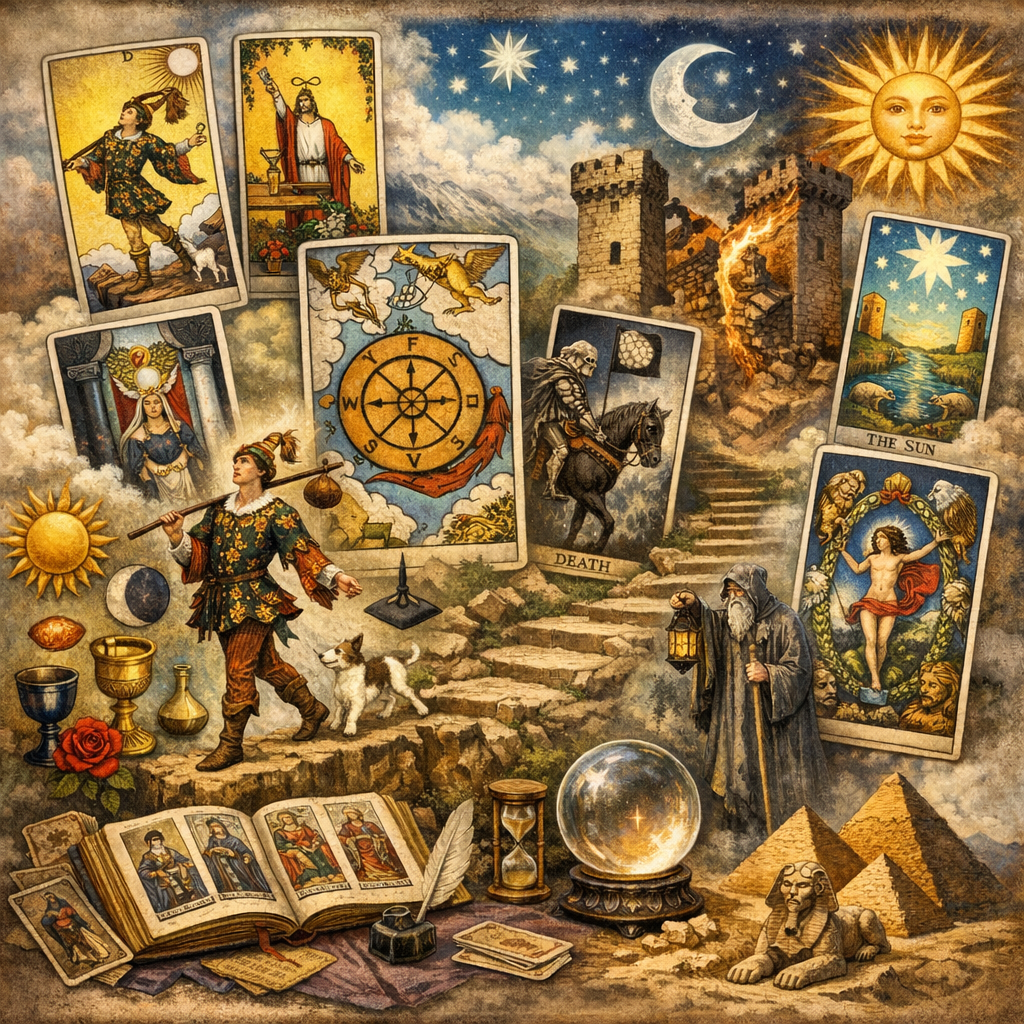
Tarot Card Deep Dive: Symbolism, History, and Story Across the Arcana
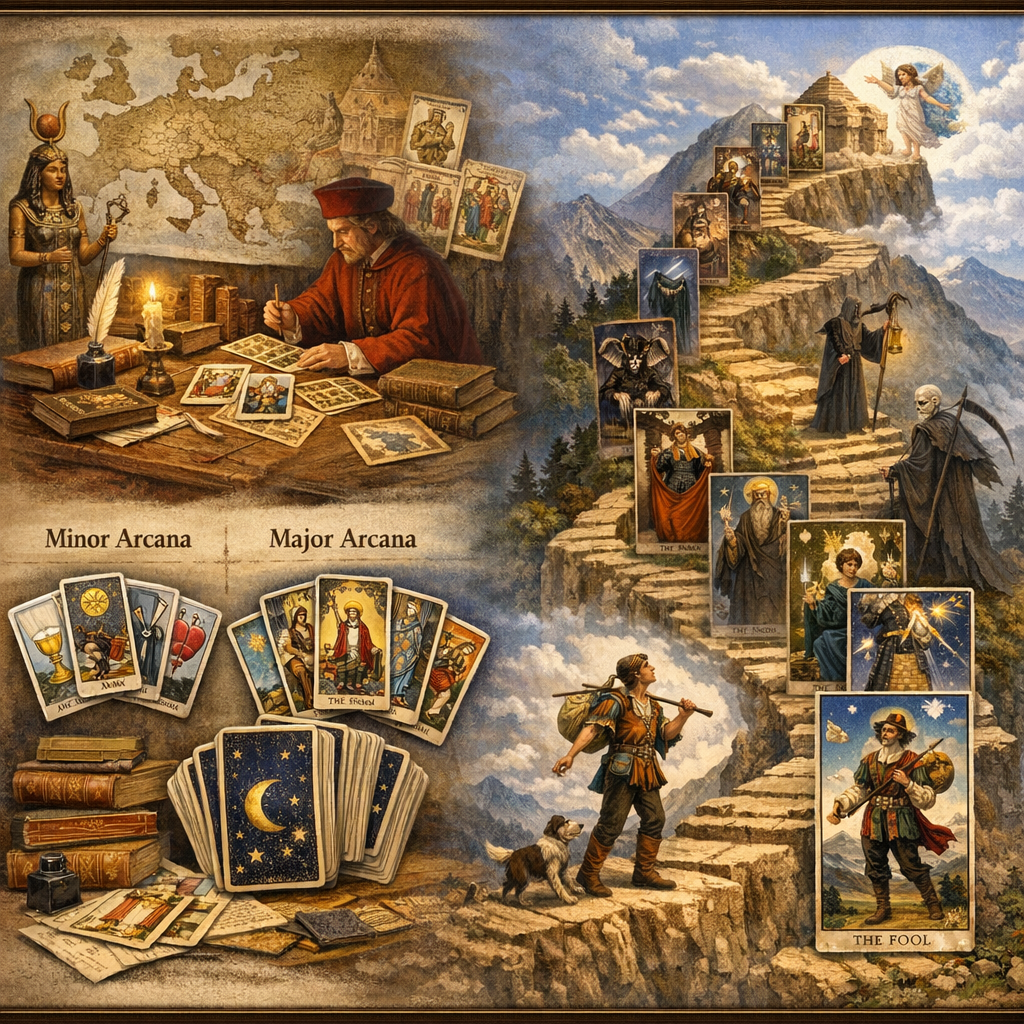
Foundations of Tarot: History, Structure, and the Major Arcana Journey
Meta-Kabbalah Lab: Architecting Your Own System of Letters, Tree, Names & Gates