Skarp
Skarp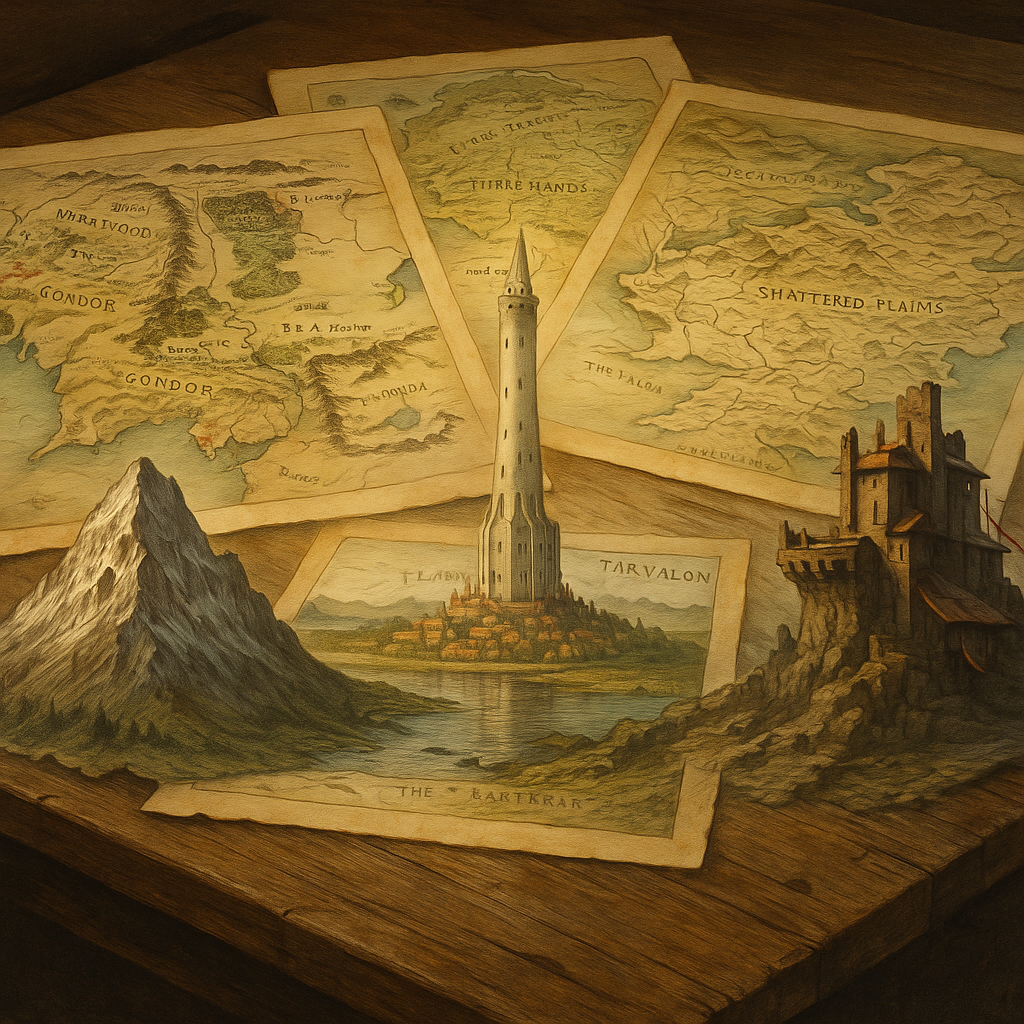
Worldbuilding in Epic Fantasy: Comparing Middle-earth, the Wheel of Time, and the Stormlight Archive
This course guides you through a structured comparison of the fantasy worlds in The Lord of the Rings, The Wheel of Time, and The Stormlight Archive. You will explore their geographies, histories, magic systems, cultures, and themes so you can articulate meaningful similarities and differences between these three landmark secondary worlds.
The first lecture plays free — no account needed.
What you'll learn
- Students will be able to briefly describe the basic premise and setting of each series’ world.
- Students will understand the difference between comparing stories and comparing worldbuilding elements.
- Students will be able to identify at least three dimensions along which fantasy worlds can be compared (e.g., geography, magic, culture).
- Students will be able to sketch or mentally map the major regions of each world and describe their key environmental features.
- Students will understand how geography constrains or enables travel, warfare, and cultural contact in each series.
- Students will be able to compare how each author uses distinctive environmental features to create mood and thematic resonance.
- Students will be able to summarize the broad historical structure of each world (major Ages or epochs).
- Students will understand how mythic or legendary past events affect current politics, prophecy, and character motivations.
- Students will be able to compare how each series uses cyclical vs. linear conceptions of history.
- Students will be able to describe the key features of each magic system, including who can use it and at what cost.
Prerequisites
- Secondary-world fantasy vs. real-world settings
- High-level overview of Middle-earth, the Wheel of Time world, and Roshar
- Ages and epochs (Ages of Middle-earth, Ages in the Wheel of Time, Desolations on Roshar)
- Continents, regions, and travel in each world
- Sources and limitations of magic (divine, natural, cosmic, investiture)
- Soft vs. hard magic systems
Course Content
9 modules · 1h 55m total
Orienting the Map: Three Landmark Fantasy Worlds
Get an overview of Middle-earth, the world of The Wheel of Time, and Roshar in The Stormlight Archive, and clarify what it means to compare fantasy worlds rather than just plots or characters.
Geography and Environment: Landscapes that Shape Stories
Examine how the physical landscapes of Middle-earth, the Wheel of Time world, and Roshar differ, and how climate, terrain, and natural features influence the stories and cultures within them.
Deep Time: Histories, Ages, and Mythic Backstory
Explore how each world handles ancient history, legends, and previous ages, and how that deep time shapes the present-day conflicts of the stories.
Magic Systems: From Subtle Enchantment to Codified Power
Contrast the nature, rules, and narrative role of magic in Middle-earth, the One Power in The Wheel of Time, and Surgebinding and related systems in The Stormlight Archive.
Cultures, Societies, and Politics: Peoples of Three Worlds
Analyze the major cultures, races, and political systems across the three settings, and how each author uses them to explore identity, power, and conflict.
Religion, Myth, and Metaphysics: The Hidden Architecture of Reality
Compare the religious systems, cosmologies, and metaphysical rules that underpin each world, from Eru and the Valar to the Creator and the Dark One to Shards and the Cosmere.
Language, Names, and Symbolism: How Worlds Feel Real
Investigate how invented languages, naming conventions, and symbolic motifs contribute to the distinct flavor of each fantasy world.
Themes and Tone: What These Worlds Are Ultimately About
Synthesize how worldbuilding choices in each series support their core themes, such as hope vs. despair, the burden of destiny, and the nature of heroism.
Putting It All Together: A Structured Comparative Analysis
Use a simple analytical framework to systematically compare and contrast the three worlds, and draft your own short comparative essay or discussion outline.
Read the Textbook
Read every chapter for free, right here in your browser.
When readers talk about Middle-earth, the world of The Wheel of Time, or Roshar from The Stormlight Archive, they often mix together: Story (plots, characters, themes) World (geography, cultures, magic systems, history)
This module focuses on the worlds themselves.
Secondary-world fantasy All three examples are secondary-world fantasy: The story happens in a fictional world that is not our Earth (even if it sometimes has distant connections). The author must design everything: maps, cultures, languages, magic, history, even the shape of the continents.
Study Flashcards
Key concepts from this course as flashcard pairs.
Orienting the Map: Three Landmark Fantasy Worlds
Secondary-world fantasy
A type of fantasy set in a completely fictional world separate from our Earth, with its own geography, history, and often its own physical and magical laws (e.g., Middle-earth, Roshar, the Wheel of Time world).
Worldbuilding
The process of creating the setting for a story: its geography, cultures, history, magic systems, technology, and underlying rules.
Magic system
The organized set of rules or patterns that govern how magic works in a fictional world—who can use it, what it can do, and what it costs.
Cosmology (in fantasy)
The way a fictional universe is structured at a large scale: its gods or cosmic forces, the origin of magic, the nature of time and reality (e.g., the Wheel and the Pattern, Shards in the Cosmere).
Design goals (of a world)
The author’s underlying purposes for building a world a certain way—such as creating a mythic atmosphere, exploring moral questions, or enabling specific kinds of conflicts.
Tone (of a world)
The overall emotional feel of a setting—such as mythic, hopeful, grim, or whimsical—created by its history, magic, cultures, and the stories told within it.
Geography and Environment: Landscapes that Shape Stories
Highstorm (Roshar)
A massive, recurring magical storm that travels from east to west across Roshar, shaping architecture, ecosystems, culture, and the use of stormlight.
Shattered Plains (Roshar)
A fractured plateau landscape of plateaus and deep chasms in eastern Roshar, making travel and warfare logistically complex and dangerous.
The Blight (Wheel of Time)
A corrupted, dangerous region bordering the Shadow’s stronghold in the north, acting as a buffer zone that most people avoid.
Aiel Waste (Wheel of Time)
A harsh, desert-like region east of the main nations, separated by mountains; home to the Aiel, whose culture is adapted to scarcity and heat.
Misty Mountains (Middle-earth)
A central mountain range in Middle-earth that blocks easy east–west travel, forcing characters into risky passes and underground routes.
Geographic constraint
A physical feature (like a mountain, desert, or storm system) that limits where people can travel or live, influencing culture and plot.
+1 more flashcards
Deep Time: Histories, Ages, and Mythic Backstory
Deep time (in fantasy)
The long, layered history of a fantasy world—including ancient Ages, myths, and world-shaping events—that continues to influence the present story.
Age (Middle-earth)
A large historical period (e.g., First, Second, Third Age) in a mostly linear timeline, each marked by major events like the War of Wrath or the War of the Ring.
The Long Defeat
An Elvish idea in Middle-earth that history is a gradual decline where good wins battles but never fully defeats evil, and beauty and power fade over time.
The Wheel and the Pattern
In The Wheel of Time, the Wheel is the cosmic force that turns Ages in a cycle; the Pattern is the woven fabric of reality made from people’s lives and choices.
Desolations (Roshar)
Repeated, catastrophic wars on Roshar in which the Voidbringers (and later the Fused) return, separated by long periods of fragile peace and increasing forgetfulness.
Artifacts and ruins
Physical leftovers from earlier Ages—like the One Ring, ter’angreal, or Shardblades—that carry power, history, and consequences into the present story.
+1 more flashcards
Magic Systems: From Subtle Enchantment to Codified Power
Soft magic system
A style of magic where rules are vague or unexplained, used mainly to create mood, mystery, and a sense of the mythic, rather than for precise problem-solving.
Hard magic system
A style of magic with clear, consistent, and often explicitly explained rules that allow readers to predict what is possible and see magic used like a tool or technology.
The One Power
The fundamental magical force in The Wheel of Time, drawn from the True Source and divided into saidar (female half) and saidin (male half), used through weaves of the Five Powers.
Surgebinding
A major magic system in The Stormlight Archive where Knights Radiant bond spren and manipulate fundamental forces called Surges, powered by Stormlight.
Investiture
Cosmere-wide term for magical energy or the power of creation; on Roshar, it appears most clearly as Stormlight and fuels systems like Surgebinding and fabrials.
Istari
The order of wizards in Middle-earth (e.g., Gandalf, Saruman), actually Maiar spirits sent by the Valar to guide the peoples of Middle-earth against Sauron.
+4 more flashcards
Cultures, Societies, and Politics: Peoples of Three Worlds
Aes Sedai
An organization of women who can channel the One Power in *The Wheel of Time*, based in the White Tower. They are divided into Ajahs and hold significant political and magical influence.
Vorinism (Vorin religion)
The dominant religion in many human nations on Roshar (e.g., Alethkar). It shapes gender roles (women as scribes and scholars, men as warriors) and social expectations.
Lighteyes / Darkeyes
A hereditary caste division among humans on Roshar. Lighteyes form the nobility and ruling class, while darkeyes are commoners with limited access to power.
Seanchan damane system
A system in *The Wheel of Time* where the Seanchan Empire enslaves women who can channel (damane) using collars and leashes, turning them into living weapons.
Knights Radiant
Orders of Surgebinders on Roshar who bond spren and swear Ideals. They blend magical power with moral codes, influencing both warfare and politics.
Monarchies and Nobility in Middle-earth
Political structures where kings (e.g., Théoden, Aragorn) and noble houses (e.g., Stewards of Gondor) rule, often tied to ancient bloodlines and oaths.
+1 more flashcards
Religion, Myth, and Metaphysics: The Hidden Architecture of Reality
Eru Ilúvatar
The single, transcendent creator God in Tolkien's legendarium, who originates the Music of the Ainur and brings the world (Arda) into being.
Music of the Ainur
The cosmic symphony in Tolkien’s mythology through which Eru and the Ainur shape the design of reality; history is the unfolding of this Music in time.
The Wheel and the Pattern
In The Wheel of Time, the Wheel of Time spins out the Pattern of the Ages, weaving individual lives as threads into a vast tapestry that represents reality and history.
Ta’veren
Individuals in The Wheel of Time whose threads are so central that the Pattern bends other threads around them, causing improbable events and major historical shifts.
Adonalsium
The original, godlike power in the Cosmere that was shattered into 16 Shards, each embodying a specific Intent such as Honor, Odium, Preservation, or Ruin.
Shard (of Adonalsium)
A vast fragment of Adonalsium's power in the Cosmere, each with a distinct Intent; usually held by a Vessel, it shapes magic systems and often local religions.
+2 more flashcards
Language, Names, and Symbolism: How Worlds Feel Real
Conlang (constructed language)
A deliberately invented language, often with its own grammar, vocabulary, and sometimes script (e.g., Tolkien’s Quenya and Sindarin).
Phonology
The system of sounds in a language; in fantasy, choosing certain sounds (soft vs. harsh) helps shape cultural and emotional tone.
Old Tongue (Wheel of Time)
A partially developed ancient language used for prophecies, battle cries, and inscriptions, giving the world a sense of deep history.
Glyph
A stylized symbol or character, often used in Stormlight Archive for prayers, house emblems, and magical diagrams.
Motif
A recurring element (image, phrase, symbol) that gains meaning through repetition, like rings, wheels, storms, or light vs. shadow.
Symbolism
Using an object, image, or recurring element to represent a larger idea or theme (e.g., the One Ring symbolizing power and corruption).
+1 more flashcards
Themes and Tone: What These Worlds Are Ultimately About
Theme
The central idea or question a story keeps returning to (e.g., loss and fading, cyclical struggle, trauma and redemption).
Tone
The emotional atmosphere or "feel" of a story, created by style, setting, events, and character attitudes (e.g., mythic, elegiac, intense, hopeful).
Long Defeat (Middle-earth)
Tolkien’s idea that history is a mostly losing battle against evil, yet it is still worth fighting—victories are real but never final.
The Wheel and the Pattern
In The Wheel of Time, the metaphysical structure that weaves lives and events into a repeating tapestry of Ages, supporting themes of destiny and cycles.
Shards (Cosmere)
Fragments of a once-whole divine power, each with a specific Intent, whose existence and conflicts shape the magic, history, and ethics of Cosmere worlds.
Elegiac
A tone that feels like a lament for something beautiful that is passing away or already lost; strongly present in Middle-earth.
+1 more flashcards
Putting It All Together: A Structured Comparative Analysis
Axis of comparison
A specific dimension or feature you use to compare multiple things (e.g., magic system, political structure, tone).
Comparative thesis
A main claim that explains an important similarity and/or difference between two or more texts or worlds—and why it matters.
Analytical framework
A simple, organized way of looking at something (like a checklist or set of lenses) so your analysis is systematic instead of random.
Worldbuilding
The deliberate construction of a fictional world’s history, cultures, rules, and details to make it feel real and meaningful.
Theme vs. tone
Theme = what the story is about at a deep level (e.g., hope, power, sacrifice). Tone = the emotional attitude or mood (e.g., grim, playful, epic).
More in Arts & Culture
See all →
Introduction to Philosophy: Big Questions and Key Thinkers
Mastering The Wheel of Time: A Comprehensive Expert Course
Advanced Tarot: Archetypes, Symbolism, and the Narrative Web of the Arcana
Tarot Card Deep Dive: Symbolism, History, and Story Across the Arcana
Foundations of Tarot: History, Structure, and the Major Arcana Journey