Skarp
Skarp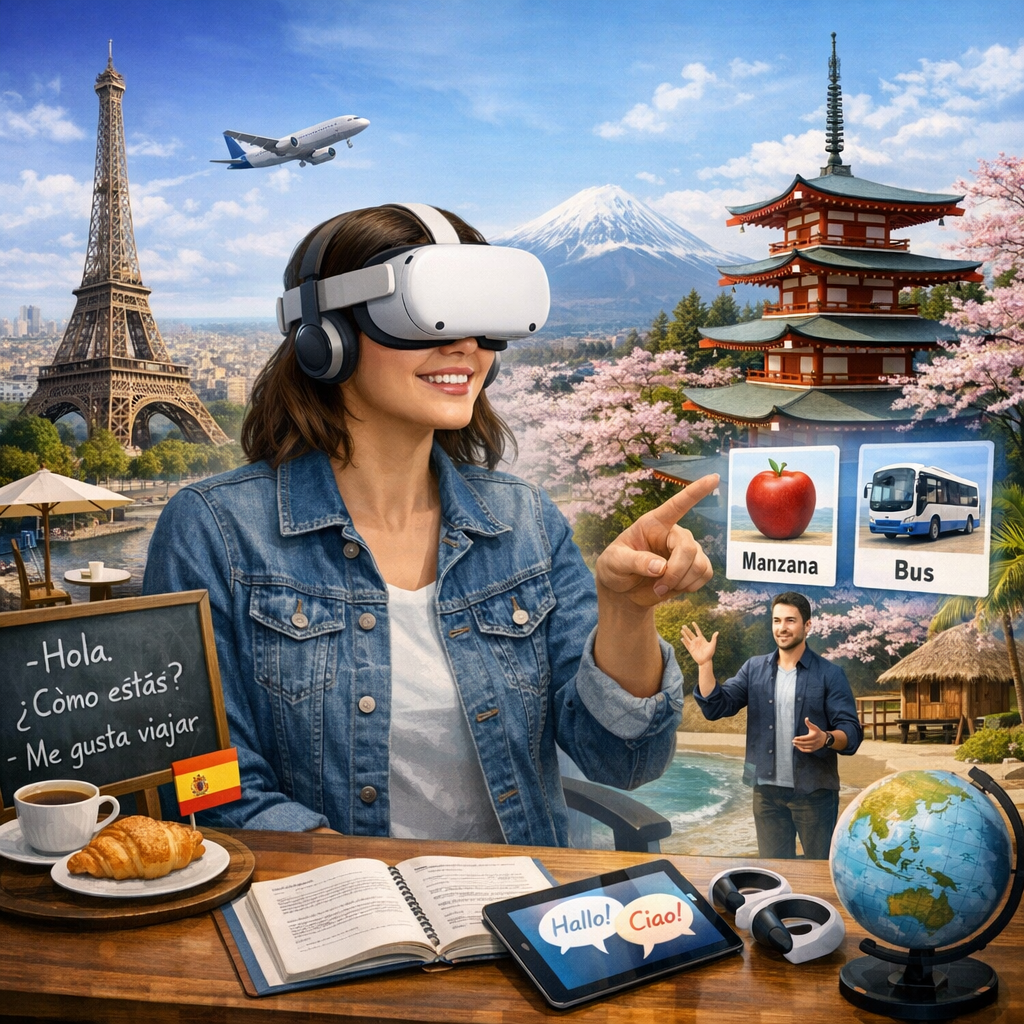
Virtual Reality Language Immersion: The Future of Language Learning
This course explores how immersive virtual reality (VR) is transforming language learning today and in the near future. You will examine the research evidence, leading platforms, AI-driven conversation agents, and design principles behind effective VR language immersion experiences.
The first lecture plays free — no account needed.
What you'll learn
- Students will be able to describe what immersive VR is and explain the concepts of immersion and presence in their own words.
- Students will understand the historical evolution of VR in language education and identify how HMD-based and AI-enhanced VR differ from earlier approaches.
- Students will be able to compare key features of VR language immersion with traditional classroom and mobile app language learning.
- Students will be able to summarize how communicative and task-based approaches map onto VR environments.
- Students will understand how embodied cognition and sensory immersion can support language acquisition, especially vocabulary and pragmatic skills.
- Students will be able to interpret key findings from recent studies on VR language learning (e.g., effects on achievement, motivation, and engagement).
- Students will be able to distinguish between dedicated VR language learning apps and general social VR platforms used for language practice.
- Students will understand different experience types (e.g., guided lessons, field trips, job interviews, informal meetups) and their pedagogical purposes.
- Students will be able to match sample learner profiles (e.g., child beginner, adult professional) to appropriate types of VR language experiences.
- Students will be able to outline the elements of an effective VR language task, including context, roles, goals, and target language.
Prerequisites
- definitions of VR, immersion, and presence
- VR language immersion vs. conventional classrooms and apps
- stages of VR in language education (2D, 3D desktop, HMD, AI-enhanced)
- recent empirical findings on VR language learning (high-level awareness)
- communicative language teaching and task-based learning in VR
- types of VR experiences for language learning
Course Content
9 modules · 2h 15m total
From Textbooks to Headsets: What Is VR Language Immersion?
Introduce the core ideas of immersive VR and how it differs from traditional and desktop-based language learning. Situate VR language immersion within the broader evolution of digital language education.
How VR Changes Language Learning: Theory and Evidence
Examine the main learning theories and recent research that explain why immersive VR can enhance language learning outcomes, motivation, and engagement.
Platforms and Experiences: Today’s VR Language Learning Ecosystem
Survey the current landscape of VR language learning tools and environments, from dedicated language platforms to social VR spaces and 360° experiences.
Inside the Headset: Core Design Principles for VR Language Immersion
Explore how to design effective VR language learning scenarios, focusing on interaction, feedback, and scaffolding that leverage immersion without overwhelming learners.
Talking to Avatars and AI: Speech Tech in VR Language Learning
Investigate how speech recognition, chatbots, and large language models are integrated into VR to enable real-time conversation practice and feedback.
Beyond Vocabulary: Pragmatics, Culture, and Social Communication in VR
Look at how VR can support not just words and grammar but also pragmatic language use, intercultural competence, and social communication skills.
Measuring What Matters: Assessment and Analytics in VR Language Learning
Examine how learner performance and progress can be assessed within VR, including both traditional language measures and new VR-specific indicators.
Access, Inclusion, and Ethics: Who Benefits from VR Language Immersion?
Consider accessibility, equity, and ethical issues around deploying VR language learning, including hardware access, safety, privacy, and inclusive design.
Designing the Future: Your Own VR Language Immersion Concept
Synthesize what you have learned by sketching a concept for a future-focused VR language immersion experience, integrating research-based design choices and emerging technologies.
Read the Textbook
Read every chapter for free, right here in your browser.
For decades, language learning mainly meant textbooks, worksheets, and classrooms. Then came CD-ROMs, websites, and mobile apps like Duolingo and Babbel. Today, we’re in a new phase: immersive Virtual Reality (VR) and AI-enhanced VR.
In this module, you’ll learn: What VR language immersion actually is What experts mean by immersion and presence How VR language learning evolved from 2D screens to 3D headsets How VR immersion compares to traditional classrooms and mobile apps
Time context: As of early 2026, consumer VR headsets like Meta Quest 3, Apple Vision Pro, and various PC VR headsets are widely used in education pilots and language-learning apps. AI-powered speaking partners and automatic feedback are now common features in experimental VR language platforms.
Study Flashcards
Key concepts from this course as flashcard pairs.
From Textbooks to Headsets: What Is VR Language Immersion?
Virtual Reality (VR)
A computer-generated 3D environment that you can experience from the inside, usually with a head-mounted display and controllers, allowing you to look and move around as if you were there.
Immersion
The technical and sensory intensity of the VR system—how fully it surrounds your senses and tracks your movements to create a convincing virtual world.
Presence
The subjective feeling of ‘being there’ in the virtual environment, even though you know it’s computer-generated.
HMD (Head-Mounted Display)
A headset worn on the head that shows separate images to each eye and often tracks head movement to create a 3D VR experience.
AI-Enhanced VR
VR experiences that integrate artificial intelligence (such as speech recognition and language models) to create interactive, adaptive characters and feedback.
VR Language Immersion
Using VR to place learners inside realistic, interactive situations where the target language is used naturally, encouraging active speaking, listening, and decision-making.
How VR Changes Language Learning: Theory and Evidence
Communicative Language Teaching (CLT)
An approach that prioritizes meaningful communication and the ability to use the language in real-life situations, focusing on interaction and negotiating meaning rather than just grammar drills.
Task-Based Language Teaching (TBLT)
An approach that organizes learning around tasks with real-world outcomes, where language is used as a tool to complete meaningful goals (e.g., planning a trip, solving a problem).
Embodied Cognition
A theory that suggests thinking and learning are deeply linked to bodily actions and sensory experiences, so moving, gesturing, and manipulating objects can support language acquisition.
Contextualized Learning
Learning that occurs within rich, meaningful situations where language is tied to specific settings, roles, and purposes, rather than decontextualized lists or isolated sentences.
Pragmatics
The study and practice of how language is used appropriately in social contexts, including politeness, formality, indirectness, and cultural norms.
Presence (in VR)
The subjective feeling of ‘being there’ in a virtual environment, often associated with higher immersion and engagement.
+1 more flashcards
Platforms and Experiences: Today’s VR Language Learning Ecosystem
Dedicated VR language platform
A VR app or service built specifically for language learning, with structured lessons, curricula, and often teacher tools (e.g., Mondly VR, Immerse, Noun Town).
Social VR platform
A general-purpose virtual world focused on social interaction and user-created spaces, not only language learning (e.g., VRChat, ENGAGE, Rec Room).
Metaverse space
A persistent, shared virtual environment where users interact as avatars. In language learning, it’s often used for informal practice and events.
Curriculum alignment (e.g., CEFR)
When a platform’s lessons are organized according to recognized proficiency frameworks (A1–C2), making progress easier to compare with traditional courses.
Scripted / guided VR lesson
A structured, pre-designed VR activity with clear steps, prompts, and feedback. Ideal for introducing or practicing specific language items in a controlled way.
Simulation (task-based scenario)
A VR activity that imitates real-world tasks (e.g., job interviews, hotel check-in) to build practical communicative skills and confidence.
+3 more flashcards
Inside the Headset: Core Design Principles for VR Language Immersion
Scenario (in VR language learning)
A structured situation combining context, roles, goals, and target language, implemented inside a virtual environment to create meaningful communication.
Interaction pattern
The way participants communicate in a task (e.g., learner–AI, peer-to-peer, learner–teacher), which shapes the type of language practice.
Scaffolding
Temporary support (prompts, cues, hints, structure) that helps learners perform tasks they could not yet do alone, gradually reduced as they gain competence.
Cognitive load
The total amount of mental effort required to process information and perform a task; in VR it includes language, controls, navigation, and sensory input.
Progression (task sequencing)
The planned increase in difficulty and complexity across tasks, often by reducing support, adding realism, or requiring more complex language.
Simulator sickness
Discomfort (nausea, dizziness, headache) some users feel in VR, often caused by mismatches between visual motion and body motion or overly intense environments.
Talking to Avatars and AI: Speech Tech in VR Language Learning
Automatic Speech Recognition (ASR)
Technology that converts spoken language into written text. In VR language learning, ASR powers speech-to-text, pronunciation scoring, and checks whether you said the target phrase.
Large Language Model (LLM)
A type of AI model trained on huge text datasets that can generate and understand human-like language. In VR, LLMs drive multi-turn dialogue, adapt difficulty, and provide feedback.
Latency
The delay between your action (speaking) and the system’s response. High latency breaks natural conversation flow; low latency feels more like real dialogue.
Multi-turn Dialogue
A conversation where the system remembers previous exchanges within the session and responds based on that context, instead of treating each sentence as isolated.
Affective Factors
Emotional and psychological elements (like anxiety, confidence, motivation) that influence language learning. VR avatars and AI design can raise or lower these factors.
Pronunciation Feedback
Information about how close your speech sounds are to a target model. In VR, this can be visual (color-coded words), audio (repetition), or textual explanations from an AI tutor.
+1 more flashcards
Beyond Vocabulary: Pragmatics, Culture, and Social Communication in VR
Pragmatic competence
The ability to use language appropriately in context, including politeness, turn-taking, register, and managing speech acts like requests, refusals, and apologies.
Intercultural competence
The ability to communicate effectively and appropriately with people from other cultural backgrounds, combining awareness, knowledge, skills, and attitudes like openness and curiosity.
Social presence
The feeling of being with real people in a digital environment; in VR, supported by avatars, spatial audio, shared tasks, and real-time interaction.
Speech act
An action performed through language, such as requesting, apologizing, inviting, refusing, or complimenting.
Register
The level of formality or style of language used in a specific context (e.g., casual vs formal speech).
Intercultural simulation in VR
A VR scenario that recreates social situations from different cultural contexts so learners can experience and practice alternative norms and communication styles.
Measuring What Matters: Assessment and Analytics in VR Language Learning
In-VR performance data
All the information a VR system can automatically capture **while you are inside the virtual environment**, such as speech logs, interaction patterns, task completion, gaze, and movement.
Formative assessment
Low-stakes assessment **during learning** that provides feedback to help learners improve, often embedded naturally in VR tasks.
Summative assessment
Higher-stakes assessment **after a learning period**, used to judge overall achievement (e.g., end-of-unit VR role-play exam).
Learning analytics dashboard
A visual interface that shows processed data about learning behavior and performance over time (graphs, charts, indicators) for teachers and/or students.
Data minimization
The ethical and often legal principle of collecting and storing **only the data that is necessary** for a clear purpose, especially important in data-rich VR environments.
Algorithmic bias
Systematic errors in automated systems (like speech scoring or analytics) that make them less accurate or fair for certain groups (e.g., specific accents or backgrounds).
Access, Inclusion, and Ethics: Who Benefits from VR Language Immersion?
Access (in VR language learning)
The ability of learners to actually use VR tools, including having suitable hardware, internet, physical space, time, and institutional support—not just theoretical availability.
Inclusive design
Designing VR experiences so that people with diverse abilities, ages, language levels, and neurotypes can participate meaningfully, often by providing options and flexibility.
Data minimization
An ethical and legal principle: collect and store only the personal data that is truly necessary for a specific purpose, and nothing extra.
Social VR harassment
Abusive or unwanted behavior in shared VR spaces, such as insults, slurs, stalking, or invasive avatar contact, which can feel very real and harmful to learners.
Developmentally appropriate design
Adjusting VR content, interaction, and safety features to match learners’ age and maturity, especially important for children and teens.
Accessibility features in VR
Tools and settings such as captions, adjustable text size, seated mode, reduced motion, simplified environments, and alternative input methods that make VR usable for more people.
Designing the Future: Your Own VR Language Immersion Concept
Task-based language learning (TBLT)
An approach where learners use language to complete meaningful tasks with clear outcomes (e.g., booking a hotel, solving a problem), focusing on communication first and form second.
Immersion / presence in VR
The feeling of “being there” in a virtual environment. High presence can increase engagement and authenticity of language use, but needs good design to avoid overload.
AI-driven agent
A virtual character or system powered by artificial intelligence (often large language models plus speech tech) that can interact with learners, adapt to their level, and provide feedback.
Analytics in VR learning
The collection and analysis of learner data (e.g., speaking time, gaze, task success, movement) to understand progress, personalize instruction, and improve design.
Mixed Reality (MR)
A form of extended reality where virtual content is layered onto the real world (often through passthrough video), allowing interaction with both real and virtual objects.
Inclusive design
Designing products and experiences so they are accessible and usable by people with a wide range of abilities, backgrounds, and contexts, rather than for an 'average' user only.
More in Technology
See all →
Defending at Machine Speed: AI-Accelerated Vulnerability Management

Reading the EU Cloud and AI Development Act

Operationalizing the NIST AI RMF and Generative AI Profile in Practice

CIPP/E Exam Prep: Mastering European Data Protection Law and the GDPR
ITIL 4 Foundation Exam Prep: Complete Syllabus, Exam-Focused