Skarp
Skarp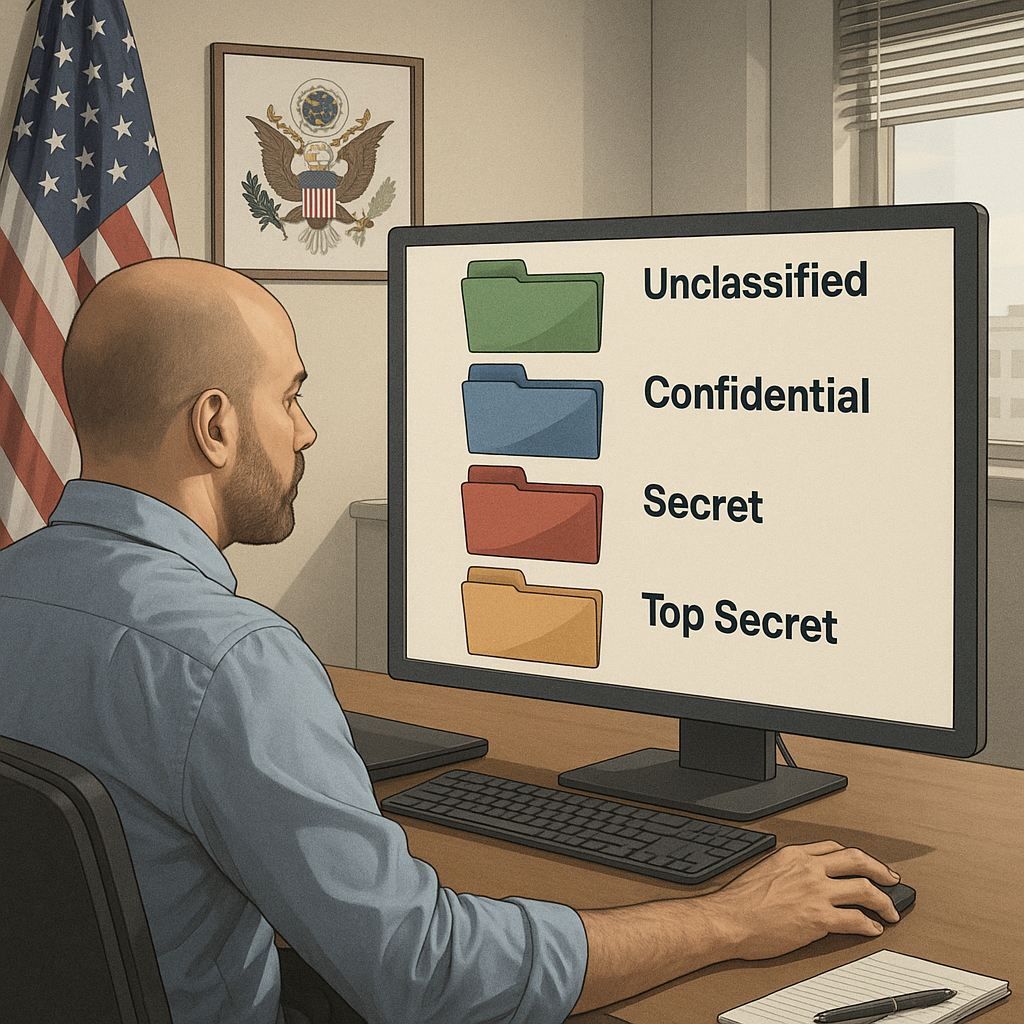
US Government Data Classifications for IT Service Providers
This course explains how the US government classifies information (from unclassified to Top Secret and CUI) and what that means in practice for IT service providers and contractors. You will learn the main classification schemes, key regulations, and how to align your services and controls with federal requirements.
The first lecture plays free — no account needed.
What you'll learn
- Students will be able to distinguish between national security classified information and unclassified but protected information used by civilian agencies.
- Students will understand how FISMA and NIST publications shape security expectations for federal agencies and their IT service providers.
- Students will be able to describe the three main national security classification levels and what they protect.
- Students will understand the difference between personnel clearance and system authorization, and why this matters when bidding on or supporting classified programs.
- Students will be able to define CUI and explain why the federal government standardized this category.
- Students will understand how CUI categories map to specific laws, regulations, and policies and why that matters for IT service design.
- Students will be able to explain how FIPS 199 impact levels relate to the sensitivity of federal information.
- Students will understand how NIST SP 800‑60 mappings guide which controls and architectures are appropriate for different kinds of federal data.
- Students will be able to summarize when and how NIST SP 800‑171 Rev. 3 applies to IT service providers handling CUI.
- Students will understand the main security families in SP 800‑171 Rev. 3 and the significance of the 2024 update for contractors and cloud providers.
Prerequisites
- National security vs. non‑national security information
- FISMA and the federal information security framework
- Overview of key NIST and FIPS documents
- Definition and purpose of CUI
- FIPS 199 impact levels
- NIST SP 800‑60 information types
Course Content
10 modules · 2h 20m total
Module 1: The US Federal Information Landscape
Introduce the main ways the US government categorizes and protects information, and where IT service providers fit into that ecosystem.
Module 2: National Security Classification Levels
Explain the traditional US classification system (Confidential, Secret, Top Secret) and why most IT service providers still need to understand it, even when handling only unclassified data.
Module 3: Controlled Unclassified Information (CUI) Basics
Introduce Controlled Unclassified Information (CUI), why it was created, and how it differs from both classified and general unclassified data.
Module 4: Impact Levels and Information Types (FIPS 199 & NIST SP 800‑60)
Connect data classification to impact levels and information types that drive technical and procedural safeguards for federal systems.
Module 5: NIST SP 800‑171 Rev. 3 – Core Requirements for CUI
Walk through the structure and intent of NIST SP 800‑171 Revision 3, the primary standard for protecting CUI in nonfederal systems used by IT service providers.
Module 6: Enhanced Protection – NIST SP 800‑172 and High‑Value CUI
Introduce the enhanced security requirements in NIST SP 800‑172 for critical programs and high‑value CUI assets, and when IT service providers may be expected to implement them.
Module 7: Contract Clauses – FAR, DFARS, and CUI Obligations
Translate data classification concepts into concrete contractual obligations for IT service providers under FAR, DFARS, and related rules.
Module 8: FedRAMP and Cloud Data Classifications
Explain how federal data classifications and impact levels map into FedRAMP requirements for cloud service providers and managed services built on cloud platforms.
Module 9: Practical Handling – Marking, Access, and Lifecycle of CUI
Provide a practical view of how CUI is marked, accessed, stored, transmitted, and disposed of in IT environments, and what controls IT service providers must support.
Module 10: Designing IT Services Around Federal Data Classifications
Bring all concepts together by showing how to design or adapt IT services, architectures, and processes to meet classification‑driven requirements, with a focus on CUI and moderate‑impact systems.
Read the Textbook
Read every chapter for free, right here in your browser.
In this module, you’ll map out the US federal information landscape and see where IT service providers (like cloud vendors, SaaS platforms, and integrators) fit.
Key idea: The US government separates information into two broad worlds: National security information Tied to defense, intelligence, and foreign relations. Can be classified (Confidential, Secret, Top Secret) under Executive Order (EO) 13526 and related directives. Non‑national security (civilian) information Used by most civilian agencies (e.g., HHS, DHS, IRS, EPA). Usually unclassified, but often still sensitive and protected (e.g., health data, tax records, PII).
Today’s focus is on how the federal government protects non‑national security information, especially under FISMA and NIST/FIPS standards, and what that means for contractors and cloud providers.
Study Flashcards
Key concepts from this course as flashcard pairs.
Module 1: The US Federal Information Landscape
FISMA (Federal Information Security Modernization Act)
US law (updated in 2014) that requires federal agencies to develop, document, and implement information security programs for systems they operate **and** systems operated on their behalf by contractors.
National security information
Information related to national defense or foreign relations that is classified under authority such as Executive Order 13526 (e.g., Confidential, Secret, Top Secret).
Unclassified but protected information
Information that is not classified but still sensitive and requires protection (e.g., PII, PHI, tax data, law enforcement data); often managed as **CUI** in modern policy.
CUI (Controlled Unclassified Information)
A category of unclassified information that requires safeguarding or dissemination controls under laws, regulations, and government‑wide policies, standardized by EO 13556 and 32 CFR Part 2002.
Nonfederal system
An information system that is not owned or operated by a federal agency but processes, stores, or transmits federal information or provides a service to a federal agency (e.g., contractor‑owned cloud systems).
FIPS 199
Federal standard that defines security categorization of federal information and information systems using impact levels (Low, Moderate, High) for confidentiality, integrity, and availability.
+3 more flashcards
Module 2: National Security Classification Levels
Executive Order 13526
The current (as of 2025) US Executive Order governing classified national security information. It defines the three classification levels (Confidential, Secret, Top Secret) and rules for classification, safeguarding, and declassification.
Confidential
The lowest national security classification level under EO 13526. Unauthorized disclosure could reasonably be expected to cause damage to national security.
Secret
A national security classification level under EO 13526. Unauthorized disclosure could reasonably be expected to cause serious damage to national security.
Top Secret
The highest national security classification level under EO 13526. Unauthorized disclosure could reasonably be expected to cause exceptionally grave damage to national security.
Sensitive Compartmented Information (SCI)
Information concerning or derived from intelligence sources, methods, or analytical processes, handled within special compartments. It is a set of control measures applied on top of a classification level (often Top Secret), not a separate level itself.
Special Access Program (SAP)
A program established for a specific class of classified information that imposes safeguarding and access requirements exceeding those normally required for the classification level. Can exist at Confidential, Secret, or Top Secret.
+4 more flashcards
Module 3: Controlled Unclassified Information (CUI) Basics
Controlled Unclassified Information (CUI)
Unclassified information that the federal government (or entities working for it) must handle using safeguarding or dissemination controls because specific laws, regulations, or government-wide policies require or permit such protection (32 CFR Part 2002).
CUI Registry
The official online catalog maintained by NARA/ISOO that lists CUI categories, their markings, descriptions, and the laws, regulations, or policies that authorize their protection.
CUI Basic vs CUI Specified
CUI Basic is subject only to the general CUI requirements. CUI Specified has additional, more detailed or stringent requirements defined by the underlying law, regulation, or government-wide policy.
FIPS 199 Moderate (for CUI confidentiality)
The minimum confidentiality impact level assumed for CUI. A compromise of CUI is treated as having at least a moderate adverse effect, driving moderate-level security controls.
Non-CUI Unclassified Information
Unclassified information that is not subject to CUI safeguarding or dissemination controls because no specific law, regulation, or government-wide policy requires such protection.
Relationship between CUI and Classified Information
CUI is unclassified and does not meet the national security damage test for classification, but still requires protection. Classified information is protected under national security classification rules (e.g., Confidential, Secret, Top Secret).
Module 4: Impact Levels and Information Types (FIPS 199 & NIST SP 800‑60)
FIPS 199
A federal standard that defines how to categorize information and information systems by assigning Low, Moderate, or High impact levels to confidentiality, integrity, and availability.
NIST SP 800‑60
NIST guidance that lists federal information types and provides typical Low/Moderate/High impact level mappings for confidentiality, integrity, and availability.
Confidentiality (FIPS 199)
The security objective that protects information from unauthorized disclosure. Loss of confidentiality means someone sees data they should not.
Integrity (FIPS 199)
The security objective that protects information from unauthorized or improper modification or destruction. Loss of integrity means data is corrupted, altered, or unreliable.
Availability (FIPS 199)
The security objective that ensures timely and reliable access to information and systems. Loss of availability means systems or data are not accessible when needed.
Low Impact
A loss of confidentiality, integrity, or availability could be expected to have a limited adverse effect on organizational operations, assets, individuals, or the nation.
+4 more flashcards
Module 5: NIST SP 800‑171 Rev. 3 – Core Requirements for CUI
NIST SP 800‑171 Rev. 3
The 2024 revision of NIST’s standard for protecting Controlled Unclassified Information (CUI) in **nonfederal systems and organizations**, widely used in contracts with IT and cloud providers.
Security Requirement Family
A group of related security requirements in SP 800‑171 (e.g., Access Control, Incident Response, Supply Chain Risk Management) that together support a particular security outcome.
Organization‑Defined Parameter (ODP)
A value that each organization must define for itself (e.g., time limits, frequencies, roles) within a SP 800‑171 requirement, based on its risk and environment.
Tailoring
The process of adapting SP 800‑171 requirements to a specific system or environment, including setting ODPs, choosing implementation approaches, and justifying any not‑applicable requirements.
Supply Chain Risk Management (SR)
A SP 800‑171 Rev. 3 family focused on identifying, assessing, and managing security risks introduced by suppliers, cloud providers, and other third parties that may affect CUI.
Module 6: Enhanced Protection – NIST SP 800‑172 and High‑Value CUI
NIST SP 800‑172
A NIST publication that provides **enhanced security requirements** for protecting CUI in nonfederal systems when facing **advanced persistent threats**, especially for **critical programs and high‑value assets**. It **supplements** SP 800‑171, not replaces it.
Advanced Persistent Threat (APT)
A **sophisticated, well‑resourced, and targeted** adversary that maintains long‑term access to systems, often using custom tools and multi‑stage attacks to compromise high‑value targets.
High‑Value Asset (HVA)
An information system or data set that is **critical to an agency’s mission or national interests**, where compromise would have **serious or catastrophic impact**. High‑value CUI in HVAs often triggers SP 800‑172 requirements.
Relationship: SP 800‑171 vs SP 800‑172
SP 800‑171 Rev. 3 defines the **baseline** for protecting CUI. SP 800‑172 adds **enhanced, APT‑focused controls** on top of that baseline for **selected high‑risk environments**.
Service Design for 800‑172
Designing IT services with capabilities like **segmented CUI enclaves**, **strong identity and access control**, **advanced monitoring and analytics**, and **mature incident response**, so they can meet enhanced CUI protection requirements when invoked.
Module 7: Contract Clauses – FAR, DFARS, and CUI Obligations
Federal Contract Information (FCI)
Information provided by or generated for the government under a contract that is not intended for public release. Typically triggers FAR 52.204‑21 basic safeguarding requirements.
Controlled Unclassified Information (CUI)
Unclassified information that requires safeguarding or dissemination controls under federal law, regulation, or government‑wide policy. Often protected under NIST SP 800‑171 via DFARS or FAR CUI clauses.
Covered Defense Information (CDI)
DoD term for certain CUI provided by DoD to the contractor or developed in performance of the contract that requires safeguarding. Central to DFARS 252.204‑7012.
FAR 52.204‑21
The Basic Safeguarding of Covered Contractor Information Systems clause. Imposes 15 baseline security requirements for systems that process, store, or transmit FCI.
DFARS 252.204‑7012
Safeguarding Covered Defense Information and Cyber Incident Reporting. Requires implementation of NIST SP 800‑171 for CDI and sets 72‑hour incident reporting and 90‑day log preservation requirements.
FAR CUI Clause (emerging)
A government‑wide FAR clause (under rulemaking as of late 2025) intended to require NIST SP 800‑171 Rev. 3 and standardized incident reporting for CUI across civilian agencies.
+2 more flashcards
Module 8: FedRAMP and Cloud Data Classifications
FedRAMP
The Federal Risk and Authorization Management Program – a government-wide program that standardizes security assessment, authorization, and continuous monitoring for cloud services used by U.S. federal agencies.
FIPS 199 Impact Levels
A standard for categorizing information systems as Low, Moderate, or High impact based on potential harm to confidentiality, integrity, and availability.
FedRAMP Low / Moderate / High Baselines
Standard sets of NIST SP 800‑53 controls tailored for cloud systems with Low, Moderate, or High FIPS 199 impact levels.
CUI (Controlled Unclassified Information)
Information that requires safeguarding or dissemination controls under laws, regulations, or government-wide policies, but is not classified under Executive Order 13526 or the Atomic Energy Act.
Shared Responsibility Model
The division of security responsibilities between the cloud service provider (infrastructure, core services) and the customer/integrator (configurations, data handling, application security).
3PAO (Third Party Assessment Organization)
An independent organization accredited to perform security assessments of cloud services for FedRAMP.
+1 more flashcards
Module 9: Practical Handling – Marking, Access, and Lifecycle of CUI
CUI Basic vs. CUI Specified
CUI Basic: Controlled by the general CUI rule and agency policies without additional specific requirements. CUI Specified: Has additional handling or dissemination requirements defined by a law, regulation, or government‑wide policy; often reflected in labels like CUI//SP-CTI or CUI//SP-EXPT.
Why markings matter for IT configuration
CUI markings (e.g., CUI, CUI//SP-CTI) drive technical controls such as access permissions, DLP rules, encryption requirements, and logging sensitivity. They tell systems *how* to protect the data.
Least privilege
A principle where users and processes are given only the minimum access necessary to perform their duties. For CUI, this means tightly scoped roles/groups and prompt removal of unused access.
Encryption at rest and in transit
At rest: Protects stored CUI on disks, databases, and backups (often using FIPS-validated crypto). In transit: Protects CUI moving across networks using protocols like TLS 1.2+ or VPNs.
CUI in backups and logs
CUI does not stop being CUI when copied to backups or logs. These must be encrypted, access‑controlled, and included in retention and disposal plans.
Media sanitization (NIST SP 800-88)
The process of rendering data on media irretrievable using methods like Clear (overwrite), Purge (e.g., cryptographic erase), or Destroy (physical destruction). Required when disposing of or repurposing media holding CUI.
+2 more flashcards
Module 10: Designing IT Services Around Federal Data Classifications
System Boundary
The set of system components (hardware, software, networks, people, locations) that are in scope for security controls and assessment for a particular system.
CUI (Controlled Unclassified Information)
Information that requires safeguarding or dissemination controls under U.S. law, regulation, or government‑wide policy, but is not classified under Executive Order 13526 or the Atomic Energy Act.
System Security Plan (SSP)
A comprehensive document that describes the system, its environment, and how each required security control is implemented, monitored, and maintained.
POA&M (Plan of Action and Milestones)
A formal document listing identified security weaknesses, planned remediation actions, milestones, due dates, and status tracking.
FedRAMP Moderate Baseline
A standardized set of security controls, based on NIST SP 800‑53 Rev. 5, required for cloud services used by federal agencies to process moderate‑impact data.
NIST SP 800-171 Rev. 3
NIST guidance specifying security requirements for protecting CUI in nonfederal systems and organizations, often applied to contractors.
+1 more flashcards
More in Technology
See all →
Defending at Machine Speed: AI-Accelerated Vulnerability Management

Reading the EU Cloud and AI Development Act

Operationalizing the NIST AI RMF and Generative AI Profile in Practice

CIPP/E Exam Prep: Mastering European Data Protection Law and the GDPR
ITIL 4 Foundation Exam Prep: Complete Syllabus, Exam-Focused