Skarp
Skarp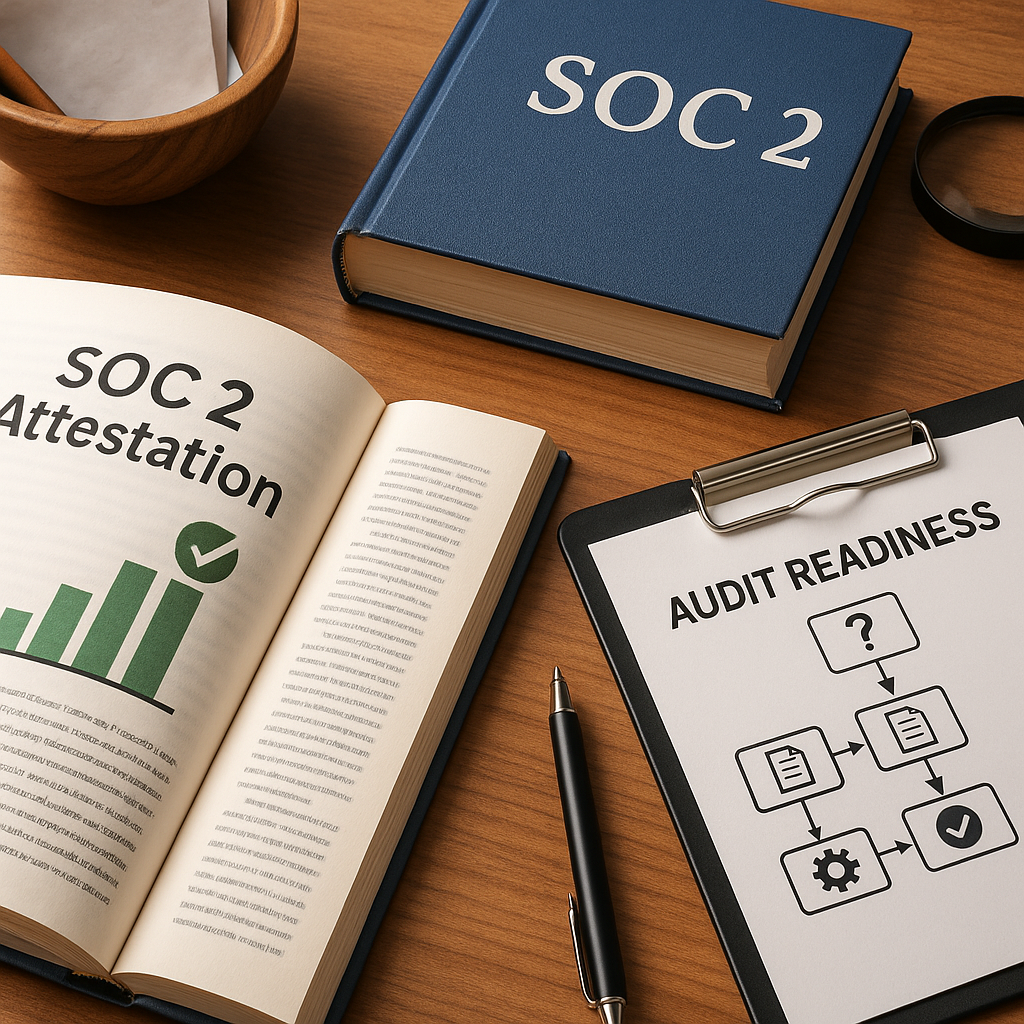
Understanding SOC 2 Attestations: From Basics to Audit Readiness
This course explains how SOC 2 attestations work, from what SOC 2 is and why it matters, through the Trust Services Criteria and control design, to how independent auditors perform SOC 2 Type I and Type II examinations and issue reports. You will learn the lifecycle of a SOC 2 engagement, key roles and documents, and how organizations prepare for, undergo, and maintain SOC 2 attestation over time.
The first lecture plays free — no account needed.
What you'll learn
- Students will be able to explain what SOC 2 is and who created the framework.
- Students will be able to distinguish SOC 2 from SOC 1 and SOC 3 at a high level.
- Students will understand why customers, regulators, and partners request SOC 2 reports.
- Students will be able to name and describe the five Trust Services Categories.
- Students will understand how the Trust Services Criteria drive control requirements in a SOC 2 engagement.
- Students will be able to explain why security (common criteria) is usually in scope for all SOC 2 reports.
- Students will be able to differentiate SOC 2 Type I and Type II and describe when each is appropriate.
- Students will understand the typical structure and content of a SOC 2 report.
- Students will be able to describe who is allowed to use a SOC 2 report and why it is generally restricted.
- Students will be able to describe what is meant by the “system” in a SOC 2 report.
Prerequisites
- SOC 2 framework and purpose
- Trust Services Criteria (TSC)
- SOC 2 Type I vs Type II
- Scoping a SOC 2 engagement
- Designing and implementing SOC 2 controls
- How auditors perform a SOC 2 examination
Course Content
8 modules · 2h total
What Is SOC 2 and Why Does It Matter?
Introduces SOC 2, its purpose, and how it fits into the broader ecosystem of security and compliance frameworks for service organizations.
Trust Services Criteria: The Backbone of SOC 2
Covers the AICPA Trust Services Criteria (TSC) that underpin SOC 2 examinations and how they relate to security, availability, processing integrity, confidentiality, and privacy.
SOC 2 Attestation Types and Report Structure
Explains the difference between SOC 2 Type I and Type II attestations and walks through the main sections of a SOC 2 report and what each audience cares about.
Scoping a SOC 2 Engagement and Defining the System
Focuses on how organizations and auditors define the scope of a SOC 2 examination, including system boundaries, services, locations, and relevant Trust Services Categories.
Designing and Implementing SOC 2 Controls
Covers how organizations translate Trust Services Criteria into concrete controls, policies, and procedures that will be evaluated during a SOC 2 examination.
How Auditors Perform a SOC 2 Examination
Explains the independent service auditor’s role, the attestation standards they follow, and how they gather and evaluate evidence to issue a SOC 2 opinion.
Inside the SOC 2 Report: Opinions, Findings, and Use
Walks through how to read and interpret a SOC 2 report, including the auditor’s opinion, description of tests and results, and how customers use the report for risk assessments.
Preparing for and Maintaining SOC 2 Attestation
Focuses on the practical lifecycle of SOC 2 compliance, including readiness assessments, remediation, annual examinations, and continuous monitoring.
Read the Textbook
Read every chapter for free, right here in your browser.
When organizations move to the cloud or outsource IT services, they are trusting another company with their data and operations. Customers, regulators, and partners need evidence that these service providers handle data securely and reliably.
This is where SOC reports come in.
What is SOC? SOC stands for System and Organization Controls. It is a reporting framework created and maintained by the AICPA (American Institute of Certified Public Accountants). SOC reports are issued by independent CPA firms (or equivalent licensed firms) after auditing a service organization.
Study Flashcards
Key concepts from this course as flashcard pairs.
What Is SOC 2 and Why Does It Matter?
SOC (System and Organization Controls)
An AICPA framework for reporting on controls at service organizations, including SOC 1, SOC 2, and SOC 3 reports.
SOC 2
An independent auditor’s report on a service organization’s controls relevant to the AICPA Trust Services Criteria (security, availability, processing integrity, confidentiality, privacy).
Trust Services Criteria (TSC)
AICPA criteria used in SOC 2 and SOC 3 engagements: Security (required), plus Availability, Processing Integrity, Confidentiality, and Privacy.
Service Organization
A company that provides services (often cloud or outsourced services) that can impact its customers’ data, operations, or financial reporting.
User Entity
An organization that uses the services of a service organization; it relies on SOC reports to evaluate the service provider’s controls.
SOC 2 Type I
A SOC 2 report that evaluates whether controls are suitably designed at a specific point in time.
+2 more flashcards
Trust Services Criteria: The Backbone of SOC 2
Trust Services Criteria (TSC)
AICPA-defined criteria that form the basis for SOC 2 examinations, organized into five categories: Security, Availability, Processing Integrity, Confidentiality, and Privacy.
Trust Services Categories
The five high-level areas covered by SOC 2: Security, Availability, Processing Integrity, Confidentiality, and Privacy.
Common Criteria (CC)
The core set of criteria that implement the Security category and apply across all SOC 2 engagements; they cover areas like control environment, risk assessment, access control, operations, and change management.
Control
A specific policy, process, or technical measure implemented by an organization to meet one or more Trust Services Criteria.
Availability (TSC)
Category focused on ensuring systems are available for operation and use as committed or agreed, including uptime, capacity, backups, and disaster recovery.
Processing Integrity (TSC)
Category focused on ensuring that system processing is complete, valid, accurate, timely, and authorized.
+2 more flashcards
SOC 2 Attestation Types and Report Structure
SOC 2 Type I
An attestation on the design of controls relevant to selected Trust Services Criteria **at a specific point in time** (e.g., “as of June 30, 2025”). Does not test operating effectiveness over a period.
SOC 2 Type II
An attestation on the design **and operating effectiveness** of controls over a **defined period** (commonly 6–12 months). Includes detailed tests of controls and results.
Restricted-use report
A report intended only for specified parties (e.g., service organization management, user entities, their auditors). SOC 2 reports are restricted-use because they contain sensitive, detailed information.
Independent Service Auditor’s Report
The section of the SOC 2 report where the CPA firm states the **scope**, **period**, and **opinion** (unmodified, qualified, etc.) on the controls examined.
System Description
The management-prepared section describing the services, system boundaries, infrastructure, software, people, procedures, data, and relevant aspects of the control environment.
Complementary User Entity Controls (CUECs)
Controls that **customers (user entities)** are expected to implement and operate for the service organization’s controls to achieve the stated objectives.
+1 more flashcards
Scoping a SOC 2 Engagement and Defining the System
System (in SOC 2 context)
The combination of services, processes, people, data, software, and infrastructure that are relevant to the services described in the SOC 2 report and to the selected Trust Services Categories.
System Boundary
The conceptual line that defines which components (people, processes, technology, data, locations) are included in the SOC 2 examination and which are excluded.
Subservice Organization (Subprocessor)
A third-party service provider that performs functions for the service organization and is relevant to the system and Trust Services Criteria (e.g., cloud provider, payment processor).
Carve-out Method
A method where the subservice organization is described in the SOC 2 report, but the auditor does not test its controls; instead, the report describes the complementary subservice organization controls the service organization implements.
Inclusive Method
A method where the subservice organization’s relevant controls are included and tested as part of the service organization’s SOC 2 examination.
Trust Services Categories (TSC)
The AICPA’s categories—Security (required), Availability, Processing Integrity, Confidentiality, and Privacy—used to organize control objectives and criteria in SOC 2.
+2 more flashcards
Designing and Implementing SOC 2 Controls
Control Design
Whether a control is appropriately designed, on paper, to address a specific risk and meet relevant Trust Services Criteria (TSC). Focuses on intent, structure, and documentation.
Control Operation
Whether a control actually functioned as designed over a defined review period (e.g., 6–12 months). Evaluated through evidence such as logs, tickets, and reports.
Trust Services Criteria (TSC)
AICPA-defined criteria for Security, Availability, Processing Integrity, Confidentiality, and Privacy that SOC 2 controls must address.
Complementary User Entity Controls (CUECs)
Controls that customers (user entities) must perform for the service organization’s controls to be effective. Listed as assumptions in SOC 2 reports.
Complementary Subservice Organization Controls
Controls performed by subservice organizations (e.g., cloud providers) that the service organization relies on to meet certain TSC. Often listed when the carve-out method is used.
Policy vs Procedure
A policy is a high-level rule approved by management; a procedure (or standard/runbook) is the detailed, step-by-step method for implementing the policy.
+1 more flashcards
How Auditors Perform a SOC 2 Examination
Independent service auditor
A CPA firm (and its engagement team) that performs the SOC 2 examination under AICPA attestation standards, independent of the service organization’s management.
AT-C Section 320
The AICPA attestation standard that specifically governs examinations of controls at a service organization relevant to the Trust Services Criteria (SOC 2).
Type 1 vs. Type 2 SOC 2 report
Type 1: Reports on the fairness of the system description and the suitability of control design at a point in time. Type 2: Includes Type 1 elements plus operating effectiveness of controls over a specified period.
Evidence collection methods
The main methods are inquiry, observation, inspection of documents/records, and reperformance of controls.
Sampling
Testing a subset of the full population of control instances to draw conclusions about the entire population, based on risk and materiality.
Exception / Deviation
A tested instance where the control did not operate as described. Auditors evaluate the frequency and severity of exceptions to decide their impact on conclusions and the SOC 2 opinion.
+1 more flashcards
Inside the SOC 2 Report: Opinions, Findings, and Use
Unmodified (Clean) Opinion
An auditor’s conclusion that, in their opinion, the description is fairly presented and controls were suitably designed (and, for Type II, operated effectively) in all material respects for the stated period.
Qualified Opinion
An opinion stating that, except for one or more specific material issues described in the report, the description and controls met the applicable criteria.
Adverse Opinion
An opinion stating that the description and/or controls did NOT meet the applicable criteria in all material respects, indicating significant, widespread issues.
Disclaimer of Opinion
A statement that the auditor does not express an opinion, usually because they could not obtain sufficient appropriate evidence to form a conclusion.
Type I vs. Type II SOC 2
Type I: Opinion on the fairness of the description and suitability of control design at a point in time. Type II: Opinion on description and control design AND operating effectiveness over a specified period.
Complementary User Entity Controls (CUECs)
Controls that the user organization (customer) is expected to implement for the service organization’s controls to achieve the Trust Services Criteria effectively.
+4 more flashcards
Preparing for and Maintaining SOC 2 Attestation
SOC 2 Readiness Assessment
A structured review of an organization’s existing controls, documentation, and practices against SOC 2 requirements to identify gaps before a formal examination.
Gap Analysis
The process of comparing current controls to the SOC 2 Trust Services Criteria to identify missing, weak, or undocumented controls.
Remediation Plan
A prioritized action plan that assigns owners and timelines to address control gaps and weaknesses identified during a readiness assessment.
Type I vs. Type II SOC 2
Type I: Opinion on the design of controls at a point in time. Type II: Opinion on the design and operating effectiveness of controls over a period (typically 6–12 months).
Continuous Monitoring
An approach where control status and key security configurations are automatically and regularly checked, rather than only reviewed during audit season.
Evidence Management
The practice of systematically collecting, organizing, storing, and labeling artifacts (logs, screenshots, tickets, reports) that demonstrate control operation.
+2 more flashcards
More in Business
See all →
Practical Ways to Make Money with AI (2026 Edition)

Entrepreneurship: From Idea to Startup Launch
Professional Scrum Master I (PSM I) Exam Power Prep
EU:s arbete med produktsäkerhet: institutioner, nätverk och standardisering (Cloned)

Cybersecurity That Sells: Building Trust in ICT Sales Pitches