Skarp
Skarp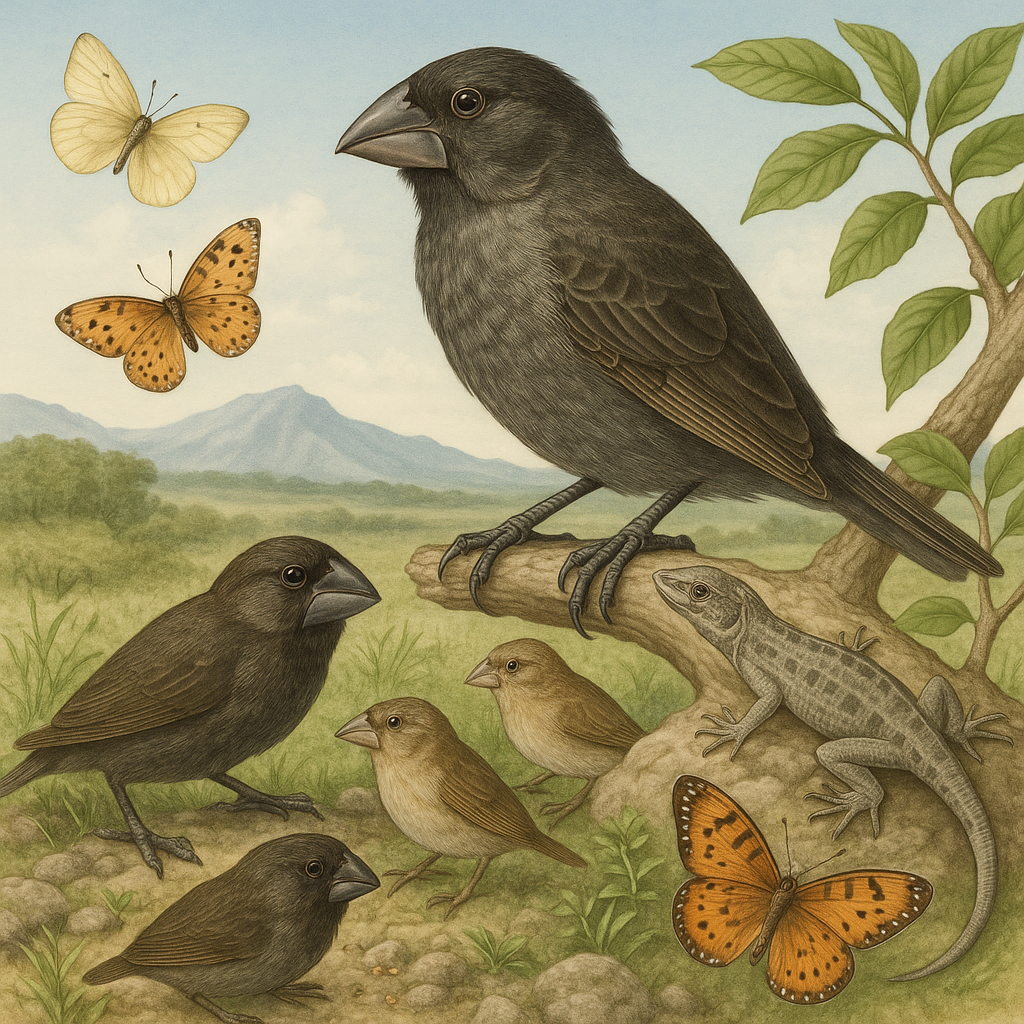
Understanding Evolution: How Natural Selection Shapes Life
This course gives you a clear, structured introduction to the theory of evolution and the mechanism of natural selection. You will learn how species change over time, how evidence from fossils, DNA, and living organisms supports evolution, and how natural selection operates in real-world examples, including recent research.
The first lecture plays free — no account needed.
What you'll learn
- Students will be able to define evolution as change in heritable traits of populations over generations.
- Students will understand the difference between changes in individuals and changes in populations.
- Students will be able to explain what is meant by species, trait, and variation with simple examples.
- Students will be able to list and describe the basic steps of natural selection: variation, selection, and inheritance over time.
- Students will understand the idea of fitness as reproductive success in a specific environment.
- Students will be able to explain how adaptations arise in populations without implying conscious choice or intention.
- Students will be able to describe genes and DNA in simple terms and explain their role in heredity.
- Students will understand that mutations and genetic recombination create new heritable variation in populations.
- Students will be able to connect genetic variation to the process of natural selection and adaptation.
- Students will be able to describe how the fossil record shows changes in life forms over long periods of time.
Prerequisites
- evolution as change in populations over time
- population vs individual
- species, trait, and variation
- evolution as change in heritable traits in populations
- variation in traits
- adaptation as a result of natural selection
Course Content
8 modules · 2h total
What Is Evolution? Big Ideas and Basic Terms
Introduce the core idea of biological evolution as change in populations over time and clarify key vocabulary needed for the rest of the course.
The Logic of Natural Selection: Variation to Adaptation
Explore how natural selection works step by step, from variation in traits to differences in survival and reproduction, leading to adaptation.
Genes, Mutations, and Heredity: The Raw Material of Evolution
Connect evolution to genetics by explaining how DNA, genes, and mutations create heritable variation that natural selection can act on.
Evidence for Evolution: Fossils, Bodies, and DNA
Survey the main lines of scientific evidence that support evolution, including fossils, comparative anatomy, and molecular data.
Speciation and the Tree of Life
Explain how new species form and how scientists represent evolutionary relationships using branching diagrams like phylogenetic trees.
Real-World Natural Selection: From Bacteria to Birds
Look at concrete case studies of natural selection in action, including antibiotic resistance, changing beak sizes in birds, and rapid evolution in response to human activity.
Human Evolution and Our Place in Nature
Introduce the main ideas and evidence about human evolution, including fossils, DNA evidence, and the relationship between humans and other primates.
Modern Evolutionary Science and Common Misconceptions
Summarize the modern understanding of evolution, clarify frequent misunderstandings, and briefly touch on current research directions in evolutionary biology.
Read the Textbook
Read every chapter for free, right here in your browser.
When scientists talk about biological evolution, they are not talking about one animal suddenly turning into another kind of animal.
Working definition (modern biology):
Evolution is a change in the heritable traits of a population over many generations.
Study Flashcards
Key concepts from this course as flashcard pairs.
What Is Evolution? Big Ideas and Basic Terms
Evolution
A change in the heritable traits of a population over many generations.
Population
A group of individuals of the same species living in the same area at the same time.
Species
A group of organisms that can interbreed in nature and produce fertile offspring (working definition for this course).
Trait
Any observable feature of an organism, such as eye color, height, or beak shape.
Heritable trait
A trait that can be passed from parents to offspring through genes (DNA).
Variation
Differences in traits among individuals in a population.
+1 more flashcards
The Logic of Natural Selection: Variation to Adaptation
Evolution (biological)
A change in the **genetic composition** or trait frequencies of a **population** over **generations**.
Natural selection
A process in which **heritable variation** in traits, combined with **differences in survival and reproduction** in a particular environment, leads to some traits becoming more common in a population over time.
Variation
Differences among individuals in a population in traits such as morphology, behavior, or physiology; some of this variation is **heritable**.
Fitness (evolutionary)
An individual's **relative reproductive success**: how many **viable, fertile offspring** it leaves compared with others in the same population and environment.
Adaptation
A **heritable trait** that increases an organism's **fitness in a specific environment**, and that became common in the population through **natural selection**.
Heritable trait
A trait that is influenced by genes and can be **passed from parents to offspring**, allowing natural selection to change its frequency over generations.
+1 more flashcards
Genes, Mutations, and Heredity: The Raw Material of Evolution
DNA
Deoxyribonucleic acid; the molecule that stores hereditary information in almost all living organisms. Its sequence of bases (A, T, C, G) encodes genetic instructions.
Gene
A specific segment of DNA that contains instructions for making a functional product (usually a protein), influencing one or more traits.
Allele
A different version of the same gene, with a slightly different DNA sequence that can produce variation in a trait.
Mutation
A change in the DNA sequence. Mutations create new alleles and are the ultimate source of new genetic variation.
Recombination
The process during sexual reproduction where paired chromosomes exchange segments, creating new combinations of alleles in offspring.
Heritable (Hereditary)
Describes a trait or variation that can be passed from parents to offspring through genes.
+2 more flashcards
Evidence for Evolution: Fossils, Bodies, and DNA
Fossil record
The ordered collection of fossils in rock layers, showing changes in life forms and the appearance and extinction of species over geological time.
Transitional fossil
A fossil that shows a mix of traits from older and newer groups in a lineage, illustrating step-by-step evolutionary change.
Homologous structures
Body parts that share a common evolutionary origin and underlying structure, even if they now have different functions (e.g., vertebrate forelimbs).
Analogous structures
Body parts with similar functions that evolved independently in different lineages, not from a common ancestral structure (e.g., bird wings and insect wings).
Convergent evolution
The independent evolution of similar traits in unrelated lineages due to similar environmental pressures or lifestyles.
Vestigial structure
A reduced or remnant structure that has lost much of its original function but remains as evidence of an organism’s evolutionary history (e.g., human tailbone).
+4 more flashcards
Speciation and the Tree of Life
Speciation
The process by which one ancestral species splits into two or more new species, usually after populations become reproductively isolated and diverge over time.
Reproductive isolation
A situation in which populations do not exchange genes (or do so very rarely) because of barriers such as geography, behavior, timing, or incompatibility, preventing successful interbreeding.
Common ancestor
An ancestral organism or population from which two or more descendant species evolved.
Phylogenetic tree
A branching diagram that represents hypotheses about evolutionary relationships among species or groups, based on evidence such as fossils, anatomy, and DNA.
Tree of Life
The overall phylogenetic tree that represents the evolutionary relationships among all living and extinct organisms.
Allopatric speciation
Speciation that occurs when populations are geographically separated and evolve independently until they become distinct species.
Real-World Natural Selection: From Bacteria to Birds
Natural selection
A process where individuals with traits better suited to their environment tend to survive and reproduce more, causing those traits to become more common over generations.
Selection pressure
Any factor in the environment that affects which individuals survive and reproduce, such as antibiotics, drought, predators, or pollution.
Antibiotic resistance
The ability of bacteria to survive and grow in the presence of an antibiotic dose that used to kill them, often due to specific genetic changes.
Pesticide resistance
An inherited ability of some insects (or other pests) to survive doses of a pesticide that would normally be lethal, leading to reduced effectiveness of the chemical.
Trait
Any observable characteristic of an organism, such as beak size, color, or enzyme structure, which can be influenced by genes and the environment.
Rapid evolution
Noticeable evolutionary change occurring over relatively few generations, often observed in organisms with short generation times or under strong selection pressures.
Human Evolution and Our Place in Nature
Common ancestor
An earlier species from which two or more later species evolved. Humans and chimpanzees share a common ancestor that is now extinct.
Primates
An order of mammals that includes lemurs, monkeys, apes, and humans, usually with forward-facing eyes, grasping hands, and relatively large brains.
Apes (Hominoids)
A group of primates that includes gibbons, orangutans, gorillas, chimpanzees, bonobos, and humans. Apes generally have no tails and larger brains for their body size.
Hominins
The group that includes modern humans and all species more closely related to us than to chimpanzees, such as Australopithecus and earlier Homo species.
Bipedalism
Walking on two legs as the main way of moving. A key feature of hominins, appearing in fossils millions of years before very large brains.
Neanderthals
An extinct human species (*Homo neanderthalensis*) that lived in Eurasia and interbred with modern humans. Many people today carry small amounts of Neanderthal DNA.
+2 more flashcards
Modern Evolutionary Science and Common Misconceptions
Modern evolutionary synthesis
The integrated framework that combines Darwin’s natural selection with Mendelian genetics and later population genetics, explaining evolution as changes in allele frequencies driven by selection, mutation, drift, and gene flow.
Allele
A different version of a gene. Evolution tracks changes in the frequencies of alleles in a population over generations.
Natural selection
The non-random process where individuals with heritable traits better suited to their environment tend to survive and reproduce more, causing those traits (and the alleles behind them) to become more common.
Genetic drift
Random changes in allele frequencies, especially strong in small populations, caused by chance events (like which individuals happen to reproduce or survive a disaster).
Mutation
A change in DNA sequence. Mutations introduce new genetic variation; they occur without regard to whether they are beneficial, harmful, or neutral.
Gene flow
The movement of alleles between populations, usually through migration and interbreeding.
+3 more flashcards
More in Science
See all →
Chemische Grundlagen für die Biotechnologie: Von Atomen zu Biomolekülen
Quantum Mechanics Mastery: From Foundations to Modern Frontiers
How the Human Brain Works: A Guided Tour of Your Mind
BIO 204: Fundamentals of Scientific Inquiry in the Biological Sciences
BCH 204 Essentials: Structure, Properties, and Functions of the 20 Amino Acids