Skarp
Skarp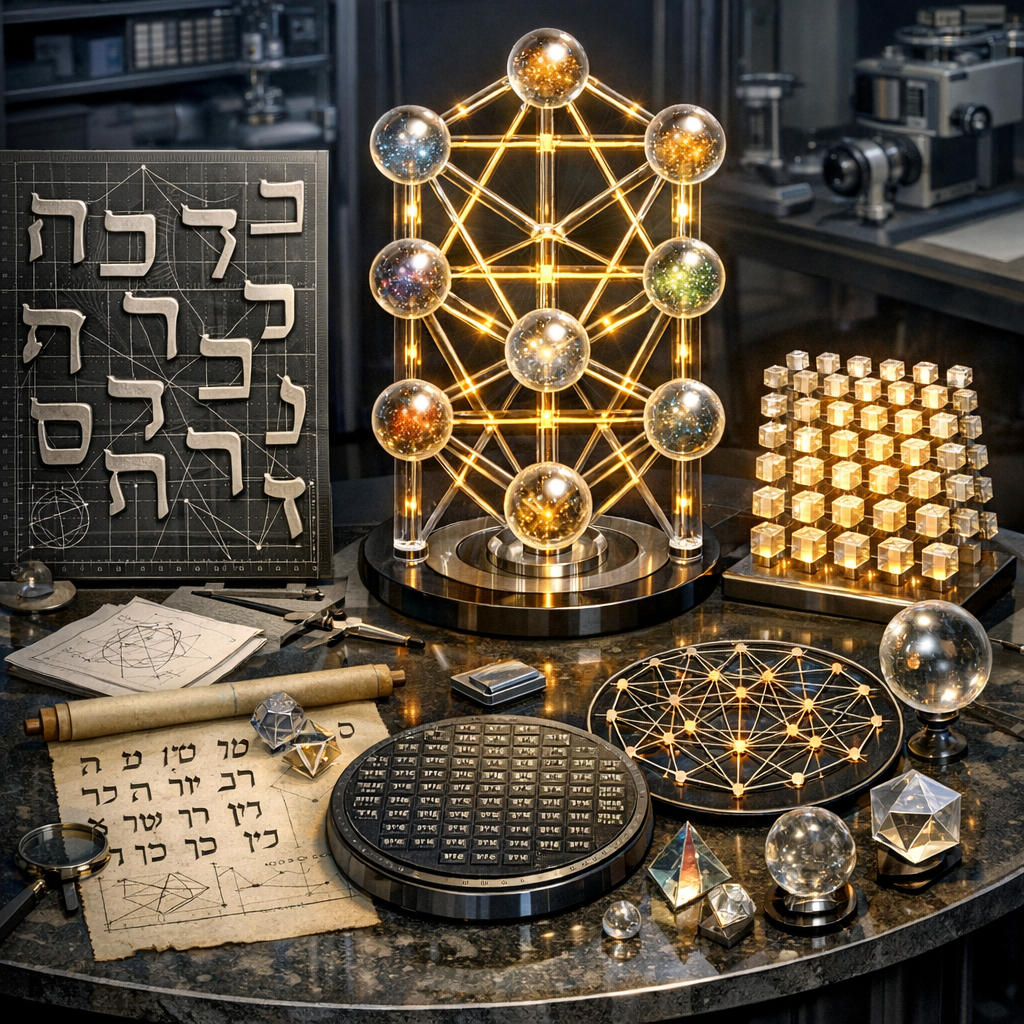
Transcendent Architectures: Formal Models of Hebrew Letters, Sefirot, 72 Names & the 231 Gates
An ultra-advanced lab-course for mathematically literate Kabbalah practitioners who want to formalize the Tree of Life, 22-letter dynamics, the 72 Names lattice, and the 231 Gates graph using combinatorics, graph theory, and information theory. Working from classical sources as data, you will design, encode, and iteratively refine your own symbolic–mathematical system for these architectures.
The first lecture plays free — no account needed.
What you'll learn
- Students will be able to restate the Tree of Life as a finite labeled graph with an explicit node and edge set.
- Students will understand how different historical diagrams correspond to distinct graph isomorphism classes and labeling conventions.
- Students will be able to represent the 22 Hebrew letters as an indexed set with chosen structural properties (e.g., partition into classes, adjacency relation).
- Students will understand how different choices of letter metrics or adjacency induce different combinatorial and graphical behaviors.
- Students will be able to derive the 231 Gates as combinations or permutations of 22 letters and formally specify which combinatorial convention they adopt.
- Students will understand how different gate conventions (ordered/ unordered, directed/undirected) correspond to different graph models (e.g., K_22 variants).
- Students will be able to encode a chosen Tree of Life variant as an adjacency matrix and identify its basic graph-theoretic properties.
- Students will understand when to extend beyond simple graphs to multigraphs or hypergraphs to model multi-letter interactions or higher-order relations.
- Students will be able to formalize at least one historical letter–path assignment as a function from letters to edges of a specific Tree of Life graph.
- Students will understand how changing the letter–path assignment alters symmetry, distance metrics, and possible interpretations on the graph.
Prerequisites
- Tree of Life as a graph (nodes, edges, labels)
- Hebrew alphabet as an ordered finite set
- Basic combinatorics (combinations and permutations)
- Combinatorial derivation of 231 from 22 letters
- Graph types and adjacency matrices for the Tree of Life
- 72 Names as length‑3 sequences over a 22‑letter alphabet
Course Content
11 modules · 2h 45m total
From Mystical Diagram to Mathematical Object
The familiar Tree of Life diagram suddenly becomes a formal graph: ten (or eleven) nodes, twenty‑two edges, and a space of possible mappings that few ever write down explicitly. This opening session reframes classical Kabbalistic structures as mathematical objects you can rigorously manipulate.
Hebrew Letters as a Finite Alphabet and State Space
Twenty‑two letters stop being mere symbols and become a finite alphabet with ordering, metrics, and operations. In this module, the alef‑bet turns into a structured state space that can drive combinatorial and dynamical models.
Combinatorics of the 231 Gates
The enigmatic 231 Gates resolve into a clean combinatorial count, yet the modeling choices behind them are anything but trivial. This module dissects ordered vs. unordered pairs, directionality, and the geometry of arranging 22 letters around a circle.
Graph-Theoretic Architectures: Trees, Lattices, and Hypergraphs
Beneath the poetic language of emanations lies a zoo of possible graph structures: trees, lattices, cliques, and higher‑order relations. Here, you select and formalize the architectures that best capture your reading of the classical sources.
Encoding the 22 Paths: Letter–Edge Correspondence Schemes
The mysterious assignment of letters to paths becomes a design space of correspondence schemes. This module walks through classical assignments and then invites you to formalize and critique your own mapping rules.
72 Names as Sequences, Codes, and Lattices
The 72 Names unfold from three verses into a combinatorial object: a set of fixed‑length sequences over a 22‑letter alphabet with internal structure. You will treat the Shem ha‑Mephorash as a code, a lattice, and a dataset for modeling.
Information-Theoretic Views of Names, Paths, and Gates
Divine names and letter‑gates become channels, codes, and constraints: where does information concentrate, and how redundant is the system? This module introduces entropy, mutual information, and constraint networks as tools for reading Kabbalistic structures.
Dynamic Processes on the Tree: Walks, Flows, and Transformations
Instead of static diagrams, the Tree becomes a state machine where awareness, influence, or ‘light’ traverses paths according to rules. You will specify update rules and study walks, flows, and transformations along your graph.
Comparing Alternative Trees, Alphabets, and Gate Systems
Multiple Trees of Life, letter orders, and gate conventions compete for primacy. This module turns that plurality into a feature, offering you tools to compare and classify entire families of models instead of chasing a single ‘true’ diagram.
Designing Your Personal Symbolic–Mathematical System
All prior work culminates in a deliberate act of system‑building: you will specify, justify, and document your own transcendent architecture, integrating letters, sefirot, gates, and Names into a coherent formalism.
Extending into Computation: Algorithms and Experiments
The final module invites you to treat your system as code: something that can be implemented, queried, and experimented with. Even without full programming, you will sketch algorithms and potential computational explorations of your architecture.
Read the Textbook
Read every chapter for free, right here in your browser.
In this module, you will treat the Kabbalistic Tree of Life not as a mystical picture, but as a mathematical object.
We will: Rephrase the Tree of Life as a finite labeled graph. Identify nodes (vertices) and edges explicitly. Notice that different historical diagrams correspond to different graphs or labelings.
By the end, you should be able to: Write down a node set and edge set for a standard Tree of Life. Say clearly what changes when you switch to another historical layout.
Study Flashcards
Key concepts from this course as flashcard pairs.
From Mystical Diagram to Mathematical Object
Graph (in this module)
A finite, undirected, simple graph G = (V, E), where V is a set of vertices (sefirot) and E is a set of edges (paths between sefirot).
Vertex labeling
A function ℓ_V that assigns a label (e.g., a sefirah name) to each vertex in V.
Edge labeling
A function ℓ_E that assigns a label (e.g., a Hebrew letter or Tarot trump) to each edge in E.
Graph isomorphism
A bijection between vertex sets that preserves adjacency: two graphs have the same connection pattern up to renaming of vertices.
Tree of Life as a graph
A representation where each sefirah is a vertex, each path is an edge, and traditional names or symbols are captured as labels on vertices and edges.
Historical Tree variants
Different diagrams across time that may share the same underlying graph (same V and E) or differ in edges and labelings, leading to distinct graph isomorphism classes.
Hebrew Letters as a Finite Alphabet and State Space
Finite alphabet (in this module)
A finite set A of 22 elements representing the Hebrew letters, typically equipped with an ordering, indices, and possibly extra structure such as partitions and adjacency.
Index function
A mapping index: A → {1,...,22} assigning each letter a position in an ordered list, enabling successor/predecessor operations.
Partition into classes
A division of A into disjoint subsets whose union is A. Here: mothers, doubles, and simples based on Sefer Yetzirah.
Adjacency relation
A set E of unordered pairs of letters indicating which letters are considered neighbors, turning (A, E) into a graph.
Metric on letters
A distance function d: A × A → ℝ≥0 satisfying non-negativity, identity of indiscernibles, symmetry, and the triangle inequality.
Cyclic order on the alphabet
An ordering where the last letter is considered adjacent to the first, forming a 22-state cycle useful for circular dynamics.
Combinatorics of the 231 Gates
231 Gates (modern combinatorial view)
The 231 unordered pairs of distinct letters from a 22-letter alphabet; mathematically, the 2-element subsets of a 22-element set, counted by C(22, 2) = 231.
Combination C(n, 2)
The number of unordered pairs from n distinct objects with no repetition: C(n, 2) = n(n - 1) / 2.
Permutation P(n, 2)
The number of ordered pairs from n distinct objects with no repetition: P(n, 2) = n(n - 1). For 22 letters, P(22, 2) = 462.
K_22
The complete simple undirected graph on 22 vertices. It has an edge between every pair of distinct vertices, for a total of C(22, 2) = 231 edges.
Complete directed graph (without loops)
A directed graph where for every pair of distinct vertices x, y there are arrows x → y and y → x. For 22 vertices, it has 22 * 21 = 462 directed edges.
Unordered vs. ordered gate
Unordered: {x, y} = {y, x}, modeled as an undirected edge. Ordered: (x, y) ≠ (y, x), modeled as a directed edge (arrow) from x to y.
Graph-Theoretic Architectures: Trees, Lattices, and Hypergraphs
Tree (graph theory)
A connected simple graph with no cycles; between any two vertices there is exactly one simple path.
Clique
A subset of vertices in which every pair of distinct vertices is connected by an edge (a fully connected subgraph).
Lattice (order theory)
A partially ordered set where any two elements have a unique meet (greatest lower bound) and join (least upper bound), often visualized by a Hasse diagram.
Multigraph
A graph that allows multiple edges between the same pair of vertices and sometimes loops, used when there are several distinct relations between the same two nodes.
Hypergraph
A generalization of a graph where hyperedges can connect any number of vertices, suitable for modeling higher-order relations such as triples or larger sets.
Adjacency matrix
An n×n matrix A for a graph with n vertices, where A[i,j]=1 if there is an edge between vertices i and j, and 0 otherwise; symmetric for undirected simple graphs.
+2 more flashcards
Encoding the 22 Paths: Letter–Edge Correspondence Schemes
Letter–edge correspondence scheme
A bijection f from the 22 Hebrew letters to the 22 edges of a fixed Tree of Life graph, possibly subject to extra structural constraints.
Mother, double, simple letters
The Sefer Yetzirah classification of Hebrew letters into 3 mothers, 7 doubles, and 12 simples; many schemes map these classes to distinct edge subsets.
Pillar constraint
A rule that restricts which letters may appear on edges belonging to the left, middle, or right pillar of the Tree.
Graph distance between letters
A distance defined by mapping letters to edges via f and measuring the shortest path between those edges in the Tree graph.
Symmetry (automorphism) of the Tree
A structure-preserving map (like a left–right flip) of the Tree graph to itself; used to analyze whether letter placements are central or paired.
72 Names as Sequences, Codes, and Lattices
Alphabet A (in this module)
The 22‑letter Hebrew consonantal alphabet, abstracted as a finite symbol set {a1, ..., a22}. Only the cardinality and distinctness of symbols matter for the combinatorics.
72 Names (Shem ha‑Mephorash)
A classical set of 72 three‑letter sequences derived from Exodus 14:19–21 by arranging the verses in alternating directions and reading columns top to bottom.
Code (subset of A^n)
A set C of fixed‑length sequences (codewords) drawn from the ambient space A^n. Here, the 72 Names form a code C ⊆ A^3.
Hamming Distance
A metric on fixed‑length sequences that counts the number of positions where two sequences differ. Used to define similarity and neighborhoods among names.
Neighborhood (radius‑1)
For a codeword x, the set of codewords y such that the Hamming distance d_H(x, y) is at most 1. Often used to define adjacency in a graph.
Lattice / Ordered Structure on A^3
A view of A^3 where an order is imposed on A and extended coordinatewise, giving a finite lattice in which the 72 Names occupy specific positions.
Information-Theoretic Views of Names, Paths, and Gates
Entropy (H)
A quantitative measure of average uncertainty in a random variable, defined as H(X) = − Σ p(x) log₂ p(x). Higher entropy means more unpredictability.
Redundancy (R)
A measure of how much structure or constraint a system has, often defined as R = 1 − H/H_max. High redundancy means many potential patterns are ruled out.
Mutual Information (I)
A measure of how much knowing one variable reduces uncertainty about another: I(X;Y) = H(X) + H(Y) − H(X,Y). Zero if variables are independent.
Codeword
A fixed-length sequence of symbols from an alphabet used to represent information. In this context, a divine Name or letter-triplet is treated as a codeword.
Constraint Network
A graph-like model with variables, domains, and rules (constraints) that restrict allowed combinations. Used here to model relations among letters, sefirot, and paths.
Channel (symbolic channel)
An abstract mapping from input states (e.g., intentions or sefirot) to outputs (Names or letter patterns). Information theory analyzes how well the channel distinguishes states.
Dynamic Processes on the Tree: Walks, Flows, and Transformations
State (in this module)
A description of where light/awareness is on the Tree at a given time. It can be a single sefirah (single-particle state) or a distribution of weights over all sefirot.
Deterministic walk
A process on the Tree where the next state is completely determined by the current state via a fixed rule (no randomness).
Random walk / Markov chain
A process where, from each sefirah, the next sefirah is chosen randomly according to specified transition probabilities that depend only on the current node.
Transition probability
The probability of moving from one sefirah to another (or staying put) in a single time step; probabilities from a node must sum to 1.
Ascent (Aliyah) as dynamics
A trajectory on the Tree, typically biased or directed from lower sefirot like Malkhut toward higher ones like Keter over time.
Descent (Yeridah) as dynamics
A trajectory moving from higher to lower sefirot, modeling withdrawal, contraction, or descent as part of a larger process.
+2 more flashcards
Comparing Alternative Trees, Alphabets, and Gate Systems
Model family
A set of related models that share some structural features (e.g., same graph or alphabet) but differ in others (e.g., labeling or gate rules).
Graph isomorphism
A one-to-one renaming of nodes that preserves adjacency; two graphs are isomorphic if they have the same structure up to relabeling of nodes.
Labeled graph isomorphism
An isomorphism that preserves both adjacency and labels on nodes or edges; required for two labeled Trees to count as the same model.
Invariant
A property that does not change under isomorphism, such as number of nodes, degree sequence, or shortest-path distances.
Gate system
A set of combinatorial rules that specify which symbol-pairs or transitions are allowed, often interpreted as constraints on walks or strings.
Textual adherence
The degree to which a model respects constraints and associations found in historical or canonical texts.
+2 more flashcards
Designing Your Personal Symbolic–Mathematical System
Graph (in this module)
A set of nodes (e.g., sefirot) and edges (gates) forming the structural skeleton of your system; often a Tree of Life variant, but can be any explicit network.
Gate
A connection (edge) between two nodes, usually labeled by a letter and associated with a transformation rule on some internal state.
Name
A sequence of letters interpreted as a path or operation on the graph, with a net effect on the internal state after traversing its letters.
Internal consistency
The property that all definitions and rules in your system fit together without contradiction and can be applied predictably.
Refinement
The iterative process of adjusting nodes, edges, mappings, and rules to reduce contradictions, redundancies, and unnecessary complexity.
Extending into Computation: Algorithms and Experiments
Data structure
A precise way to organize and store information (such as letters, sefirot, gates, Names) so that algorithms can operate on it.
Algorithm
A step-by-step, finite procedure for accomplishing a task, such as generating all gates or finding all paths between two sefirot.
Enumeration
Systematically listing all objects of a certain kind (e.g., all gates, all Names of a fixed length, all simple paths on the Tree).
Random walk
A path formed by repeatedly moving from the current node to a randomly chosen neighboring node, used to explore the dynamics of a graph.
Depth-first search (DFS)
A graph traversal method that explores as far as possible along each branch before backtracking, useful for finding all simple paths.
Visualization
A graphical representation (such as a plotted Tree with highlighted paths) that makes structures and patterns in your formal system easier to see.
More in Science
See all →
Chemische Grundlagen für die Biotechnologie: Von Atomen zu Biomolekülen

Quantum Mechanics Mastery: From Foundations to Modern Frontiers

How the Human Brain Works: A Guided Tour of Your Mind

BIO 204: Fundamentals of Scientific Inquiry in the Biological Sciences
BCH 204 Essentials: Structure, Properties, and Functions of the 20 Amino Acids