Skarp
Skarp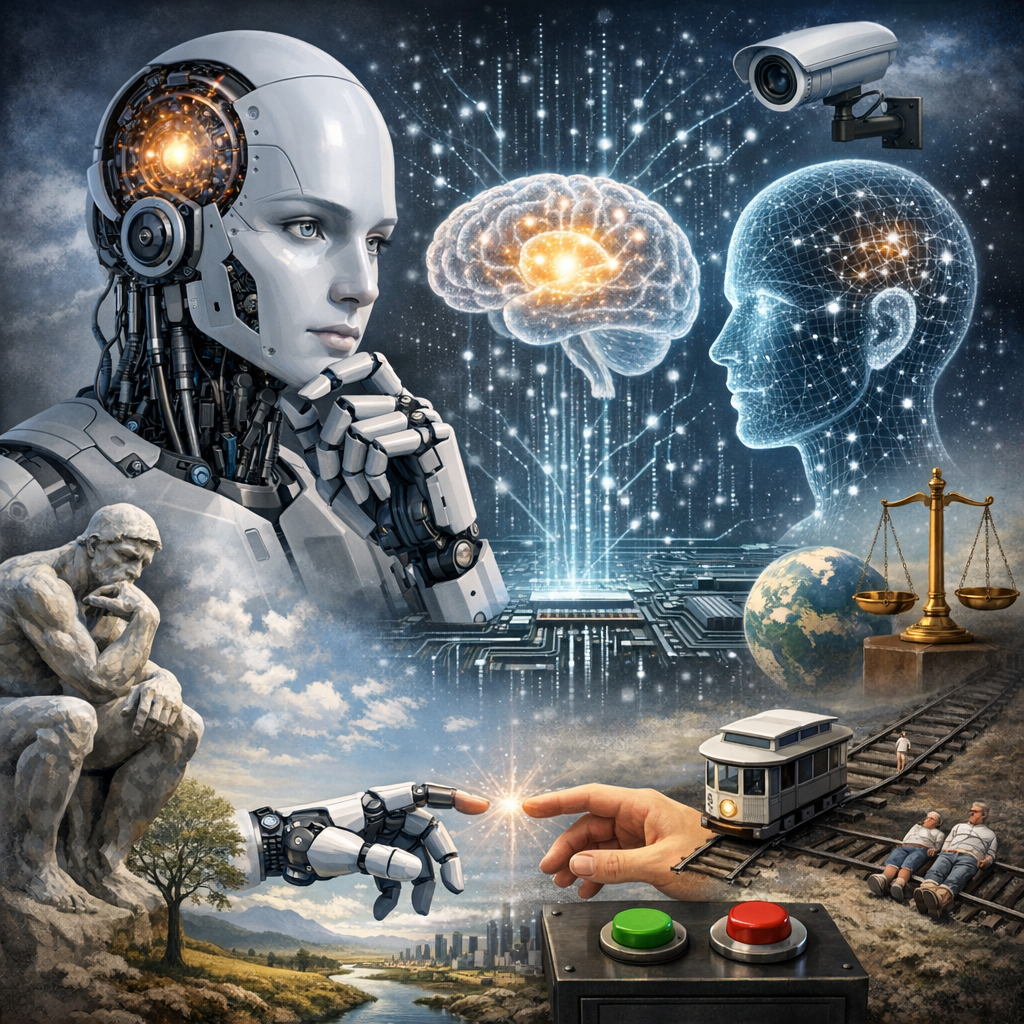
Thinking Machines: Philosophy, Consciousness, and the Ethics of AI
This course examines the deepest philosophical questions raised by artificial intelligence: whether machines can think or be conscious, and who bears moral responsibility when AI systems act in the world. Through classic arguments like the Turing Test and Searle’s Chinese Room, alongside cutting-edge debates and emerging AI regulations, learners will develop a rigorous framework for understanding and evaluating intelligent machines.
The first lecture plays free — no account needed.
What you'll learn
- Students will be able to distinguish between technical AI research and the philosophy of artificial intelligence.
- Students will understand how AI raises questions about mind, consciousness, and moral responsibility that go beyond engineering concerns.
- Students will be able to identify key contemporary developments (e.g., large language models, autonomous systems) that motivate current philosophical debates.
- Students will be able to summarize Turing’s Imitation Game and explain how it functions as a behavioral test for intelligence.
- Students will understand the distinction between testing for intelligence and testing for consciousness or understanding.
- Students will be able to evaluate major objections to the Turing Test, such as those based on intuition, speed, and context.
- Students will be able to reconstruct Searle’s Chinese Room argument and identify its key premises and conclusion.
- Students will understand Searle’s distinction between strong AI (mind as program) and weak AI (programs as useful tools).
- Students will be able to articulate why the Chinese Room is often taken to show that symbol manipulation (syntax) is not sufficient for understanding (semantics).
- Students will be able to explain major replies to the Chinese Room, including the systems reply, robot reply, and brain simulator reply.
Prerequisites
- philosophy of AI as a subfield of philosophy of mind and ethics
- overview of current AI capabilities and limitations
- Turing’s Imitation Game and the Turing Test
- behaviorism and functional criteria for intelligence
- Searle’s Chinese Room thought experiment
- syntax versus semantics
Course Content
13 modules · 3h total
From Science Fiction to Serious Philosophy: Why AI Forces Us to Rethink Mind and Morality
Stories about sentient robots and rogue algorithms are no longer just fiction—they are starting points for real philosophical puzzles about what minds are and who is responsible when machines act. This module sets the stage by tracing how AI has become a test case for some of philosophy’s oldest questions.
What Does It Mean for a Machine to Think? Turing’s Imitation Game and Its Legacy
A simple parlor game proposed in 1950 still shapes how we talk about machine intelligence today. This module dives into Turing’s Imitation Game, the so‑called Turing Test, and the radical idea that behavior alone might be enough to count as thinking.
Inside the Chinese Room: Searle’s Challenge to ‘Strong AI’
Imagine following a rulebook so well that you can chat in Chinese without understanding a single word. This thought experiment, Searle’s Chinese Room, has become one of the most famous attacks on the idea that running the right program is enough for a mind.
Beyond the Room: Replies to Searle and the Defense of Computational Minds
If the Chinese Room is right, much of AI’s philosophical optimism collapses—but many philosophers and AI researchers think Searle is wrong. This module surveys the most influential responses and what they reveal about different theories of mind.
The Hard Problem of Consciousness Meets AI: Could a Machine Ever Have an Inner Life?
Even if machines can act intelligently, can they ever feel like anything from the inside? This module connects the ‘hard problem’ of consciousness to AI, asking whether digital systems could ever be conscious or whether there is something essentially biological about experience.
Are Today’s AIs Conscious—or Just Convincing? Current Research and ‘Seemingly Conscious’ Systems
Recent AI systems can sound uncannily like conscious agents, prompting headlines, research programs, and even proposals for ‘model welfare’. This module surveys emerging scientific frameworks for assessing AI consciousness and the ethical risks of systems that only seem to have minds.
When Algorithms Decide: Autonomy, Agency, and Responsibility Gaps
Self-driving cars, trading bots, and AI-driven weapons raise a sharp question: if no human directly presses the button at the critical moment, who is responsible? This module introduces the idea of ‘responsibility gaps’ and examines whether AI systems can be moral agents or only tools.
Ethical Frameworks for AI Decisions: Consequences, Duties, and Virtues in Code
Should an autonomous vehicle be programmed as a utilitarian, a Kantian, or something else entirely? This module applies major ethical theories to AI decision-making, revealing how different moral frameworks lead to different design choices and trade‑offs.
Bias, Harm, and Fairness: When ‘Neutral’ Algorithms Make Moral Choices
Algorithms often inherit and amplify social biases, even when designers aim for neutrality. This module examines how issues of discrimination, fairness, and harm arise in AI systems that allocate resources, predict risk, or filter information.
Law Meets Philosophy: Responsibility and Liability for Autonomous Systems
As AI systems enter high-stakes domains, lawmakers struggle to assign liability when things go wrong. This module explores how emerging regulations—especially in the EU—intersect with philosophical debates about responsibility for autonomous systems.
Seemingly Conscious AI and the Ethics of Human–AI Relations
What happens when users come to believe that an AI companion, tutor, or therapist truly understands and cares about them? This module examines the ethical stakes of ‘seemingly conscious’ AI, focusing on manipulation, dependency, and the moral psychology of interacting with lifelike systems.
Should Advanced AI Have Rights—or Welfare Protections?
If some future AI systems were conscious or close enough to make us doubt, would we owe them anything morally? This module tackles controversial debates about AI rights, moral status, and emerging proposals for ‘model welfare’ safeguards.
Designing the Future: Philosophical Principles for Responsible AI
Stepping back from individual arguments and case studies, this final module asks what a philosophically informed framework for AI should look like—and how it can guide real-world design, governance, and personal decision-making in an AI-saturated world.
Read the Textbook
Read every chapter for free, right here in your browser.
Setting the Stage: Why AI Is Now a Philosophical Problem
In the last decade (especially since around 2018), AI systems have moved from labs and science fiction plots into everyday life: recommendation systems, chatbots, image generators, and autonomous vehicles. As of today (April 2026), large language models, advanced game-playing systems, and powerful vision models are widely deployed.
This creates new pressure on old philosophical questions: What is a mind? What is consciousness? Who is morally responsible when AI systems cause harm?
Study Flashcards
Key concepts from this course as flashcard pairs.
From Science Fiction to Serious Philosophy: Why AI Forces Us to Rethink Mind and Morality
Technical AI
Research and engineering focused on building and improving systems that perform tasks associated with intelligence, such as image recognition, language modeling, and control.
Philosophy of AI
A subfield of philosophy of mind and ethics that examines conceptual and normative questions raised by AI, such as consciousness, understanding, moral status, and responsibility.
Consciousness
The subjective, qualitative aspect of mind; there is something it is like to be a conscious system, to have experiences from a first-person point of view.
Functionalism (in philosophy of mind)
The view that mental states are defined by their functional roles (what they do and how they interact) rather than by the physical material they are made of.
Responsibility gap
A situation where it is unclear who should be held morally or legally responsible for the actions or harms involving AI systems.
Large Language Model (LLM)
A type of AI system trained on massive text datasets to predict and generate text, capable of tasks like conversation, summarization, and code generation.
+1 more flashcards
What Does It Mean for a Machine to Think? Turing’s Imitation Game and Its Legacy
Turing's Imitation Game
A text‑based parlor game proposed in 1950 where an interrogator tries to distinguish between two unseen respondents; in Turing's twist, one is a human and one is a machine, and success at imitation is used as a criterion for thinking.
Turing Test (general sense)
Any test in which a machine tries to behave indistinguishably from a human in conversation, and judges must tell them apart; inspired by Turing's Imitation Game and used as a behavioral test for intelligence.
Behaviorism
An approach that focuses on observable behavior rather than unobservable inner mental states; Turing's test fits this by evaluating only input‑output patterns in conversation.
Functional Criteria for Intelligence
Defining intelligence in terms of what a system **does** (its functions and abilities), rather than what it is made of; if something performs like an intelligent agent, it may count as intelligent.
Intelligence vs. Consciousness
Intelligence (behavioral sense) is about problem‑solving and adaptive performance; consciousness is about subjective experience. A system might show intelligent behavior without clear evidence of consciousness.
Objections to the Turing Test
Critiques claiming that passing the test can be a shallow party trick, that it ignores speed and non‑verbal abilities, and that it overlooks embodiment, context, and genuine understanding.
Inside the Chinese Room: Searle’s Challenge to ‘Strong AI’
Strong AI
The view that a properly programmed computer literally has a mind and genuine understanding; the right program is sufficient for having a mind.
Weak AI
The view that computers are powerful tools for simulating or studying minds, but running a program is not by itself enough for genuine understanding.
Chinese Room thought experiment
Searle's scenario where a person who does not know Chinese follows a rulebook to produce perfect Chinese responses, used to argue that symbol manipulation alone is not understanding.
Syntax
Formal structure and rules for manipulating symbols based on their shape or arrangement, without regard to what the symbols mean.
Semantics
Meaning, content, or understanding; what symbols are about, such as knowing that a word refers to a particular object or concept.
Systems Reply
Objection to Searle: while the person in the room does not understand Chinese, the entire system (person + rulebook + paper) does understand.
+1 more flashcards
Beyond the Room: Replies to Searle and the Defense of Computational Minds
Systems reply
A response to Searle claiming that understanding should be attributed to the whole system (person + rulebook + memory + input/output), not to the individual following the rules.
Robot reply
A response to Searle that emphasizes embodiment and environmental interaction, suggesting that a system with a body and sensors could have grounded understanding.
Brain simulator reply
A response proposing that a computer that replicates the brain's fine-grained causal/neuronal organization would thereby share its mental states, including understanding.
Computationalism
The view that cognition is essentially computational, and that mental states can be understood as states in an information-processing system.
Functionalism (philosophy of mind)
The theory that mental states are defined by their causal roles and relations to inputs, outputs, and other mental states, rather than by their physical substrate.
Embodiment (in cognitive science)
The idea that cognitive processes crucially depend on the body and its sensorimotor interactions with the environment, not just on internal symbol manipulation.
The Hard Problem of Consciousness Meets AI: Could a Machine Ever Have an Inner Life?
Hard problem of consciousness
The challenge of explaining why and how physical/functional processes are accompanied by subjective experience (what it is like to be a system), beyond explaining behavior and cognition.
Easy problems of consciousness
Problems about explaining cognitive and behavioral functions (perception, attention, memory, report, control of behavior) that can be addressed by standard neuroscience and cognitive science.
Computational functionalism
The view that mental states are defined by their functional roles in information processing and that these roles can be implemented by computations, potentially in non-biological systems.
Biological naturalism
The view that consciousness is a real, higher-level feature of biological brains, grounded in specific neurobiological processes, and not guaranteed by abstract computation alone.
Substrate independence
The idea that a property (such as a mind) can be realized in different physical materials, as long as the right organization or pattern is preserved.
Multiple realizability
The claim that the same mental state or function can be implemented by different physical systems (e.g., human brains, animal brains, or possibly silicon-based systems).
+1 more flashcards
Are Today’s AIs Conscious—or Just Convincing? Current Research and ‘Seemingly Conscious’ Systems
Phenomenal consciousness
The "what it is like" aspect of experience; subjective, felt qualities such as pain, color, or emotions.
Seemingly conscious AI
An AI system that behaves and talks as if it has experiences or feelings, without clear evidence that it actually has subjective experience.
Global Workspace Theory (GWT)
A theory that links consciousness to information being globally broadcast across many specialized subsystems in the brain (or an AI).
Integrated Information Theory (IIT)
A theory that ties consciousness to the degree of integrated causal structure within a system, often associated with the measure phi.
Higher-Order Theories (HOT)
Theories that claim a mental state is conscious when there is a higher-order representation of that state, such as thinking about your own perceptions.
Anthropomorphism
The tendency to attribute human traits, intentions, or feelings to non-human entities, including AI systems.
+4 more flashcards
When Algorithms Decide: Autonomy, Agency, and Responsibility Gaps
Operational autonomy (in AI)
The capacity of an AI system to sense, process information, and act on the world without continuous, moment‑to‑moment human commands, while still operating under human‑set goals and constraints.
Moral autonomy
A capacity typically attributed to humans: the ability to reflect on moral reasons and values and to govern one’s actions accordingly. Current AI systems are not considered morally autonomous.
Functional agency
A weak sense of agency where a system selects and initiates actions that affect the world based on inputs and goals, without implying moral responsibility.
Moral agent
An entity that can understand moral reasons, make choices in light of them, and be an appropriate target of praise or blame for its actions.
Moral patient
An entity that can be harmed or wronged in morally significant ways, even if it cannot itself be held responsible (e.g., infants, many animals).
Responsibility gap
A situation in which an autonomous or semi‑autonomous system causes harm, but no human seems clearly or fairly responsible under existing moral or legal frameworks.
+2 more flashcards
Ethical Frameworks for AI Decisions: Consequences, Duties, and Virtues in Code
Utilitarianism
An ethical theory that judges actions by their consequences, aiming to maximize overall well-being or minimize total harm. In AI, it maps naturally to defining and maximizing a utility function.
Deontological ethics
Duty- and rule-based ethics that emphasize rights and constraints on actions, independent of overall outcomes. In AI, it appears as hard constraints or forbidden actions that optimization cannot override.
Virtue ethics
An approach focused on character and virtues, asking what a good and wise person would do. In AI, it inspires design principles and systems that support virtuous human behavior and good judgment.
Expected harm (in decision models)
A quantitative estimate of harm that multiplies the number of people affected, severity of harm, and probability of the outcome. Often used in utilitarian cost–benefit reasoning for AI decisions.
Hybrid ethical architecture
A system design that combines frameworks, for example: first enforcing deontological constraints, then optimizing a utilitarian objective within the allowed action space.
Responsibility gap
A situation where it is unclear who is morally or legally responsible for an AI system's actions, especially when no human directly controls the final decision. Connects ethics to accountability and governance.
Bias, Harm, and Fairness: When ‘Neutral’ Algorithms Make Moral Choices
Algorithmic bias
Systematic errors in an algorithm’s outputs that disproportionately disadvantage certain individuals or groups, often reflecting existing social inequalities.
Structural injustice
Long-term, large-scale patterns of social organization (laws, institutions, norms) that systematically disadvantage some groups, even without individual ill will.
Demographic parity
A fairness criterion requiring that the rate of positive decisions (such as approvals) be similar across protected groups, regardless of underlying base rates.
Equalized odds
A fairness criterion requiring that true positive rates and false positive rates be similar across protected groups.
Classification harm
Harm that arises when people are placed into categories (e.g., high risk) that lead to stigma, misclassification, or loss of opportunities.
Personalization harm
Harm from tailored content or recommendations, such as echo chambers, exploitative targeting, or unequal exposure to opportunities.
+1 more flashcards
Law Meets Philosophy: Responsibility and Liability for Autonomous Systems
EU AI Act
A comprehensive EU regulation adopted in 2024 that uses a risk-based approach to govern the design, development, and use of AI systems, focusing on ex ante obligations like risk management, data quality, transparency, and human oversight.
Risk-Based Regulation
A regulatory approach that tailors rules to the level of risk posed by a technology or activity, imposing stricter obligations on high-risk uses and lighter rules on lower-risk ones.
High-Risk AI System
Under the EU AI Act, an AI system used in sensitive areas (e.g., safety components, employment, credit, law enforcement, medical devices) that must meet strict requirements for risk management, data, documentation, and oversight.
Product Liability (EU)
A legal regime under the Product Liability Directive that imposes strict liability on producers for damage caused by defective products, now explicitly including software and AI.
Defective Product
A product that does not provide the safety the public is entitled to expect, considering its presentation, foreseeable use, timing, and, for AI, behavior influenced by data, updates, and learning.
Responsibility Gap
A situation where harm occurs but it is unclear who is responsible, often because many actors contributed to the outcome or because the behavior of an autonomous system is hard to attribute.
+2 more flashcards
Seemingly Conscious AI and the Ethics of Human–AI Relations
Seemingly conscious AI
AI systems that appear to have understanding, feelings, or a mind (through language or behavior), even though there is no good evidence that they are genuinely conscious.
Anthropomorphism
The human tendency to attribute human traits, emotions, or intentions to non-human entities such as animals, objects, or AI systems.
Emotional attachment (to AI)
A felt bond of affection or trust toward an AI system, often strengthened by personalization, constant availability, and human-like interaction.
Dependency (on AI)
A state in which a person feels they cannot cope or make decisions without the AI, potentially neglecting human relationships or alternative sources of help.
Manipulation (in AI design)
Shaping users’ choices by exploiting their vulnerabilities or biases, often through emotional language or dark patterns, without properly respecting their autonomy.
Transparency (in human–AI interaction)
The principle that users should be clearly informed that they are interacting with AI, understand key limitations, and not be misled about the system’s nature or goals.
+2 more flashcards
Should Advanced AI Have Rights—or Welfare Protections?
Moral status
The property of being the kind of entity that can be wronged in its own right and whose interests matter morally for its own sake.
Sentience-based view
A theory that grounds moral status primarily in the capacity for conscious experiences, especially pleasure and pain.
Rationality / autonomy-based view
A theory that ties moral status (or full moral standing) to rational agency: the ability to form, reflect on, and act on reasons and long-term projects.
Relational account of moral status
An approach that emphasizes social relationships, roles, and expressive norms in grounding our moral obligations toward entities, including AI.
AI rights
The idea that some AI systems could be rights-bearing entities, potentially entitled to protections analogous (though not necessarily identical) to human or animal rights.
Model welfare
Proposals to limit how AI systems are trained and used to avoid practices that would be seriously harmful if the systems were capable of suffering.
+2 more flashcards
Designing the Future: Philosophical Principles for Responsible AI
Respect for Persons and Possible Persons
A principle that requires treating humans as ends in themselves, not mere means, and adopting a cautious stance toward potentially conscious AI, avoiding needless cruelty even under uncertainty.
Well-being and Harm Reduction
A consequentialist-inspired principle focusing on minimizing harms and promoting benefits for humans, and potentially for AI systems if there is credible risk of suffering.
Justice and Inclusion
A principle emphasizing fairness across social groups, attention to structural inequalities, and preventing systematic disadvantage or exclusion in AI design and deployment.
Epistemic Responsibility and Transparency
The duty to make honest, evidence-based claims about AI systems, provide understandable explanations and documentation, and avoid exaggerating understanding or consciousness.
Human Flourishing and Agency
A virtue and capabilities-based principle that asks whether AI expands users' capabilities, skills, and autonomy, rather than making them passive or easily manipulated.
Moral and Ontological Humility
Recognizing deep uncertainty about consciousness, moral status, and long-term effects, and therefore designing and governing AI in reversible, monitorable, and revisable ways.
+4 more flashcards
More in Technology
See all →
Defending at Machine Speed: AI-Accelerated Vulnerability Management

Reading the EU Cloud and AI Development Act

Operationalizing the NIST AI RMF and Generative AI Profile in Practice

CIPP/E Exam Prep: Mastering European Data Protection Law and the GDPR

ITIL 4 Foundation Exam Prep: Complete Syllabus, Exam-Focused