Skarp
Skarp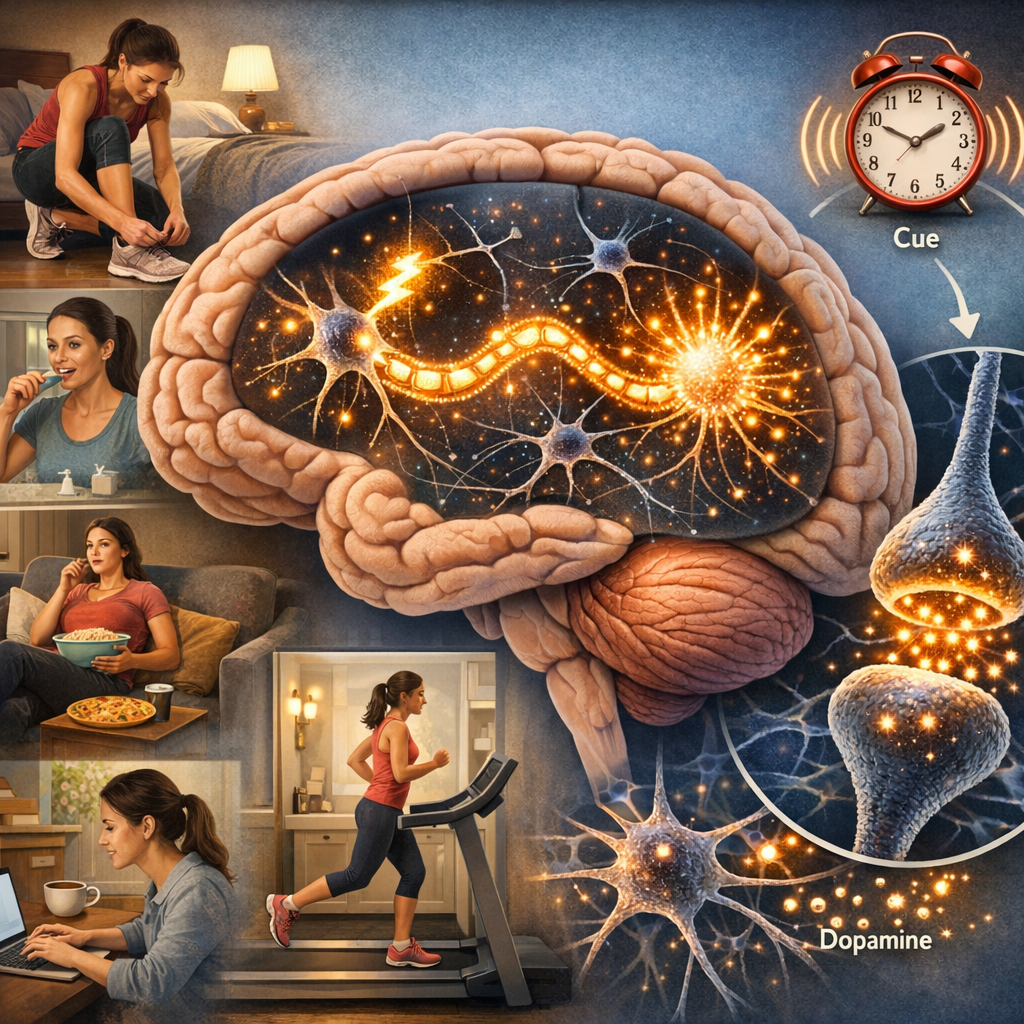
The Science of Habit Formation: How Repetition Rewires Daily Life
This course explains how repeated actions become habits, what happens in the brain during habit formation, and why context and rewards matter more than willpower alone. You’ll learn evidence-based strategies to design, repeat, and sustain habits that fit your real life.
The first lecture plays free — no account needed.
What you'll learn
- Students will be able to define a habit in scientific terms and distinguish it from routines and conscious decisions.
- Students will understand the basic habit loop of cue, behavior, and reward and identify it in their own daily activities.
- Students will be able to explain how repeated behavior in the same context increases automaticity over time.
- Students will understand that habit formation timelines vary (from weeks to many months) and critically evaluate common claims like “21 days to a habit.”
- Students will be able to identify key cues that trigger their own habits, such as time of day, location, or emotional states.
- Students will understand how stable contexts and environmental design support or interfere with habit repetition.
- Students will be able to describe, at a high level, how brain regions like the basal ganglia and prefrontal cortex contribute to habit formation.
- Students will understand how repeated rewards strengthen neural pathways, making behaviors more automatic over time.
- Students will be able to explain how rewards strengthen repeated behaviors and increase the chances they become habits.
- Students will understand why relying on willpower alone is less effective than designing rewarding, repeatable behaviors.
Prerequisites
- habit loop: cue–behavior–reward
- automaticity and effort
- repetition and strengthening of behavioral patterns
- definition of habits and automaticity
- repetition and automaticity curves
- reinforcement learning and dopamine signals
Course Content
8 modules · 2h total
What Exactly Is a Habit?
Clarify what scientists mean by “habit,” how it differs from routines and goals, and why automatic behaviors dominate much of daily life.
Repetition, Time, and the 21-Day Myth
Explore how repetition changes behavior over time, what research actually says about how long habits take to form, and why timelines vary widely.
Cues, Context, and Environment: Why Where You Are Matters
Examine how stable contexts, cues, and environments drive habits, and how small changes in surroundings can strengthen or disrupt repeated behaviors.
Inside the Habit Brain: From Effortful to Automatic
Learn how different brain systems support habit formation, including the basal ganglia and prefrontal cortex, and how repeated actions shift from deliberate to automatic control.
Motivation, Rewards, and Why Willpower Isn’t Enough
Connect repetition to motivation and rewards, showing how reinforcement, feedback, and immediate payoffs shape which repeated behaviors become lasting habits.
Designing Effective Habits: If–Then Plans and Tiny Steps
Translate the science into practice using techniques like implementation intentions, habit stacking, and tiny habits to make repetition easier and more reliable.
Breaking and Rewiring Unwanted Habits
Apply habit science to disrupt unhelpful habits by altering cues, changing rewards, and replacing old behaviors with new, repeated responses.
Habits in the Digital Age: Apps, Prompts, and Data
Explore how modern digital behavior-change tools use repetition, reminders, and rewards, and how to choose or design tools that align with real habit science.
Read the Textbook
Read every chapter for free, right here in your browser.
When psychologists and neuroscientists talk about a habit, they mean something more specific than just “something you do a lot.”
Scientific definition (modern view): A habit is a behavior that is: Learned through repetition in a stable context Triggered automatically by cues (not by a fresh decision each time) Performed with little conscious effort or attention, even if it once required effort
Researchers often describe habits as “automatic responses to cues, developed through repetition.”
Study Flashcards
Key concepts from this course as flashcard pairs.
What Exactly Is a Habit?
Habit (scientific meaning)
A learned behavior that has become automatic in response to specific cues, requiring little conscious effort or decision-making.
Routine
A repeated pattern of actions, often scheduled or planned, that may still require conscious effort and decision-making.
Goal-directed behavior
Action chosen by thinking about desired outcomes or consequences, guided by current goals rather than automatic cues.
Cue (Trigger)
Any internal or external signal—such as time, place, emotion, people, or a preceding action—that starts a habit loop.
Reward
The positive outcome or relief your brain experiences after a behavior, which strengthens the habit loop over time.
Habit loop
A cycle of cue → behavior → reward, which, through repetition, makes the behavior more automatic in response to the cue.
+1 more flashcards
Repetition, Time, and the 21-Day Myth
Habit automaticity
The extent to which a behavior is performed quickly, efficiently, and with little conscious thought in response to a specific cue or context.
Automaticity curve
A graph showing how the automaticity of a habit increases with repetition over time, usually rising quickly at first and then leveling off.
21-day rule
A popular but unscientific claim that it takes 21 days to form a habit; modern research shows much longer median times and wide variation.
Median habit formation time (Lally et al.)
In a 2010 study, the median time for habit automaticity to plateau was about 66 days, with a broad range from roughly 18 to 254 days.
Context–behavior link
The learned association between a specific cue (time, place, event) and a behavior, which strengthens with repeated pairing.
Consistency of context
Keeping the cue, time, and place for a habit as stable as possible, which helps automaticity grow faster.
Cues, Context, and Environment: Why Where You Are Matters
Context cue
A signal from your environment (like time, place, preceding actions, people, or emotions) that triggers an automatic behavior or habit.
Context stability
How similar the situation is each time you perform a behavior (same time, place, and sequence). Higher stability usually leads to stronger habits.
Habit strength
How automatic a behavior is—how quickly and effortlessly you do it when the cue appears, and how hard it feels to NOT do it.
Environment design
Deliberately arranging your surroundings—objects, spaces, and cues—to make desired behaviors easier and undesired behaviors harder.
Action slip
A mistake where an old habit runs automatically instead of the new behavior you intended, often triggered by familiar context cues.
Preceding action (as a cue)
A behavior that comes right before another and acts as a trigger for it (e.g., finishing dinner → checking your phone).
Inside the Habit Brain: From Effortful to Automatic
Prefrontal cortex (PFC)
Front part of the brain involved in planning, decision-making, self-control, and goal-directed behavior. It is heavily used when a behavior is still effortful and consciously chosen.
Basal ganglia
Deep brain structures that help form, store, and run habits and routines. They support automatic, stimulus–response behaviors once they are well learned.
Goal-directed behavior
Actions chosen by thinking about their consequences and how they help you reach a goal. Strongly involves the prefrontal cortex.
Habitual behavior
Actions triggered by cues and learned stimulus–response links, often performed with little conscious thought. Strongly involves the basal ganglia.
Dopamine
A neurotransmitter that acts as a teaching signal in reinforcement learning. Dopamine bursts often occur when outcomes are better than expected, strengthening the actions that led to them.
Reward prediction error (RPE)
The difference between the reward you expected and the reward you actually got. Positive RPE (better than expected) and negative RPE (worse than expected) both help the brain update which actions to repeat.
+2 more flashcards
Motivation, Rewards, and Why Willpower Isn’t Enough
Immediate reward
A benefit or pleasant feeling you get right after a behavior (within seconds or minutes), which strongly encourages your brain to repeat that behavior.
Delayed reward
A benefit that arrives later (days, weeks, or years after the behavior), such as better health, skills, or grades. Powerful but often weaker in the moment than immediate rewards.
Reward prediction
Your brain’s expectation about how rewarding a behavior will be. When the actual reward matches or beats this prediction, the behavior is reinforced.
Reinforcement
The process where behaviors that lead to satisfying outcomes become more likely to be repeated, strengthening habit pathways in the brain.
Intrinsic motivation
Wanting to do something because you find it enjoyable, interesting, or meaningful in itself, not just for an external reward.
Extrinsic motivation
Doing something to earn an external reward or avoid a punishment, such as grades, money, praise, or approval.
+2 more flashcards
Designing Effective Habits: If–Then Plans and Tiny Steps
Implementation intention (if–then plan)
A specific plan that links a cue to a behavior using an if–then format, e.g., “If it is 7:00 pm after dinner, then I will read for 10 minutes at my desk.”
Habit stacking
A strategy where you attach a new habit to an existing one: “After I [current habit], then I will [new tiny habit].” The existing habit acts as a reliable cue.
Tiny habit
A very small version of a desired behavior that is easy to do consistently, even on low-energy days (e.g., one push-up, one sentence, one problem).
Person–behavior fit
The degree to which a habit matches an individual’s real schedule, energy, and preferences. High fit = more likely to be repeated and become automatic.
Cue (or trigger)
A specific time, place, event, or existing action that signals when to perform a habit. In if–then plans, it is the “if” part.
Automaticity
The state where a behavior can be performed with little conscious effort or decision-making, often after many repetitions in a stable context.
Breaking and Rewiring Unwanted Habits
Habit loop
A cycle of cue → behavior → reward that runs largely automatically once learned.
Cue
The trigger that starts a habit, such as a time, place, emotion, person, or previous action.
Reward
The benefit or feeling your brain gets from a behavior, which makes the habit more likely to repeat.
Friction (in habits)
Any added obstacle—physical, time, or context—that makes a behavior harder to start or continue.
Replacement behavior
A new, usually smaller and healthier action that you do when the old cue appears, designed to give a similar reward.
Implementation intention (If–Then plan)
A specific plan that links a cue to a behavior using an "If [cue], then I will [behavior]" statement.
Habits in the Digital Age: Apps, Prompts, and Data
Digital prompt
A cue delivered by technology (notification, vibration, pop‑up, message) that nudges you to perform a specific behavior, ideally at a moment when you can act.
Micro-randomized intervention (MRI)
A research method where, at many decision points, an app randomly decides whether and how to deliver an intervention (like a prompt), allowing scientists to learn which types of prompts work best in which contexts.
Feedback loop
The cycle where you perform a behavior, see data or feedback about it, and that information influences your future behavior (e.g., streaks, charts, messages).
Stable cue
A reliable, repeated trigger (time, place, or existing routine) that consistently comes before a habit and helps your brain automate the behavior.
Habit stacking
A strategy where you add a new habit immediately after an existing one ("After I do X, I will do Y"), often supported digitally with linked reminders.
More in Science
See all →
Chemische Grundlagen für die Biotechnologie: Von Atomen zu Biomolekülen
Quantum Mechanics Mastery: From Foundations to Modern Frontiers
How the Human Brain Works: A Guided Tour of Your Mind

BIO 204: Fundamentals of Scientific Inquiry in the Biological Sciences
BCH 204 Essentials: Structure, Properties, and Functions of the 20 Amino Acids