 Skarp
Skarp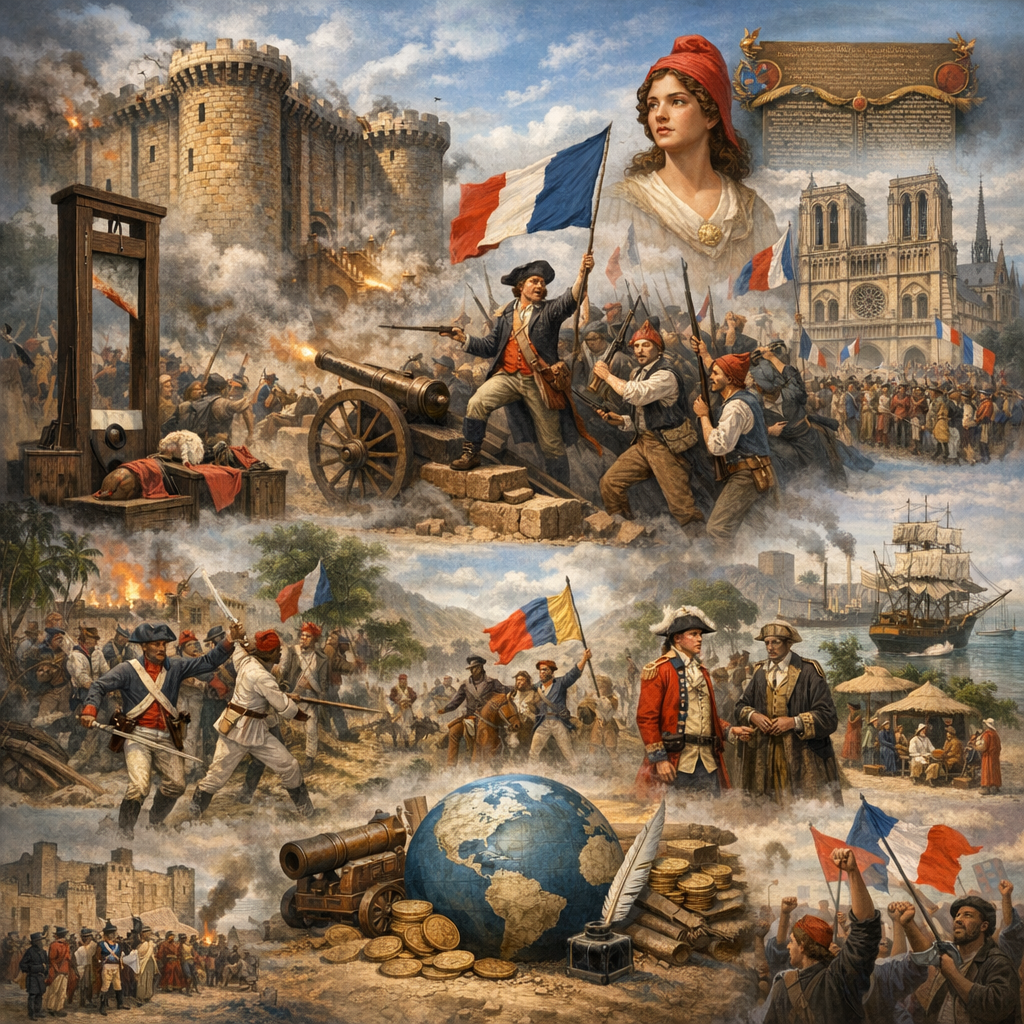
The French Revolution and Its Global Impact
This course explores how the French Revolution transformed France and reshaped the wider world. You will trace its causes, key events, core ideas, and long-term influence on revolutions, nationalism, human rights, and modern political systems across the globe.
The first lecture plays free — no account needed.
What you'll learn
- Students will be able to describe the structure of the Ancien Régime, including the First, Second, and Third Estates.
- Students will understand how debt, taxation, and poor harvests contributed to crisis and popular discontent.
- Students will be able to explain how Enlightenment thinkers challenged traditional monarchy and privilege.
- Students will be able to summarize why the Estates-General was called and how it led to the formation of the National Assembly.
- Students will understand the symbolic and practical significance of the storming of the Bastille in July 1789.
- Students will be able to explain the August 4, 1789 abolition of feudalism and its impact on noble and clerical privileges.
- Students will be able to identify key principles in the Declaration of the Rights of Man and of the Citizen and relate them to modern human rights.
- Students will understand how the 1791 Constitution attempted to balance monarchy with representative government.
- Students will be able to define ‘citizen’ and ‘sovereignty of the people’ in the revolutionary context.
- Students will be able to explain why France moved from constitutional monarchy to a republic and executed Louis XVI.
Prerequisites
- Three Estates and social hierarchy
- Economic distress and fiscal crisis
- Influence of Enlightenment ideas
- Estates-General and National Assembly
- Storming of the Bastille
- Abolition of feudalism (August Decrees)
Course Content
8 modules · 2h total
From Ancien Régime to Crisis: France on the Eve of Revolution
Introduce the social, economic, and political structure of pre-revolutionary France and why the system came under such intense pressure in the late 18th century.
Revolution Ignites: 1789 and the Collapse of the Old Order
Examine the pivotal events of 1789 that triggered the Revolution and dismantled the old regime.
Rights, Constitutions, and Citizens: Redefining Power
Focus on how the Revolution reimagined rights, law, and political authority through new documents and institutions.
Radicalization and Terror: Revolution Under Pressure
Analyze why the Revolution became more radical, leading to the Republic, the execution of the king, and the Reign of Terror.
Napoleon, Empire, and the Napoleonic Code
Explore how Napoleon Bonaparte rose from revolutionary general to emperor and spread key revolutionary reforms across Europe.
Revolution and Slavery: The Haitian Revolution and Beyond
Investigate how the French Revolution’s ideas helped spark the Haitian Revolution and challenged slavery and colonial rule.
Waves of Change: European Revolutions and Nationalism
Examine how the French Revolution inspired later revolutions and nationalist movements across Europe in the 19th century.
Global Echoes: From Latin America to Modern Democracies
Look beyond Europe to see how revolutionary France influenced independence movements and the development of modern democratic institutions worldwide.
Read the Textbook
Read every chapter for free, right here in your browser.
Imagine France around 1780–1789, just before the Revolution of 1789. It is one of the richest and most powerful kingdoms in Europe, but also deeply unequal and in crisis.
This system is called the Ancien Régime (French for “old regime”): Absolute monarchy under King Louis XVI Rigid social hierarchy divided into Three Estates Traditional privileges for some groups, heavy burdens for others
As you go through this module, keep asking:
Study Flashcards
Key concepts from this course as flashcard pairs.
From Ancien Régime to Crisis: France on the Eve of Revolution
Ancien Régime
The political and social system of France before the Revolution of 1789, characterized by absolute monarchy, the Three Estates, and widespread legal privileges for clergy and nobility.
First Estate
The clergy in pre-revolutionary France. A small but influential group that owned significant land, collected tithes, and enjoyed many legal and fiscal privileges.
Second Estate
The nobility in pre-revolutionary France. They held many top positions, owned large amounts of land, collected feudal dues, and were largely exempt from many direct taxes.
Third Estate
Everyone not in the First or Second Estate: peasants, urban workers, and the bourgeoisie. They made up about 97–98% of the population and paid most of the taxes.
Tithe
A payment, often about 10% of a person’s income or harvest, given to the Church. In France, it was collected by the First Estate from peasants and others.
Feudal dues
Payments or services that peasants owed to their seigneur (lord), such as rent, a share of crops, or labor, based on traditional feudal obligations.
+4 more flashcards
Revolution Ignites: 1789 and the Collapse of the Old Order
Estates-General
A representative assembly of the three estates (clergy, nobility, Third Estate) in France. It had not met since 1614 and was called again in 1789 to address the financial crisis.
Third Estate
The estate that included everyone not in the clergy or nobility—bourgeoisie, urban workers, and peasants. It bore most of the tax burden and claimed to represent the nation.
National Assembly
The body declared by the deputies of the Third Estate (and some allies) in June 1789, claiming to represent the French nation and to draft a constitution.
Tennis Court Oath
A pledge taken on 20 June 1789 by National Assembly deputies to not separate until they had given France a constitution, symbolizing their defiance of royal authority.
Bastille
A fortress-prison in Paris, stormed on 14 July 1789. Its fall became a symbol of the people’s power against royal despotism.
Great Fear
A wave of panic and rural unrest in summer 1789, when peasants attacked manors and feudal records amid rumors of aristocratic plots.
+1 more flashcards
Rights, Constitutions, and Citizens: Redefining Power
Declaration of the Rights of Man and of the Citizen (1789)
Foundational revolutionary text that set out natural, inalienable rights (liberty, property, security, resistance to oppression), equality before the law, and the principle that sovereignty resides in the nation.
Natural rights
Rights that people are understood to have simply by being human, not granted by a ruler or law, and considered inalienable (cannot be legitimately taken away).
Constitutional monarchy (1791, France)
System in which the king remained head of state but his powers were limited and defined by a written constitution; legislative power belonged mainly to an elected assembly.
Active vs. passive citizens
Distinction in the 1791 Constitution: all men were citizens in principle, but only those who paid a certain level of tax (active citizens) could vote and hold certain offices.
Citizen (revolutionary sense)
A member of the nation who holds rights and, at least in principle, participates in making the law, in contrast to a subject who owes obedience to a ruler.
Popular sovereignty
The doctrine that all political authority originates in the people (the nation); governments and rulers are legitimate only as expressions of the people’s will.
+1 more flashcards
Radicalization and Terror: Revolution Under Pressure
Radicalization (in the French Revolution)
The process by which the Revolution moved from moderate reforms (constitutional monarchy) to more extreme measures (republic, execution of the king, Reign of Terror) under pressure from war, economic crisis, and internal conflict.
National Convention
The elected assembly that governed France from 1792 to 1795. It abolished the monarchy, declared the Republic, tried and executed Louis XVI, and oversaw the Reign of Terror.
Jacobins
A radical political club based in Paris. Supported strong central power, harsh measures against enemies, and close alliance with the sans‑culottes. Key figures included Robespierre and Saint‑Just.
Girondins
A more moderate republican faction in the National Convention, often from provincial areas. They feared Parisian violence, opposed some extreme measures, and were purged in June 1793.
Sans‑culottes
Urban workers and small shopkeepers in Paris and other cities who pushed for price controls, direct action, and harsh treatment of enemies. Their pressure helped drive radical policies.
Reign of Terror (1793–1794)
A period when the revolutionary government used exceptional laws, special courts, and widespread executions to defend the Republic against internal and external enemies.
+4 more flashcards
Napoleon, Empire, and the Napoleonic Code
Consulate
The government in France from 1799 to 1804 after the coup of 18 Brumaire, with Napoleon as First Consul. It claimed to preserve the republic and revolutionary gains but concentrated real power in Napoleon’s hands.
Coup d’état
A sudden, usually illegal, seizure of power from a government by a small group, often involving the military. Napoleon’s takeover in 1799 is a classic example.
Napoleonic Code (Civil Code of 1804)
A unified, written civil law code created under Napoleon, emphasizing legal equality among men, protection of private property, secular law, and clear, accessible rules. It became a model for many civil law systems worldwide.
Legal equality
The principle that the law applies in the same way to all citizens (in this period, mainly men), without special legal privileges based on birth, nobility, or religion.
Serfdom
A system in which peasants are legally tied to the land and subject to a landlord’s authority. Many Napoleonic reforms weakened or abolished serfdom in the territories he controlled.
Secular law
Law made and enforced by the state, not by religious authorities or church courts. The Napoleonic Code is a key example of secular law in action.
+2 more flashcards
Revolution and Slavery: The Haitian Revolution and Beyond
Saint-Domingue
The French colonial name for the western part of the island of Hispaniola (today’s Haiti). Before 1789, it was France’s richest colony, based on slave labor producing sugar and coffee.
Declaration of the Rights of Man and of the Citizen (1789)
Foundational French Revolutionary document stating that all men are born free and equal in rights, and that sovereignty belongs to the nation. Its ideas inspired demands for rights in Saint-Domingue but clashed with the reality of slavery.
Gens de couleur libres (free people of color)
Free Black and mixed-race people in French colonies who often owned property and sometimes enslaved people, but faced legal and social discrimination compared with whites.
Haitian Revolution (1791–1804)
A complex series of uprisings, wars, and political struggles in Saint-Domingue that began with a massive slave revolt and ended with Haiti’s independence and the permanent abolition of slavery there.
Toussaint Louverture
Formerly enslaved man who became the leading general and political figure of the Haitian Revolution in its middle phase, allied with revolutionary France after abolition, and issued a 1801 constitution for Saint-Domingue.
Abolition (1794 in French colonies, then reversed in 1802 in most)
The legal ending of slavery. The French Convention abolished slavery in 1794, but Napoleon restored it in most colonies in 1802. In Saint-Domingue, attempts to reverse abolition helped push the colony toward full independence.
+1 more flashcards
Waves of Change: European Revolutions and Nationalism
Nationalism
A belief that people who share a common language, culture, and history should form their own political community (often a nation-state), and that loyalty to this nation is very important.
Liberalism (19th-century context)
A political ideology that favored constitutions, individual rights, equality before the law, and representative government; usually supported expanding (but not always fully democratic) voting rights and limiting the power of kings.
Conservatism (19th-century context)
A political ideology that aimed to preserve traditional institutions such as monarchy, aristocracy, and the Church, and that feared rapid change, revolution, and mass democracy.
Revolutions of 1830
A wave of uprisings across Europe, including the July Revolution in France, Belgian independence, and the failed Polish uprising, driven by liberal and nationalist demands against conservative governments.
Revolutions of 1848 ("Springtime of Nations")
A widespread series of revolutions across Europe in 1848, combining liberal and nationalist goals—demanding constitutions, civil rights, and national self-determination—most of which were defeated but had lasting effects.
Congress of Vienna (1814–1815)
A meeting of major European powers after Napoleon’s defeat that aimed to restore monarchies, redraw borders, and create a balance of power to prevent future large-scale wars and revolutions.
+2 more flashcards
Global Echoes: From Latin America to Modern Democracies
Popular sovereignty
The principle that political power comes from the **people (the nation)** rather than from a monarch or a small elite. Example: Latin American juntas claiming to rule in the name of the people when the Spanish king was deposed.
Republicanism
A form of government without a monarch, where the head of state is chosen (not inherited) and power is supposed to reflect the will of the citizens. Example: The early republics formed in Gran Colombia or Mexico after independence.
Constitutionalism
The idea that government powers are defined and limited by a **written constitution**, which also protects certain rights. Example: The adoption of written constitutions across Latin America in the 19th century.
Civil Code (Napoleonic Code)
A systematic written collection of private law (property, contracts, family) first issued under Napoleon in 1804, which influenced many later legal systems. Example: Chile’s 1855 Civil Code, inspired in part by the French model.
Secularism / Laïcité
The principle that the state is officially neutral in matters of religion and does not favor or endorse a particular faith. In France, laïcité is a core legal principle; in Latin America, versions of church–state separation appear in several constitutions.
Citizenship
Legal membership in a political community (usually a state), giving a person specific rights and duties. Example: Post-independence constitutions defining which men could vote and hold office, and later extending these rights to women and formerly excluded groups.
More in History
See all →
The Origin Story of the English Alphabet
Yhdysvaltain sisällissota: syyt, kulku ja seuraukset
Första världskriget för åk 8: Från skottet i Sarajevo till Versaillesfreden
Decisive Battles of the American Civil War

World War I: A Global War and Its Lasting Aftermath
