Skarp
Skarp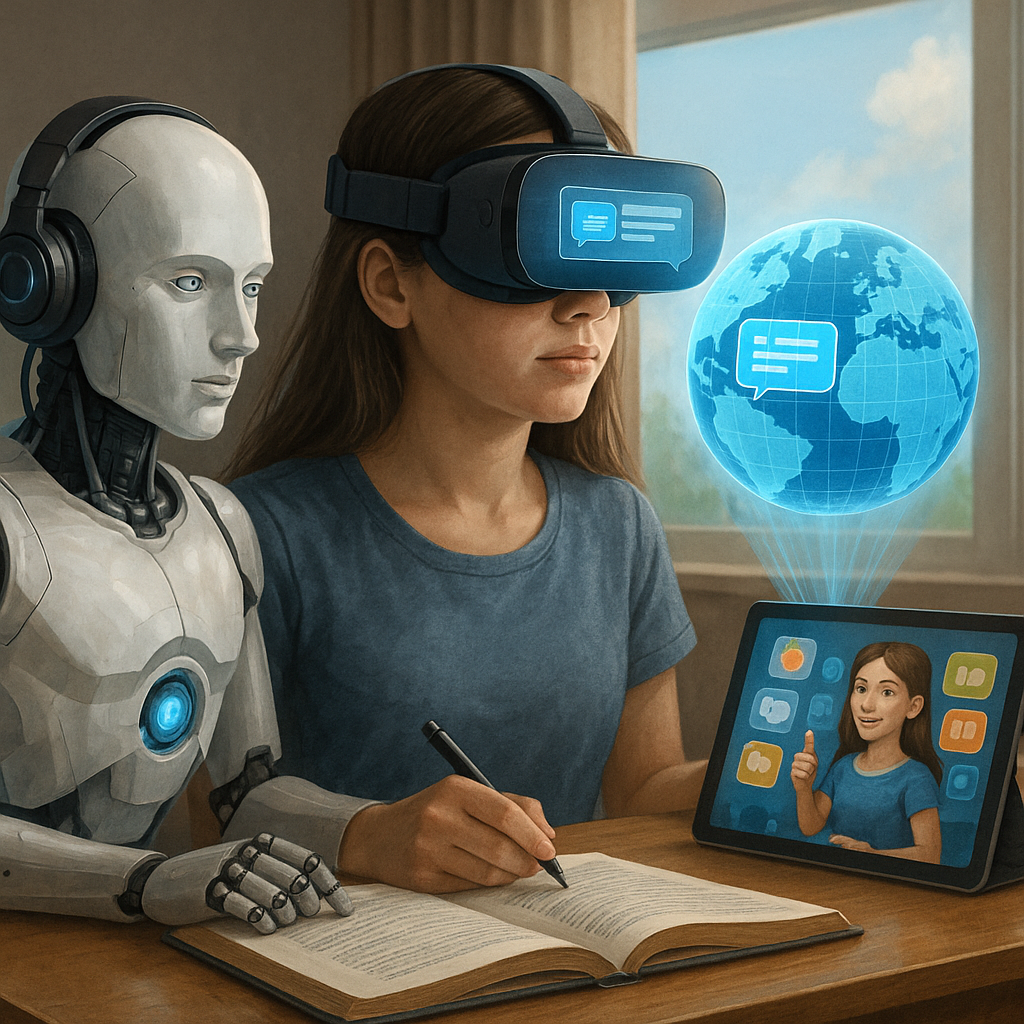
The Evolution of Language Learning: AI, VR, and Gamified Futures
Explore how artificial intelligence, virtual and augmented reality, and gamification are transforming the way we learn languages. This course connects historical methods with today’s cutting-edge tools and helps you critically evaluate and practically apply modern technologies in language education.
The first lecture plays free — no account needed.
What you'll learn
- Students will be able to summarize key historical language teaching methods and their main characteristics.
- Students will understand how digital technologies led from early CALL systems to today’s app-based learning.
- Students will be able to explain how input, output, and interaction contribute to language development.
- Students will understand how spaced repetition, retrieval practice, and motivation theories relate to technology-enhanced language learning.
- Students will be able to describe how AI-driven tools personalize language learning paths.
- Students will understand the strengths and limitations of AI chatbots and feedback systems for language practice.
- Students will be able to identify typical VR and AR use cases for language learning (e.g., virtual field trips, role-plays).
- Students will understand how immersion and presence can support communicative competence and confidence.
- Students will be able to distinguish between gamification and full game-based learning experiences.
- Students will understand which game mechanics most strongly relate to motivation and sustained language practice.
Prerequisites
- major historical language teaching methods
- computer-assisted language learning (CALL)
- input, output, and interaction in language learning
- intrinsic vs extrinsic motivation
- spaced repetition and retrieval practice
- AI-driven language learning tools
Course Content
8 modules · 1h 55m total
From Grammar-Translation to Apps: A Brief History of Language Learning
Trace the evolution of language learning methods from traditional classroom approaches to digital and mobile tools, setting the stage for AI, VR, and gamification.
How We Learn Languages: Core Learning Science and Motivation
Introduce key ideas from second language acquisition and educational psychology that explain why AI, VR, and gamification can support language learning when used well.
AI-Powered Language Learning: From Intelligent Tutors to Chatbots
Explore how modern AI systems—especially large language models and adaptive platforms—are reshaping language learning through personalization and conversational practice.
Immersive Worlds: VR and AR in Language Learning
Examine how virtual and augmented reality create immersive, contextualized environments for communication, and what current research suggests about their impact.
Game On: Gamification Principles in Language Education
Unpack the mechanics of gamification and serious games, and how points, levels, narratives, and social features can support—or sometimes hinder—language learning.
Designing an AI-Enhanced Language Learning Journey
Connect AI, VR, and gamification into coherent learning pathways, focusing on how to blend tools with clear goals, feedback, and assessment.
Ethics, Privacy, and Bias in AI Language Learning Tools
Critically examine ethical issues around data privacy, algorithmic bias, content safety, and equity when using AI-driven language learning technologies.
Future Horizons: Emerging Trends and Your Personal Action Plan
Look ahead to emerging trends such as multimodal AI, mixed reality, and learning analytics, and create a personal or institutional roadmap for adopting these tools responsibly.
Read the Textbook
Read every chapter for free, right here in your browser.
Language learning today feels very digital—apps, videos, AI chatbots—but these tools are built on ideas that are over 100 years old.
In this 15‑minute module, you will: See how language teaching moved from Grammar‑Translation to apps and AI. Learn the main historical methods and what they focused on. Understand how CALL (Computer-Assisted Language Learning) and MALL (Mobile-Assisted Language Learning) developed.
Keep this guiding question in mind:
Study Flashcards
Key concepts from this course as flashcard pairs.
From Grammar-Translation to Apps: A Brief History of Language Learning
Grammar-Translation Method
A traditional method focusing on grammar rules, vocabulary lists, and translation between the first and target language; emphasizes reading and writing over speaking and listening.
Direct Method
A method that uses only the target language in class, focuses on speaking and listening, and teaches vocabulary through objects and actions rather than translation.
Audiolingual Method
A method influenced by behaviorism that uses repetition and drills to build language habits, emphasizing accurate pronunciation and sentence patterns.
Communicative Language Teaching (CLT)
An approach that focuses on communicative competence—using language to communicate meaningfully in real-life situations, often through interactive tasks and authentic materials.
Task-Based Language Teaching (TBLT)
An approach where lessons are organized around real-world tasks (e.g., planning a trip), and grammar is addressed as needed to complete those tasks.
CALL (Computer-Assisted Language Learning)
The use of computers to support language learning, from early drill-and-practice programs to internet-based communication and multimedia tools.
+4 more flashcards
How We Learn Languages: Core Learning Science and Motivation
Input (in second language acquisition)
The language you are exposed to through listening and reading. For learning, it should be meaningful and mostly understandable (comprehensible input).
Output (in second language acquisition)
The language you produce through speaking or writing. It helps you notice gaps, test ideas, and get feedback.
Interaction
Two-way communication where learners and partners (human or AI) exchange messages, negotiate meaning, and provide feedback.
Spaced repetition
A learning strategy where you review information several times with increasing intervals between reviews to strengthen long-term memory.
Retrieval practice
Actively pulling information from memory (e.g., answering a question or using a flashcard) instead of just re-reading it.
Intrinsic motivation
Wanting to learn because the activity itself is interesting, enjoyable, or personally meaningful.
+2 more flashcards
AI-Powered Language Learning: From Intelligent Tutors to Chatbots
Large Language Model (LLM)
An AI system trained on massive text data to predict the next word in a sequence, enabling it to generate and understand natural-sounding language across many tasks.
Chatbot (for language learning)
An interface built on an LLM or similar model that lets learners practice conversation, receive corrections, and get explanations in real time.
Adaptive Learning
A system that adjusts content, difficulty, and review schedules based on a learner’s performance data, aiming to optimize practice and learning efficiency.
Automated Feedback
Instant responses from AI systems on aspects like grammar, vocabulary, style, or pronunciation, usually without direct human involvement.
Hallucination (in AI)
When an AI system generates confident but incorrect or made-up information, such as false facts, wrong rules, or invented examples.
Spaced Repetition
A learning technique where items are reviewed at increasing intervals to strengthen long-term memory; often implemented automatically in adaptive apps.
Immersive Worlds: VR and AR in Language Learning
Virtual Reality (VR)
A fully digital 3D environment, usually experienced through a headset, that replaces the real world and can simulate places like cafés, streets, or classrooms for language practice.
Augmented Reality (AR)
Technology that overlays digital content (labels, characters, objects) onto the real world, often through a phone, tablet, or AR glasses, connecting language to real environments.
Presence
The psychological feeling of 'being there' in a virtual or augmented environment; important because it makes language tasks feel real and meaningful.
Immersion
The degree to which technology surrounds your senses (visual, audio, movement) to create a convincing environment; higher immersion can support stronger presence.
Task-Based Language Teaching (TBLT)
An approach that focuses on learners completing real-world tasks (like ordering food or asking for directions) where language is used as a tool to achieve a clear outcome.
Scenario-Based Learning
Designing learning around realistic situations or stories (e.g., a hotel check-in scenario) where learners must make decisions and use language to progress.
+1 more flashcards
Game On: Gamification Principles in Language Education
Gamification
The use of game elements (such as points, badges, leaderboards, quests) in a non-game context (like a language course or app) to increase motivation and engagement.
Game-Based Learning (GBL)
An approach where complete games are used as the main method for learning. The learning happens through playing the game itself.
Serious Game
A full game designed primarily for learning or training rather than entertainment, with gameplay tightly linked to specific educational goals.
Points / XP
A basic game mechanic that gives numerical rewards for completing tasks, often used to signal progress and provide quick feedback.
Leaderboards
Rankings that compare users based on scores or activity. They can increase competition and motivation, but may also encourage shallow or speed-focused learning.
Quest / Mission
A structured task with a clear goal, often embedded in a story, that gives learners a sense of purpose and context for using the target language.
+3 more flashcards
Designing an AI-Enhanced Language Learning Journey
Blended / Hybrid Language Learning
A model that combines face-to-face instruction with online or technology-mediated activities (AI, VR, apps), intentionally distributing work across both spaces to meet clear learning objectives.
Formative Assessment
Ongoing assessment used to monitor learning and provide feedback that helps students improve during the learning process, rather than to assign a final grade.
Data-Informed Teaching
Using evidence from learner performance data (e.g., AI error reports, time on task, VR task success) to adjust instruction, materials, and support.
Gamification
The use of game elements (points, levels, badges, quests, narratives, social competition/cooperation) in non-game contexts to increase motivation and engagement.
Immersive VR Task
A language activity conducted in a virtual environment that simulates real-world contexts, requiring learners to use the target language to complete meaningful tasks.
Communicative Objective (Can Do Statement)
A description of what learners should be able to do with the language in a real or realistic situation, often phrased as 'Learners can…'.
+2 more flashcards
Ethics, Privacy, and Bias in AI Language Learning Tools
Data Privacy
The right to control how your personal information is collected, used, and shared. In AI language tools, this includes your text, voice, account, and usage data.
Data Security
Technical and organizational measures (like encryption and access controls) that protect data from unauthorized access, leaks, or attacks.
Algorithmic Bias
Systematic and unfair patterns in how an algorithm behaves, often caused by biased training data or design choices, leading to unequal treatment of certain groups.
Content Moderation
Processes and tools used to detect and reduce harmful, offensive, or unsafe content generated or shared on a platform.
Equity in Education
Ensuring that all learners have fair access to opportunities, resources, and support, taking into account different needs and starting points.
Data Minimization
The principle of collecting only the data that is strictly necessary for a specific purpose, and keeping it only as long as needed.
+1 more flashcards
Future Horizons: Emerging Trends and Your Personal Action Plan
Multimodal AI
AI systems that can process and generate multiple types of input and output (e.g., text, audio, images, video), enabling richer language-learning tasks like speaking practice with images or video prompts.
Mixed Reality (MR)
An umbrella term covering Virtual Reality (VR) and Augmented Reality (AR), where digital content is blended with real or fully virtual environments to create immersive learning experiences.
Learning Analytics
The collection, analysis, and use of learner data (e.g., performance, behavior, engagement) to understand and improve learning and teaching, ideally with strong privacy and ethics safeguards.
Dashboard
A visual interface that shows key learning data (such as progress, scores, time on task, or skill breakdowns) to learners, teachers, or administrators.
Human in the Loop
A principle where humans (teachers or learners) stay actively involved in decisions and interpretations, instead of fully trusting automated AI outputs.
More in Technology
See all →
Defending at Machine Speed: AI-Accelerated Vulnerability Management

Reading the EU Cloud and AI Development Act

Operationalizing the NIST AI RMF and Generative AI Profile in Practice

CIPP/E Exam Prep: Mastering European Data Protection Law and the GDPR

ITIL 4 Foundation Exam Prep: Complete Syllabus, Exam-Focused