Skarp
Skarp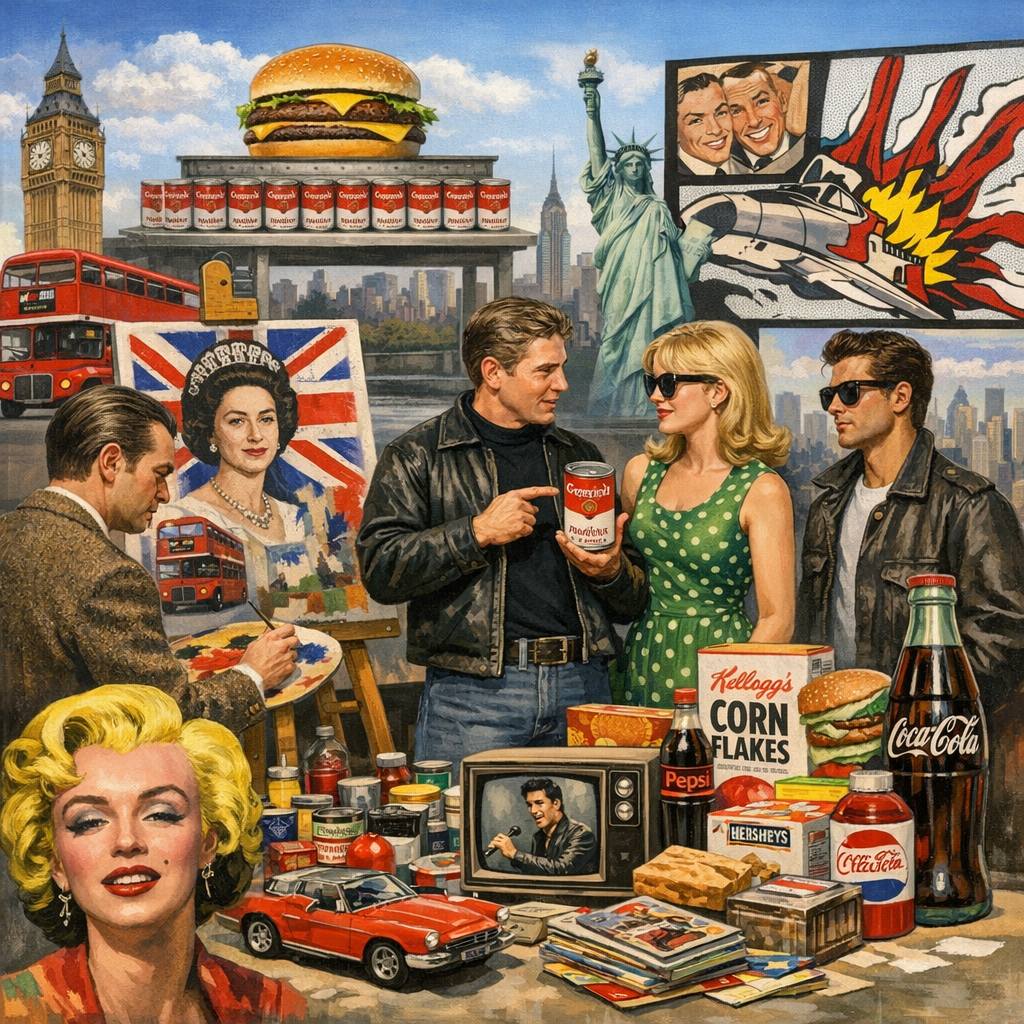
The Birth of Pop Art: A Revolution in Visual Culture
Explore how Pop Art emerged in the 1950s and 1960s in Britain and the United States, transforming everyday images from mass media and consumer culture into radical works of art. You will trace its roots, meet key artists, and understand how Pop Art reshaped visual culture and still influences how we see images today.
The first lecture plays free — no account needed.
What you'll learn
- Students will be able to describe key social and cultural changes in Britain and the United States after World War II that shaped visual culture.
- Students will understand how advertising, television, and mass-produced goods transformed everyday images and created a new visual environment.
- Students will be able to explain how traditional fine art typically related to popular culture before the emergence of Pop Art.
- Students will be able to identify the Independent Group and explain its role as a precursor to Pop Art in Britain.
- Students will understand how Paolozzi’s collages and Hamilton’s works used imagery from advertising, comics, and magazines.
- Students will be able to paraphrase Hamilton’s famous definition of Pop Art and relate it to postwar consumer culture.
- Students will be able to summarize why exhibitions like ‘This Is Tomorrow’ are considered milestones in the birth of Pop Art.
- Students will be able to compare Abstract Expressionism’s focus on gesture and emotion with Pop Art’s focus on everyday imagery and popular culture.
- Students will understand how artists like Jasper Johns and Robert Rauschenberg bridged Neo-Dada, abstraction, and emerging Pop concerns.
- Students will be able to outline how American galleries and critics first responded to Pop Art in the early 1960s.
Prerequisites
- Postwar economic boom and consumer society
- Rise of mass media and popular culture in the 1950s
- Postwar visual culture and consumer society
- British origins of Pop Art and the Independent Group
- Emergence of American Pop Art
- Mass media and consumer imagery in postwar culture
Course Content
9 modules · 2h total
From Postwar World to Pop: Setting the Scene
Introduce the social and visual world of the 1950s, when consumer culture, mass media, and new technologies created the conditions for Pop Art to emerge.
The British Roots: Independent Group and Early Pop Experiments
Examine how the London-based Independent Group and early British artists laid the intellectual and visual groundwork for Pop Art in the 1950s.
Across the Atlantic: The Rise of American Pop Art
Trace how Pop Art developed in the United States in the late 1950s and early 1960s, moving away from Abstract Expressionism toward images of everyday life.
Icons of Pop: Warhol, Lichtenstein, and the American Image
Focus on key American Pop artists and their most iconic works, exploring how they turned celebrities, comics, and brands into powerful visual symbols.
British Pop Art: Homes, Youth, and the Everyday Object
Explore how British Pop artists developed their own version of Pop, focusing on domestic life, youth culture, and the changing urban environment.
Techniques of Pop: Collage, Appropriation, and the Printed Image
Analyze the visual strategies and techniques that defined Pop Art and helped it transform mass-media images into fine art.
Pop Art as Critique and Celebration of Consumer Culture
Investigate how Pop Art functioned both as a mirror of consumer society and as a critical commentary on mass production, desire, and identity.
Beyond Britain and the U.S.: International Currents and Variations
Situate Pop Art within a broader international context, looking at related movements and artists in Europe and beyond that adapted Pop strategies to local concerns.
From Pop to Present: Legacy in Contemporary Visual Culture
Connect the birth of Pop Art to today’s visual culture, from advertising and graphic design to social media, digital art, and contemporary debates about images.
Read the Textbook
Read every chapter for free, right here in your browser.
In the 1950s, less than a decade after World War II ended (the war ended in 1945, about 80 years ago from today), everyday life in Britain and the United States changed dramatically. These changes created the visual world that Pop Art later responded to.
In this module you will: Connect postwar social changes to new kinds of images people saw every day. See how consumer culture and mass media reshaped the look of cities, homes, and even bodies. Understand how traditional fine art usually treated popular culture before Pop Art.
Keep in mind: we are focusing on the 1950s, but many trends began in the late 1940s and continued into the early 1960s.
Study Flashcards
Key concepts from this course as flashcard pairs.
From Postwar World to Pop: Setting the Scene
Consumer society
A society in which buying and owning goods (clothes, gadgets, cars, etc.) is central to everyday life and identity.
Mass media
Forms of communication that reach large audiences, such as television, radio, newspapers, magazines, cinema, and later the internet.
Advertising
Paid messages in media that promote products, services, or ideas, often using persuasive images and slogans.
Youth culture
The styles, values, music, and behaviors associated with young people, especially teenagers, as a distinct social group.
Fine art (traditional view)
Art forms like painting and sculpture that were historically valued for originality, seriousness, and separation from everyday commercial life.
Popular culture
Entertainment, images, and products widely enjoyed by ordinary people—such as pop music, films, comics, TV shows, and brand logos.
+1 more flashcards
The British Roots: Independent Group and Early Pop Experiments
Independent Group (IG)
A loose circle of artists, architects, and critics meeting at the ICA in London in the early–mid 1950s. They studied and debated mass culture (ads, comics, films) and laid the intellectual foundations for British Pop Art.
Institute of Contemporary Arts (ICA), London
A London art institution where the Independent Group held seminar-style meetings. It served as a key hub for early discussions about mass media and modern visual culture.
Eduardo Paolozzi’s ‘Bunk!’
A series of collages made from American magazines, ads, and comics, created in the late 1940s–early 1950s and shown to the IG in 1952. They are seen as early prototypes of Pop Art because they use mass-media imagery as artistic material.
Richard Hamilton
British artist and IG member who helped define Pop Art. Known for his 1957 written definition of Pop and for works like ‘Just what is it that makes today’s homes so different, so appealing?’ (1956).
Hamilton’s definition of Pop Art (core idea)
Pop Art is tied to mass-produced, popular imagery; it is youthful, witty, glamorous, and closely linked to consumer goods and big business, rather than to timeless, elite culture.
‘This Is Tomorrow’ (1956)
An exhibition at Whitechapel Art Gallery in London that combined art, architecture, design, and popular imagery into immersive environments. It is considered a landmark in the emergence of British Pop Art.
+2 more flashcards
Across the Atlantic: The Rise of American Pop Art
Abstract Expressionism
A post–World War II art movement centered in New York that emphasized large-scale, non-representational painting focused on gesture, spontaneity, and inner emotion. Dominant in U.S. art in the late 1940s and 1950s.
Pop Art
An art movement that emerged in the late 1950s and early 1960s, using imagery from mass media, advertising, comics, and consumer products to explore and question popular culture.
Everyday imagery
Visuals taken from ordinary life—such as logos, packaging, comic strips, gas stations, and celebrities—that Pop artists used as serious subjects for art.
Neo-Dada
A label for 1950s–early 1960s work (including Johns and Rauschenberg) that revived Dada-like strategies—collage, found objects, irony—while bridging abstraction and emerging Pop concerns.
Jasper Johns
American artist known for paintings of flags, targets, numbers, and maps using thick, textured surfaces. A transitional figure linking Abstract Expressionism, Neo-Dada, and Pop Art.
Robert Rauschenberg
American artist famous for his 'Combines', which mixed painting, sculpture, and everyday objects. Helped bring mass media and real-world materials into high art, paving the way for Pop.
+2 more flashcards
Icons of Pop: Warhol, Lichtenstein, and the American Image
Silkscreen Printing
A printing technique where ink is pushed through a mesh screen onto a surface using a stencil. Warhol used it to transfer photographic images to canvas, creating a mechanical, mass-produced look.
Ben-Day Dots
A commercial printing method using small, evenly spaced dots to create shading and secondary colors. Roy Lichtenstein enlarged and hand-painted these dots to imitate and exaggerate comic book printing.
Appropriation (in art)
The intentional borrowing or reuse of existing images or styles (such as comics, ads, or photos) in a new artwork, often to comment on culture, originality, or authorship.
Repetition (Warhol)
The repeated use of the same image (like multiple Marilyns or soup cans) to echo mass production, question uniqueness, and reflect how media endlessly reproduces icons.
Billboard Aesthetics
A visual style inspired by large outdoor advertisements: huge scale, bold imagery, and commercial finish. James Rosenquist used this to fill gallery walls with fragmented ad-like images.
Irony in Lichtenstein
The contrast between intense, melodramatic comic-book emotions and a cool, controlled painting style, encouraging viewers to question how media packages and exaggerates feelings.
+2 more flashcards
British Pop Art: Homes, Youth, and the Everyday Object
British Pop Art
A form of Pop Art that developed in the UK from the mid‑1950s, often focusing on domestic interiors, youth culture, and the social impact of consumer goods and mass media, usually with an ironic or reflective tone.
Richard Hamilton
British artist and early pioneer of Pop Art; created the 1956 collage “Just what is it that makes today’s homes so different, so appealing?”, which uses magazine cut‑outs of a modern living room to comment on consumer culture.
“Just what is it that makes today’s homes so different, so appealing?”
A 1956 collage by Richard Hamilton showing a hyper‑modern living room packed with consumer goods, a bodybuilder, and a pin‑up model; often seen as one of the first major Pop Art works.
Peter Blake
British Pop artist known for his interest in youth culture, music, and fan imagery; co‑designed The Beatles’ 1967 album cover for “Sgt. Pepper’s Lonely Hearts Club Band.”
David Hockney (in relation to Pop Art)
British artist whose early 1960s work is linked to Pop Art through its focus on modern life, stylized everyday scenes, and domestic spaces, later including iconic images of Los Angeles pools.
Domestic interior
The inside of a home (living room, kitchen, bedroom); in British Pop Art, often used as a setting to explore how consumer goods, media, and technology shape everyday life.
+2 more flashcards
Techniques of Pop: Collage, Appropriation, and the Printed Image
Collage
An artwork made by **pasting together different materials** (photos, text, packaging, etc.) on a surface. In Pop Art, often used to combine ads, magazine images, and everyday objects to comment on consumer culture.
Montage (visual art)
A composition made by **combining multiple images** into a single unified picture. In Pop, montage can feel like a crowded billboard or magazine spread, mixing different scenes and messages.
Appropriation
The practice of **taking existing images** (logos, comic panels, photos) and reusing them in new artworks, usually with changes in scale, color, or context, to create new meanings and question ownership and originality.
Silkscreen (screen printing)
A **printing technique** where ink is pushed through a mesh screen onto a surface. It allows for **multiple copies** of an image and gives artworks a look similar to **mass‑produced prints and advertisements**.
Mechanical reproduction
Any process (like silkscreen, offset printing, photocopying) that allows an image to be **reproduced many times**. Pop Art used this to challenge the idea that art must be unique and hand‑made.
Scale (in Pop Art)
How **big or small** an image appears in an artwork. Pop artists often **enlarged** tiny images (like comic panels or logos) to make them feel powerful and unavoidable, or shrank them to make them seem weak or lost.
+4 more flashcards
Pop Art as Critique and Celebration of Consumer Culture
Pop Art
An art movement that emerged in the late 1950s–1960s in the UK and US, using imagery and techniques from mass media, advertising, and consumer culture to explore everyday life, desire, and identity.
Consumer Culture
A society in which buying and owning goods and services is a central way people express identity, status, and belonging.
Branding
The use of names, logos, colours, designs, and messages to create a specific image and emotional response for a product, company, or person.
Ambiguity (in Pop Art)
The quality of an artwork having more than one possible meaning at the same time, such as both celebrating and criticizing consumer culture.
Mass Production
The industrial process of making large numbers of identical or nearly identical products, often using machines and assembly lines.
Authorship
The idea of who creates an artwork, including questions about originality, control, and the role of assistants, machines, and borrowed images.
+1 more flashcards
Beyond Britain and the U.S.: International Currents and Variations
Nouveau Réalisme
A mainly French and European movement (from 1960) that used real objects, junk, machines, and urban materials to create new ways of seeing reality, often critiquing consumer culture through destruction, performance, and assemblage.
Yves Klein
French artist linked to Nouveau Réalisme, famous for International Klein Blue, body-print paintings (Anthropometries), and performance-like events that turned color and the human body into a kind of brand and spectacle.
Jean Tinguely
Swiss artist associated with Nouveau Réalisme, known for kinetic sculptures and self-destructing machines made from junk, which comment on technology, progress, and waste.
Niki de Saint Phalle
French-American artist tied to Nouveau Réalisme, known for her Shooting Paintings (Tirs) and brightly colored Nana sculptures that mix Pop aesthetics with critiques of violence, gender roles, and social norms.
Local adaptation of Pop strategies
When artists use Pop-like techniques (appropriation, bright graphics, everyday objects) but adjust them to address specific local political, social, or cultural issues (such as dictatorship in Spain or postwar reconstruction in Germany).
Capitalist Realism (Germany)
A term used in 1960s West Germany for artists like Gerhard Richter and Sigmar Polke, who used photo-based painting and ironic images to comment on consumerism and the Cold War, paralleling Pop but with a distinct local focus.
From Pop to Present: Legacy in Contemporary Visual Culture
Pop Art
An art movement (mainly 1950s–60s) that used imagery from mass media, advertising, and popular culture, often with bright colors, repetition, and an ambiguous mix of celebration and critique.
Appropriation
The artistic strategy of taking existing images or objects (such as ads, photos, or logos) and reusing them in a new context, often to question originality, authorship, or cultural values.
Repetition / Seriality
Showing the same image or object multiple times, echoing mass production and advertising, and changing how we emotionally respond to the image.
Postmodern Remix Culture
A cultural approach (especially from the late 20th century onward) that freely mixes, samples, and layers existing images and styles, often blurring high/low art and questioning originality.
Digital Pop
Contemporary visual styles that extend Pop Art’s bright, graphic, mass-media look into digital spaces such as apps, emojis, stickers, and online branding.
Image Saturation
The condition of being surrounded by a huge, continuous flow of images (especially on digital platforms), which shapes how we think, feel, and form identities.
+1 more flashcards
More in Arts & Culture
See all →
Introduction to Philosophy: Big Questions and Key Thinkers

Mastering The Wheel of Time: A Comprehensive Expert Course
Advanced Tarot: Archetypes, Symbolism, and the Narrative Web of the Arcana
Tarot Card Deep Dive: Symbolism, History, and Story Across the Arcana
Foundations of Tarot: History, Structure, and the Major Arcana Journey