Skarp
Skarp
Quantum Mechanics Mastery: From Foundations to Modern Frontiers
A fast-paced, concept-driven journey through quantum mechanics that builds solid mathematical foundations while constantly connecting ideas to modern research, quantum information, and real experiments. You will move from wavefunctions and uncertainty to entanglement, approximation methods, and how today’s quantum technologies harness quantum rules.
The first lecture plays free — no account needed.
What you'll learn
- Students will be able to describe key historical experiments that motivated quantum mechanics and why classical theories could not explain them.
- Students will understand wave–particle duality and how it leads to the need for a probabilistic description of microscopic systems.
- Students will be able to interpret the wavefunction as a probability amplitude and apply normalization and the Born rule.
- Students will understand the form and role of the Schrödinger equation and distinguish between time-dependent and time-independent versions.
- Students will be able to solve the time-independent Schrödinger equation for simple 1D potentials such as the infinite square well.
- Students will understand the origin of discrete energy levels and qualitatively analyze tunneling through potential barriers.
- Students will be able to represent quantum states and observables using Dirac notation and understand the structure of Hilbert space.
- Students will understand the role of operators, eigenvalues, and commutators in defining measurable quantities and uncertainty relations.
- Students will be able to state the measurement postulates and compute expectation values and uncertainties for simple observables.
- Students will understand the Heisenberg uncertainty principle and qualitatively describe how decoherence links quantum behavior to classical outcomes.
Prerequisites
- failures of classical physics and motivation for quantum mechanics
- basic calculus and differential equations
- wavefunctions and Schrödinger equation
- basic differential equation solving
- wavefunction interpretation
- linear algebra basics (vectors, inner products, matrices)
Course Content
14 modules · 3h 30m total
Why the Quantum World Breaks Classical Intuition
Everyday experience says particles follow definite paths and objects behave predictably—yet double-slit experiments, blackbody radiation, and atomic spectra scream otherwise. Step into the historical and conceptual cracks where classical physics failed and quantum mechanics had to be invented.
Wavefunctions, Probability, and the Schrödinger Equation
A mysterious function ψ(x,t) suddenly claims to encode everything knowable about a particle—yet it is not directly observable. See how this abstract object becomes the central character of quantum theory and how a single differential equation dictates its fate.
Quantum in One Dimension: Boxes, Barriers, and Bound States
From a particle trapped in a tiny box to tunneling through barriers that should be impenetrable, one-dimensional quantum models reveal how quantization and probability flows actually work in practice.
Dirac Notation, Operators, and the Mathematics of Quantum States
Kets, bras, and inner products may look like cryptic typography, yet they provide a powerful language that unifies all of quantum mechanics—from spin systems to continuous wavefunctions—in one elegant framework.
Measurement, Uncertainty, and the Quantum-to-Classical Tension
Quantum mechanics says you cannot know position and momentum arbitrarily well and that measurement itself reshapes reality. Examine how projection, uncertainty relations, and decoherence challenge classical notions of determinism.
The Quantum Harmonic Oscillator and Ladder Operators
Hidden beneath springs and oscillations lies one of the most important quantum systems: the harmonic oscillator, whose discrete energy ladder underpins phonons, photons, and modern quantum technologies.
Angular Momentum, Spin, and Two-Level Quantum Systems
Quantum objects carry a peculiar form of angular momentum—spin—that has no classical analogue yet powers MRI machines, atomic clocks, and qubits. Discover how two-level systems become the workhorses of modern quantum physics.
Many-Particle Quantum Worlds: Identical Particles and Statistics
Electrons, photons, and atoms lose their individuality in the quantum many-body world, obeying strange rules that give rise to the Pauli principle, superfluidity, and the structure of the periodic table.
Time Evolution, Dynamics, and Scattering Basics
How do quantum states actually change in time, and what happens when particles collide and scatter? Follow the unitary flow of states and see how cross sections emerge from wave mechanics.
Approximation Power Tools: Perturbation Theory and Variational Methods
Most real quantum systems cannot be solved exactly, yet clever approximation schemes open them up. See how small perturbations and smart trial wavefunctions unlock spectra and shifts observed in real atoms and molecules.
Entanglement, Bell Inequalities, and the Limits of Local Realism
Pairs of particles seem to share correlations that defy distance, challenging classical ideas of locality and realism. Dive into entanglement, Bell tests, and how modern experiments decisively confirm quantum predictions.
Qubits, Quantum Gates, and Decoherence in Real Devices
The abstract mathematics of two-level systems becomes very concrete when encoded in superconducting circuits, trapped ions, and spins. Trace how qubits are manipulated, entangled, and ultimately threatened by noise and decoherence in today’s quantum hardware.
Topological Phases: When Quantum States Are Protected by Geometry
Some quantum phases refuse to change under smooth deformations, hiding robust edge states and exotic excitations that shrug off local noise. Meet topological insulators, superconductors, and the ideas behind topological quantum computation.
Quantum Mechanics in Today’s Laboratories and Frontiers
From precision sensors and quantum networks to exotic materials engineered in twisted bilayers and extreme environments, see how the principles you have learned power cutting-edge experiments and open problems in modern physics.
Read the Textbook
Read every chapter for free, right here in your browser.
In the late 19th century (about 130–150 years ago), physicists believed the universe was a giant clockwork machine. If you knew all positions and velocities, Newton's laws and Maxwell's equations could, in principle, predict everything.
This classical intuition rests on three ideas: Particles have definite positions and velocities at all times. Causes lead to predictable effects (determinism). Waves and particles are distinct: waves spread out, particles are localized.
But around 1900, several experiments began to break this picture: Blackbody radiation (how hot objects glow) led to the ultraviolet catastrophe. Photoelectric effect showed light acting like particles. Atomic spectra (discrete lines of color from atoms) resisted explanation.
Study Flashcards
Key concepts from this course as flashcard pairs.
Why the Quantum World Breaks Classical Intuition
Blackbody radiation
Radiation emitted by an ideal object that absorbs and emits all frequencies. Its observed spectrum forced the introduction of energy quantization (Planck's law).
Ultraviolet catastrophe
The classical prediction that blackbodies emit infinite energy at high frequencies. Resolved by Planck's assumption that energy is quantized in units of h f.
Quantization of energy
The idea that certain physical quantities (like energy of oscillators or atomic levels) can only take discrete values, not a continuous range.
Atomic spectra
The discrete set of wavelengths of light emitted or absorbed by atoms, evidence that atomic energy levels are quantized.
Wave–particle duality
The principle that quantum objects (like electrons or photons) exhibit both wave-like and particle-like behavior, depending on the experiment.
Double-slit experiment
An experiment in which particles like electrons produce an interference pattern when not measured for which path, revealing their wave-like nature.
+3 more flashcards
Wavefunctions, Probability, and the Schrödinger Equation
Wavefunction ψ(x,t)
A complex-valued function that encodes the quantum state of a system. It is a probability amplitude; |ψ(x,t)|² gives the probability density of finding a particle at position x at time t.
Born rule
The rule that connects the wavefunction to measurement outcomes: the probability density of finding a particle at x at time t is |ψ(x,t)|².
Normalization
The requirement that the total probability of finding the particle somewhere equals 1, expressed as ∫ |ψ(x,t)|² dx = 1 (or the appropriate multidimensional integral).
Time-dependent Schrödinger equation
The fundamental equation governing the time evolution of ψ: iħ ∂ψ/∂t = Ĥψ, where Ĥ is the Hamiltonian operator.
Time-independent Schrödinger equation
The eigenvalue equation Ĥφ = Eφ obtained for time-independent potentials V(x). Its solutions φ(x) give stationary states with definite energy E.
Stationary state
A state with definite energy E for which the probability density |ψ(x,t)|² does not change in time. It has the form ψ(x,t) = φ(x) e^{-iEt/ħ}.
+2 more flashcards
Quantum in One Dimension: Boxes, Barriers, and Bound States
Time-independent Schrödinger equation (TISE)
The eigenvalue equation `-(ħ²/2m) d²ψ/dx² + V(x) ψ = E ψ` describing stationary states with definite energy E in a given potential V(x).
Infinite square well
An idealized 1D potential with V=0 in a finite region and V=∞ outside, leading to strictly confined particles and discrete energy levels `E_n ∝ n²`.
Bound state
A quantum state with energy less than the asymptotic potential, whose wavefunction is normalizable and localized (often with exponential decay at infinity).
Quantum tunneling
The phenomenon where a particle has a nonzero probability to cross a classically forbidden region (E < V), due to the wavefunction penetrating and decaying inside the barrier.
Transmission coefficient T
The ratio of transmitted probability current to incident current in a scattering problem; in 1D, satisfies R + T = 1 with reflection coefficient R.
Nodes of a wavefunction
Points where the wavefunction ψ(x) is exactly zero. In the infinite well, the n-th energy eigenstate has n−1 nodes inside the well.
Dirac Notation, Operators, and the Mathematics of Quantum States
Ket |ψ⟩
An abstract state vector in Hilbert space representing the quantum state of a system.
Bra ⟨ψ|
The Hermitian adjoint (dual) of the ket |ψ⟩, acting as a linear functional that maps kets to complex numbers.
Inner product ⟨φ|ψ⟩
A complex number measuring the overlap between two states; its modulus squared is a transition probability.
Observable (operator)
A Hermitian linear operator on Hilbert space whose eigenvalues correspond to possible measurement outcomes.
Eigenvalue equation
A|a⟩ = a|a⟩, where |a⟩ is an eigenstate of operator A with eigenvalue a.
Expectation value ⟨A⟩
The average outcome of many measurements of observable A in state |ψ⟩, given by ⟨ψ|A|ψ⟩.
+2 more flashcards
Measurement, Uncertainty, and the Quantum-to-Classical Tension
Projective (von Neumann) measurement
An idealized quantum measurement in which outcomes correspond to eigenvalues of a Hermitian operator, with probabilities given by the Born rule, and the post-measurement state is the corresponding eigenstate (projection).
Born rule
The rule that the probability of obtaining eigenvalue a_n when measuring observable A in state |ψ> is P(a_n) = |<a_n|ψ>|^2.
Expectation value ⟨A⟩
The statistical average of measurement outcomes of observable A for many identically prepared systems, given by ⟨A⟩ = ⟨ψ|A|ψ⟩.
Uncertainty ΔA
The standard deviation of measurement outcomes of observable A in a given state, defined by (ΔA)^2 = ⟨A^2⟩ − ⟨A⟩^2.
Heisenberg uncertainty principle
A fundamental limit on the product of uncertainties of non-commuting observables, such as Δx · Δp ≥ ħ/2 for position and momentum.
Decoherence
The process by which a system loses quantum coherence through entanglement with its environment, making interference between components of a superposition effectively unobservable and leading to classical-like behavior.
+1 more flashcards
The Quantum Harmonic Oscillator and Ladder Operators
Harmonic oscillator potential V(x)
V(x) = 1/2 k x^2 = 1/2 m ω^2 x^2, a quadratic potential describing small oscillations around equilibrium.
Hamiltonian of the 1D harmonic oscillator
H = p^2 / (2m) + 1/2 m ω^2 x^2.
Annihilation operator a
a = (1/√2)(X + iP) in dimensionless form, or a = sqrt(m ω / (2 ℏ)) x + i p / sqrt(2 m ℏ ω). Lowers the energy level by one quantum.
Creation operator a†
a† = (1/√2)(X - iP) in dimensionless form. Raises the energy level by one quantum.
Canonical commutation relation for ladder operators
[a, a†] = 1.
Number operator N
N = a† a. Its eigenvalues n = 0, 1, 2, ... count the quanta (e.g., photons or phonons) in the mode.
+4 more flashcards
Angular Momentum, Spin, and Two-Level Quantum Systems
Angular momentum commutation relations
For any angular momentum J: [J_x, J_y] = i ħ J_z and cyclic permutations. They imply quantization and mutual incompatibility of different components.
Quantum numbers j and m
j is the total angular momentum quantum number (0, 1/2, 1, ...). For fixed j, m takes values −j, −j+1, ..., j, giving 2j+1 states.
Spin-1/2 system
A quantum system with intrinsic spin s = 1/2, having exactly two spin states, often written as |↑⟩ and |↓⟩. It is the prototype of a two-level system and a qubit.
Pauli matrices
Three 2×2 matrices σ_x, σ_y, σ_z that represent spin-1/2 operators up to a factor of ħ/2. They form a basis for 2×2 Hermitian matrices (with identity).
Stern–Gerlach experiment
A 1922 experiment where a beam of atoms in a non-uniform magnetic field splits into discrete spots, demonstrating quantized spin components and two-level outcomes.
Two-level Hamiltonian in a magnetic field
For a spin-1/2 in a field B along z: H = −γ B S_z = −(γ B ħ / 2) σ_z. It produces two energy levels separated by γ B ħ.
+1 more flashcards
Many-Particle Quantum Worlds: Identical Particles and Statistics
Indistinguishable particles
Particles that are identical in all intrinsic properties (mass, charge, spin, internal structure) so that swapping any two does not lead to a physically distinguishable state.
Symmetrization principle
Rule stating that the total wavefunction of identical particles must be symmetric (bosons) or antisymmetric (fermions) under exchange of any two particles.
Boson
A particle with integer spin whose total wavefunction is symmetric under particle exchange. Examples: photons, helium-4 atoms.
Fermion
A particle with half-integer spin whose total wavefunction is antisymmetric under particle exchange. Examples: electrons, protons, neutrons, helium-3 atoms.
Pauli exclusion principle
No two identical fermions can occupy the same single-particle quantum state. It follows from the antisymmetry of the fermionic wavefunction.
Fermi–Dirac statistics
Quantum statistics describing the average occupation of energy levels by fermions, enforcing at most one particle per single-particle state.
+4 more flashcards
Time Evolution, Dynamics, and Scattering Basics
Time-dependent Schrödinger equation (TDSE)
The fundamental equation of nonrelativistic quantum dynamics: `iħ ∂|ψ(t)⟩/∂t = H|ψ(t)⟩`, determining how quantum states evolve in time.
Time-evolution operator U(t)
For time-independent H, `U(t) = e^(-iHt/ħ)` with `|ψ(t)⟩ = U(t)|ψ(0)⟩`. U(t) is unitary and preserves total probability.
Stationary state
An energy eigenstate of a time-independent Hamiltonian. Its wavefunction has the form `ψ_E(x,t) = φ_E(x)e^(-iEt/ħ)` with time-independent probability density.
Wavepacket
A localized quantum state built as a superposition of many momentum or energy eigenstates. It moves and usually spreads over time.
Reflection and transmission amplitudes (r, t)
Complex coefficients in scattering states describing the amplitudes of reflected and transmitted waves relative to the incoming wave.
Reflection and transmission probabilities (R, T)
Measurable quantities derived from amplitudes and currents. In 1D with wave numbers k (left) and k' (right): R = |r|², T = (k'/k)|t|², with R + T = 1 for real, time-independent potentials.
+1 more flashcards
Approximation Power Tools: Perturbation Theory and Variational Methods
Time-independent non-degenerate perturbation theory
An approximation method where the Hamiltonian is written as H = H0 + H', with H0 solvable and energy levels non-degenerate. Small corrections to energies and eigenstates are computed as power series in the perturbation.
First-order energy correction
For a non-degenerate level n, the first-order shift is E_n(1) = ⟨n(0)| H' |n(0)⟩, the expectation value of the perturbation in the unperturbed eigenstate.
First-order state correction
The correction to |n(0)⟩ is |n(1)⟩ = Σ_{m ≠ n} |m(0)⟩ ⟨m(0)| H' |n(0)⟩ / (E_n(0) - E_m(0)), showing mixing with other unperturbed states.
Variational principle
For any normalized trial state |ψ_trial⟩, the expectation value ⟨ψ_trial| H |ψ_trial⟩ is an upper bound on the true ground-state energy E₀.
Trial wavefunction
A guessed, normalized wavefunction with adjustable parameters used in the variational method to approximate the ground state by minimizing the energy expectation value.
Upper bound
In the variational method, the computed energy is always ≥ E₀. Improving the trial wavefunction (more flexibility) can only lower or keep the same energy.
Entanglement, Bell Inequalities, and the Limits of Local Realism
Tensor product space
The Hilbert space of a composite system formed from subsystems A and B: H_total = H_A ⊗ H_B. States of the joint system live in this larger space.
Separable (product) state
A state of a composite system that can be written as |ψ⟩ = |φ⟩_A ⊗ |χ⟩_B. Each subsystem has its own pure state; there is no entanglement.
Entangled state
A composite-system state that cannot be written as a single tensor product of subsystem states. It describes correlations that cannot be reduced to local properties.
Bell states
Four maximally entangled two-qubit states: |Φ+⟩, |Φ-⟩, |Ψ+⟩, |Ψ-⟩. They form an orthonormal basis and show perfect correlations in suitable measurements.
Local realism
The combined assumption that (1) measurement outcomes reveal pre-existing properties (realism) and (2) no influence travels faster than light (locality).
Bell inequality
A mathematical constraint (such as the CHSH inequality) that any local hidden-variable theory must satisfy. Its violation by experiments rules out local realism.
+2 more flashcards
Qubits, Quantum Gates, and Decoherence in Real Devices
Qubit
A quantum two-level system with basis states |0> and |1>, described by a superposition c0|0> + c1|1> with |c0|^2 + |c1|^2 = 1.
Bloch sphere
A geometric representation of a single-qubit pure state as a point on the surface of a unit sphere, parameterized by angles θ and φ.
Hadamard gate (H)
A single-qubit gate that maps |0> to (|0> + |1>)/√2 and |1> to (|0> - |1>)/√2, rotating between z-basis and x-basis states.
CNOT gate
A two-qubit controlled-NOT gate that flips the target qubit if the control qubit is |1>, used to generate entanglement such as Bell states.
T1 (relaxation time)
The characteristic time scale for energy relaxation from |1> to |0>, causing population decay of the excited state.
T2 (dephasing time)
The characteristic time scale for loss of phase coherence between |0> and |1>, shrinking superpositions without necessarily changing populations.
+3 more flashcards
Topological Phases: When Quantum States Are Protected by Geometry
Topological phase of matter
A phase whose key properties are determined by global, topological features of the quantum state (e.g., band topology), not by a simple local order parameter; robust under smooth deformations that keep the gap and symmetries.
Topological invariant
A discrete quantity (often an integer) that classifies topological phases and cannot change under smooth deformations without closing the energy gap or breaking required symmetries.
Bulk–boundary correspondence
The principle that nontrivial topology of the bulk bands guarantees the existence of robust edge or surface states at the boundary between topological and trivial regions.
Topological insulator
A material that is insulating in the bulk but hosts conducting edge or surface states protected by symmetries (often time-reversal), arising from nontrivial band topology.
Topological superconductor
A superconductor with a gapped bulk and topologically nontrivial structure that supports special boundary or defect modes, such as Majorana zero modes.
Majorana zero mode
A zero-energy quasiparticle excitation in a topological superconductor that is effectively its own antiparticle and typically appears localized at boundaries or defects.
+2 more flashcards
Quantum Mechanics in Today’s Laboratories and Frontiers
Quantum sensor
A device that uses quantum states (often superposition and entanglement) to measure physical quantities such as time, fields, or acceleration with precision beyond classical limits.
Interferometer
An arrangement that splits and recombines waves so that relative phase differences become measurable intensity variations, enabling precise sensing and tests of fundamental physics.
Berry phase
A geometric phase acquired by a quantum state when parameters in its Hamiltonian are changed adiabatically around a closed loop, central to topological materials and the quantum Hall effect.
Topological insulator
A material that is insulating in the bulk but hosts robust conducting edge or surface states protected by topological invariants and symmetries such as time‑reversal.
Moiré material
A system formed by stacking 2D layers (often with a twist angle) that creates a long‑wavelength superlattice, reshaping band structure and often producing flat, strongly correlated bands.
Quantum simulator (analog)
A controllable quantum system whose Hamiltonian is engineered to mimic a target model, allowing study of quantum many‑body physics that is hard to simulate classically.
+2 more flashcards
More in Science
See all →
Chemische Grundlagen für die Biotechnologie: Von Atomen zu Biomolekülen

How the Human Brain Works: A Guided Tour of Your Mind

BIO 204: Fundamentals of Scientific Inquiry in the Biological Sciences
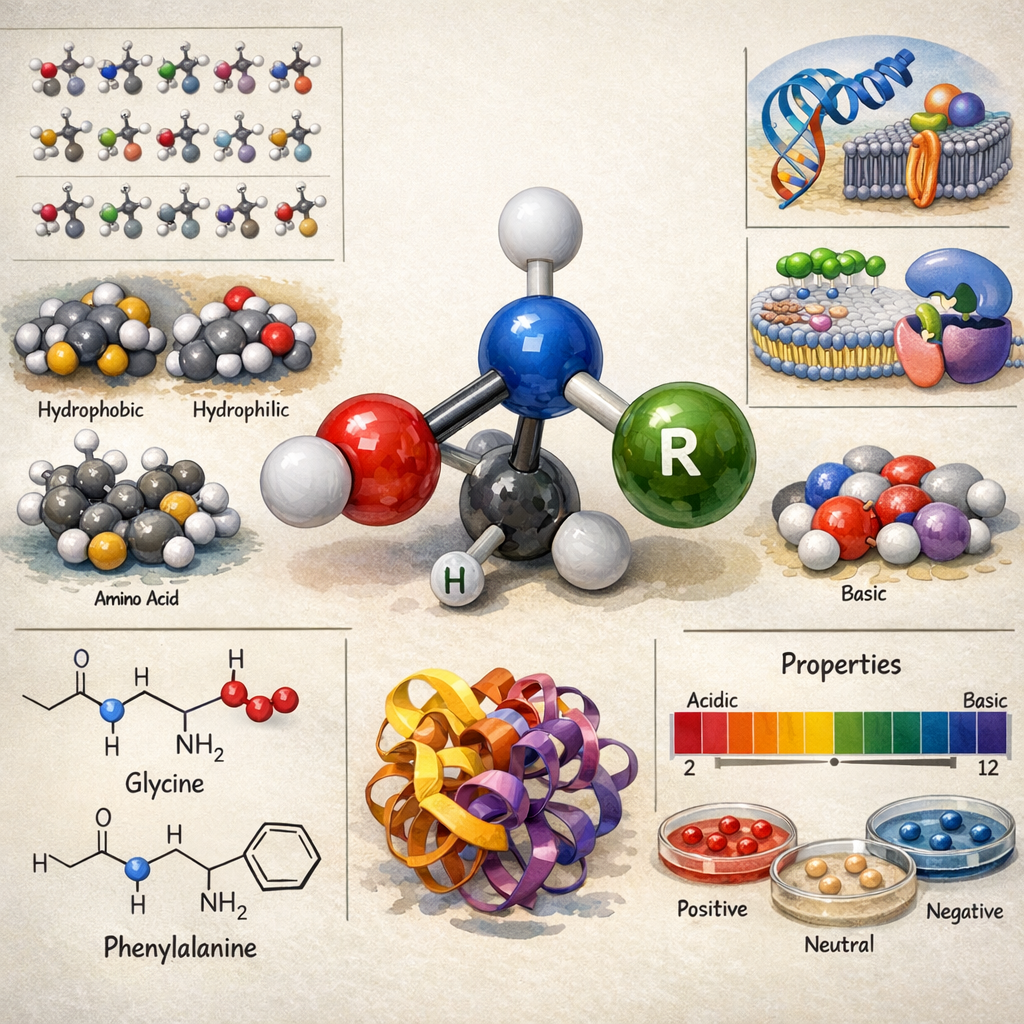
BCH 204 Essentials: Structure, Properties, and Functions of the 20 Amino Acids

Transcendent Architectures: Formal Models of Hebrew Letters, Sefirot, 72 Names & the 231 Gates