 Skarp
Skarp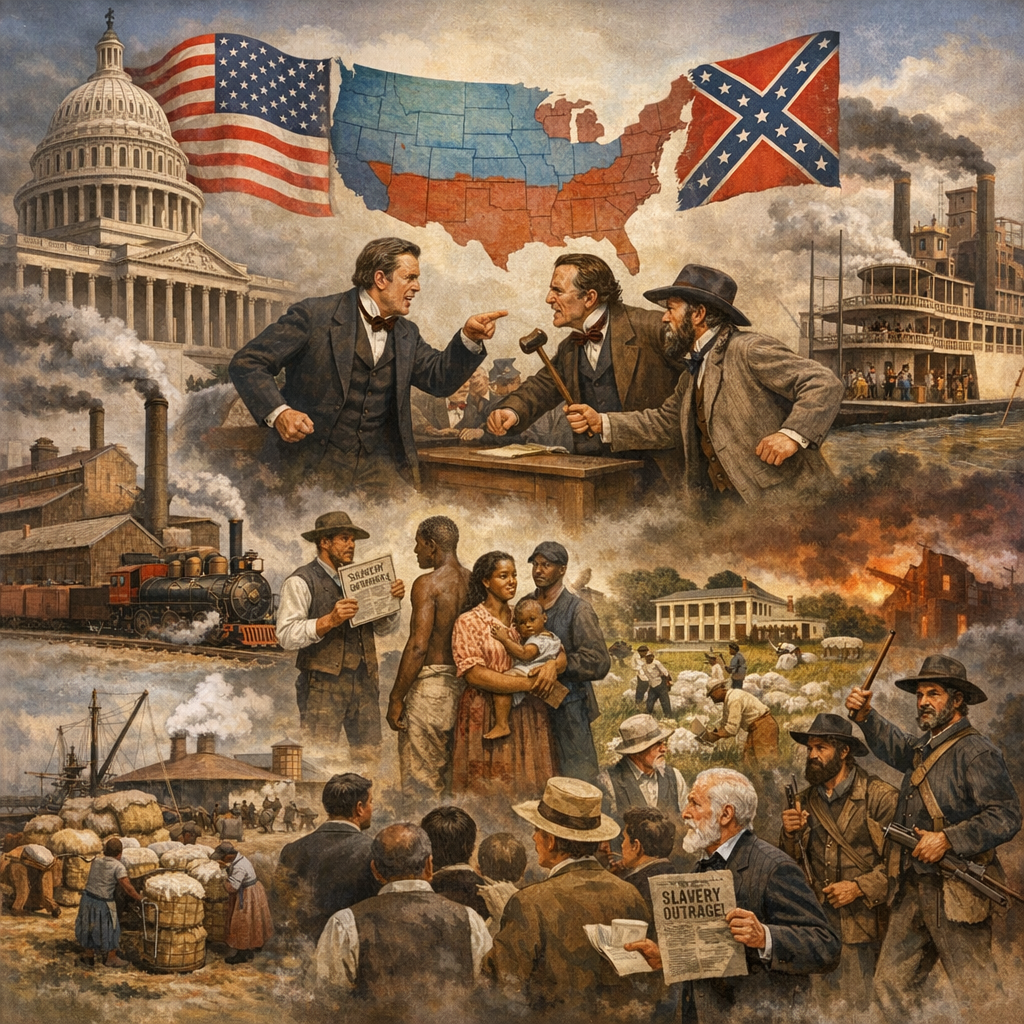
Prelude to Conflict: The Road to the American Civil War
This course traces how political battles, economic tensions, and social conflicts—rooted above all in slavery and sectionalism—pushed the United States from uneasy union to open civil war. Students examine key turning points, competing ideologies, and evolving historical interpretations to understand why compromise ultimately collapsed in 1861.
The first lecture plays free — no account needed.
What you'll learn
- Students will be able to summarize why most modern historians identify slavery as the central cause of the Civil War, while acknowledging other contributing factors.
- Students will understand the concept of sectionalism and describe how it shaped political, economic, and social conflicts between North and South.
- Students will be able to outline the major categories of causes—political, economic, and social—that will be examined throughout the course.
- Students will be able to explain how the U.S. Constitution and early national policies accommodated and protected slavery.
- Students will understand how the expansion of cotton cultivation and enslaved labor transformed the Southern economy and deepened sectional divisions.
- Students will be able to identify early flashpoints (e.g., Missouri Compromise) that foreshadowed later conflicts over slavery’s expansion.
- Students will be able to compare the industrializing, wage-labor economy of the North with the agrarian, slave-based economy of the South.
- Students will understand how economic policies such as tariffs and internal improvements became flashpoints in sectional politics.
- Students will be able to explain how economic interests reinforced and were reinforced by the institution of slavery, rather than existing as separate causes.
- Students will be able to describe how debates over states’ rights and federal power were closely tied to the protection and expansion of slavery.
Prerequisites
- slavery as the primary cause of the Civil War
- sectionalism and regional identities
- rise of the cotton economy and expansion of slavery
- slavery in the Constitution and early republic
- economic sectionalism between North and South
- states’ rights vs. federal authority
Course Content
9 modules · 1h 57m total
Two Nations in One: Slavery, Sectionalism, and the Coming Storm
Step into an America that is legally one country but increasingly feels like two, as rival regions clash over slavery, power, and identity long before the first shots are fired.
Building a Divided Republic: From Constitution to Cotton Kingdom
Return to the early republic to see how compromises over slavery and rapid economic change planted the seeds of a sectional crisis that would erupt decades later.
Economies at Odds: Industrial North vs. Slave South
Enter the workshops, farms, and plantations of antebellum America to see how starkly different economic systems fueled incompatible visions of the nation’s future.
Politics Under Pressure: Parties, Power, and States’ Rights
Watch the nation’s political system strain and crack as parties realign, states challenge federal authority, and leaders struggle to contain a crisis they increasingly cannot control.
Lines in the Sand: Compromises, Territories, and the Expansion of Slavery
Trace the map westward to see how every new territory became a battlefield, where lines drawn on paper tried—and failed—to contain a moral and political explosion.
A Nation Radicalized: Abolitionists, Pro‑Slavery Ideology, and Cultural Conflict
Step into pulpits, parlors, and print shops where fiery sermons, novels, and speeches turned slavery from a distant policy debate into a moral emergency—or a way of life to be defended at all costs.
From Debate to Violence: Bleeding Kansas, Dred Scott, and John Brown
Follow the descent from legislative wrangling to bloodshed as courtrooms, territories, and even the floor of Congress become stages for open conflict over slavery’s future.
The Breaking Point: Election of 1860, Secession, and the Collapse of Compromise
Stand on the brink of war as a fractured election shatters the old party system, Southern leaders choose secession, and the Union unravels in a matter of months.
Remembering the Road to War: Historians, Myths, and the Politics of Memory
Fast‑forward from Appomattox into the classroom, courthouse, and public square to see how generations have argued over why the war began—and why those arguments still matter today.
Read the Textbook
Read every chapter for free, right here in your browser.
In the decades before the Civil War (roughly the 1820s–1861), the United States was legally one nation but increasingly felt like two different societies.
Historians today overwhelmingly agree that slavery was the central cause of the Civil War. Other issues like tariffs, states' rights, and cultural differences mattered, but they almost always connected back to slavery in some way.
In this module, you will: See how the North and South developed different economies and identities. Learn what historians mean by sectionalism. Practice spotting how political, economic, and social conflicts all tied back to slavery.
Study Flashcards
Key concepts from this course as flashcard pairs.
Two Nations in One: Slavery, Sectionalism, and the Coming Storm
Sectionalism
Loyalty to the interests of your own region (such as North or South) over the interests of the nation as a whole; a major force shaping conflicts over slavery before the Civil War.
Free labor
An economic system based on work done by free, paid workers who can choose their jobs; central to many Northern states' identity in the mid-1800s.
Slave-based economy
An economic system that relies heavily on enslaved people for labor, especially in agriculture; dominant in the Southern states before the Civil War.
Missouri Compromise (1820)
A law that admitted Missouri as a slave state and Maine as a free state, and drew a line at 36°30' across the Louisiana Purchase to limit the expansion of slavery.
Secession
The act of formally withdrawing from a nation; Southern states seceded from the United States in 1860–1861, leading to the Civil War.
Abolitionist
A person who actively worked to end slavery; some Northern activists, both Black and white, pushed for immediate abolition before the Civil War.
Building a Divided Republic: From Constitution to Cotton Kingdom
Three-Fifths Compromise
Constitutional rule counting each enslaved person as three-fifths of a free person for representation and taxation, boosting Southern political power.
Fugitive Slave Clause
Constitutional clause requiring that enslaved people who escaped to another state be returned to their enslavers, even if they reached a free state.
Missouri Compromise (1820)
Agreement admitting Missouri as a slave state and Maine as a free state, and banning slavery in most of the Louisiana Purchase north of 36°30', except Missouri.
Cotton Kingdom
Term for the Deep South region where cotton production using enslaved labor dominated the economy and shaped society and politics.
Internal Slave Trade
The forced sale and movement of enslaved people within the United States, especially from the Upper South to the expanding cotton regions of the Deep South.
Gradual Emancipation
Northern legal approach that ended slavery over time, often by freeing future children or setting deadlines, rather than abolishing slavery instantly.
Economies at Odds: Industrial North vs. Slave South
Free labor
An economic and social system based on legally free workers who earn wages and can, in theory, choose their jobs and move, often linked in the North to ideas of upward mobility and moral superiority to slavery.
Plantation economy
A system in which large estates grow cash crops (like cotton or sugar) for export using coerced labor, in the antebellum South primarily enslaved African Americans.
Tariff
A tax on imported goods. In the antebellum U.S., high tariffs tended to protect Northern industry while raising costs for the export-oriented South.
Internal improvements
Infrastructure projects such as roads, canals, and railroads. Debates focused on whether the federal government should fund them and which regions would benefit most.
Sectionalism
Strong loyalty to the interests of one region (North, South, or West) over those of the nation as a whole, often leading to political conflict.
King Cotton
A phrase used by Southern leaders to emphasize cotton’s economic power, arguing that British and Northern dependence on Southern cotton made the South secure and influential.
+1 more flashcards
Politics Under Pressure: Parties, Power, and States’ Rights
States' rights
The idea that U.S. states retain significant powers and can resist or limit federal actions they see as unconstitutional; in the antebellum South, often invoked to defend slavery.
Federal authority
The power of the national government to act within its constitutional sphere, for example on tariffs, territories, and enforcing federal laws like the Fugitive Slave Act.
Nullification
A claimed state power to declare a federal law null and void within that state; tested in the 1832–1833 Nullification Crisis and later tied to defending slavery.
Secession
The act of a state withdrawing from the United States; justified by some Southerners as a constitutional right when they believed the federal government threatened slavery.
Sectional party
A political party whose support is concentrated in one region (such as North or South), like the largely Northern Republican Party in the 1850s.
Party realignment
A major shift in party coalitions and voter support, such as the collapse of the Whigs and the rise of the Republicans over the issue of slavery's expansion.
+1 more flashcards
Lines in the Sand: Compromises, Territories, and the Expansion of Slavery
Missouri Compromise (1820)
Agreement admitting Missouri as a slave state and Maine as a free state, and banning slavery north of 36°30' in the Louisiana Purchase (except Missouri). Temporarily preserved Senate balance but drew a sharp sectional line.
36°30' Line
Latitude line established by the Missouri Compromise. Territories north of it (except Missouri) were closed to slavery; south of it, slavery was allowed. Later partly repealed by the Kansas-Nebraska Act.
Compromise of 1850
Package of laws dealing with lands gained from Mexico. Admitted California as a free state, used popular sovereignty in Utah and New Mexico, banned the slave trade in D.C., and created a stricter Fugitive Slave Act.
Popular Sovereignty
Idea that people in a U.S. territory should vote on whether to allow slavery. Used in the Compromise of 1850 and the Kansas-Nebraska Act; in practice it led to conflict and violence, especially in Kansas.
Fugitive Slave Act of 1850
Law requiring citizens and officials in free states to help capture alleged runaway slaves, denying them jury trials and many legal protections. Deeply angered Northerners and increased resistance to slavery.
Kansas-Nebraska Act (1854)
Law that created Kansas and Nebraska Territories, repealed the Missouri Compromise line in that region, and allowed popular sovereignty to decide slavery. Led directly to Bleeding Kansas and helped spark the rise of the Republican Party.
+2 more flashcards
A Nation Radicalized: Abolitionists, Pro‑Slavery Ideology, and Cultural Conflict
Abolitionism
A movement to end slavery; in the U.S. context, especially the 19th‑century campaign for immediate or gradual emancipation and, for many activists, equal rights for Black Americans.
Pro-slavery ideology
A set of arguments defending slavery as natural, beneficial, biblically supported, and essential to social order and property rights, especially developed by Southern leaders before the Civil War.
Slave narrative
A first-person account written or dictated by someone who had been enslaved, describing their experiences and often used as a powerful abolitionist tool (for example, Frederick Douglass's Narrative).
Fugitive Slave Act of 1850
A law that strengthened slaveholders' ability to recapture escaped enslaved people, even in free states, and penalized Northerners who helped fugitives, increasing Northern resistance.
Uncle Tom's Cabin
An 1852 anti-slavery novel by Harriet Beecher Stowe that depicted the cruelty of slavery, became a bestseller in the North, and helped shift public opinion by humanizing enslaved people.
Gag rule (U.S. House of Representatives)
A series of rules beginning in 1836 that automatically tabled anti-slavery petitions without debate, angering many Northerners who saw it as a violation of free speech and the right to petition.
From Debate to Violence: Bleeding Kansas, Dred Scott, and John Brown
Popular sovereignty
The idea that people living in a territory should vote to decide whether slavery would be allowed there, used in the Kansas-Nebraska Act and shown to be unstable in Bleeding Kansas.
Bleeding Kansas
A period of violent conflict (mid-1850s) in the Kansas Territory between pro-slavery and anti-slavery forces, featuring election fraud, rival governments, and guerrilla warfare.
Dred Scott v. Sandford (1857)
Supreme Court case that ruled Black people could not be U.S. citizens and that Congress lacked power to ban slavery in the territories, striking down the Missouri Compromise.
Slave Power
A term used by many Northerners to describe a perceived conspiracy of slaveholders and pro-slavery politicians controlling the federal government to protect and expand slavery.
John Brown's raid on Harpers Ferry
An 1859 attempt by abolitionist John Brown to seize a federal arsenal in Virginia and start a slave uprising, which failed but frightened the South and deepened sectional tensions.
Border Ruffians
Pro-slavery Missourians who crossed into Kansas to influence elections through illegal voting and intimidation during the Bleeding Kansas period.
+2 more flashcards
The Breaking Point: Election of 1860, Secession, and the Collapse of Compromise
Election of 1860
A four-way presidential contest (Lincoln, Douglas, Breckinridge, Bell) that exposed deep sectional divisions and resulted in Lincoln’s victory without Southern electoral votes.
Republican Party (1860 platform)
Political party dominant in the North and West that opposed the expansion of slavery into the territories, supported free labor, and accepted slavery where it already existed.
Popular Sovereignty
The idea, championed by Stephen Douglas, that settlers in a U.S. territory should vote to decide whether to allow slavery.
Secession
The act of a state formally withdrawing from the United States; beginning with South Carolina in December 1860 and followed by other Deep South states.
Confederate States of America
The government formed in 1861 by seceded Southern states, with its own constitution that explicitly protected slavery and recognized enslaved people as property.
Crittenden Compromise
A failed 1860–1861 proposal to extend the Missouri Compromise line and permanently protect slavery south of it, rejected mainly because it expanded slavery into new territories.
+2 more flashcards
Remembering the Road to War: Historians, Myths, and the Politics of Memory
Politics of memory
The ways societies remember and interpret the past to serve present-day power, identity, and policy goals; includes monuments, textbooks, holidays, and public debates.
Lost Cause narrative
A post-Civil War myth that downplayed slavery's role, portrayed the Confederacy as noble and defensive, idealized slavery as benign, and blamed Reconstruction for Southern problems.
Dunning School
Early 20th-century historical interpretation that depicted Reconstruction as a tragic mistake dominated by corrupt Northerners and "ignorant" freedpeople, supporting Jim Crow racism.
Reconciliationist memory
A style of Civil War remembrance that emphasized healing and soldierly bravery on both sides while often ignoring slavery and Black freedom.
Revisionist scholarship (Civil War/Reconstruction)
Mid-20th-century and later historical work that challenged earlier racist narratives, centered slavery and Black agency, and reinterpreted Reconstruction as a major democratic experiment.
Sectionalism
Intense loyalty to a region (North, South, West) over the nation as a whole; in the Civil War era, it was closely tied to conflicts over slavery's expansion.
+1 more flashcards
More in History
See all →
The Origin Story of the English Alphabet
Yhdysvaltain sisällissota: syyt, kulku ja seuraukset
Första världskriget för åk 8: Från skottet i Sarajevo till Versaillesfreden
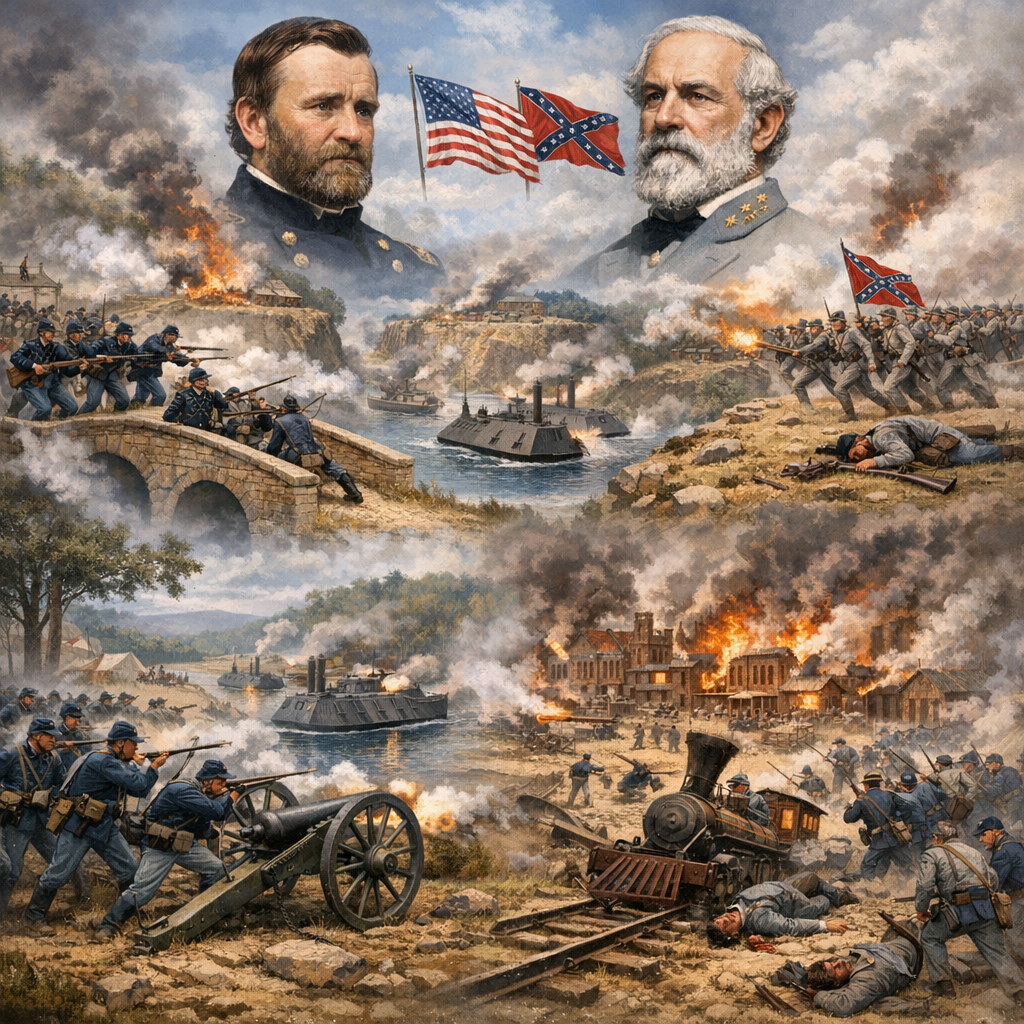
Decisive Battles of the American Civil War

World War I: A Global War and Its Lasting Aftermath
