Skarp
Skarp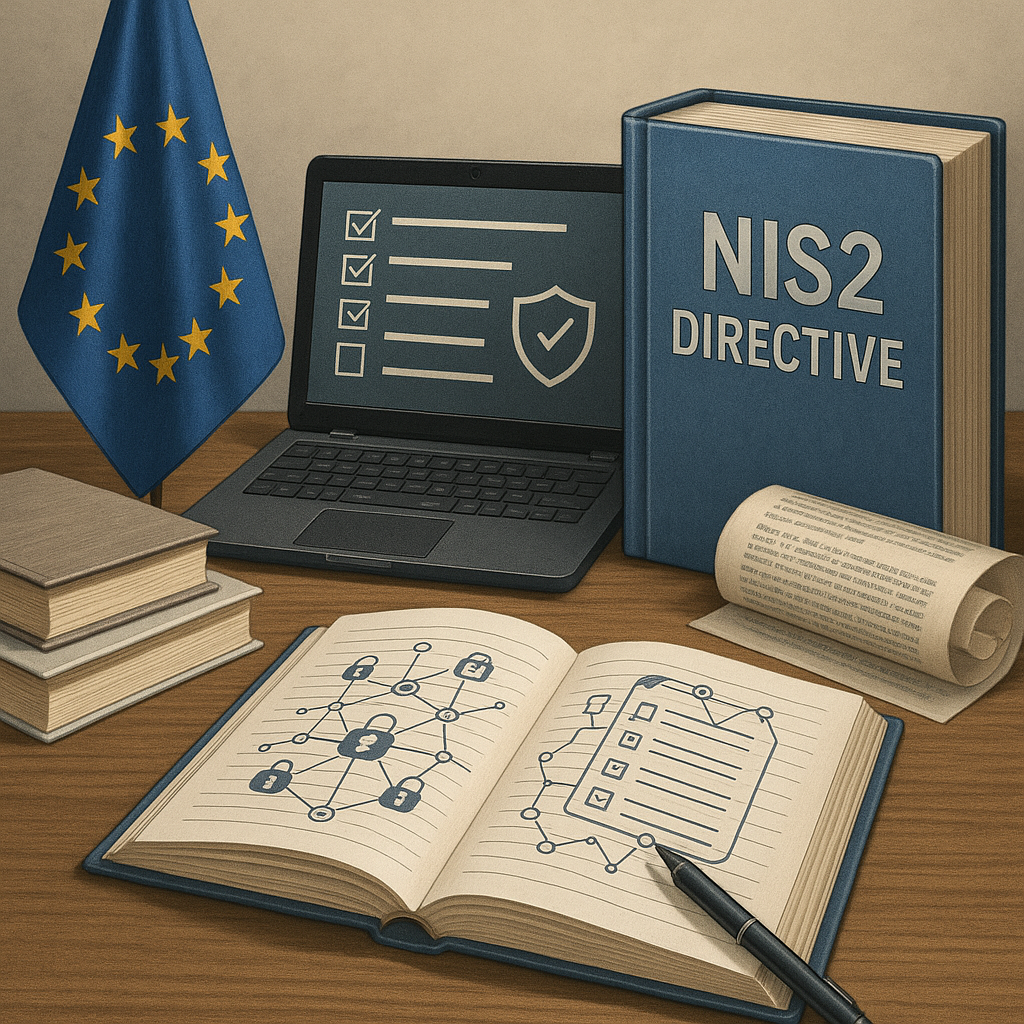
Mastering the EU NIS2 Directive: From Legal Framework to Practical Compliance
This course provides a deep, practice-oriented exploration of the EU NIS2 Directive (Directive (EU) 2022/2555), from its legal foundations and scope to hands-on implementation of risk management, incident reporting, and governance. You will learn how NIS2 is being transposed across Member States, what it means for essential and important entities, and how to build a robust, auditable cybersecurity compliance program.
The first lecture plays free — no account needed.
What you'll learn
- Students will be able to explain why the EU replaced NIS1 with NIS2 and identify the main goals of Directive (EU) 2022/2555.
- Students will understand how NIS2 fits into the wider EU cybersecurity and digital policy landscape.
- Students will be able to determine whether an organization is in scope as an essential or important entity based on sector and size.
- Students will understand how cross-border activities affect NIS2 obligations.
- Students will be able to describe the formal NIS2 transposition and application dates and how they are enforced.
- Students will understand how differing national timelines and enforcement approaches affect organizational compliance planning.
- Students will be able to list and explain the main NIS2 risk-management measures and relate them to concrete security controls.
- Students will understand how to apply proportionality and risk-based thinking when implementing NIS2 measures.
- Students will be able to describe NIS2 incident reporting thresholds and deadlines and design compliant reporting workflows.
- Students will understand how to coordinate incident communication with authorities and internal stakeholders.
Prerequisites
- Directive (EU) 2022/2555: objectives and structure
- Covered sectors and entities under NIS2
- NIS2 transposition and enforcement timelines
- NIS2 risk-management obligations
- Incident reporting obligations
- Governance and sanctions under NIS2
Course Content
11 modules · 2h 45m total
NIS2 in Context: Why the EU Reinvented Its Cybersecurity Directive
Introduces the evolution from NIS1 to NIS2, the policy drivers behind the new directive, and its role in the broader EU cybersecurity strategy.
Scope and Entities: Who Must Comply with NIS2?
Deep dive into NIS2’s expanded sectoral scope, the distinction between essential and important entities, and size and sector criteria.
Transposition, Timelines, and Enforcement Reality
Explores Article 41 transposition deadlines, Member State implementation status, and what the October 2024 date and later national timelines mean in practice.
Core Cybersecurity Risk-Management Measures Under NIS2
Breaks down the mandatory risk-management measures NIS2 requires, mapping them to practical controls and common frameworks like ISO 27001.
Incident Reporting and Communication Duties
Covers NIS2’s incident notification timelines, thresholds, and coordination with CSIRTs and competent authorities.
Governance, Management Accountability, and Sanctions
Examines NIS2’s focus on board-level responsibility, management training, and the sanctions regime for non-compliance.
Supply Chain and Third-Party Risk Under NIS2
Focuses on how NIS2 elevates supply chain cybersecurity, including requirements for assessing and managing third-party risk.
National Authorities, CSIRTs, and EU-Level Cooperation
Explores the institutional architecture NIS2 creates, including competent authorities, CSIRTs, EU-CyCLONe, and cooperation mechanisms.
Designing a NIS2 Compliance Program and Roadmap
Translates legal requirements into a practical, phased implementation roadmap, including gap assessment, prioritization, and project governance.
Integrating NIS2 with Existing Frameworks (ISO 27001, SOC 2, Sectoral Rules)
Shows how to leverage existing security and compliance frameworks to meet NIS2 requirements efficiently.
Sector-Specific and Cross-Border Case Studies
Applies NIS2 concepts to realistic scenarios in different sectors (e.g., energy, cloud services, healthcare) and cross-border groups.
Read the Textbook
Read every chapter for free, right here in your browser.
In this module you will situate NIS2 within the evolution of EU cybersecurity law and understand why the EU decided to fundamentally revise its first Network and Information Security Directive (NIS1).
Key timeline (relative to today – December 2025): 2016 – Directive (EU) 2016/1148 ("NIS1") adopted: the EU’s first horizontal cybersecurity law. 2018 – NIS1 implementation deadline for Member States. 2018–2020 – Growing criticism: limited scope, inconsistent implementation, uneven security levels. December 2020 – European Commission proposes NIS2. December 2022 – Directive (EU) 2022/2555 ("NIS2") adopted. January 2023 – NIS2 enters into force. 17 October 2024 – Deadline for Member States to transpose NIS2 into national law.
By late 2025, all Member States are legally required to have implemented NIS2, though in practice transposition quality and enforcement maturity vary.
Study Flashcards
Key concepts from this course as flashcard pairs.
NIS2 in Context: Why the EU Reinvented Its Cybersecurity Directive
NIS1 (Directive (EU) 2016/1148)
The EU’s first horizontal cybersecurity directive, adopted in 2016. Introduced obligations for operators of essential services (OES) and digital service providers (DSPs) but suffered from limited scope and fragmented implementation.
NIS2 (Directive (EU) 2022/2555)
The second-generation EU cybersecurity directive, in force since 2023. Expands scope, harmonises security and reporting obligations, introduces essential and important entities, and strengthens supervision and penalties.
Essential vs Important Entities
Categories under NIS2. Both face similar security and reporting obligations, but essential entities are subject to more proactive supervision, while important entities are typically supervised ex post.
Size-cap Rule
General rule under NIS2 that medium and large entities (≥50 employees and/or ≥€10m turnover/balance sheet) in listed sectors fall within scope, with exceptions allowing inclusion of smaller but critical entities.
CER Directive
Directive (EU) 2022/2557 on the resilience of critical entities, focusing on physical resilience. Complementary to NIS2, which addresses cyber resilience.
DORA
Regulation (EU) 2022/2554 on digital operational resilience for the financial sector. Acts as lex specialis to NIS2 for covered financial entities.
+4 more flashcards
Scope and Entities: Who Must Comply with NIS2?
Size‑cap rule
Under NIS2, **medium and large entities** in the listed sectors (Annex I and II) are **in scope by default**. Micro and small entities are generally excluded unless they meet specific criticality or exception criteria or are brought in by national law.
Essential vs Important Entities
**Essential Entities** are typically in **Annex I sectors** and subject to **ex‑ante supervision**; **Important Entities** are mainly in **Annex II** and subject to **ex‑post supervision**. Substantive cybersecurity obligations are broadly similar, but enforcement intensity and maximum fines differ.
Annex I vs Annex II
Annex I lists **high‑criticality sectors** (e.g., energy, transport, banking, health, water, digital infrastructure, core public administration, space) that usually produce **Essential Entities**. Annex II lists **other critical sectors** (e.g., postal, waste, manufacturing, food, digital platforms, research) that usually produce **Important Entities**.
Public administration scope
NIS2 includes certain **public administration entities** (central and some regional/local) but excludes **national security, public security, defence, judiciary, parliaments, and central banks** at EU level. Member States may extend coverage further in their national laws.
Criticality overrides size
Even **micro or small entities** can be designated as **Essential or Important** if their disruption would have a **significant impact** on critical societal or economic functions (e.g., sole provider of a vital service).
Cross‑border supervision principle
An entity is primarily supervised by the **Member State of establishment** (or EU representative for non‑EU entities), even if it provides services in other Member States. Cooperation mechanisms ensure that cross‑border incidents are coordinated at EU level.
Transposition, Timelines, and Enforcement Reality
Transposition (of a Directive)
The process by which an EU Member State converts the requirements of an EU directive into national law (e.g., statutes, regulations, administrative rules) within a specified deadline.
Article 41 NIS2 – Key Dates
Sets 17 October 2024 as the deadline for Member States to adopt and publish national measures implementing NIS2, and 18 October 2024 as the date from which those measures must apply and NIS1 is repealed.
No EU-Level Grace Period
NIS2 does not grant entities a general EU-wide grace period after 18 October 2024; any grace periods or phase-ins must come from national implementing laws.
Infringement Procedure
A legal process through which the European Commission can pursue Member States that fail to comply with EU law (e.g., late or incorrect transposition of NIS2), potentially leading to CJEU judgments and financial sanctions.
Earliest Applicable Date Principle
A conservative compliance strategy where a cross-border organization adopts the earliest relevant national application date among the Member States in which it operates as its internal deadline for a given NIS2 obligation.
Application vs Entry into Force
Entry into force is when a law becomes legally valid; application is when its provisions actually start to bind entities. National NIS2 laws may enter into force on one date but apply specific obligations later.
Core Cybersecurity Risk-Management Measures Under NIS2
Article 21(2) NIS2
The central list of mandatory cybersecurity risk-management measures that essential and important entities must implement, covering areas such as risk analysis, incident handling, business continuity, supply-chain security, secure development, training, cryptography, access control, and MFA.
Proportionality (under NIS2)
The principle that cybersecurity measures must be appropriate to the entity’s risk exposure, size, and the criticality of services. All Article 21(2) areas must be addressed, but depth and sophistication can vary based on risk.
Link between NIS2 and ISO/IEC 27001
NIS2 defines *what* must be covered in risk management; ISO/IEC 27001 provides a structured way to implement and document the *how*. ISO 27001 certification helps but does not guarantee NIS2 compliance unless scope and controls match NIS2 obligations.
Incident Handling vs. Incident Reporting
Incident handling is the internal technical and organizational process for managing security events; incident reporting under NIS2 is the legal obligation to notify competent authorities and CSIRTs about significant incidents within defined timeframes.
Supply-chain security under NIS2
A requirement to manage cybersecurity risks stemming from suppliers and service providers, including contractual security clauses, due diligence, and continuous monitoring of third-party risk. Responsibility remains with the regulated entity.
Business Continuity & Backup in NIS2
NIS2 explicitly mandates business continuity, crisis management, and backup management. Entities must be able to maintain or restore essential/important services within risk-based RTO/RPO targets, supported by tested backup and recovery processes.
+1 more flashcards
Incident Reporting and Communication Duties
Significant incident (under NIS2)
An incident having a **significant impact** on the provision of services, typically assessed using criteria such as number of users affected, duration, geographic spread, severity of disruption, and societal/economic impact. It triggers **mandatory reporting** (24h early warning, 72h notification, 1‑month final report).
Early warning (24‑hour report)
A **rapid, high‑level notification** sent within **24 hours** of becoming aware of an incident or cyber threat that may lead to a significant incident. Focuses on suspected malicious nature, potential cross‑border impact, and initial indicators.
Incident notification (72‑hour report)
A more detailed report submitted within **72 hours** of becoming aware that an incident has had a **significant impact**. Includes initial impact assessment, suspected root cause, and mitigation measures.
Final report (1‑month report)
A comprehensive report submitted within **1 month** of the incident notification (or resolution), providing detailed root cause analysis, full timeline, implemented measures, lessons learned, and future improvements.
CSIRT under NIS2
A **Computer Security Incident Response Team** designated by a Member State to handle incident response, early warnings, and technical support. Often a key recipient of early warnings and incident notifications.
Competent authority under NIS2
The **regulatory body** (sectoral or cross‑sector) responsible for supervising and enforcing NIS2 obligations, including incident reporting and risk management, and for applying corrective measures and sanctions.
+3 more flashcards
Governance, Management Accountability, and Sanctions
Management body (under NIS2)
The body or bodies of an entity, appointed under national law, that set the entity’s strategy, objectives, and overall direction and oversee and monitor management decision‑making (e.g., board of directors, supervisory board, managing partners).
Article 20 NIS2
Provision that sets out governance and management obligations: the management body must approve and oversee the implementation of cybersecurity risk‑management measures, follow cybersecurity training, and can be held liable for breaches of its duties.
Administrative fines (NIS2 Article 34)
Turnover‑based monetary penalties for essential and important entities. For essential entities: up to €10 million or 2% of worldwide annual turnover; for important entities: up to €7 million or 1.4% of turnover, with the higher figure applying.
Non‑monetary enforcement measures
Supervisory powers such as on‑site inspections, orders to remedy deficiencies, mandated security measures, temporary suspension of services, and, in serious cases, temporary bans on individuals exercising managerial functions.
Mandatory management training
NIS2 requirement that members of the management body receive training to acquire sufficient knowledge and skills to identify cybersecurity risks and assess risk‑management practices; entities must also offer training to employees.
Proportionality in sanctions
The principle that enforcement measures and fines must be effective, proportionate, and dissuasive, taking into account factors such as the gravity, duration, and intent of the infringement, and mitigating or aggravating circumstances.
+1 more flashcards
Supply Chain and Third-Party Risk Under NIS2
Supply chain security (under NIS2)
The requirement for entities to manage cybersecurity risks arising from their relationships with direct suppliers and service providers, including technical, organizational, and contractual measures to prevent or limit the impact of incidents propagated through the supply chain.
Third‑party vs. fourth‑party risk
Third‑party risk arises from organizations you contract with directly (vendors, service providers). Fourth‑party risk arises from your suppliers’ own suppliers or sub‑processors, which can still affect your services even though you have no direct contract with them.
Appropriate and proportionate measures
A central NIS2 principle requiring that cybersecurity controls, including supplier assessments and clauses, be calibrated to the entity’s risk exposure, size, and the criticality of services, rather than being one‑size‑fits‑all.
Critical supplier (Tier 1)
A supplier whose failure or compromise would likely cause significant disruption to essential or important services, potentially triggering NIS2 incident notification obligations and heightened regulatory scrutiny.
Security assurance clause
A contractual provision obliging a supplier to maintain defined security measures, provide evidence of their effectiveness (e.g., audit reports, certifications), and notify the customer of material changes or incidents.
Incident cooperation clause
A contract clause requiring the supplier to promptly notify the customer of relevant security incidents and to actively support investigation, containment, and reporting to authorities under NIS2.
+1 more flashcards
National Authorities, CSIRTs, and EU-Level Cooperation
National Competent Authority (NCA)
A national body (or bodies) designated under NIS2 to supervise and enforce cybersecurity obligations for essential and important entities, coordinate at national level, and act as Single Point of Contact for EU cooperation.
CSIRT (Computer Security Incident Response Team)
A national team responsible for incident handling, technical analysis, early warning, and operational support under NIS2, cooperating with other CSIRTs through the CSIRTs Network.
CSIRTs Network
EU-level network of national CSIRTs that facilitates technical and operational cooperation, information-sharing, and joint responses to cyber incidents across Member States.
EU-CyCLONe
European Cyber Crisis Liaison Organisation Network; coordinates high-level, strategic response and crisis management among Member States during large-scale cyber incidents.
Cooperation Group
A strategic and policy-level forum under NIS2 where Member States and the Commission cooperate on implementation, best practices, guidance, risk assessments, and peer reviews.
Coordinated supervision
Mechanisms under NIS2 for NCAs to jointly supervise cross-border entities, including lead authority arrangements, mutual assistance, and joint supervisory actions.
+2 more flashcards
Designing a NIS2 Compliance Program and Roadmap
NIS2 Gap Assessment
A structured comparison between current security and governance practices and the requirements derived from NIS2 and national law, typically using a maturity model and evidence collection.
Maturity Level 3 (in a 0–5 model)
Controls are defined, documented, and consistently implemented across the organization, but may not yet be fully measured or optimized.
Quick Wins in NIS2 Programs
Low‑effort, high‑impact or highly visible improvements (e.g., formalizing incident reporting, implementing MFA for key accounts) that demonstrate progress early in the roadmap.
Program Governance
The set of structures (sponsor, steering committee, PMO, workstream leads) and processes that direct and control the NIS2 compliance program.
Evidence Catalogue
A mapping between each NIS2/national requirement and specific documents, records, and data sources that demonstrate compliance (e.g., policies, logs, incident reports, contracts).
Essential vs. Important Entity
Both are in scope under NIS2, but essential entities generally face more intensive supervision and, in some Member States, stricter requirements or enforcement approaches.
Integrating NIS2 with Existing Frameworks (ISO 27001, SOC 2, Sectoral Rules)
NIS2 Article 21(2)
The provision that lists the minimum areas for cybersecurity risk‑management measures (e.g., incident handling, business continuity, supply chain security, MFA). It is central to mapping NIS2 to ISO 27001/27002 and SOC 2.
Integrated Management System (IMS)
A unified governance structure that combines multiple standards and regulations (e.g., ISO 27001, ISO 22301, NIS2, DORA, GDPR, SOC 2) into a single set of policies, processes, controls, and audits.
Control mapping matrix
A structured table or database that links individual requirements (e.g., NIS2 obligations) to specific controls and clauses in frameworks like ISO 27001/27002, SOC 2, and sectoral regulations.
Audit fatigue
The overload on teams caused by multiple, overlapping audits and assessments. It can be mitigated by integrated audits, a unified control library, and shared evidence repositories.
Appropriate and proportionate (NIS2)
A risk‑based standard requiring entities to tailor their cybersecurity measures to their size, sector, risk exposure, and societal impact. Existing ISO 27001 risk assessments are a key input to justify proportionality.
Trust Services Criteria (TSC)
The criteria used in SOC 2 engagements (Security, Availability, Confidentiality, Processing Integrity, Privacy). They provide a structure for evaluating control design and operating effectiveness, but do not encode EU‑specific legal obligations like NIS2 reporting timelines.
Sector-Specific and Cross-Border Case Studies
Essential vs Important Entity (high-level difference)
Both must implement NIS2 risk management and incident reporting, but essential entities are typically subject to more intensive (often proactive) supervision and may face higher expectations and scrutiny. Important entities are usually supervised ex post, often triggered by incidents or evidence of non-compliance.
Main Establishment (under NIS2)
The Member State where the entity has its central administration in the EU or where decisions on the security of network and information systems are primarily taken. The competent authority of this State usually acts as the lead authority for cross-border supervision.
Group-wide ISMS with National Overlays
A security management approach where a corporate group runs a single, central ISMS (often ISO 27001-based) and adds country-specific annexes or controls to address national NIS2 implementation and sectoral rules.
Common Pitfall: Formalism without Substance
Entities rely on generic ISO 27001/SOC 2 documentation without tailoring it to NIS2’s specific requirements (e.g., incident reporting timelines, governance, supply chain). Regulators increasingly demand proof of actual implementation, not just policies.
Cross-Border Incident Reporting (lead authority concept)
For entities operating across Member States, the authority of the main establishment typically acts as the lead. The entity notifies this authority, which then coordinates with others. Separate primary notifications in every Member State are usually not required unless national law says otherwise.
Dependency Mapping
The practice of documenting how critical services depend on underlying IT/OT systems, shared group infrastructures (e.g., IdP, SOC), and external suppliers (e.g., cloud, MSPs). It is crucial for assessing NIS2 impact and incident reporting obligations.
More in Legal
See all →
Commission Implementing Regulation (EU) 2024/2690: Cybersecurity Measures and Significant-Incident Thresholds

EU:s AI-förordning artikel för artikel

Understanding the EU’s New Legislative Framework

Förstå EU:s allmänna produktsäkerhetsförordning (GPSR) i detalj

Mastering DORA: Digital Operational Resilience Act Expert Track