Skarp
Skarp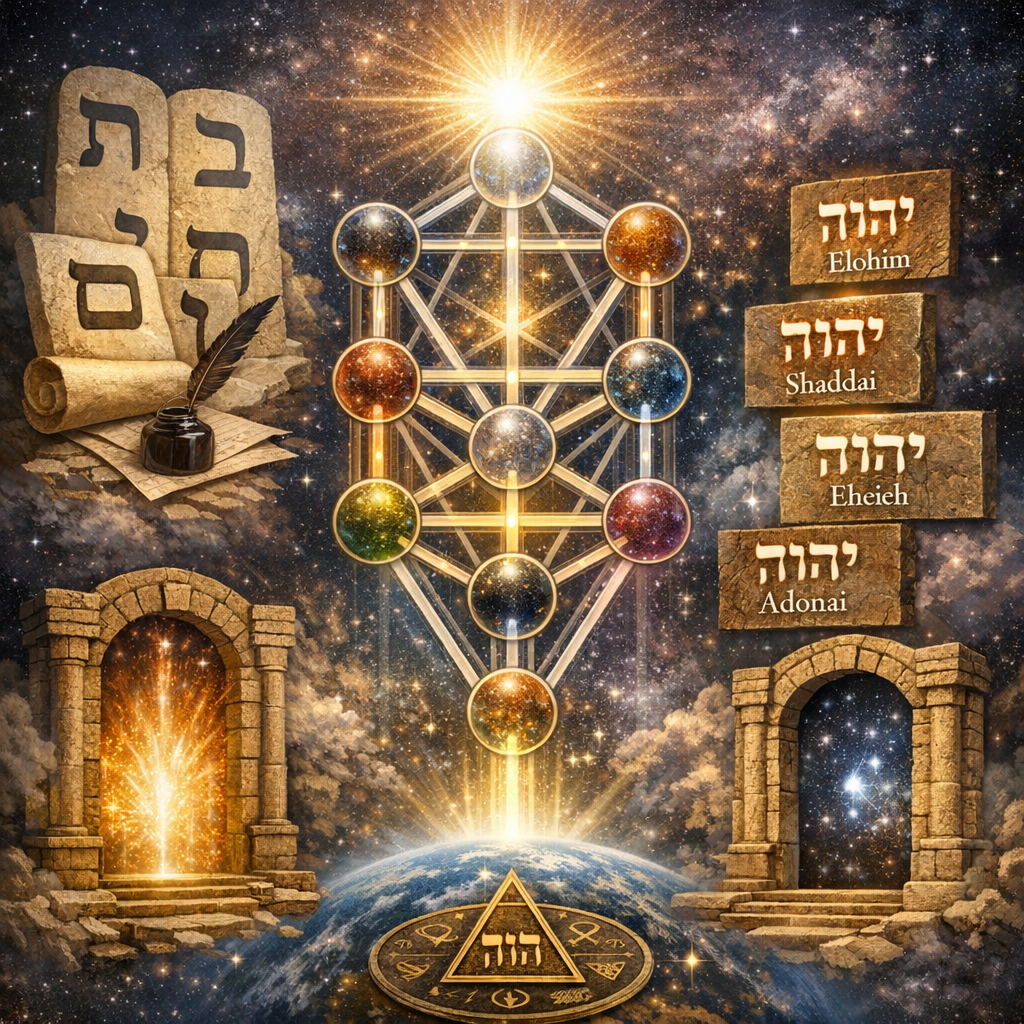
Kabbalistic Architecture of Creation: Tree, Letters, Names, and Gates
A high-intensity practicum for experienced Kabbalists, this course systematizes the Tree of Life, Hebrew letters, the 72 Names, and the 231 Gates into a single working architecture of Creation. You will work directly with Hebrew sources, construct full permutation systems, and design rigorous contemplative and theurgic protocols grounded in classical and Lurianic frameworks.
The first lecture plays free — no account needed.
What you'll learn
- Students will be able to articulate how sefirot, partzufim, and olamot interlock into a single architectural model of Creation.
- Students will understand how their prior classical and Lurianic maps can be overlaid to create a unified working diagram for practice.
- Students will be able to map Sefer Yetzirah’s 22 letters and 10 sefirot onto their existing Tree of Life model.
- Students will understand the functional distinction between mothers, doubles, and simples as creative operators.
- Students will be able to construct a complete 231-Gate wheel (Galgal) from the Hebrew alphabet without reference aids.
- Students will understand how directional pairings (forward/backward) map to themes of building and undoing in Sefer Yetzirah.
- Students will be able to generate and classify letter permutations into coherent families suitable for meditative work.
- Students will understand how to design a basic zeruf protocol that synchronizes breath, visualization, and recitation.
- Students will be able to reconstruct the full 72-Name matrix directly from the Hebrew verses of Exodus.
- Students will understand recurring structural features in the 72 Names and how these inform their contemplative use.
Prerequisites
- Working familiarity with sefirot and their basic correspondences
- Basic understanding of Lurianic partzufim and the four worlds
- Module 1: Mapping the Architecture: From Sefirot to Partzufim and Worlds
- Ability to read Hebrew letters and basic Sefer Yetzirah terminology
- Module 2: Sefer Yetzirah’s Engine: 32 Paths, 22 Letters, and the Creative Code
- Comfort with combinatorial counting and basic letter permutations
Course Content
13 modules · 3h total
Mapping the Architecture: From Sefirot to Partzufim and Worlds
The familiar Tree of Life suddenly becomes a living organism when its sefirot crystallize into partzufim and entire worlds; this opening module reframes your existing maps into a single dynamic architecture of Creation that everything else in the course will plug into.
Sefer Yetzirah’s Engine: 32 Paths, 22 Letters, and the Creative Code
Beneath the poetic surface of Sefer Yetzirah lies a precise generative engine in which numbers, letters, and paths weave the cosmos; this session uncovers that engine in its raw structural form.
The 231 Gates: Constructing the Galgal of Letter Pairings
When the Hebrew alphabet is set on a wheel and every letter is joined to every other, a web of 231 Gates appears as a hidden skeleton of Creation; this module takes you from text to a physically constructed, mathematically exact Galgal.
Letter Permutation Systems: From Theory to Working Zeruf
The abstract idea that ‘letters permute’ becomes a concrete discipline when you build full zeruf systems and subject them to strict structural rules, turning raw combinations into a precise mystical technology.
The 72 Names: Three-Verse Matrix and Structural Lattice
The 72 Names emerge not as a mystical list but as a tightly ordered lattice extracted from three verses in Exodus; this session reconstructs that lattice and prepares it to interface with your letter and Gate systems.
Weaving Names into the Tree: Sefirot, Partzufim, and Olamot
Once the 72 Names are seen as a lattice of forces, they can be threaded through sefirot, partzufim, and worlds, turning the Tree into a multi-layered grid of specific Name–structure correspondences.
Gates and Names: Integrating the 231 Wheel with the 72-Name Matrix
When the 231 Gates’ wheel of pairings is cross-wired with the 72 Names’ three-letter grid, a powerful composite architecture emerges, allowing you to trace forces from letter pairs through Names into the Tree.
Lurianic Dynamics: Tzimtzum, Shevirah, and Tikun in Letter Practice
Behind every letter and Name stands the drama of contraction, shattering, and repair; this module translates Lurianic myth into precise guidelines for how letter and Name work participates in cosmic tikkun.
Designing High-Rigor Contemplative Protocols I: Micro-Practices
The architecture is now in place; this session moves from theory to finely tuned micro-practices, crafting short, repeatable contemplative units that can be combined into larger workings.
Designing High-Rigor Contemplative Protocols II: Macro-Workings
Micro-practices become full-scale workings when arranged into multi-stage sequences aligned with the Tree and the worlds; this module guides you in architecting such extended operations with precision.
Theurgic Orientation: From Inner Contemplation to Outer Effect
At advanced levels, letter and Name work is not only introspective but theurgic; this session clarifies what it means to intend influence in higher worlds while maintaining humility, alignment, and safeguards.
Diagnostics and Integration: Reading Experiences Through the Architecture
Experiences arising from intense practice can be bewildering; this module offers a diagnostic lens so that visions, shifts, and crises can be interpreted and integrated through the shared Kabbalistic architecture you have built.
Capstone Design Lab: Crafting a Complete Architecture-Based Working
The course culminates in a personal capstone: a fully specified working that threads letters, Gates, Names, and the Tree into a single, coherent operation aimed at a carefully chosen tikkun.
Read the Textbook
Read every chapter for free, right here in your browser.
In this module you will take the familiar Tree of Life and learn to see it as a multi‑layered, living architecture.
We will move from: Sefirot as simple spheres on a diagram to Partzufim (configurations of sefirot in Lurianic Kabbalah) to Worlds (Olamot) as stacked dimensions of experience.
Historically, the basic ten‑sefirot scheme appears in early Kabbalah (roughly 12th–13th centuries). In the 16th century, R. Isaac Luria (the Ari) and his students in Safed re‑organized this into a more dynamic system of partzufim and worlds. Contemporary Kabbalistic teaching (including most serious introductions in the last 20–30 years) usually assumes this Lurianic architecture as the default background.
Study Flashcards
Key concepts from this course as flashcard pairs.
Mapping the Architecture: From Sefirot to Partzufim and Worlds
Sefirah (plural: Sefirot)
A specific mode or channel of divine expression (e.g., Chesed, Gevurah). In this module, the basic “nodes” of the Tree of Life pattern repeated in each world.
Partzuf (plural: Partzufim)
A configuration of several sefirot functioning together as a persona‑like whole (e.g., Zeir Anpin, Nukva), central in Lurianic Kabbalah.
Four Worlds (Olamot)
Atzilut (Emanation), Beriah (Creation), Yetzirah (Formation), Asiyah (Action). A vertical stack of reality‑levels, each containing a full Tree of sefirot.
Zeir Anpin
The “Small Face”; a partzuf built from Chesed through Yesod, representing the emotional body of the divine, especially in Atzilut.
Nukva / Malkhut
The feminine, receiving and expressive partzuf associated with Malkhut, paired with Zeir Anpin and channeling flow into lower worlds.
Adam Kadmon
The primordial human‑shaped configuration of divine light, a cosmic template from which the partzufim and worlds unfold.
+2 more flashcards
Sefer Yetzirah’s Engine: 32 Paths, 22 Letters, and the Creative Code
32 paths of wisdom
A core Sefer Yetzirah phrase: the combined system of **10 sefirot** and **22 letters** that together form the structural engine of Creation.
Sefirot belimah
Literally "10 sefirot of non‑substance"; in this context, abstract **axes or dimensions** of divine expression that act as fixed nodes on the Tree of Life.
Three mothers
The letters **Alef, Mem, Shin**; foundational operators that set up basic polarities and balance, often linked to elemental structures in later traditions.
Seven doubles
The letters **Bet, Gimel, Dalet, Kaf, Pe, Resh, Tav**; switchable operators associated with dualities (e.g., success/failure), forming major structural paths.
Twelve simples
The remaining 12 letters; fine‑grained operators that weave detailed connections and qualities, often mapped to zodiac signs in later systems.
Macrocosm–microcosm
The idea that the **same letter‑based code** structures both the cosmos (macrocosm) and the human being (microcosm), allowing symbolic work to mirror Creation.
+1 more flashcards
The 231 Gates: Constructing the Galgal of Letter Pairings
231 Gates
All unordered two-letter combinations of the 22 Hebrew letters, with no repetition. Mathematically: 22 choose 2 = 231.
Directional Pairing
A specific ordered path between two letters (L1→L2). Each gate yields two directional pairings: forward and backward.
Galgal
A circular diagram with the 22 Hebrew letters on its rim. When every letter is connected to every other, it visualizes the 231 Gates.
Gematria
A system that assigns numerical values to Hebrew letters and interprets words and letter-pairs via their numerical sums.
Temurah (Replacement Cipher)
A kabbalistic technique of systematically substituting one Hebrew letter for another (e.g., ATBASH), which can be visualized as specific pairings on the Galgal.
Letter Permutation Systems: From Theory to Working Zeruf
Zeruf
A structured practice of permuting and reciting letters (often Hebrew), typically coordinated with breath and visualization, used for contemplative or mystical purposes.
Non-repetition (within a unit)
A rule for permutation units: no letter appears more than once in a single 2-, 3-, or 4-letter sequence (e.g., ABA is excluded under this constraint).
Order-sensitivity
The principle that the sequence of letters matters: AB and BA are treated as distinct permutations, not as the same combination.
Structural family
A small, well-defined set of permutations generated by a clear rule, such as all permutations of a chosen triple of letters, or all pairs with a fixed first letter.
Three Mothers
Alef, Mem, Shin in Sefer Yetzirah; traditionally linked to elemental qualities (Air, Water, Fire) and often used as a foundational triple in zeruf practice.
Breath–letter mapping
A protocol that assigns specific letters or positions in a permutation to phases of the breath (inhale, hold, exhale, rest) to synchronize body and recitation.
The 72 Names: Three-Verse Matrix and Structural Lattice
Boustrophedon (in the 72 Names context)
An alternating reading pattern: Verse A read right-to-left, Verse B read left-to-right, Verse C read right-to-left, so that vertical columns can be formed across the three verses.
72×3 Matrix
The structural lattice of the 72 Names: 72 columns (Names), each containing 3 letters (one from each of the three Exodus verses), forming a grid of 72×3 letters.
Name k (general definition)
The k-th three-letter Name in the sequence, built from the k-th letter of Verse A (R→L), the k-th letter of Verse B (L→R), and the k-th letter of Verse C (R→L).
231 Gates
The full set of unordered 2-letter combinations from the 22-letter Hebrew alphabet (22×21/2 = 231). Each 3-letter Name contains three such Gates as internal pairs.
Energetic / Angelic Modality
A way of understanding each 3-letter Name (and its derived angelic form) as a distinct channel or pattern of divine energy or angelic influence, depending on the tradition.
Structural vs Interpretive Layer
Structural: the fixed 72×3 letter lattice and its Gates. Interpretive: tradition-dependent associations (healing, protection, angels, zodiac, etc.) attached to each Name.
Weaving Names into the Tree: Sefirot, Partzufim, and Olamot
Sefirot
Ten emanations or attributes through which divine energy is structured and flows: Keter through Malkhut.
Partzufim
Personified configurations of the sefirot (such as Arich Anpin, Abba, Imma, Zeir Anpin, Nukva) used especially in Lurianic Kabbalah.
Four Worlds (Olamot)
Atzilut (Emanation), Beriah (Creation), Yetzirah (Formation), Asiyah (Action); four levels of reality and consciousness.
Kavanah (plural: Kavanot)
Focused intention or inner orientation during prayer, ritual, or contemplation, often guided by specific Names or mappings.
Mapping Schema
A consistent rule-set that assigns each of the 72 Names to a sefirah, world, and partzuf, creating a multi-layered grid.
Zeir Anpin
A partzuf that includes the mid-sefirot (Chesed–Yesod), often representing the emotional and relational face of the divine.
Gates and Names: Integrating the 231 Wheel with the 72-Name Matrix
231 Gates (Shaarei 231)
The set of all pairings of the 22 Hebrew letters. Treated as 231 undirected Gates (AB = BA) on a circular diagram, representing fundamental letter-to-letter connections.
72-Name Matrix
A 72×3 lattice of three-letter Names derived from Exodus 14:19–21 via the traditional boustrophedon method (right–left, left–right, right–left). Each row is one Name.
Gate Supported by a Name
In this module’s rule set, a 72 Name supports a Gate when the Gate’s two letters appear as an adjacent pair in the Name, in either order (AB or BA).
Convergence Zone
A region where specific letters, Gates, and multiple 72 Names all cluster together, often mapped onto a particular sefirah, path, or area of the Tree of Life.
Composite Diagram
A visual overlay that combines the 231 Gates Wheel with annotations showing which 72 Names support each Gate, optionally linked to positions on the Tree of Life.
Adjacent Pair (in a Name)
One of the two main letter pairs in a three-letter Name: positions 1–2 and 2–3. These are treated as the primary instances of Gates within Names.
Lurianic Dynamics: Tzimtzum, Shevirah, and Tikun in Letter Practice
Tzimtzum
Lurianic concept of divine contraction or withdrawal that creates a "vacated space" for finite worlds; in practice, your deliberate focusing and withdrawal from distraction to make inner space for a letter or Name.
Shevirat ha-kelim
"Shattering of the vessels": the breakdown of early sefirotic containers under intense light, scattering sparks and shells; in practice, the emotional, mental, and bodily reactions that surface when focused light meets your limited patterns.
Tikun
Repair, re-alignment, and integration of shattered sparks through structured sefirot, partzufim, and worlds; in practice, consciously re-channelling stirred-up energy along balanced pillars and into specific world–partzuf configurations.
Partzufim
Structured configurations or "faces" of the sefirot (e.g., Arikh, Abba, Imma, Zeir Anpin, Nukva) that organize divine flow; used in practice to target tikun in specific functional areas like will, understanding, or speech.
Chesed and Din (Right and Left Pillars)
Chesed (right) is expansive, generous, and unifying; Din/Gevurah (left) is constricting, judging, and boundary-setting. Advanced practice uses letter and Name work to consciously sweeten excess din or structure excess chesed.
Raising Sparks
Symbolic act of lifting scattered divine sparks from broken vessels back toward their source; in letter practice, noticing reactive "shards" and imaginatively guiding them along the appropriate pillar and into the targeted world–partzuf.
Designing High-Rigor Contemplative Protocols I: Micro-Practices
Micro-practice
A short, 10–15 minute, repeatable contemplative protocol with defined intent, specific letters/Gates/Names, standardized breath and posture, and a known intensity and safety profile.
Gate (231 Wheel)
A specific pair of Hebrew letters representing a dynamic interaction of forces. In this context, it serves as a focused channel for shaping an inner state.
72-Name triplet
One of the three-letter Names from the traditional 72-Name matrix. It refines and focuses the quality initiated by a Gate and can be mapped onto Sefirotic dynamics.
Visualization anchor
A simple, consistent body location and mental image (such as letters glowing at the heart or along the spine) used to stabilize attention during practice.
Gradual intensification
A safety principle: increase duration and subtle complexity of practices over weeks, not within a single session, to support integration and avoid overwhelm.
Stop conditions
Predefined signs that a practice should be paused or ended (e.g., strong anxiety, dizziness, dissociation), along with a plan for grounding and returning to baseline.
Designing High-Rigor Contemplative Protocols II: Macro-Workings
Macro-working
A multi-stage contemplative operation built by sequencing micro-practices across time, sefirot, and worlds, usually spanning multiple sessions or weeks.
Tikun trajectory
A clearly defined movement of repair or clarification (tikun) framed in Lurianic terms, specifying the shift from a shevirah-pattern to a more integrated pattern.
Temporal structuring
Designing when practices occur: within a day, across days or weeks, and in relation to Jewish liturgical cycles like Shabbat or holidays.
Halachic integration
Designing contemplative practices so they respect and harmonize with halachic norms, especially regarding fixed prayers and berachot.
Feedback loop
A cycle in which you log experiences, review them, and adjust the protocol, creating iterative versions (v1.0, v1.1, etc.).
Partzufim (basic)
Configured faces or personae of the sefirot (e.g., Zeir Anpin, Nukva) used as higher-level patterns for organizing certain macro-workings.
Theurgic Orientation: From Inner Contemplation to Outer Effect
Theurgy (in Kabbalistic context)
The orientation in which human actions, especially mitzvot and kavanot, are understood as participating in tikkun and influencing the configuration of the higher worlds, always under divine sovereignty and not as magical control.
Kavanah
Focused intention in prayer or practice. In classical sources, mainly sincerity and devotion; in Lurianic systems, sometimes includes technical awareness of sefirot, worlds, and yichudim, though heart and humility remain primary.
Yichudim
Lurianic unifications of divine Names and aspects of the sefirot/partzufim, often through specific visualizations and permutations. Considered advanced and not for unsupervised experimentation.
Intercessory orientation
Framing a practice as praying on behalf of others, focusing on changing your own heart and leaving any further effect to God, without coercion or claims of control.
Protective orientation
Using Names or Gates with the intention of strengthening inner resilience, clarity, and courage in the face of harm, while asking God for protection and avoiding magical or coercive claims.
Epistemic humility
Recognizing the limits of your knowledge about unseen effects, especially in theurgic work, and therefore holding intentions modestly and conditionally.
Diagnostics and Integration: Reading Experiences Through the Architecture
Tree–World–Partzuf Architecture
An integrated map using sefirot (Tree of Life), four worlds (Asiyah, Yetzirah, Beriah, Atzilut), and partzufim (personified configurations of sefirot) to interpret and guide contemplative experiences.
Phenomenological Marker
A characteristic way an experience feels or appears from the inside (e.g., chest warmth, time distortion) that helps you map it to specific sefirot or worlds.
Inflation
An imbalance where insight or spiritual intensity expands the sense of self-importance or specialness, often linked to Tiferet–Keter zones without enough grounding in Malkhut.
Dissociation (in this context)
A drift away from embodied, ordinary awareness toward detached, unreal, or overly spacious states, often linked to Beriah–Atzilut emphasis without Malkhut–Yesod anchoring.
Asiyah vs. Yetzirah
Asiyah refers to concrete, sensory, and behavioral experience; Yetzirah refers to images, emotions, and subtle energetic or symbolic experience.
Integration Strategy
A deliberate practice or behavior (body-based, cognitive, relational) chosen to counterbalance a specific architectural imbalance and stabilize learning from intense experiences.
Capstone Design Lab: Crafting a Complete Architecture-Based Working
Tikkun (in this course context)
A focused act of repair or re-alignment in yourself or your immediate sphere of responsibility, modest in scope and ethically grounded, guided by the shared Kabbalistic architecture.
Theurgic orientation
An approach where practice is intended to influence higher worlds or subtle dimensions, while maintaining humility, ethical alignment, and clear safeguards.
Gate (in this architecture)
A structured threshold or letter pairing that marks a transition between states, Sefirot, or phases of a working, often corresponding to specific paths on the Tree.
Structural coherence
The quality of a protocol in which aim, Tree mapping, letters, Gates, Names, and procedures all mutually support one another and can be clearly justified.
Evaluation criteria
Explicit, modest, and observable standards you use to assess the process and effects of your working over time, including safety, fidelity to the script, and small behavioral shifts.
More in Arts & Culture
See all →
Introduction to Philosophy: Big Questions and Key Thinkers

Mastering The Wheel of Time: A Comprehensive Expert Course
Advanced Tarot: Archetypes, Symbolism, and the Narrative Web of the Arcana
Tarot Card Deep Dive: Symbolism, History, and Story Across the Arcana
Foundations of Tarot: History, Structure, and the Major Arcana Journey