Skarp
Skarp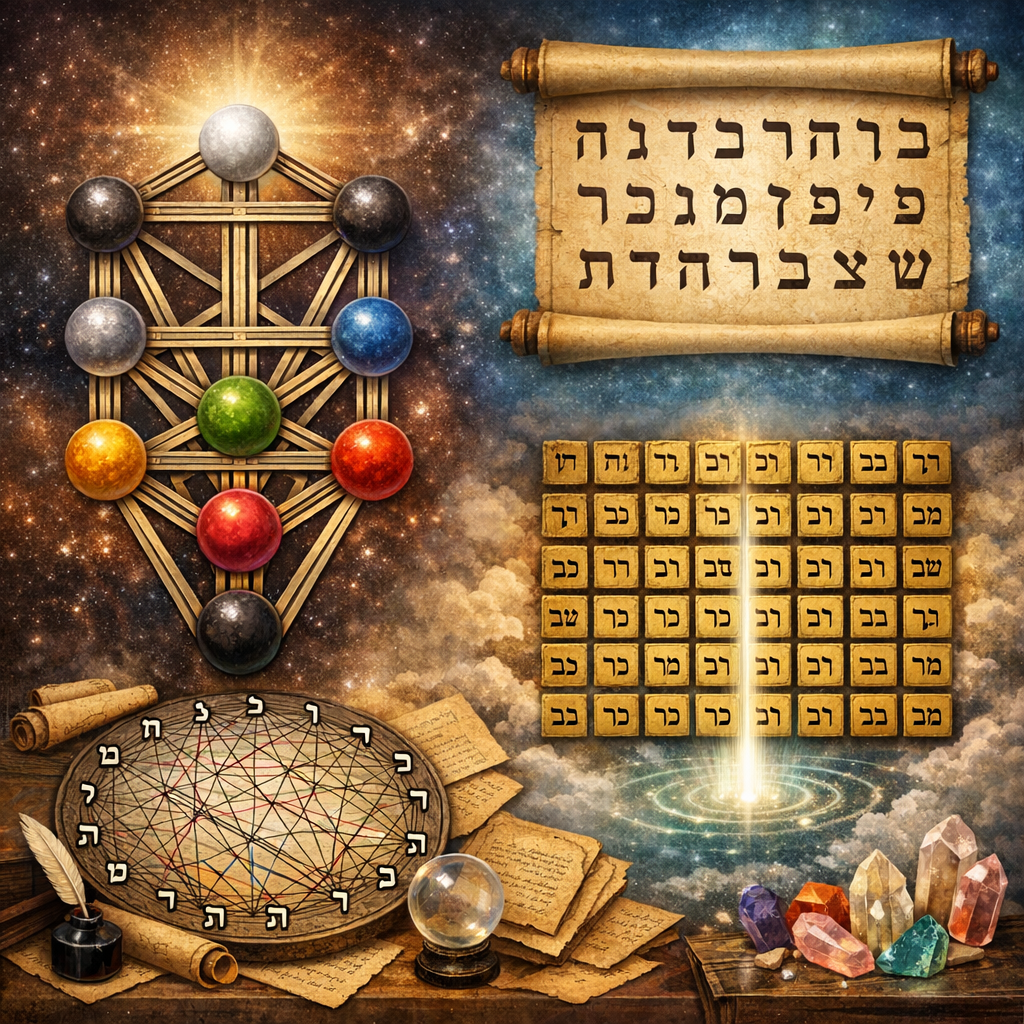
Kabbalah Deep Dive: Sefirot, Hebrew Letters, 72 Names, and the 231 Gates
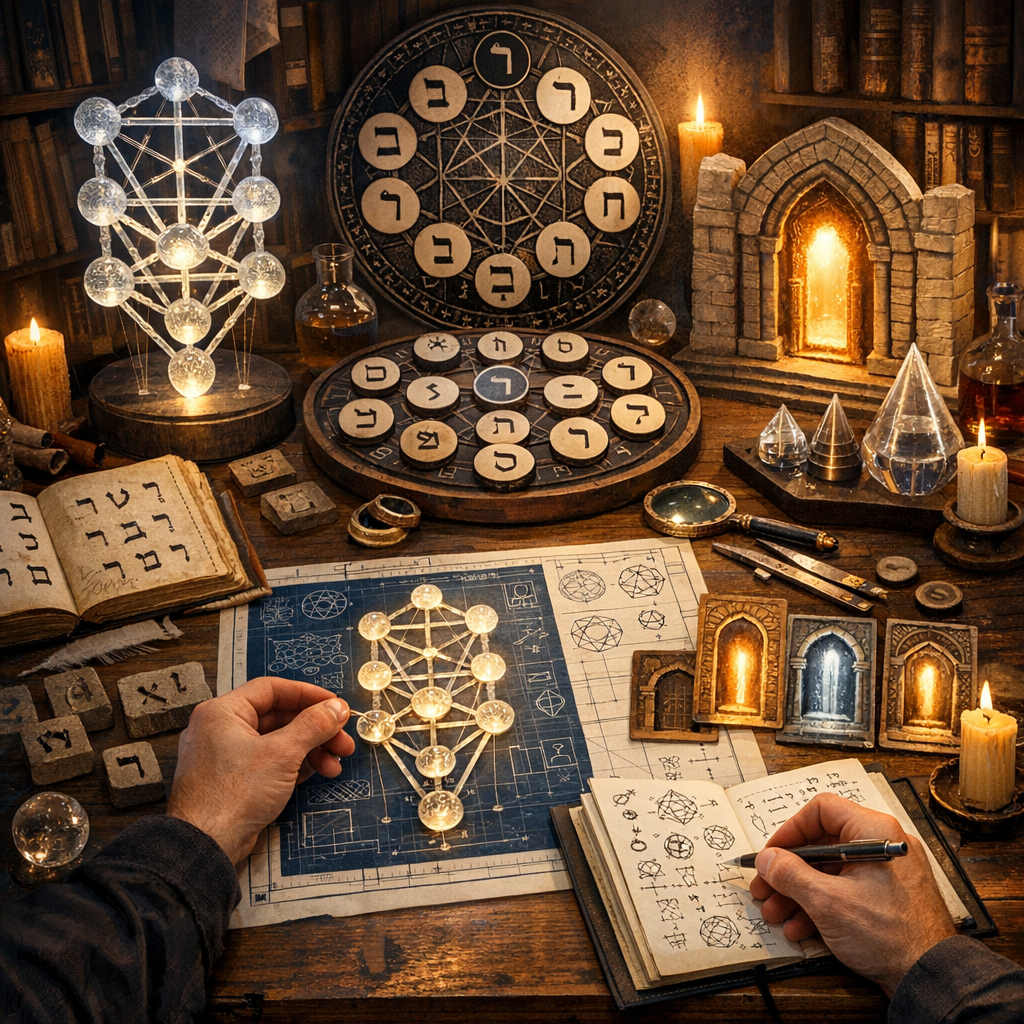
An intensive immersion into the core mystical architectures of classical and Lurianic Kabbalah, working directly with the ten sefirot as states of consciousness, the 22 Hebrew letters as creative vectors, structured groupings of the 72 Names, and the 231 Gates of Sefer Yetzirah as a living combinatorial map. Emphasis is on rigorous textual engagement with Sefer Yetzirah, the Zohar, and Lurianic sources, alongside advanced letter- and name-based contemplative practice.
The first lecture plays free — no account needed.
What you'll learn
- Students will be able to articulate how sefirot, Hebrew letters, the 72 Names, and the 231 Gates relate within the broader kabbalistic system.
- Students will understand the roles of Sefer Yetzirah, the Zohar, and Lurianic texts as primary sources for these structures.
- Students will be able to describe each of the ten sefirot as a distinct state of consciousness and divine attribute.
- Students will understand Lurianic notions of mochin d’katnut and mochin d’gadlut as applied to sefirotic experience.
- Students will be able to map the ten sefirot onto the Tree of Life and describe the function of pillars and paths.
- Students will understand how the four Worlds and Lurianic processes of contraction, shattering, and rectification contextualize sefirotic consciousness.
- Students will be able to summarize the basic structure and key themes of Sefer Yetzirah relevant to sefirot and letters.
- Students will understand how Sefer Yetzirah’s ten sefirot and twenty-two letters become the basis for later kabbalistic cosmology.
- Students will be able to describe the main classifications of the 22 Hebrew letters in Sefer Yetzirah and their symbolic associations.
- Students will understand how letters function as creative vectors in kabbalistic cosmology and contemplative practice.
Prerequisites
- Overview of sefirot and core kabbalistic sources from Module 1
- Ten sefirot as states of consciousness from Module 2
- Familiarity with sefirot and Tree of Life from Modules 2–3
- Sefer Yetzirah’s role and 32 paths from Module 4
- Understanding of the 22 letters as creative vectors from Module 5
- Conceptual grasp of the 231 Gates from Module 6
Course Content
14 modules · 3h 15m total
Mapping the Mystical Architecture: Sefirot, Letters, Names, and Gates
A panoramic orientation to the inner landscape of Kabbalah where numbers, letters, and Names interlock into a single multidimensional system of consciousness and creation. Step into a framework in which the ten sefirot, the Hebrew alphabet, the 72 Names, and the 231 Gates form one integrated map rather than isolated curiosities.
The Ten Sefirot as States of Consciousness
Enter the living Tree of Life not as an abstract diagram but as ten distinct modes of awareness, motivation, and perception. Trace how classical and Lurianic Kabbalah read the sefirot simultaneously as divine attributes and interior psychological states.
Tree of Life and the Four Worlds: Vertical and Horizontal Maps
Move from a flat diagram of ten circles into a multi-layered universe where each sefirah repeats across four worlds and along three pillars. Discover how kabbalists use the Tree of Life to navigate between levels of being, from primordial light to embodied reality.
Sefer Yetzirah and the 32 Paths: Numbers, Letters, and Creation
Enter the dense, cryptic world of Sefer Yetzirah, where ten numbers and twenty-two letters are said to be the very tools of creation. Trace how this early text seeds later kabbalistic understandings of sefirot, letters, and the 32 paths of wisdom.
The 22 Hebrew Letters as Creative Vectors
Shift your view of the Hebrew alphabet from a writing system to a set of energetic vectors through which reality is articulated. See how kabbalists classify the letters, map them to elements, planets, and body parts, and work with them as instruments of transformation.
The 231 Gates: Combinatorial Map of Consciousness
Enter the intricate lattice formed when every Hebrew letter is paired with every other, generating the 231 Gates. Watch how this complete graph of letter-pairs becomes a meditative dome, a map of permutations, and a way to think about the fabric of speech, thought, and being.
Working with the 231 Gates: Textual and Meditative Techniques
Move from theory to practice by engaging specific passages and commentaries that describe how to contemplate the 231 Gates. Glimpse traditional visualizations of the letters in a circle, techniques of permutation, and the interplay between sefirot and Gates in meditative states.
The 72 Names of God: Structures, Groupings, and Lineages
Open the dense cluster of the 72 Names not as a random list of syllables, but as a highly structured matrix derived from biblical verses and elaborated in later kabbalah. Trace different ways kabbalists group, interpret, and apply these Names within a traditional framework.
Names, Letters, and Sefirot: Configuring Consciousness
Watch how Names, letters, and sefirot interlock into larger configurations—partzufim, mochin, and other Lurianic structures—that describe shifting states of mind and spirit. See how kabbalists map particular Names and letter-forms onto specific sefirot and worlds.
Zoharic Readings: Sefirot and Letters in Narrative Garments
Enter the mythic, symbolic world of the Zohar where sefirot and letters appear as colors, rivers, garments, and lovers. Discover how narrative, parable, and poetic imagery encode highly technical teachings about divine attributes and the creative alphabet.
Integrating the 231 Gates with the Tree of Life
Overlay the lattice of the 231 Gates onto the Tree of Life to see how letter-pairs can be contemplated as paths linking sefirot and worlds. Experiment conceptually with how specific Gates might express transitions between states of consciousness mapped on the Tree.
Practices of Permutation: Letters, Names, and Gates in Contemplation
Bring the system to life through carefully framed, tradition-conscious exercises in letter and Name permutation. Examine classical descriptions of vocalization, visualization, and rotation of letters, and consider how to approach such practices with rigor and safety.
From Chaos to Rectification: 231 Gates and the Dynamics of Tikkun
Revisit the Gates within the Lurianic drama of shattering and repair, where permutations of letters and Names participate in the elevation of sparks. Consider how constructive and destructive combinations mirror the movement from chaos to rectification in psyche and cosmos.
Designing a Personal Kabbalistic Study and Practice Regimen
Gather the threads of sefirot, letters, Names, and Gates into a disciplined, long-term path of study and contemplative work. Shape a personal syllabus that honors traditional boundaries while allowing the system to function as a living map of your own consciousness.
Read the Textbook
Read every chapter for free, right here in your browser.
In this module, you will meet four key structures of Kabbalah as one integrated map: The ten sefirot (divine attributes / channels) The 22 Hebrew letters The 72 Names of God (a set of three-letter combinations) The 231 Gates (pairings of letters)
Our focus is not only what each is, but how they lock together into a single system of consciousness and creation.
Historically, these ideas emerge from different layers of Jewish mystical literature: Sefer Yetzirah ("Book of Formation") – usually dated between late antiquity and early medieval period. It presents a compact system of sefirot and letters as building blocks of reality. The Zohar – a medieval Aramaic mystical compendium (13th century) that becomes the core of classical Kabbalah. Lurianic Kabbalah – 16th-century system centered on the teachings of Rabbi Isaac Luria (the Ari) in Safed. It reinterprets sefirot, Names, and letters through new narratives like tzimtzum (contraction) and shevirat ha-kelim (shattering of the vessels).
Study Flashcards
Key concepts from this course as flashcard pairs.
Mapping the Mystical Architecture: Sefirot, Letters, Names, and Gates
Sefirot
Ten divine attributes or channels forming the backbone of the Kabbalistic Tree of Life, linking infinite Ein Sof to the finite world and serving as a ladder of consciousness.
Sefer Yetzirah
Early mystical text describing creation through 10 sefirot and 22 letters, introducing structures like the 32 paths of wisdom and the 231 Gates.
Zohar
Core work of classical Kabbalah (13th century), offering symbolic, narrative, and mystical interpretations of Torah, centered on the sefirot and divine Names.
Lurianic Kabbalah
16th-century Kabbalistic system of Rabbi Isaac Luria, featuring tzimtzum, shevirat ha-kelim, and tikun, and reinterpreting sefirot, Names, and letters as dynamic processes.
231 Gates
All possible pairs of the 22 Hebrew letters (22×21/2), conceptualized in Sefer Yetzirah as basic micro-channels or relationships between letter-energies.
72 Names of God
A set of 72 three-letter sequences derived from Exodus 14:19–21, treated as special channels or codes of divine energy in classical and Lurianic Kabbalah.
+2 more flashcards
The Ten Sefirot as States of Consciousness
Mochin d'katnut
Constricted consciousness: short horizon, strong ego defensiveness, reactive patterns, either/or thinking.
Mochin d'gadlut
Expanded consciousness: spacious awareness, patience, both/and thinking, ability to witness and choose responses.
Keter as consciousness
Awareness of awareness itself; a quiet sense of "I am" beyond specific thoughts and roles.
Chochmah vs Binah
Chochmah is the sudden flash of insight; Binah is the unpacking, analysis, and articulation of that insight.
Chesed in gadlut
Healthy, joyful generosity that respects your own and others' boundaries.
Gevurah in gadlut
Compassionate discipline and clear boundaries used in service of growth, not punishment.
+2 more flashcards
Tree of Life and the Four Worlds: Vertical and Horizontal Maps
Tree of Life (Etz Chaim)
A symbolic map of ten sefirot and 22 paths, arranged in three pillars, used to describe the structure of divine attributes, consciousness, and creation.
Sefirot
Ten dynamic modes or attributes of divine expression that also function as states of human consciousness, from Keter (crown) to Malkhut (embodiment).
Three Pillars
Right (expansion, Chesed), Left (contraction, Gevurah), and Middle (balance, Tiferet) columns on the Tree, expressing basic energetic tendencies.
Four Worlds
Atzilut (Emanation), Beriah (Creation), Yetzirah (Formation), Asiyah (Action) – four levels at which the Tree of Life pattern is expressed with increasing concreteness.
Tzimtzum
Lurianic concept of divine contraction or withdrawal of revealed light to make apparent space for finite creation and the four Worlds.
Shevirat ha-kelim
The shattering of the sefirotic vessels when they cannot contain divine light, scattering shards and sparks and introducing brokenness into creation.
+2 more flashcards
Sefer Yetzirah and the 32 Paths: Numbers, Letters, and Creation
Sefer Yetzirah
An early Jewish mystical text (core layers roughly 3rd–6th c. CE) that describes creation through ten sefirot belimah and twenty-two Hebrew letters, forming 32 paths of wisdom.
32 Paths of Wisdom
A formula in Sefer Yetzirah: 10 sefirot belimah + 22 letters = 32 paths by which God 'engraves' or structures reality. Later kabbalists expand this into a full Tree of Life system.
Sefirot belimah
Literally 'sefirot of nothingness' or 'without what'. In Sefer Yetzirah, abstract, non-material principles or dimensions, later identified with the ten kabbalistic sefirot.
Three Mother Letters
Alef, Mem, Shin. In Sefer Yetzirah, associated with the elements air, water, and fire, and with major bodily and cosmic zones.
Seven Double Letters
Bet, Gimel, Dalet, Kaf, Peh, Resh, Tav. Called 'double' due to two pronunciations; mapped to the seven classical planets and the seven days of the week.
Twelve Simple Letters
The remaining twelve Hebrew letters in Sefer Yetzirah, associated with the twelve zodiac signs and twelve bodily organs or functions.
+1 more flashcards
The 22 Hebrew Letters as Creative Vectors
Sefer Yetzirah
An early Jewish mystical text that describes creation through **10 sefirot** and **22 Hebrew letters**, forming the 32 paths of wisdom. It is the main source for the classification of letters into mothers, doubles, and simples.
Mother letters
The 3 letters **Alef, Mem, Shin**. In Sefer Yetzirah they are linked to the elements **air, water, fire** and function as primal axes or root forces in creation.
Double letters
The 7 letters **Bet, Gimel, Dalet, Kaf, Pe, Resh, Tav**. Called "double" because they have dual pronunciations or polar qualities, and are associated with **7 planets** and **7 days of the week**.
Simple letters
The 12 letters **He, Vav, Zayin, Chet, Tet, Yod, Lamed, Nun, Samekh, Ayin, Tzadi, Qof**. Associated with **12 zodiac signs**, **12 months**, and **12 bodily functions or organs**.
Creative vector (in this module)
A way of understanding a letter as a **direction of energy or pattern of articulation** in reality, rather than just a sound or symbol.
Four Worlds
A kabbalistic model of reality: **Atzilut (Emanation)**, **Beriah (Creation)**, **Yetzirah (Formation)**, **Asiyah (Action)**. Each letter can be contemplated as operating differently in each world.
+2 more flashcards
The 231 Gates: Combinatorial Map of Consciousness
231 Gates
The full set of distinct 2-letter combinations formed from the 22 Hebrew letters, counted as unordered pairs: C(22, 2) = 231. A core concept in Sefer Yetzirah.
Combination vs. permutation
A combination ignores order (AB = BA), while a permutation treats different orders as distinct (AB ≠ BA). The 231 Gates use combinations; forward/backward readings use permutations.
Forward and backward letter-pairs
Two directions of a given Gate (e.g., AB and BA). Traditionally read as constructive (building, expression) vs. destructive or returning (undoing, integration).
Complete graph K_n
A graph in which every vertex is connected to every other. For n = 22 letters, K_22 has C(22, 2) = 231 edges, mirroring the 231 Gates.
Sefer Yetzirah and the 32 Paths
An early Jewish mystical text describing creation through 10 sefirot and 22 letters (32 paths). The 231 Gates refine how the 22 letters interrelate.
Working with the 231 Gates: Textual and Meditative Techniques
231 Gates
The complete set of pairwise combinations of the 22 Hebrew letters, described in Sefer Yetzirah as lines connecting letters arranged in a circle, forming a network that underlies speech and opposites.
Gate (letter-pair)
A specific ordered pair of Hebrew letters (e.g., אב). In meditation, it functions as a micro-path or dynamic relationship between the energies or qualities of the two letters.
Linguistic-combinatorial lens
A way of reading the 231 Gates that focuses on letters as building blocks of words and roots, treating each gate as a generator of possible syllables and meanings.
Ontological / metaphysical lens
An approach that sees letters as energetic vectors. A gate is then a tension or dialogue between two letter-energies, not just a sound or spelling unit.
Sefirotic lens
A later kabbalistic approach that links letters and gates to sefirot or inner traits, viewing each gate as a small pathway between aspects of divine or human character.
Gate walk
A meditative technique where you visualize two letters and a line between them, then use breath and attention to "travel" from one letter to the other and back.
+1 more flashcards
The 72 Names of God: Structures, Groupings, and Lineages
72 Names of God (Shem Ayin‑Bet)
A set of 72 three‑letter sequences derived from Exodus 14:19–21 using a forward‑backward‑forward (boustrophedon) arrangement of the verses; understood in classical kabbalah as 72 aspects of the one divine Name.
Boustrophedon
A writing pattern that alternates direction line by line (forward, backward, forward). Kabbalists use it to arrange Exodus 14:19–21 into a 3×72 grid that yields the 72 triplets.
Practical Kabbalah
Streams of kabbalistic practice focused on applied uses such as protection, healing, or amulets, often involving divine Names. Distinct from purely contemplative or philosophical kabbalah and subject to halakhic debate.
Structural Grouping
Any systematic way of organizing the 72 Names: by sequence (1–72), table rows/columns, fourfold division (18×4), initial letters, or intended function.
Syncretic Adaptation
Later systems that combine the 72 Names with non‑Jewish frameworks (e.g., astrology, Tarot, New Age self‑help), often detaching them from halakhic and traditional communal contexts.
Kavanah
Inner intention or focused awareness during prayer or ritual. In classical kabbalah, contemplation of the 72 Names is grounded in kavanah and ethical self‑work.
Names, Letters, and Sefirot: Configuring Consciousness
Partzuf (plural: partzufim)
A full ten‑sefirah configuration treated as a "face" or persona (e.g., Arich Anpin, Abba, Imma, Zeir Anpin, Nukva) that represents a complex state of Divine and human consciousness.
Mochin
Literally "brains" or mind-states; in Lurianic Kabbalah, the degree of consciousness and integration present in a partzuf, often described as katnut (smallness) or gadlut (greatness).
Katnut
A constricted state of mochin: narrow perspective, strong reactivity, limited capacity to integrate insight and emotion.
Gadlut
An expanded state of mochin: broad perspective, emotional balance, and the ability to hold nuance and integrate insight with feeling.
Zeir Anpin
The "Small Face" partzuf composed mainly of the emotional sefirot (Chesed–Yesod); often associated with the Name YHVH and our inner emotional life.
Nukva / Malkhut
The feminine, receptive partzuf corresponding to Malkhut; associated with expression, speech, manifestation, and the Name Adonai.
+4 more flashcards
Zoharic Readings: Sefirot and Letters in Narrative Garments
Zoharic narrative garments
Stories, parables, and poetic images (kings, queens, rivers, gardens, garments) that clothe technical teachings about sefirot, letters, and Names.
Malkhut / Shekhinah in Zoharic imagery
Often appears as queen, bride, daughter, moon, garden, orchard, field, or the community of Israel; represents the revealed, receptive aspect of divinity.
Binah in Zoharic imagery
Frequently symbolized by mother, palace, womb, sea, or river that flows out and expands; associated with understanding and expansion from a hidden source.
Letters as garments
Zoharic idea that Torah letters and Names are like clothes or colored glass through which hidden divine light becomes visible and readable.
Letters petitioning for creation
A Zoharic story where each Hebrew letter asks to begin creation. Encodes a hierarchy and selection of letter‑forces that will structure the world.
Technical paraphrase (in this module)
A short restatement of a Zoharic story using kabbalistic terms like sefirot, letters, Names, and worlds, making the encoded doctrine explicit.
+1 more flashcards
Integrating the 231 Gates with the Tree of Life
231 Gates
All unordered pairs of the 22 Hebrew letters (22×21/2). In this module, each Gate is treated as a potential directional transition in consciousness that can be overlaid onto Tree of Life paths.
Tree of Life (simplified model)
A structured map of 10 sefirot arranged in right, left, and center columns, with vertical, horizontal, and diagonal paths. Used here as a coarse map of states of consciousness and their transitions.
Layer 1 (Mapping method)
Associate each individual letter with a sefirah or broader zone (intellect, emotional-ethical, implementation) based on its traditional qualities and your working framework.
Layer 2 (Mapping method)
Treat a Gate AB as a directional path from the sefirah associated with A to that of B, deciding whether it is vertical, horizontal, or diagonal on the Tree.
Layer 3 (Mapping method)
Refine the mapping by considering front/back aspects of the involved sefirot and articulating the inner state change or experiential transition that the Gate expresses.
Front (panim) of a sefirah
The outward, expressive face of a sefirah, turned toward lower sefirot or the worlds. A Gate engaging the front often emphasizes expression, giving, or manifestation.
+2 more flashcards
Practices of Permutation: Letters, Names, and Gates in Contemplation
231 Gates
The set of all unique pairs of the 22 Hebrew letters (22 × 21 / 2 = 231), described in Sefer Yetzirah as 'gates' through which creation is articulated.
Letter Circle
A visualization in which letters are arranged around a circular perimeter, supporting contemplation of rotation, cyclical time, and encompassing presence.
Yichudim
Complex kabbalistic unifications involving Divine Names, vowels, and sefirot, often combining visualization and vocalization; traditionally reserved for advanced, supervised practice.
Practical Kabbalah
The use of Names, permutations, or rituals to attempt direct effects in the world (healing, protection, control). Strongly restricted or forbidden by many halakhic authorities.
Architectural Imagination
A way of thinking in kabbalah that arranges letters and Names as circles, lines, domes, or spheres, creating inner 'spaces' for contemplation.
Safe Undergraduate Practice
Working with neutral letters or standard liturgical phrases, focusing on visualization and attention training, while leaving experimental Name permutations to advanced, supervised contexts.
From Chaos to Rectification: 231 Gates and the Dynamics of Tikkun
231 Gates (Shaarei Tziruf)
The set of all unique pairings of the 22 Hebrew letters (22×21/2), treated as dynamic links that can be read forward or backward and used to model flows of energy between states or sefirot.
Olam HaTohu (World of Chaos)
A Lurianic configuration in which sefirot receive intense divine light without sufficient integration, leading to the shattering of the vessels and the scattering of sparks.
Olam HaTikkun (World of Rectification)
The balanced post-shattering configuration in which sefirot are harmonized and inter-included; human action and intention participate in elevating sparks and repairing fractures.
Shevirat HaKelim (Shattering of the Vessels)
The Lurianic event in which unstable vessels of Tohu break under intense light, their fragments and sparks falling into lower realms and becoming embedded in kelipot.
Nitzotzot (Sparks)
Divine energy particles trapped in broken vessels and shells; tikkun involves elevating these sparks back to their proper roots.
Kelipot (Shells)
Layers of concealment or obstruction that imprison divine sparks; often associated with chaotic or destructive configurations of energy.
+2 more flashcards
Designing a Personal Kabbalistic Study and Practice Regimen
Sefirot
Ten interconnected divine modalities or attributes used in Kabbalah as a map of God, cosmos, and psyche (e.g., Chesed, Gevurah, Tiferet).
Sefer Yetzirah
An early short Kabbalistic text focusing on creation through 32 paths (10 sefirot and 22 letters), including the 231 Gates (letter pairs).
Zohar
Foundational medieval Kabbalistic work, a mystical Aramaic commentary on the Torah, compiled in 13th‑century Spain and attributed to R. Shimon bar Yochai.
Lurianic Kabbalah
System developed by R. Isaac Luria (the Ari, 16th c.), centered on themes of contraction (tsimtsum), shattering (shevirah), and repair (tikkun).
231 Gates
All ordered pairs of the 22 Hebrew letters (22×21/2), described in Sefer Yetzirah as dynamic pathways of creation and transformation.
Name (Divine Name)
A traditional designation of God (e.g., the Tetragrammaton) used in scripture and liturgy; in this module treated conceptually and devotionally, not for unsupervised practical magic.
+2 more flashcards
More in Arts & Culture
See all →
Introduction to Philosophy: Big Questions and Key Thinkers
Mastering The Wheel of Time: A Comprehensive Expert Course
Advanced Tarot: Archetypes, Symbolism, and the Narrative Web of the Arcana
Tarot Card Deep Dive: Symbolism, History, and Story Across the Arcana
Foundations of Tarot: History, Structure, and the Major Arcana Journey