Skarp
Skarp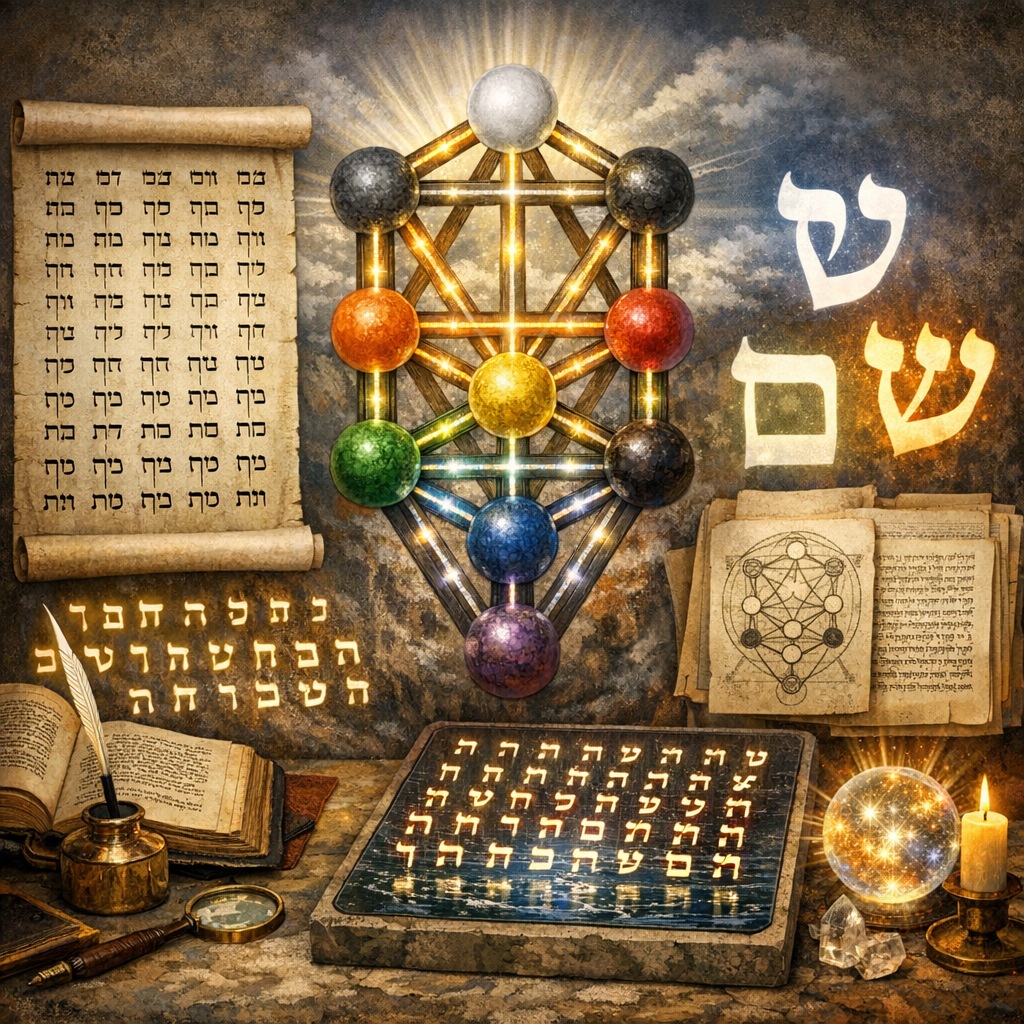
Kabbalah Beyond Maps: Intensive Letter, Tree, and Name Work as Technology of Consciousness
A demanding, text-rooted immersion in the Tree of Life, the 22 Hebrew letters, the 72 Names of God, and the 231 Gates as a practical technology of consciousness and creation. Students work daily with primary sources and structured meditative, contemplative, and ritual exercises to internalize these patterns as living forces rather than abstract diagrams.
The first lecture plays free — no account needed.
What you'll learn
- Students will be able to articulate the difference between symbolic study of Kabbalah and its use as a technology of consciousness.
- Students will understand the overall architecture of the course and how Tree, letters, 72 Names, and 231 Gates interlock.
- Students will be able to describe the four worlds and the sefirotic Tree at a high level as a framework for practice.
- Students will understand baseline safety, ethical, and psychological guidelines for intensive contemplative work.
- Students will be able to identify the ten sefirot and three pillars and link each to concrete inner experiences.
- Students will understand how to use the Tree as a map for observing emotional and cognitive patterns.
- Students will be able to perform a brief Tree-of-Life body scan linking physical sensations to sefirotic zones.
- Students will be able to classify the 22 letters into mothers, doubles, and simples based on Sefer Yetzirah.
- Students will understand how letter-shape, sound, and numeric value function as multidimensional symbols.
- Students will be able to perform a short contemplative exercise with at least one letter using visualization and breath.
Prerequisites
- Kabbalah as experiential technology vs. abstract theory
- Four worlds and Tree of Life as layered states of consciousness
- Ten sefirot as psycho-spiritual functions
- Primary sources: Sefer Yetzirah, Zohar, Lurianic corpus
- Twenty-two letters as foundation of creation in Sefer Yetzirah
- Core passages on letter permutation and 231 Gates
Course Content
13 modules · 3h total
From Diagram to Device: Reframing Kabbalah as Technology of Consciousness
Kabbalah stops being a set of pretty diagrams and becomes a precision device the moment you treat letters, sefirot, and Names as levers on awareness. This opening module sketches the terrain and sets the frame for a high-intensity, text-rooted practice path.
The Tree as Nervous System: Sefirot, Paths, and Inner Topography
The Tree of Life stops being an abstract glyph when it maps directly onto your attention, emotions, and will. This module turns the sefirot and paths into an inner nervous system you can actually feel and navigate.
The Twenty-Two Forces: Hebrew Letters as Vectors of Creation
When the Hebrew letters are treated not as phonetic symbols but as forces, each shape, sound, and number becomes a distinct way consciousness moves. This module introduces the letters as the basic operators of the system.
Inside Sefer Yetzirah: Structure, Cosmology, and Practice Keys
Behind the dense, cryptic lines of Sefer Yetzirah lies a remarkably compact operating manual for consciousness and cosmos. This module unpacks its structure so you can begin to read it as a set of practice instructions rather than an obscure relic.
The 231 Gates: Combinatorial Engine of Letters and States
Pair every letter with every other and a lattice of 231 Gates appears, a combinatorial engine that Sefer Yetzirah presents as the scaffolding of creation. This module turns that abstraction into a concrete meditative and imaginative practice.
The 72 Names as Luminous Matrices: Origin, Structure, and Orientation
Seventy-two three-letter sequences derived from Exodus become, in Kabbalistic hands, a set of luminous matrices for aligning with specific modes of divine action. This module lays out where they come from and how they are traditionally framed.
Working the Names: Visualization, Intention, and Breath Protocols
Once the 72 Names are seen as living matrices, the question becomes how to actually touch them without slipping into fantasy. This module offers concrete visualization, intention, and breath protocols for disciplined Name work.
Lurianic Dynamics: Tzimtzum, Shattering, and Repair in Personal Practice
Lurianic Kabbalah reframes creation as contraction, shattering, and ongoing repair—a drama that plays out inside your own psyche. This module connects those cosmological motifs to concrete inner work with the Tree, letters, and Names.
Zoharic Imagery as Practice: Light, Speech, and Symbolic Worlds
The Zohar’s dense images of light, speech, and flowing letters are not just poetic—they are practice environments. This module teaches you how to enter those images and let them reconfigure perception from the inside out.
Integrating Letters, Gates, Names, and Tree in One Practice Circuit
The system becomes truly powerful when letters, Gates, Names, and the Tree stop being separate topics and start functioning as one integrated circuit. This module walks through building a compact yet potent sequence that touches all four.
Risk, Ethics, and Discernment: Safeguards for High-Intensity Work
Any technology that can rewire perception can also destabilize it. This module addresses the shadow side: inflation, obsession, bypassing, and how to build ethical and psychological guardrails around your practice.
Designing Your Personal Regimen: Daily, Weekly, and Cycle-Based Practice
With the tools in hand, the question becomes how to live with them over months and years. This module helps you architect a sustainable yet demanding regimen that weaves Tree, letters, Names, and Gates into the fabric of ordinary days.
Closing the Circuit: Integration, Assessment, and Next Steps in Kabbalistic Practice
Intensive work needs equally intentional closure. This final module consolidates what has been built, helps you assess changes in perception and behavior, and sketches possible next directions for deeper engagement with texts and teachers.
Read the Textbook
Read every chapter for free, right here in your browser.
In this opening step, we set the frame for the entire course.
Most people today meet Kabbalah as posters of the Tree of Life, lists of sefirot, or mystical buzzwords. In this course, you will approach Kabbalah as technology of consciousness: a set of precisely structured practices that change how you perceive, feel, and act.
"Technology" here does not mean electronics. It means repeatable procedures (like algorithms or lab protocols) that reliably shift awareness when used with care. Letters, sefirot, and Divine Names stop being abstract symbols and start functioning like levers, lenses, and filters for attention.
Study Flashcards
Key concepts from this course as flashcard pairs.
From Diagram to Device: Reframing Kabbalah as Technology of Consciousness
Technology of consciousness
A set of structured, repeatable practices that reliably shift awareness, treating symbols (like letters and sefirot) as practical levers, not just ideas.
Four worlds
Atzilut, Beriah, Yetzirah, Asiyah: traditionally levels of reality, used here as layers of experience (presence, thought/meaning, emotion/imagery, body/action).
Sefirot / Tree of Life
Ten interconnected qualities or functions (like Chesed, Gevurah, Tiferet) forming a map of recurring states and transitions in consciousness.
72 Names of God
Seventy-two three-letter Names, traditionally derived from Exodus, used here as complex attention patterns and focal points for kavvanah.
231 Gates
All unique pairs of the 22 Hebrew letters, described in Sefer Yetzirah, treated as transitions or relationships between micro-states of attention.
Kavvanah
Directed intention and focused awareness in practice; knowing why you are practicing and keeping attention on the chosen focus.
+2 more flashcards
The Tree as Nervous System: Sefirot, Paths, and Inner Topography
Sefirot (singular: sefirah)
Ten core functional hubs on the Tree of Life. In this module: psycho-spiritual modes of attention, emotion, and will that you can directly feel and observe.
Three Pillars
Right (expansion: Chesed/Netzach side), left (contraction: Gevurah/Hod side), middle (integration: Keter–Tiferet–Yesod–Malkhut). They describe regulation styles of your inner system.
Chesed
Sefirah of lovingkindness and expansion. Feels like warmth, generosity, saying yes, and moving outward. When excessive: over-giving, poor boundaries.
Gevurah
Sefirah of strength, discipline, and boundaries. Feels like clarity, focus, and the ability to say no. When excessive: harshness, rigidity, self-criticism.
Tiferet
Sefirah of beauty and heart-centered balance. Feels like coherence, integrity, and honest presence. Integrates the pull of Chesed and Gevurah.
Yesod
Sefirah of foundation. Represents subconscious patterns, emotional memory, sexuality, and bonding. Feels like gut-level attraction, aversion, and habit energy.
+2 more flashcards
The Twenty-Two Forces: Hebrew Letters as Vectors of Creation
Mothers (3)
The 3 Mother letters in Sefer Yetzirah are **Alef (א), Mem (מ), Shin (ש)**. They model fundamental states (air, water, fire; balance, flow, intensity).
Doubles (7)
The 7 Double letters are **Bet, Gimel, Dalet, Kaf, Pe, Resh, Tav**. They can take hard/soft sounds and encode basic polarities of experience.
Simples (12)
The 12 Simple letters are **He, Vav, Zayin, Chet, Tet, Yod, Lamed, Nun, Samekh, Ayin, Tzadi, Qof**. They represent more detailed qualities or directions.
Three Lenses of a Letter
Each letter-force is approached through **shape (visual geometry)**, **sound (auditory/somatic waveform)**, and **number (numeric value / position)**.
Alef as a Vector
Alef’s shape suggests balance along a vertical axis, its sound is a glottal pause carrying vowels, and its number is **1**, pointing to unity and centering.
Letter Contemplation
A practice that uses a letter’s **visual form**, **pronounced sound**, and **felt effects in the body** (often with breath) to shift consciousness intentionally.
Inside Sefer Yetzirah: Structure, Cosmology, and Practice Keys
Sefer Yetzirah
A short early Jewish mystical text (likely late antiquity to early Middle Ages) that describes creation through 10 sefirot and 22 Hebrew letters, serving as a compact blueprint for later Kabbalistic cosmology and practice.
Ten Sefirot of Nothingness
In Sefer Yetzirah, abstract measures or axes of reality (depths, directions, beginnings/ends), not yet the fully named Tree-of-Life sefirot. They structure space, time, and value as polar dimensions.
22 Letters (Mothers, Doubles, Simples)
The Hebrew alphabet divided into 3 Mother letters (elements/primary modes), 7 Double letters (reversible, planetary states), and 12 Simple letters (zodiacal, fine‑tuning qualities).
231 Gates
The 231 unique pairs formed by combining 22 letters two at a time (22×21/2). Each pair is a "gate" or relational configuration of forces, used as a basis for permutation and meditative practice.
Permutation (in Sefer Yetzirah)
The process of combining and reordering letters to generate different creative and experiential patterns, often linked to imagery of engraving, hewing, and rotating letters in all directions.
Practice Key
A way of reading a line of Sefer Yetzirah as a direct instruction for attention, breath, or imagination, rather than as a purely theoretical or historical statement.
The 231 Gates: Combinatorial Engine of Letters and States
231 Gates
The set of all unordered pairings of the 22 Hebrew letters, C(22, 2) = 231, treated in Sefer Yetzirah as a lattice or network of creative connections.
Ordered pair
A pairing where direction matters: AB is different from BA. In this module, ordered pairs represent directional flows between letter-forces.
Unordered pair
A pairing where AB is considered the same as BA. The 231 Gates are usually counted as unordered pairs of letters.
Directionality (forward/backward)
The distinction between moving from letter X to letter Y (X→Y) and from Y back to X (Y→X), used to model different inner state transitions.
Micro-practice
A brief (30–90 second) contemplative drill focused on a single gate and direction, using breath, attention, and small physical cues.
Graph representation
A way of visualizing the 231 Gates as a network: letters are nodes, and each gate is an edge connecting two nodes.
The 72 Names as Luminous Matrices: Origin, Structure, and Orientation
72 Names (in Kabbalistic context)
A set of seventy-two three-letter Hebrew sequences derived from Exodus 14:19–21, treated as luminous matrices or patterned modes of divine action rather than simple labels.
Boustrophedon method
The back-and-forth arrangement used to derive the 72 Names: write three 72-letter verses in rows, reverse the middle row, then read vertically in columns to form triplets.
Name as luminous matrix
A Kabbalistic understanding of a divine Name as a specific configuration of letter-qualities, like a stable pattern or "standing wave" in divine speech, not just a tag or label.
Connection to angels
Later Kabbalistic and magical systems form 72 angelic names from the 72 triplets (often adding "El" or "Yah"), mapping them to cosmic functions while emphasizing that worship is directed only to God.
Ethical orientation of Name practice
Classical sources require that work with Names be grounded in ethical behavior, humility, and prayerful intention, aiming at closeness to God and moral refinement rather than control or manipulation.
Relationship to Sefer Yetzirah and 231 Gates
Like Sefer Yetzirah and the 231 Gates, the 72 Names treat Hebrew letters as building blocks of reality, using a specific combinatorial pattern (from Exodus) to generate a lattice of 72 triplets.
Working the Names: Visualization, Intention, and Breath Protocols
Kavvanah
Focused intention or directed awareness in practice. In Name work, it means aligning your inner orientation with the Name's traditional theme and expressing it through ethical, concrete behavior.
Somatic visualization
Placing imagined letters or symbols at specific locations in the body (for example, chest, throat, forehead) to link abstract matrices with embodied awareness.
Equal breath (4–4)
A breathing pattern where you inhale for a count of 4 and exhale for 4, often pairing the inhale with visualization and the exhale with silent recitation of the Name.
Extended exhale (4–6)
A pattern of inhaling for 4 counts and exhaling for 6, associated with calming the nervous system and useful for Names focused on letting go or soothing anxiety.
Box breathing (4–4–4–4)
A structured breath cycle: inhale 4, hold 4, exhale 4, hold 4. Often used for centering and for Names connected to strength, boundaries, or clarity.
Practice cycle (3–7 days)
A short, time-limited period in which you work consistently with one (or a small set of) Name(s), following a fixed protocol for duration, timing, breath pattern, and journaling.
+2 more flashcards
Lurianic Dynamics: Tzimtzum, Shattering, and Repair in Personal Practice
Tzimtzum
Lurianic "contraction" or self‑limitation of divine presence, understood in later tradition as concealment rather than literal absence; in inner work, a practice of spacious, awake withdrawal that creates room for response.
Shevirat ha‑kelim
"Shattering of the vessels" when early sefirotic containers cannot hold the divine light; inwardly, moments of overload, fragmentation, or crisis when existing structures of meaning crack.
Tikkun
Ongoing repair and re‑configuration after shattering; cosmically, raising sparks and harmonizing sefirot; psychologically, iterative integration and building more balanced inner containers.
Sefirah (plural: sefirot)
One of the ten modalities or channels of divine expression on the Tree of Life (e.g., Hesed, Gevurah, Tiferet), used in practice as lenses for specific qualities and patterns.
72 Names
Seventy‑two three‑letter sequences derived from Exodus 14:19–21, treated in Kabbalah as "luminous matrices" of divine action, engaged through visualization, intention, and breath.
Vessel (Kli)
A container for light; symbolically, any structure (habit, belief, boundary, skill) that holds energy or insight. Shattering occurs when the light exceeds the vessel's capacity.
Zoharic Imagery as Practice: Light, Speech, and Symbolic Worlds
Zohar as symbolic landscape
An approach that treats the Zohar as a set of imaginal worlds or practice environments you can enter, rather than as a systematic doctrinal manual.
Rivers of light
A recurring Zoharic image of flowing, often multicolored light, linked to the emanation of divine energy through the sefirot on the Tree of Life.
Garments of letters
Zoharic motif in which souls, prayers, or divine light are clothed in Hebrew letters that both conceal and reveal the inner light they carry.
Speaking fire
Imagery in which speech appears as fire (e.g., black fire on white fire), highlighting the tangible, transformative power of words and Names.
Lectio divina–style reading
A four‑phase method (read, reflect, respond, rest) of slow, contemplative engagement with a short text passage, adapted here to Zoharic study.
Practice environment
A symbolic scene (like a river of light or garden of sparks) that you enter imaginally and inhabit, allowing it to shape your perception and inner states.
+1 more flashcards
Integrating Letters, Gates, Names, and Tree in One Practice Circuit
Practice circuit
A time-bound sequence (about 20–30 minutes) that integrates Tree grounding, letter or Gate work, and one or more Divine Names into a single coherent flow.
Gate (in this course)
A repeatable movement between two sefirot or states (e.g., Yesod→Tiferet, Hod→Netzach) that reliably opens a recognizable inner configuration.
Coherent correspondence
A set of Tree focus, letter, Gate, and Name chosen because they naturally support each other and match your current psychological pattern, rather than being random.
Lurianic tzimtzum in practice
The intentional contraction of attention and time (e.g., a 25-minute circuit) to create a container in which inner shattering and repair can safely unfold.
Symbolic density
How many images, letters, Names, and Tree-elements you hold at once; a key variable for adjusting practice intensity to your current capacity.
Risk, Ethics, and Discernment: Safeguards for High-Intensity Work
Spiritual bypassing
Using spiritual ideas or practices to avoid dealing with unresolved emotional issues, trauma, or relational work (for example, "everything is light" instead of addressing real harm).
Grandiosity (in mystical practice)
An exaggerated sense of spiritual importance or power, such as believing you are uniquely chosen or beyond critique because of your experiences.
Ethical focus of Name and letter work
Directing practices toward your own inner transformation and alignment, not toward manipulating or covertly influencing other people's minds, bodies, or choices.
Support structure (three circles)
A safety network of (1) teachers/guides, (2) peer companions, and (3) mental health/medical professionals who help you pace and ground your practice.
Early warning sign
A change in thoughts, emotions, or behavior (for example, obsession, mood swings, derealization, superiority) that signals your practice may be destabilizing or ethically compromised.
Designing Your Personal Regimen: Daily, Weekly, and Cycle-Based Practice
Daily micro-practice
A short (about 5–20 minute) routine you can do most days that lightly touches the Tree, letters, Names, and Gates in an integrated way.
Weekly deep dive
A longer session (about 30–60 minutes) that combines expanded practice, study, and review of your notes to integrate and adjust your work.
Thematic cycle
A focused period, often about 4 weeks, centered on one sefirah or related cluster of letters, Names, and Gates to avoid scattered practice.
Gate (in this course)
A specific state, threshold, or life context where certain Tree qualities and Names become especially active and noticeable.
Iteration
The process of regularly reviewing your practice, keeping what works, softening what strains you, and trying small, safe adjustments each cycle.
Closing the Circuit: Integration, Assessment, and Next Steps in Kabbalistic Practice
Tikkun
Literally "repair" or "rectification"; in this context, the integration and re-ordering of consciousness and life that follows spiritual work, not just the intense experiences themselves.
Sefirot
Dynamic modalities or channels of Divine expression and human experience (such as Chesed, Gevurah, Tiferet), often mapped as the Tree of Life.
Gates / Paths
Connections between Sefirot on the Tree of Life; represent transitions, processes, and inner journeys rather than static states.
Divine Names
Specific designations of the Divine understood in Kabbalah as distinct modes of relationship and energy, not merely labels or magic formulas.
Inflation (Spiritual)
A distorted state where spiritual experiences are used to support grandiosity, specialness, or superiority instead of humility and responsibility.
Spiritual Bypassing
Using spiritual ideas or practices to avoid dealing with psychological wounds, ethical responsibilities, or real-world problems.
+2 more flashcards
More in Personal Development
See all →
Master Thief of Skyrim: Stealth, Strategy, and Heists

Rc-autoilun perusteet ja turvallinen harrastaminen

Matematiklyftet åk 9 – komplett träning inför nationella provet
Hyper-Advanced Kabbalah Lab: Designing and Operating Your Personal Tree of Life System

Strategie per la Maturità: Metodo di Studio e Gestione dell’Esame