Skarp
Skarp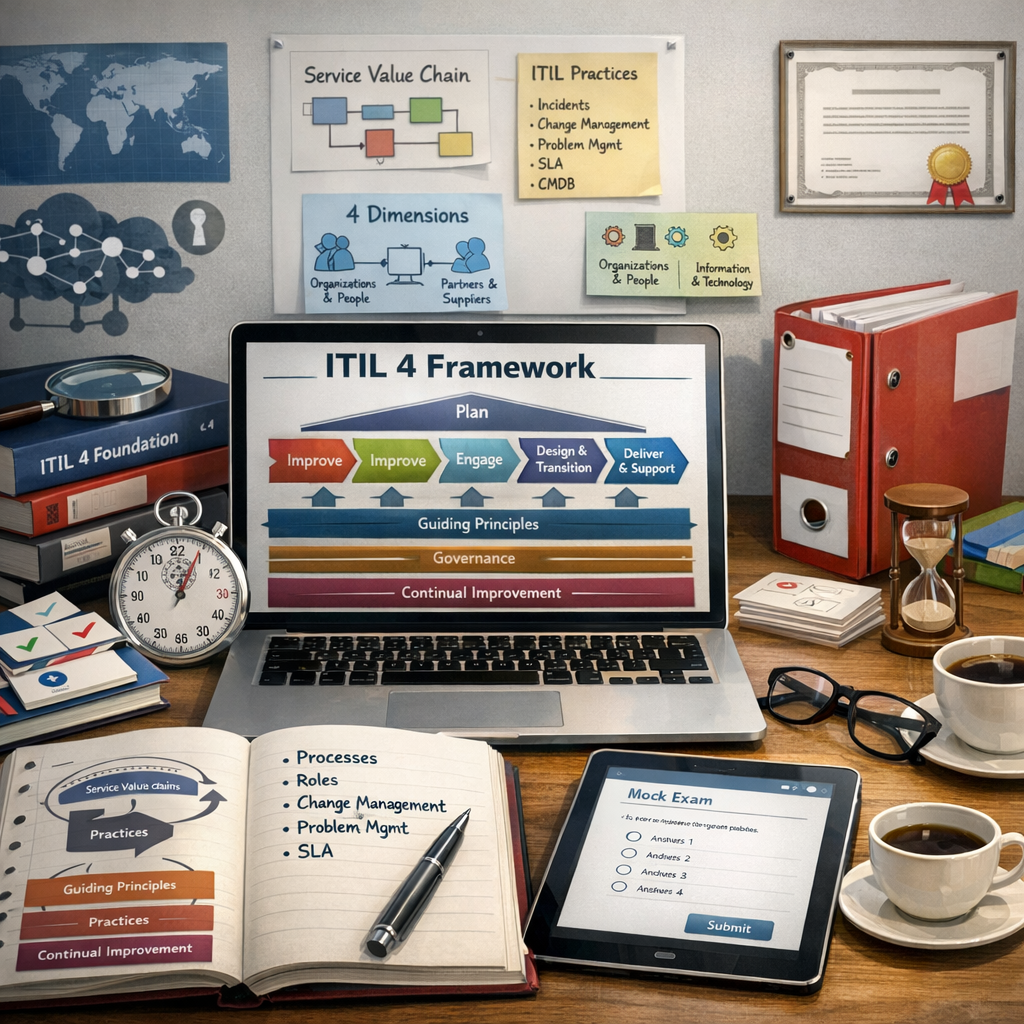
ITIL 4 Foundation Exam Prep: Complete Syllabus, Exam-Focused
A focused, exam-level ITIL 4 Foundation course that mirrors the official PeopleCert syllabus and question style. You’ll build a solid grasp of key concepts, guiding principles, the Service Value System, and the most-tested management practices so you can walk into the 40-question, 60‑minute exam with confidence.
The first lecture plays free — no account needed.
What you'll learn
- Students will be able to describe the official ITIL 4 Foundation exam format, timing, and passing criteria.
- Students will understand the five main syllabus domains and their relative exam weight.
- Students will be able to distinguish between recall and understanding-style questions and explain how this impacts their study strategy.
- Students will be able to outline a personal study plan that aligns with the current ITIL 4 Foundation syllabus.
- Students will be able to define key ITIL 4 terms such as service, value, outcome, output, cost, and risk in exam-accurate language.
- Students will understand how value is co-created between service providers and consumers through service relationships.
- Students will be able to identify different service consumer roles (customer, user, sponsor) in typical exam scenarios.
- Students will be able to answer sample questions that test recognition and application of these core concepts.
- Students will be able to list and describe all seven ITIL 4 guiding principles using exam-ready wording.
- Students will understand how guiding principles support decision-making and improvement across all organizations and situations.
Prerequisites
- PeopleCert ITIL 4 Foundation exam format and syllabus domains
- Core service management concepts such as service, value, and outcomes
- ITIL 4 guiding principles
- Core service management concepts
- Four dimensions of service management
- Service Value System components and overall flow from opportunity and demand to value
Course Content
13 modules · 2h 55m total
Orientation: How the ITIL 4 Foundation Exam Really Works
Step behind the scenes of the ITIL 4 Foundation certification to see exactly what’s tested, how questions are written, and why some candidates pass easily while others struggle despite memorizing the book.
Core Service Management Concepts: Value, Services, and Relationships
Before tackling acronyms and diagrams, dive into the simple but powerful ideas of value, services, and outcomes that underpin every question on the exam.
ITIL 4 Guiding Principles: Navigating Real-World Scenarios
Meet the seven guiding principles that quietly drive many of the trickiest scenario questions and discover how they steer decisions in messy, real-world IT situations.
Four Dimensions of Service Management: A 360° View
Step back and look at services from four angles—people, technology, partners, and value streams—so you can quickly spot what’s missing when a question describes a failing service.
Inside the ITIL 4 Service Value System (SVS)
Unpack the central ITIL 4 picture—inputs of opportunity and demand flowing through the Service Value System to create value—and see how governance, practices, and continual improvement fit together.
The Service Value Chain: From Demand to Value
Follow the path work takes through the Service Value Chain activities, seeing how plan, engage, design & transition, obtain/build, deliver & support, and improve combine into real value streams.
Governance and Continual Improvement in the SVS
Zoom in on how direction, control, and evaluation shape service management, and see how continual improvement runs as a constant thread through every practice and value stream.
General Management Practices: Foundation for Every Organization
Discover how core organizational capabilities like continual improvement, information security, and relationship management show up in ITIL questions—even when the scenario doesn’t sound "technical" at all.
Service Management Practices: Keeping Services Healthy
Walk through the most heavily tested service management practices—like incident, problem, change enablement, and service level management—and see how exam questions weave them into everyday IT stories.
Technical Management Practices: Enabling Reliable Services
Look at the technical-side practices that underpin stable, resilient services and learn how they’re tested at Foundation level without requiring deep hands-on experience.
Linking It All: Practices Inside the Service Value Chain
See how ITIL 4 concepts and practices come together by tracing end-to-end value streams, so multi-step scenario questions feel familiar instead of overwhelming.
Exam Question Patterns, Traps, and Time Management
Peek into how ITIL Foundation questions are constructed, spot common distractors, and practice a pacing strategy that keeps you calm and accurate through all 40 questions.
Final Review: High-Yield Topics and Mock Exam Debrief
Bring everything together with a targeted recap of the most heavily tested ideas and a guided walk-through of representative mock questions to close last-minute knowledge gaps.
Read the Textbook
Read every chapter for free, right here in your browser.
In this module you will look behind the scenes of the ITIL 4 Foundation exam as it exists today (PeopleCert, ITIL 4 Foundation, single exam).
By the end, you should be able to: Describe the official format, timing, and pass mark See how the syllabus is structured and weighted Recognize the difference between recall and understanding questions Sketch a realistic personal study plan
Important context (as of 2026): ITIL is owned by AXELOS, and PeopleCert is the official examination institute. The current entry-level certification is ITIL 4 Foundation (ITIL v3 Foundation is retired). Exam details can change, but the core pattern has been stable for several years. Always cross-check with the latest PeopleCert syllabus before booking.
Study Flashcards
Key concepts from this course as flashcard pairs.
Orientation: How the ITIL 4 Foundation Exam Really Works
ITIL 4 Foundation exam format
40 multiple-choice questions, 60 minutes, closed-book, 1 mark per question, 65% pass mark (26 correct answers).
Pass mark (percentage and raw score)
65% of 40 questions, which equals 26 correct answers.
Bloom level 1 (Recall)
Cognitive level where you must remember or recognize facts, terms, and basic concepts, such as definitions.
Bloom level 2 (Understand)
Cognitive level where you must grasp meaning, explain ideas, or choose the best example or description in context.
Service value system (SVS)
The model that describes how all components and activities of an organization work together to create value through services.
ITIL practice
A set of organizational resources designed for performing work or accomplishing an objective.
+2 more flashcards
Core Service Management Concepts: Value, Services, and Relationships
Value
The perceived benefits, usefulness, and importance of something. Decided by the service consumer, based on benefits, costs, and risks.
Service
A means of enabling value co-creation by facilitating outcomes that customers want to achieve, without the customer having to manage specific costs and risks.
Output
A tangible or intangible deliverable of an activity, such as a report, feature, or device, produced by the service provider.
Outcome
A result for a stakeholder enabled by one or more outputs. It describes what the customer experiences or achieves.
Cost (in ITIL 4)
The amount of money and resources spent on an activity or resource. Services remove some costs from consumers and impose others.
Risk (in ITIL 4)
A possible event that could cause harm or loss or make it harder to achieve objectives. Services remove some risks and impose others.
+5 more flashcards
ITIL 4 Guiding Principles: Navigating Real-World Scenarios
Focus on value
Everything the organization does should create value for customers, users, and the organization. Always ask: value for whom and in what form?
Start where you are
Do not build from scratch. Assess the current state and use what is already available before deciding what to change.
Progress iteratively with feedback
Do not try to do everything at once. Work in small, manageable steps and use feedback to guide each step.
Collaborate and promote visibility
Work together across boundaries and make work and information visible so people can make better decisions.
Think and work holistically
See the service and organization as a whole system. Understand how all parts interact, not just isolated pieces.
Keep it simple and practical
Use the minimum number of steps and controls necessary. Remove anything that does not help achieve the objective.
+1 more flashcards
Four Dimensions of Service Management: A 360° View
Four dimensions of service management
1) Organizations and people, 2) Information and technology, 3) Partners and suppliers, 4) Value streams and processes.
Organizations and people – core idea
How people are organized, led, and supported (culture, roles, skills, communication) so they can deliver and improve services.
Organizations and people – typical risk if neglected
Processes and tools exist but are not used properly; low morale; unclear responsibilities; resistance to change.
Information and technology – core idea
The data, information, applications, and infrastructure that support service delivery and enable value creation.
Information and technology – typical risk if neglected
Decisions based on poor data, manual workarounds, high error rates, security and compliance issues.
Partners and suppliers – core idea
External organizations that help design, deliver, or support services, and the contracts and relationships with them.
+4 more flashcards
Inside the ITIL 4 Service Value System (SVS)
Service Value System (SVS)
The model in ITIL 4 that describes how all components and activities of an organization work together as a system to enable value creation from opportunity and demand.
Opportunity
A chance to add value for stakeholders or improve the organization, which enters the SVS as an input alongside demand.
Demand
The need or desire for products and services from customers, entering the SVS as a key input.
Value
The perceived benefits, usefulness, and importance of something. In ITIL 4, value is co-created by provider and consumer through services.
Guiding principles
Recommendations that guide an organization in all circumstances, regardless of changes in goals, strategies, or structure. They influence every part of the SVS.
Governance
The means by which an organization is directed and controlled, providing oversight and setting priorities for the SVS.
+4 more flashcards
The Service Value Chain: From Demand to Value
Service Value Chain (SVC)
The central operating model of the ITIL 4 Service Value System. It is a set of interconnected activities that convert demand and opportunities into value.
Value stream
An end-to-end series of steps (a route through the Service Value Chain) that an organization uses to create and deliver value to a specific customer or stakeholder.
Plan (SVC activity)
Ensures a shared understanding of the vision, current status, and improvement direction for all products and services.
Engage (SVC activity)
Provides a good understanding of stakeholder needs, transparency, and ongoing engagement with all stakeholders.
Design & transition (SVC activity)
Ensures that products and services meet stakeholder expectations for quality, costs, and time-to-market.
Obtain/build (SVC activity)
Ensures that service components are available when and where needed and meet agreed specifications.
+2 more flashcards
Governance and Continual Improvement in the SVS
Governance (in ITIL 4)
The means by which an organization is directed and controlled, using **evaluate, direct, and monitor** activities over the SVS.
Evaluate (governance)
Assess the organization’s environment, stakeholders, and performance to determine the need for change or confirmation of current direction.
Direct (governance)
Set vision, strategy, policies, and priorities that guide management and operational activities.
Monitor (governance)
Track performance and compliance to ensure that direction is followed and objectives are achieved.
Continual improvement (ITIL 4)
A recurring organizational activity performed at all levels to ensure that the organization’s performance continually meets stakeholders’ expectations.
Continual improvement model
A 7-step guide: 1 What is the vision? 2 Where are we now? 3 Where do we want to be? 4 How do we get there? 5 Take action. 6 Did we get there? 7 How do we keep the momentum going?
+4 more flashcards
General Management Practices: Foundation for Every Organization
Continual improvement (purpose)
To align the organization’s practices and services with changing business needs by identifying and improving services, components, and all elements involved in service management.
Information security management (purpose)
To protect the organization’s information by understanding and managing risks to confidentiality, integrity, availability, and other security properties.
Relationship management (purpose)
To establish and nurture the links between the organization and its stakeholders at strategic and tactical levels.
Supplier management (purpose)
To ensure that the organization’s suppliers and their performances are managed appropriately to support the seamless provision of quality products and services.
Confidentiality
A security property ensuring that information is accessible only to those authorized to have access.
Integrity
A security property ensuring that information is accurate, complete, and protected from unauthorized modification.
+2 more flashcards
Service Management Practices: Keeping Services Healthy
Incident
An unplanned interruption to a service, a reduction in service quality, or a CI failure that has not yet impacted a service. Focus: restore service quickly.
Problem
A cause, or potential cause, of one or more incidents. Focus: understand and reduce the likelihood and impact of incidents.
Known error
A problem that has been analyzed and not resolved, with a documented workaround or root cause.
Service request
A user request that is part of normal service delivery (for example, access, information, or a standard item), not a failure.
Change (ITIL 4)
The addition, modification, or removal of anything that could affect services. Managed through the change enablement practice.
Change enablement
Practice that maximizes successful changes by properly assessing, authorizing, and scheduling them, focusing on risk and impact.
+3 more flashcards
Technical Management Practices: Enabling Reliable Services
Deployment management (purpose)
To move new or changed components (hardware, software, documentation, etc.) into appropriate environments (test, staging, production) in a controlled way that protects live services.
Monitoring and event management (purpose)
To observe services and service components, record and report on their state, and identify and prioritize events so that the right actions can be taken.
Infrastructure and platform management (purpose)
To oversee the infrastructure and platforms used by the organization, ensuring they support the creation, delivery, and improvement of services.
Technical vs service management practices
Technical practices focus on **technology resources and operation** (deploying, monitoring, running infrastructure). Service management practices focus on **managing services and value** (incidents, changes, SLAs, etc.).
Keywords: Deployment management
Look for: roll out, push to production, install update, deploy patch, new version goes live, release pipeline executes deployment steps.
Keywords: Monitoring and event management
Look for: alerts, thresholds, dashboards, logs, events, monitoring tools, automatic ticket creation based on metrics.
+1 more flashcards
Linking It All: Practices Inside the Service Value Chain
Value stream
A specific combination of Service Value Chain activities that an organization follows to create value for a particular stakeholder or outcome.
Service Value Chain (SVC)
The central ITIL 4 model describing six activities (Plan, Improve, Engage, Design and transition, Obtain/build, Deliver and support) that can be combined into value streams.
Engage – typical practices
Service desk, relationship management, service level management, incident management (initial contact), service request management, supplier management.
Deliver and support – typical practices
Incident management, service request management, service desk, problem management, monitoring and event management, IT asset management.
Design and transition – typical practices
Change enablement, service design, release management, service validation and testing, project management.
Guiding principle: Focus on value
Always identify who the customer or stakeholder is and how each step in the value stream contributes to outcomes they care about.
+1 more flashcards
Exam Question Patterns, Traps, and Time Management
Average time available per ITIL 4 Foundation question (40 questions, 60 minutes)
1.5 minutes per question on average.
What does the word "FIRST" in a question usually signal?
It is a sequence question. The correct answer is the most appropriate early step, not necessarily the final or most complete solution.
Definition of a distractor
An answer option that looks attractive or partly correct but is not the best or does not truly answer the question.
Two common distractor patterns in ITIL 4 questions
1) An option that is true in general but does not answer the specific question. 2) An option describing a different practice than the one being tested.
First thing to do when you are stuck between options
Use elimination: remove options that are clearly off-topic, contradict definitions, or violate guiding principles.
How to use guiding principles as tie-breakers
When two options seem plausible, choose the one that better reflects principles like focus on value, start where you are, or progress iteratively with feedback.
+2 more flashcards
Final Review: High-Yield Topics and Mock Exam Debrief
Service
A means of enabling value co-creation by facilitating outcomes that customers want to achieve, without the customer having to manage specific costs and risks.
Value
The perceived benefits, usefulness, and importance of something. In ITIL 4, value is co-created through active collaboration between provider and consumer.
Utility vs Warranty
Utility: "fit for purpose" – what the service does. Warranty: "fit for use" – how well it performs (availability, capacity, security, continuity). Both are needed for full value.
Service Value System (SVS)
A model representing how all the components and activities of an organization work together to enable value creation through services.
SVS Components
Guiding principles, Governance, Service value chain, Practices, Continual improvement.
Service Value Chain
A set of interconnected activities (Plan, Improve, Engage, Design & Transition, Obtain/Build, Deliver & Support) that convert demand into value.
+4 more flashcards
More in Technology
See all →
Defending at Machine Speed: AI-Accelerated Vulnerability Management

Reading the EU Cloud and AI Development Act

Operationalizing the NIST AI RMF and Generative AI Profile in Practice

CIPP/E Exam Prep: Mastering European Data Protection Law and the GDPR
US Government Data Classifications for IT Service Providers