Skarp
Skarp
ITIL 4 Foundation Exam Power Prep
A focused, exam-aligned preparation course for the PeopleCert ITIL 4 Foundation certification, covering the full official syllabus at the depth needed to pass with confidence. You’ll build a solid understanding of ITIL 4 concepts, the Service Value System, and the key practices most heavily tested on the current exam.
The first lecture plays free — no account needed.
What you'll learn
- Students will be able to describe the current ITIL 4 Foundation exam format, scoring, and conditions based on the latest PeopleCert specification.
- Students will understand the official syllabus structure and how it maps to the core ITIL 4 concepts and practices.
- Students will be able to identify typical multiple-choice question patterns and common distractors used in the exam.
- Students will be able to outline a personal study and mock-exam strategy aligned to the official blueprint.
- Students will be able to define key IT service management terms such as service, value, utility, and warranty in line with ITIL 4 Foundation terminology.
- Students will understand how service providers, consumers, and other stakeholders co-create value through service relationships.
- Students will be able to distinguish between outputs, outcomes, costs, and risks in the context of IT services.
- Students will be able to map simple real-world IT scenarios to ITIL 4’s value co-creation concepts for exam-style questions.
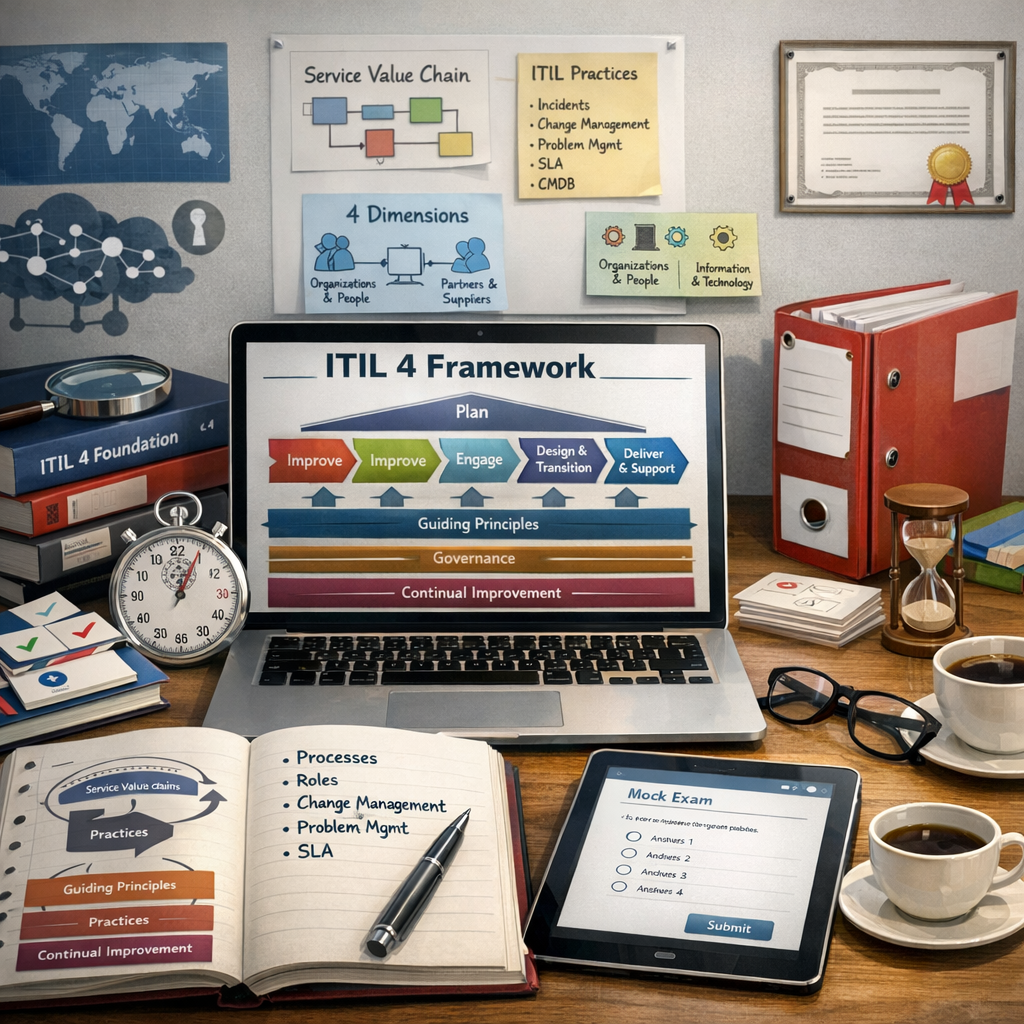
- Students will be able to describe the purpose and components of the ITIL 4 Service Value System as defined in the syllabus.
- Students will understand how opportunity and demand flow through the SVS to result in value co-creation.
Prerequisites
- PeopleCert ITIL 4 Foundation exam format and syllabus overview
- Core IT service management concepts and value co-creation
- Service Value System components and purpose
- Service Value System and four dimensions overview
- Service Value System structure
- Guiding principles overview
Course Content
14 modules · 3h total
Cracking the ITIL 4 Foundation Exam: Scope, Structure, and Strategy
Step behind the scenes of the PeopleCert ITIL 4 Foundation exam and see exactly what you’re up against: what’s on the syllabus, how questions are written, and where most candidates slip up—so you don’t.
IT Service Management Essentials: Services, Value, and Stakeholders
Before diving into frameworks and models, anchor your thinking in what ITIL 4 is really about: services, value, and why organizations invest in IT service management in the first place.
Inside the ITIL 4 Service Value System (SVS)
See how all the moving parts of ITIL 4 fit together into one integrated system that takes demand and opportunities and turns them into value.
The Four Dimensions of Service Management: A 360° View
Move beyond processes and tools to a holistic view of service management that balances people, technology, partners, and workflows.
ITIL 4 Guiding Principles: Mindset for Modern IT
Discover the seven guiding principles that shape every ITIL 4 decision, helping organizations stay agile, lean, and focused on what really matters.
The Service Value Chain: From Demand to Value
Walk through the core activities that transform raw demand into meaningful value, and see how value streams are assembled in practice.
Continual Improvement: Keeping Services Moving Forward
Shift from one-off projects to a culture of ongoing enhancement, using the ITIL continual improvement model to drive better services over time.
Key ITIL 4 Practices I: Service Level, Incident, and Problem Management
Dive into the high-yield operational practices that dominate real-world ITSM—and the ITIL 4 Foundation question bank.
Key ITIL 4 Practices II: Change Enablement, Release, Deployment, and Configuration
Follow the lifecycle of change from idea to live environment, and see how ITIL 4 keeps risk under control while enabling rapid delivery.
Key ITIL 4 Practices III: Service Desk, Request Management, and Support Practices
Step into the front line of IT support and see how service desks, request handling, and supporting practices work together to keep users productive.
Key ITIL 4 Practices IV: Information Security, Relationship, and Supplier Management
Look beyond the service desk to the practices that protect information, manage customers, and keep suppliers aligned with business goals.
Other Exam-Relevant Practices: Overview and Quick Recall
Round out your knowledge of the remaining ITIL 4 practices that appear in the Foundation syllabus, focusing on what you must recall—not every implementation detail.
Linking It All Together: End-to-End Scenarios and Value Streams
See how concepts, dimensions, value chain activities, and practices combine in real-world scenarios similar to those you’ll face in the exam.
Final Sprint: Mock Questions, Tricky Topics, and Exam-Day Tactics
Put your knowledge to the test with exam-style questions, fix lingering weak spots, and lock in a plan for staying calm and accurate on exam day.
Read the Textbook
Read every chapter for free, right here in your browser.
Before you start studying, you need a clear picture of the current ITIL 4 Foundation exam as managed by PeopleCert.
As of today (May 2026), PeopleCert is the official Examination Institute for ITIL. The exam is aligned to the ITIL 4 Foundation guidance (based on the ITIL 4 framework introduced in 2019 and updated in the following years). The Foundation exam checks your basic understanding, not your ability to design full processes.
Key points about the certification context: ITIL is a service management framework, not a standard or a tool. ITIL 4 focuses on value co-creation, the Service Value System (SVS), and practices rather than old-style processes. PeopleCert controls: official syllabus, exam specifications, question style, and official sample papers.
Study Flashcards
Key concepts from this course as flashcard pairs.
Cracking the ITIL 4 Foundation Exam: Scope, Structure, and Strategy
Service
A means of enabling value co-creation by facilitating outcomes that customers want to achieve, without the customer having to manage specific costs and risks.
Outcome
A result for a stakeholder enabled by one or more outputs. Outcomes are what customers actually want to achieve.
Output
A tangible or intangible deliverable produced by an activity (for example, a report, a completed transaction, or a piece of software).
Utility
The functionality offered by a product or service to meet a particular need; often described as "what the service does" or fitness for purpose.
Warranty
Assurance that a product or service will meet agreed requirements, such as availability, capacity, continuity, and security; often called fitness for use.
Incident
An unplanned interruption to a service, or reduction in the quality of a service, or a failure of a configuration item that has not yet affected a service.
+4 more flashcards
IT Service Management Essentials: Services, Value, and Stakeholders
Service
A means of enabling value co‑creation by facilitating outcomes that customers want to achieve, without the customer having to manage specific costs and risks.
Value
The perceived benefits, usefulness, and importance of something.
Utility
The functionality offered by a product or service to meet a particular need. Often called fit for purpose (what the service does).
Warranty
The assurance that a product or service will meet agreed requirements. Often called fit for use (how well it works, e.g., availability, capacity, security, reliability).
Service Provider
An organization that provides services to consumers.
Service Consumer
A generic role that includes customers, users, and sponsors who consume services.
+4 more flashcards
Inside the ITIL 4 Service Value System (SVS)
Service Value System (SVS)
A model that describes how all the components and activities of an organization work together as a system to enable value creation through IT-enabled services.
Opportunity and demand
The inputs to the SVS. Opportunity is a possibility to add value; demand is the need or desire for products and services.
Value (in the SVS)
The perceived benefits, usefulness, and importance of something. In ITIL 4, value is co-created through active collaboration between providers and consumers.
Guiding principles
Recommendations that guide an organization in all circumstances, regardless of changes in its goals, strategies, or type of work.
Governance (in ITIL 4)
The means by which an organization is directed and controlled, including policies, decision-making, and performance monitoring.
Service value chain
The central element of the SVS, providing an operating model with six activities (plan, improve, engage, design and transition, obtain/build, deliver and support) for creating, delivering, and improving services.
+2 more flashcards
The Four Dimensions of Service Management: A 360° View
Organizations and People
Covers structure, roles, skills, culture, leadership, and communication. If neglected: resistance to change, unclear responsibilities, low morale, and good tools or processes fail in practice.
Information and Technology
Covers data, information, knowledge, applications, tools, and infrastructure. If neglected: poor data quality, security issues, tool failures, and inability to support or measure services.
Partners and Suppliers
Covers external providers and contracts. If neglected: unclear responsibilities, unmanaged risks, vendor lock-in, and services failing when suppliers fail.
Value Streams and Processes
Covers end-to-end workflows and processes. If neglected: bottlenecks, delays, rework, inconsistent outcomes, and wasted effort even with good people and tools.
Four Dimensions and the SVS
The four dimensions are applied to all parts of the Service Value System and every practice. Balanced attention across all four enables the Service Value Chain to convert demand and opportunities into value.
ITIL 4 Guiding Principles: Mindset for Modern IT
Focus on value
Always identify, understand, and focus on value for the customer and other stakeholders in everything the organization does.
Start where you are
Do not start from scratch and build something new without first considering what is already available.
Progress iteratively with feedback
Organize work into smaller, manageable sections that can be executed and completed in a timely manner, and use feedback before, during, and after each iteration.
Collaborate and promote visibility
Work together across boundaries to create value, and ensure that information is visible and understandable to those who need it.
Think and work holistically
Recognize that outcomes are delivered through the effective management and integration of information, technology, organization, people, practices, partners, and processes.
Keep it simple and practical
Always use the minimum number of steps needed to accomplish an objective, and eliminate anything that does not contribute to value.
+1 more flashcards
The Service Value Chain: From Demand to Value
Service Value Chain (SVC)
The central model in the ITIL 4 Service Value System that describes how an organization turns demand and opportunities into value through six interconnected activities.
Value stream
A series of steps an organization uses to create and deliver products and services to consumers, built by combining Service Value Chain activities and ITIL practices.
Plan (SVC activity)
Ensures a shared understanding of the vision, current status, and improvement direction for all products and services.
Improve (SVC activity)
Ensures continuous improvement of products, services, and all Service Value Chain activities.
Engage (SVC activity)
Provides a good understanding of stakeholder needs, transparent communication, and strong relationships with stakeholders.
Design and transition (SVC activity)
Ensures that products and services are designed and transitioned to meet stakeholder expectations for quality, cost, and time-to-market.
+4 more flashcards
Continual Improvement: Keeping Services Moving Forward
Continual improvement (practice) – simple definition
An ongoing organizational activity that identifies, prioritizes, and implements improvements to ensure services and practices stay aligned with changing business needs.
Continual Improvement Register (CIR)
A central log or list used to record and manage improvement opportunities and initiatives, including their priority, status, and ownership.
Key question: What is the vision?
First step of the continual improvement model; clarifies the high-level direction and desired value so improvements support the organization’s goals.
Difference: Incident vs continual improvement
Incident management restores normal service quickly after an unplanned interruption. Continual improvement focuses on preventing issues and enhancing value over time.
Difference: Project vs continual improvement
Projects are time-limited efforts with a defined output and end date. Continual improvement is an ongoing cycle of smaller changes that may never fully end.
Step: Did we get there?
A check in the continual improvement model where results are measured against the target state to see whether the improvement was successful.
Key ITIL 4 Practices I: Service Level, Incident, and Problem Management
Service level management (purpose)
To set clear business-based targets for service performance and ensure that delivery of services is properly assessed, monitored, and managed against those targets.
Incident management (purpose)
To minimize the negative impact of incidents by restoring normal service operation as quickly as possible.
Problem management (purpose)
To reduce the likelihood and impact of incidents by identifying actual and potential causes of incidents and managing workarounds and known errors.
Incident (ITIL 4)
An unplanned interruption to a service, a reduction in the quality of a service, or a failure of a configuration item that has not yet affected a service.
Problem (ITIL 4)
A cause, or potential cause, of one or more incidents.
Known error
A problem that has been analyzed and has a documented root cause and a workaround (or a planned permanent fix).
+4 more flashcards
Key ITIL 4 Practices II: Change Enablement, Release, Deployment, and Configuration
Change enablement (purpose)
To maximize the number of successful changes by ensuring risks are properly assessed, authorizing changes, and managing the change schedule.
Standard change
A low-risk, pre-authorized change that is well understood and follows a documented, repeatable procedure.
Normal change
A change that must be assessed and authorized individually because its risk and impact can vary.
Emergency change
A change that must be implemented as soon as possible, often to resolve a major incident or security issue, using streamlined assessment and authorization.
Release management (purpose)
To make new and changed services and features available for use in a controlled way, focusing on what is released and when.
Deployment management (purpose)
To move new or changed components to live or other environments, focusing on how the rollout is executed.
+3 more flashcards
Key ITIL 4 Practices III: Service Desk, Request Management, and Support Practices
Service desk (purpose)
To capture demand for incident resolution and service requests, and to be the single point of contact for the service provider and its users.
Service request
A user’s request for something that should normally be available, often pre-approved and handled via a standard workflow (request model).
Service request management (purpose)
To support the agreed quality of a service by handling all predefined, user-initiated service requests in an effective and user-friendly manner.
Incident (ITIL 4)
An unplanned interruption to a service, a reduction in the quality of a service, or a failure of a configuration item that has not yet impacted a service.
Monitoring and event management (purpose)
To observe services and service components, record and report events, and determine the appropriate response to those events.
Event (ITIL 4)
Any change of state that has significance for the management of a service or other configuration item.
+4 more flashcards
Key ITIL 4 Practices IV: Information Security, Relationship, and Supplier Management
Information security management (purpose)
To protect the information needed by the organization to conduct its business.
Three core security goals (CIA)
Confidentiality, Integrity, Availability.
Relationship management (purpose)
To establish and nurture the links between the organization and its stakeholders at strategic and tactical levels.
Supplier management (purpose)
To ensure that the organization's suppliers and their performance are managed appropriately to support the seamless provision of quality products and services.
Customer (ITIL 4 role)
The role that defines requirements for a service and takes responsibility for the outcomes of service consumption.
User (ITIL 4 role)
The role that uses services on a day-to-day basis.
+3 more flashcards
Other Exam-Relevant Practices: Overview and Quick Recall
Architecture management – simple purpose?
Provides a big-picture understanding of all organizational elements and how they relate, so the organization can achieve current and future objectives. Image: city map of business, data, apps, and tech.
Strategy management – simple purpose?
Defines goals and chooses courses of action and resource allocation to achieve them. Image: compass setting long-term direction.
Portfolio management – simple purpose?
Manages the mix of programs, projects, products, and services to support strategy. Image: investment fund of initiatives.
Risk management – key idea?
Identifies, assesses, and treats risks to objectives (threats and opportunities). Image: umbrella before it rains.
Business analysis – key focus?
Understands business needs and defines requirements, recommending value-creating solutions. Image: translator between business and IT.
Service design – key focus?
Designs products and services that are fit for purpose and fit for use, and can be delivered. Image: service blueprint.
+7 more flashcards
Linking It All Together: End-to-End Scenarios and Value Streams
Service Value Chain: Six activities
Plan, Improve, Engage, Design and transition, Obtain/build, Deliver and support.
Value stream
A specific sequence of activities (a path through the Service Value Chain) that creates value for a particular product or service.
Which SVC activity? "Interact with customers, users, or suppliers"
Usually **Engage**.
Which practice? "Restore service as quickly as possible"
**Incident management**.
Which practice? "Identify and remove the causes of recurring incidents"
**Problem management**.
Guiding principle: "Use what you already have"
**Start where you are**.
+5 more flashcards
Final Sprint: Mock Questions, Tricky Topics, and Exam-Day Tactics
Incident management vs problem management
**Incident management**: Restore normal service as quickly as possible and minimize impact. **Problem management**: Reduce likelihood and impact of incidents by identifying causes and workarounds.
Change enablement vs release management
**Change enablement**: Ensure changes are assessed, authorized, and scheduled to balance value and risk. **Release management**: Make new and changed services and features available for use.
Service request management vs incident management
**Service request management**: Handle user requests (information, access, standard changes, service delivery). **Incident management**: Handle unplanned interruptions or reduction in service quality.
Guiding principle: Focus on value
Everything the organization does should directly or indirectly create value for customers and stakeholders. Understand who the customers are, what they value, and how they measure success.
Guiding principle: Progress iteratively with feedback
Do not attempt everything at once. Organize work into smaller, manageable pieces, and use feedback at each iteration to guide and adjust further work.
Guiding principle: Think and work holistically
Recognize that services and value streams are complex systems. Consider all dimensions and SVS components, not isolated parts, when making decisions.
+2 more flashcards
More in Technology
See all →
Defending at Machine Speed: AI-Accelerated Vulnerability Management

Reading the EU Cloud and AI Development Act

Operationalizing the NIST AI RMF and Generative AI Profile in Practice

CIPP/E Exam Prep: Mastering European Data Protection Law and the GDPR
ITIL 4 Foundation Exam Prep: Complete Syllabus, Exam-Focused