Skarp
Skarp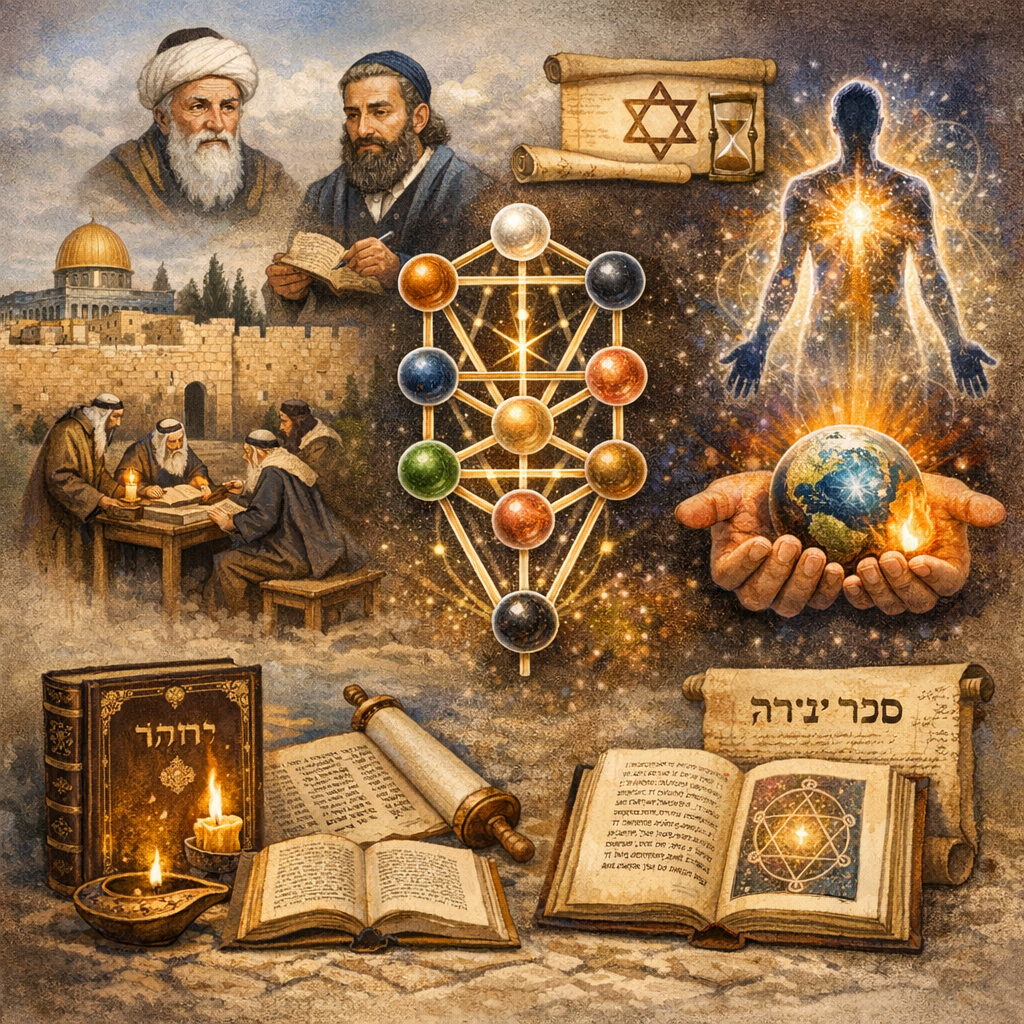
Introduction to Kabbalah: History, Core Ideas, and Classical Texts
This course offers a clear, beginner-friendly introduction to Jewish mysticism known as Kabbalah. You will trace its historical roots, meet core ideas like Ein Sof, the Sefirot, Tzimtzum, and the Tree of Life, and situate major texts such as the Zohar and Lurianic writings within wider Jewish tradition, while also learning to avoid common misconceptions and sensationalized portrayals.
The first lecture plays free — no account needed.
What you'll learn
- Students will be able to describe Kabbalah in one or two sentences as a stream within Judaism rather than a stand‑alone system.
- Students will understand the difference between Kabbalah, general mysticism, and modern pop‑kabbalah.
- Students will be able to identify why Kabbalistic teachings were historically reserved for advanced students.
- Students will be able to outline a simple timeline from early Jewish mysticism to classical medieval Kabbalah.
- Students will understand the historical context and significance of Sefer Yetzirah and Sefer ha‑Bahir as precursors to later Kabbalah.
- Students will be able to situate the appearance of the Zohar in late 13th‑century Spain within Jewish history.
- Students will be able to define Ein Sof as the Infinite dimension of God beyond all attributes.
- Students will understand why Kabbalists insist that Ein Sof is ultimately beyond human comprehension and description.
- Students will be able to explain how the idea of Ein Sof prepares the way for the doctrine of the Sefirot.
- Students will be able to name and briefly characterize the ten Sefirot as presented in classical Kabbalistic sources.
Prerequisites
- Kabbalah as Jewish mysticism, not a separate religion
- Esoteric vs. exoteric teaching and why Kabbalah was traditionally restricted
- Historical development of Kabbalah within Judaism
- Ein Sof as the Infinite, unknowable aspect of God
- Formative texts: Sefer Yetzirah and Sefer ha‑Bahir
- Sefirot as divine attributes or channels of emanation
Course Content
9 modules · 2h 15m total
Mystery Within Tradition: What Kabbalah Really Is (and Is Not)
Step behind the stereotypes of red strings and celebrity mystics to encounter Kabbalah as a deeply rooted Jewish mystical tradition, woven into centuries of scripture study, prayer, and philosophy.
From Ancient Roots to Medieval Flowering: A Brief History of Kabbalah
Travel from early Jewish mystical speculations to the medieval ‘Kabbalistic renaissance’, meeting the thinkers and texts that shaped Kabbalah into a coherent tradition.
Ein Sof: Encountering the Infinite in Kabbalistic Thought
Enter the Kabbalists’ language for the utterly unknowable God, where words strain to describe the Infinite that precedes all worlds and concepts.
The Ten Sefirot: Divine Emanations and the Architecture of Reality
Move from the Infinite to the many, discovering how Kabbalists describe ten interrelated emanations through which the divine becomes knowable and the world comes into being.
The Tree of Life: Mapping the Sefirot and the Four Worlds
See how centuries of mystics turned abstract ideas into a striking diagram—the Tree of Life—that charts the flow of divine energy through multiple worlds.
Lurianic Kabbalah: Tzimtzum, Shattering, and Repair
Enter the dramatic cosmic story crafted by Isaac Luria, where divine contraction, broken vessels, and scattered sparks turn ordinary life into a theater of repair.
The Zohar and Other Classical Texts: Reading the Mystical Library
Step into the dense, symbolic world of Kabbalah’s core books, from the cryptic Sefer Yetzirah to the luminous, sprawling Zohar and the systematizing Lurianic writings.
Kabbalah in Jewish Life: Practice, Prayer, and Community
Watch mystical ideas flow into lived Judaism, shaping prayer, ritual, and community life without replacing traditional law and practice.
Misconceptions, Appropriation, and Respectful Paths for Further Study
Confront the myths head‑on—celebrity Kabbalah, occult mash‑ups, and cultural borrowing—and chart an informed, ethical way forward in your own engagement with this tradition.
Read the Textbook
Read every chapter for free, right here in your browser.
In everyday media, Kabbalah is often linked to red string bracelets, celebrity followers, or vague ideas of "secret wisdom." This picture is incomplete and often misleading.
In Jewish tradition, Kabbalah is a stream of Jewish mysticism that grows from the same roots as mainstream Judaism: the Torah (the Five Books of Moses), the Talmud (classical rabbinic discussions of law and ethics), and centuries of rabbinic interpretation.
Think of Judaism as a large tree: The roots are the Torah and the covenant between God and the Jewish people. The trunk is Jewish law, practice, and community life. The branches include different approaches: legal, philosophical, mystical, ethical.
Study Flashcards
Key concepts from this course as flashcard pairs.
Mystery Within Tradition: What Kabbalah Really Is (and Is Not)
Kabbalah
The Jewish mystical tradition that interprets the Torah and Jewish practice as expressions of a hidden spiritual structure of reality and of God's relationship with the world.
Exoteric
Open, basic religious teachings meant for everyone, such as simple stories of the Torah and basic commandments.
Esoteric
Hidden or advanced teachings meant for prepared students, such as detailed Kabbalistic descriptions of spiritual worlds.
Halakhah
The body of Jewish law, based on the Torah and Talmud, that guides practical Jewish life (Shabbat, food laws, family, etc.).
Pop-kabbalah
Modern, often commercialized uses of Kabbalistic symbols and language that detach them from traditional Jewish law, texts, and community.
Mysticism (general)
Religious approaches that seek direct or deep experience of the divine and the inner meaning of reality, found in many religions including Judaism.
From Ancient Roots to Medieval Flowering: A Brief History of Kabbalah
Merkavah mysticism
Early Jewish mystical tradition (roughly 1st–6th c. CE) focused on Ezekiel’s vision of the divine chariot and heavenly ascent to see God’s throne.
Heikhalot literature
Mystical texts about journeys through heavenly “palaces,” meeting angels and dangers, aiming to reach the divine throne and secret knowledge.
Sefer Yetzirah
“Book of Formation,” a short text (core 3rd–7th c. CE) describing creation through ten sefirot and the 22 Hebrew letters; a key precursor to Kabbalah.
Sefer ha-Bahir (the Bahir)
Mystical work appearing in late 12th‑century Provence; presents sefirot as divine qualities and is one of the first clearly Kabbalistic texts.
Sefirot (in early vs. later use)
In Sefer Yetzirah: abstract enumerations or principles. In the Bahir and later Kabbalah: dynamic divine qualities or emanations, often mapped as a tree.
Medieval Kabbalistic renaissance
12th–13th century movement in Provence and Spain where mystics systematized earlier ideas into a more coherent Kabbalistic tradition.
+2 more flashcards
Ein Sof: Encountering the Infinite in Kabbalistic Thought
Ein Sof
Hebrew for "without end" or "no limit". Kabbalistic term for God as absolutely infinite, beyond all attributes, concepts, and human comprehension.
Transcendence (in this context)
The idea that God, as Ein Sof, is beyond the world, beyond space, time, and all human categories or images.
Immanence (in this context)
The idea that God is present within the world and that all things exist only because they are continuously dependent on the Infinite.
Negative theology
A way of speaking about God by saying what God is not, used by Kabbalists to point toward Ein Sof without claiming to define it positively.
Sefirot (very short definition)
Ten modes or channels through which the Infinite is said to relate to creation; they make the unknowable Ein Sof relatable in structured ways.
Why use symbols and metaphors for Ein Sof?
Because human minds need images, and symbolic language can hint at a mystery that cannot be directly described, while reminding us that Ein Sof is beyond all images.
The Ten Sefirot: Divine Emanations and the Architecture of Reality
Keter
Means "Crown"; represents divine will and the first impulse to create, beyond specific thoughts or emotions.
Chokhmah
Means "Wisdom"; a flash of insight or raw inspiration, the first spark of an idea.
Binah
Means "Understanding"; analysis and structure, unpacking and organizing the initial insight.
Chesed
Means "Lovingkindness"; overflowing love, generosity, and expansion, giving without holding back.
Gevurah
Means "Strength" or "Judgment"; limits, discipline, boundaries, the power to say "no" or "enough".
Tiferet
Means "Beauty" or "Harmony"; balance and compassion, harmonizing Chesed and Gevurah into a beautiful whole.
+4 more flashcards
The Tree of Life: Mapping the Sefirot and the Four Worlds
Tree of Life (Etz Chaim)
A diagram used in Kabbalah that arranges the ten Sefirot as circles connected by paths, showing the flow of divine energy from the Infinite into the world.
Sefirot
Ten interrelated divine emanations or qualities through which Ein Sof is revealed and the world is structured, often shown as the circles on the Tree of Life.
Three Pillars
The right, left, and middle columns of the Tree of Life, symbolizing expansion/mercy, limitation/judgment, and balance/harmony.
Paths
The lines connecting the Sefirot on the Tree of Life, showing relationships and routes of flow; commonly associated with the 22 Hebrew letters.
Atzilut
The highest of the Four Worlds, the World of Emanation, where reality is almost purely divine and the Sefirot are experienced as pure qualities.
Beriah
The World of Creation, a high spiritual level associated with pure concepts and exalted beings; like the conceptual plan of reality.
+4 more flashcards
Lurianic Kabbalah: Tzimtzum, Shattering, and Repair
Ein Sof
Hebrew for "the Infinite"; the limitless divine reality that exists before and beyond all creation in Kabbalistic thought.
Tzimtzum
Divine "contraction" or self-hiding that makes space for a finite world to exist; a central image in Lurianic Kabbalah.
Shevirat ha-Kelim
The "shattering of the vessels"; the first arrangement of the Sefirot breaks under the intensity of divine light, scattering holy sparks.
Sparks (Nitzotzot)
Fragments of divine light that fall and become trapped in coarse husks after the shattering of the vessels.
Kelipot (Husks)
Coarse "shells" that imprison divine sparks; associated with chaos, distortion, and what we experience as evil.
Tikkun
Repair or restoration; the ongoing process of freeing sparks and healing the broken structure of the Sefirot and the world.
+2 more flashcards
The Zohar and Other Classical Texts: Reading the Mystical Library
Sefer Yetzirah
An early, very short mystical text focusing on creation through 10 sefirot (as numbers) and 22 Hebrew letters; reads like a dense manual or formula list.
Sefer ha-Bahir
A 12th–13th century mystical work from Provence with brief teachings and stories; often seen as a bridge into full medieval Kabbalah.
Zohar
The central classic of Kabbalah, a sprawling Aramaic mystical commentary on the Torah, mixing stories of sages with symbolic teachings.
Etz Chaim
A major Lurianic text (16th century, Safed) recording Isaac Luria’s teachings in a systematic way, explaining tzimtzum, shattering, and repair.
Midrashic style
A way of writing that comments on biblical verses through stories, questions, and symbolic explanations rather than linear argument.
Lurianic Kabbalah
The highly structured system associated with Isaac Luria, focusing on divine contraction, shattering of vessels, scattered sparks, and cosmic repair.
+2 more flashcards
Kabbalah in Jewish Life: Practice, Prayer, and Community
Halakhah
Jewish law and legal practice. Provides the basic framework for Jewish life; Kabbalah adds meaning and customs but does not overrule it.
Kavanah
Intention or focused mindset during prayer or mitzvot. In Kabbalah, correct kavanah helps "raise" actions through spiritual worlds.
Kabbalat Shabbat
Friday night service developed by Kabbalists in Safed. Includes Lecha Dodi and imagery of Shabbat as a bride or queen.
Hasidism
18th‑century movement strongly influenced by Kabbalah. Emphasizes joy, song, the role of the rebbe, and finding God in everyday life.
Tikkun
Repair or restoration. In Lurianic Kabbalah, refers to repairing the cosmic break by raising divine sparks through mitzvot and holy living.
Shekhinah
Term for the divine presence, often associated with nearness, compassion, and in Kabbalah sometimes linked to the Shabbat bride.
Misconceptions, Appropriation, and Respectful Paths for Further Study
Jewish Kabbalah
A stream of Jewish mysticism rooted in Torah, mitzvot, Hebrew and Aramaic texts (like the Zohar and Lurianic writings), and Jewish communal life.
Christian Kabbalah
Renaissance and early modern Christian re‑readings of Jewish Kabbalah, using its symbols to support Christian theology about the Trinity and Jesus.
Hermetic/occult Kabbalah
Esoteric systems (18th–21st centuries) that blend Kabbalistic symbols with Western magic, astrology, and tarot, often focused on personal power and ritual.
Commercial distortion of Kabbalah
The use of "Kabbalah" mainly as a brand to sell products or quick‑fix spirituality, usually detached from Jewish texts, practice, and community.
Appropriation vs. appreciation
Appropriation takes symbols or ideas without context or relationship; appreciation learns with, credits, and respects the source community and its boundaries.
Plug‑and‑play spirituality (myth)
The false idea that Kabbalah is a universal, context‑free technique anyone can use instantly, without background or connection to Judaism.
More in Arts & Culture
See all →
Introduction to Philosophy: Big Questions and Key Thinkers

Mastering The Wheel of Time: A Comprehensive Expert Course
Advanced Tarot: Archetypes, Symbolism, and the Narrative Web of the Arcana
Tarot Card Deep Dive: Symbolism, History, and Story Across the Arcana
Foundations of Tarot: History, Structure, and the Major Arcana Journey