Skarp
Skarp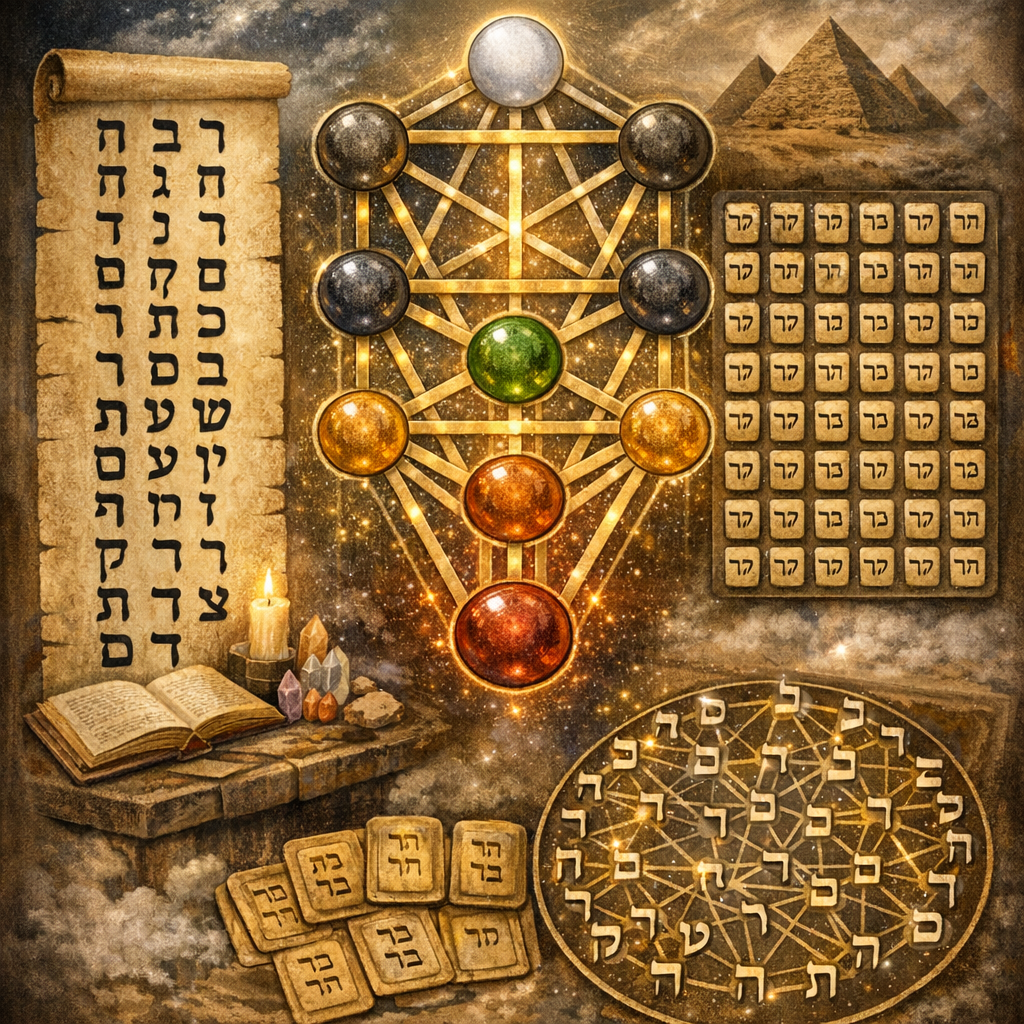
Intermediate Kabbalah Practice: Hebrew Letters, Tree of Life, 72 Names & the 231 Gates
A practice‑oriented intermediate journey into the Tree of Life, the 22 Hebrew letters, the 72 Names of God, and the 231 Gates of Sefer Yetzirah. You will connect classical sources with meditative, contemplative, and ethical practices, learning structured, safe ways to work with these systems in shaping inner life and daily decisions.
The first lecture plays free — no account needed.
What you'll learn
- Students will be able to distinguish between historical Jewish Kabbalah and later Hermetic or New Age systems at a high level.
- Students will understand where the Tree of Life, Hebrew letters, 72 Names, and 231 Gates appear in classical sources such as Sefer Yetzirah and the Zohar.
- Students will be able to articulate personal intentions and boundaries for engaging in Kabbalistic practice in a grounded, ethical way.
- Students will be able to describe how the textual notion of ten sefirot in sources like Sefer Yetzirah developed into fixed Tree of Life diagrams in medieval and early modern Kabbalah.
- Students will understand key differences between Jewish sefirotic trees and later standardized diagrams used in Western esotericism.
- Students will be able to sketch and label a basic sefirotic Tree of Life and explain how it functions as a contemplative map rather than a rigid cosmic blueprint.
- Students will be able to name and briefly characterize each of the ten sefirot in terms of both classical theological meanings and inner psychological resonances.
- Students will understand how sefirotic relationships (triads, pillars, and paths) can frame tensions such as mercy–judgment, expansion–contraction, and ideal–implementation.
- Students will be able to apply a simple sefirotic reflection process to a recent life decision or emotional pattern.
- Students will be able to recognize and name the 22 Hebrew letters in transliteration and basic block script, with approximate pronunciation.
Prerequisites
- Historical Kabbalah vs. modern popularizations
- Core primary texts: Sefer Yetzirah, Bahir, Zohar, Etz Chaim
- Ten sefirot in Sefer Yetzirah and later theosophical Kabbalah
- Emergence of Tree of Life diagrams and ilanot traditions
- Hebrew alphabet overview: consonants, finals, and basic phonetics
- Letters as “stones” or “elements” of creation in Sefer Yetzirah
Course Content
12 modules · 3h total
Orienting the Journey: What Intermediate Kabbalah Really Works With
Step into the living landscape of Kabbalah where letters, numbers, and a luminous Tree of Life map consciousness, creation, and ethical responsibility. This opening module frames what it means to practice Kabbalah today without confusion, appropriation, or spiritual overreach.
Maps of Mystery: Tree of Life Diagrams in Text and Tradition
Behind the now‑familiar ten‑sphere diagram lies a tangled history of manuscripts, diagrams, and Victorian standardizations. This module takes you behind the image to see how the Tree of Life grew from text into the visual map you know—and why that matters for practice.
The Ten Sefirot as Inner Landmarks: From Cosmology to Character
Beyond metaphysical speculation, the ten sefirot can serve as a mirror for your inner life and relationships. This module turns the Tree from an abstract diagram into a subtle anatomy of attention, emotion, and ethical choice.
The 22 Hebrew Letters as Powers of Formation
Letters in Kabbalah are not just sounds on a page but units of creative energy, each with its own texture and field of meaning. This module introduces the 22 letters as Sefer Yetzirah’s building blocks of world, soul, and story.
Letter‑Meditation Foundations: Safe, Grounded Practice
Working with letters and divine names touches deep layers of psyche and faith. Before turning to complex permutations, this module establishes a safe container, basic techniques, and clear red lines for responsible practice.
The 72 Names of God: Structure, Sources, and Misconceptions
From amulets to modern bestsellers, the 72 Names of God are often surrounded by hype and confusion. This module traces their scriptural origin, classical uses, and how to approach them as a serious practitioner rather than a consumer of spiritual technology.
Practicing with the 72 Names: Contemplation, Prayer, and Character
Once the 72 Names are seen as lenses rather than levers, they can become catalysts for subtle shifts in awareness and behavior. This module offers structured, low‑risk ways to weave selected names into prayer, journaling, and ethical self‑work.
The 231 Gates of Sefer Yetzirah: Combinatorial Mysticism
Sefer Yetzirah imagines the 22 letters arrayed in a circle, joined by 231 connecting lines or “gates”—a visionary image of language, number, and world‑building. This module unpacks that image and what it can mean for your own perception of thought and speech.
Tziruf in Practice: Working Gently with Letter Pairs and Gates
Letter‑combination practices can quickly become intense or abstract. This module introduces a restrained, psychologically aware way of playing at the edge of the 231 Gates—touching their power without getting lost in permutation for its own sake.
Weaving the Systems: Letters, Sefirot, 72 Names, and Gates on the Tree
Once seen in isolation, letters, sefirot, names, and gates begin to reveal a shared architecture. This module surveys how different Kabbalistic and Hermetic traditions map letters and names onto the Tree—and how you can engage these correspondences critically and creatively.
Ethics, Ego, and Discernment in Kabbalistic Practice
Any work with power‑charged symbols can inflate ego or bypass uncomfortable realities. This module brings the conversation down to earth, asking how to recognize projections, protect others’ boundaries, and let the Tree of Life reshape character more than fantasy.
Designing Your Ongoing Kabbalistic Practice Path
With the Tree, letters, names, and gates now in your toolkit, the question becomes: what next, and how to continue without overload? This capstone module guides you in crafting a sustainable, evolving practice that honors both tradition and your real life.
Read the Textbook
Read every chapter for free, right here in your browser.
In this module you are not learning a grab-bag of mystical tricks. You are learning how intermediate Kabbalah actually works: with texts, symbols, language, and ethical responsibility.
We assume you already know basic terms like sefirot and have heard of the Zohar. Now we refine and deepen that knowledge so you can practice in a grounded way.
Key orienting points: Kabbalah is a Jewish mystical tradition. It emerged within Jewish communities, in dialogue with Torah, Talmud, and halakhah (Jewish law and practice). It is not a generic “mysticism toolkit,” even though parts of it have been adapted into other systems. Intermediate Kabbalah works with specific symbolic systems: The sefirot (dynamic aspects of divine manifestation). The Hebrew alphabet as a spiritual-creative code. Combinatorics of letters and numbers (like the 231 Gates). Divine names and permutations, including what later sources call the 72 Names. Historical vs. popular Kabbalah today: Historical Kabbalah: rooted in Hebrew and Aramaic texts, rabbinic frameworks, and communal practice. Popular/Hermetic/New Age Kabbalah: often blends Kabbalah with astrology, tarot, chakras, or “manifestation” language.
Study Flashcards
Key concepts from this course as flashcard pairs.
Orienting the Journey: What Intermediate Kabbalah Really Works With
Sefer Yetzirah
Early Kabbalistic text on creation through 32 paths of wisdom (10 sefirot + 22 letters), source of the 231 Gates.
Bahir
12th century Kabbalistic work that develops sefirotic symbolism and early tree/body imagery of the divine.
Zohar
Late 13th century Aramaic mystical commentary on the Torah, central to classical Kabbalah.
Etz Chaim
Lurianic Kabbalah compendium by Chaim Vital, organizing Isaac Luria's teachings on tzimtzum, shevirah, and tikkun.
Sefirot
Dynamic aspects or channels of divine manifestation; in classical sources they are living processes, not just diagram nodes.
231 Gates
All unique pairs of the 22 Hebrew letters, described in Sefer Yetzirah as channels of creative combination.
+2 more flashcards
Maps of Mystery: Tree of Life Diagrams in Text and Tradition
Sefer Yetzirah
An early Jewish mystical text (probably compiled between about the 3rd–6th centuries CE) that speaks of ten sefirot belimah and the 22 Hebrew letters, but does not present a fixed Tree of Life diagram.
Sefirot
Ten divine attributes or modalities of manifestation in Kabbalah, originally described textually and dynamically, later arranged visually in various Tree of Life diagrams.
Ilan / Ilanot
Hebrew for tree / trees; refers to Kabbalistic diagram traditions that visually map sefirot, worlds, and related concepts in diverse layouts, especially in medieval and early modern manuscripts.
Lurianic Kabbalah
A 16th‑century Kabbalistic system associated with Isaac Luria and his circle in Safed, which strongly influenced the later, more standardized three‑column sefirotic tree.
Hermetic Kabbalah
A Western esoteric adaptation of Kabbalah, especially from the 19th century onward, that integrates sefirot with astrology, Tarot, and other occult systems, often using a standardized 10‑sefirot, 22‑path Tree.
Golden Dawn Tree of Life
A specific Hermetic Tree of Life layout popularized by the Hermetic Order of the Golden Dawn (founded 1887), featuring 10 sefirot, 22 lettered paths, and systematic correspondences to Tarot trumps and astrological symbols.
+1 more flashcards
The Ten Sefirot as Inner Landmarks: From Cosmology to Character
Keter
Crown; supernal will and deep purpose. Inner: overarching intention, your sense of "why" beyond specific goals.
Chokhmah
Wisdom as flash insight. Inner: sudden intuition, creative spark, raw idea before it is organized.
Binah
Understanding. Inner: analysis, reflection, turning flashes into coherent plans or narratives.
Chesed
Lovingkindness, expansion. Inner: generosity, openness, saying "yes", emotional warmth, idealism.
Gevurah
Strength, judgment, boundaries. Inner: discipline, saying "no", critical thinking, focus, healthy fear or caution.
Tiferet
Beauty, harmony, compassion. Inner: balanced empathy and integrity, mediating Chesed and Gevurah.
+4 more flashcards
The 22 Hebrew Letters as Powers of Formation
Sefer Yetzirah
An early Jewish mystical text (late antiquity–early Middle Ages) that describes creation through 10 sefirot and 22 Hebrew letters, treating letters as building blocks of world, year, and soul.
Three Mothers
The letters alef, mem, shin. In Sefer Yetzirah they are primordial letters associated with air (alef), water (mem), and fire (shin), and with basic body-soul processes.
Seven Doubles
Bet, gimel, dalet, kaf, pe, resh, tav. Called "doubles" because of dual sounds or paired qualities; linked to seven classical planets and days of the week.
Twelve Simples
The remaining 12 letters (he, vav, zayin, het, tet, yod, lamed, nun, samekh, ayin, tsadi, qof). Associated with the twelve zodiac signs and basic human tendencies.
Alef (א)
A Mother letter. Often silent, carrying a vowel; symbolically linked to air, breath, balance, and open potential.
Bet (ב)
A Double letter meaning "house"; symbolically linked to containment, shelter, and the idea of creation unfolding within a container.
+2 more flashcards
Letter‑Meditation Foundations: Safe, Grounded Practice
Kavanah
Directed intention or focused inner stance for practice; should be specific, realistic, time-bound, and ethically grounded.
Hitbodedut
A mode of solitary, often spoken or spontaneous prayer/conversation with the Divine; here, adapted as simple personal contemplative practice.
Hitbonenut
Contemplative reflection or focused thinking, often on a specific text, idea, or symbol such as a Hebrew letter.
Embodied Anchor
A physical or sensory focus (breath, posture, touch, movement) that helps keep meditation grounded in the body.
Overstrain / Dissociation
States of mental or nervous-system overload, including feeling unreal, panicky, or disconnected; signals to stop and ground.
Spiritual Bypass
Using spiritual practices to avoid facing psychological issues, conflicts, or responsibilities instead of working through them.
The 72 Names of God: Structure, Sources, and Misconceptions
72 Names of God (72 triplets)
A set of seventy-two three-letter Hebrew sequences derived in Kabbalistic tradition from Exodus 14:19–21 using a boustrophedon letter-grid; treated as aspects of a 72-fold divine Name, not explicit biblical names.
Boustrophedon
A writing pattern where lines alternate direction (right-to-left, then left-to-right, and so on). Kabbalists apply this to Exodus 14:19–21 to generate the 72 triplets.
Yichudim
Lurianic Kabbalistic practices of "unifications" that combine divine names, including the 72 triplets, with sefirot and specific intentions, usually for advanced practitioners.
Practical Kabbalah
Streams of Jewish practice that use divine names and letter-combinations (including the 72 triplets) in amulets, adjurations, and rituals aimed at concrete effects; historically controversial and tightly restricted.
Instrumentalized "name magic"
An approach that treats divine names or triplets as tools to control reality or gain advantages, often with promises of guaranteed results and little emphasis on ethics or inner transformation.
Contemplative engagement
Using divine names or triplets as focal points for prayer, meditation, and character refinement, embedded in broader religious and ethical life, without expecting automatic external results.
Practicing with the 72 Names: Contemplation, Prayer, and Character
Lens mindset (for the 72 Names)
Approaching a triplet as a way to clarify awareness and refine character, without expecting mechanical control over events or other people.
Lever mindset (for the 72 Names)
Treating a triplet as spiritual technology that, if repeated correctly, forces specific external results. This module cautions against this approach.
Focus triangle
The combination of: (1) a sefirotic quality, (2) a chosen triplet, and (3) a concrete life situation you are working with in practice.
Kavanah
Focused intention in prayer or practice. Here, it means holding your chosen quality, name, and situation gently in mind during contemplation.
Tikkun hamiddot
Ethical refinement of character traits. In this module, any genuine fruit of 72-Name practice should show up as small, concrete shifts in behavior.
The 231 Gates of Sefer Yetzirah: Combinatorial Mysticism
231 Gates
The complete set of unique two-letter combinations formed from the 22 Hebrew letters in Sefer Yetzirah, counted as unordered pairs (C(22, 2) = 231).
Tziruf
Hebrew for "combination" or "permutation"; in Kabbalah, the meditative and contemplative practice of combining letters to explore spiritual and cognitive structures.
Sefer Yetzirah's Letter Circle
A visionary image of the 22 letters arranged in a circle, each connected to every other by lines representing the 231 gates.
Complete Graph on 22 Vertices
A modern mathematical description of the 231 Gates diagram: 22 points (letters) with every point connected to every other by an edge (gate).
Unordered Pair (in this context)
A pair of letters where the order does not matter for counting; אב and בא are treated as one gate rather than two distinct items.
Tziruf in Practice: Working Gently with Letter Pairs and Gates
Tziruf
A practice of combining Hebrew letters (often in pairs or sequences) through sound, visualization, and contemplation to explore symbolic and experiential dimensions of language.
231 Gates
A classical image from *Sefer Yetzirah* of all unique two-letter combinations formed from the 22 Hebrew letters, visualized as lines (gates) connecting letters arranged in a circle.
Kavanah
Intention or focused inner orientation brought to a practice, prayer, or commandment; in this module, a modest, process-focused aim for your tziruf session.
Symbolic Insight
A meaning or pattern that emerges during practice which connects the letters to themes, metaphors, or situations in your life in a way that feels coherent and potentially valuable.
Mental Noise
Background thoughts, images, or chatter (e.g., to-do lists, random songs) that arise during practice but do not carry clear symbolic meaning or emotional processing.
Grounding
Simple, present-moment actions (such as feeling your feet, naming objects, or steady breathing) that stabilize attention and reduce the risk of dissociation or overwhelm.
Weaving the Systems: Letters, Sefirot, 72 Names, and Gates on the Tree
Tree of Life (Sefirot and Paths)
A diagram of 10 sefirot (divine/psychic qualities) connected by 22 paths. Widely used in Kabbalah and Hermeticism as a map of creation and consciousness. The detailed geometry is later and varies by tradition.
231 Gates
All unordered pairs of the 22 Hebrew letters (22×21/2). In Sefer Yetzirah, imagined as connecting lines between letters, expressing combinatorial creativity in language and reality.
72 Names of God
Seventy-two three-letter names derived from Exodus 14:19–21. Historically used in Jewish mystical and magical contexts for protection, contemplation, and angelic invocations, later re-mapped in Hermetic systems.
Hermetic Golden Dawn System
A late-19th-century Western esoteric framework that assigns each Tree path a Hebrew letter, Tarot Major Arcana card, and astrological correspondence. Influential but not identical to classical Jewish Kabbalah.
Personal Practice Map
A small, self-designed configuration linking selected sefirot, letters, and names to support a specific inner-life focus, created with clear acknowledgment of its synthetic, contemporary nature.
Ethics, Ego, and Discernment in Kabbalistic Practice
Spiritual materialism
Using spiritual practices or symbols (like Kabbalistic Names) as status markers or ego‑boosters, instead of as tools for ethical growth and service.
Cultural appropriation (in Kabbalah)
Taking Kabbalistic symbols and methods from Jewish tradition without context, consent, or respect, often erasing Jewish voices and ethical‑legal frameworks.
Grandiosity
An inflated sense of spiritual importance (for example, believing mystical experiences place you above ordinary ethics or criticism).
Awe (yirah)
A sense of reverent awareness before the divine or the infinite, used in Kabbalah as a guardrail against casual or ego‑driven use of Names and symbols.
Humility (anavah)
Accurate self‑knowledge: recognizing both your limits and your responsibilities, and being open to correction from teachers, texts, or community.
Using sefirot as mirrors
Applying sefirot (such as Chesed, Gevurah, Tiferet) to examine your own behavior and choices, turning the Tree of Life into a tool for character refinement.
Designing Your Ongoing Kabbalistic Practice Path
Sefirot reflection
A contemplative practice focusing on one of the ten sefirot and how its qualities show up in your daily life, often connected to ethical self-examination.
Letter meditation
Focusing attention on a single Hebrew letter—its shape, sound, meanings, and symbolic associations—often with gentle visualization or chanting.
72 Names (Shem ha-Mephorash)
A traditional series of 72 three-letter divine Names derived from Exodus; in contemporary practice, often used for focused contemplation on specific spiritual qualities.
Tziruf
Letter permutation; rearranging letters of a word, Name, or verse in structured ways, sometimes used in ecstatic Kabbalistic techniques.
Keviut
Hebrew term for regularity or fixed practice; in this context, the value placed on steady, ongoing engagement rather than sporadic intensity.
Weekly theme
A specific sefirah, letter, or Name chosen as the focus for a given week, providing structure and coherence to your practice cycle.
+2 more flashcards
More in Arts & Culture
See all →
Introduction to Philosophy: Big Questions and Key Thinkers

Mastering The Wheel of Time: A Comprehensive Expert Course
Advanced Tarot: Archetypes, Symbolism, and the Narrative Web of the Arcana
Tarot Card Deep Dive: Symbolism, History, and Story Across the Arcana
Foundations of Tarot: History, Structure, and the Major Arcana Journey