 Skarp
Skarp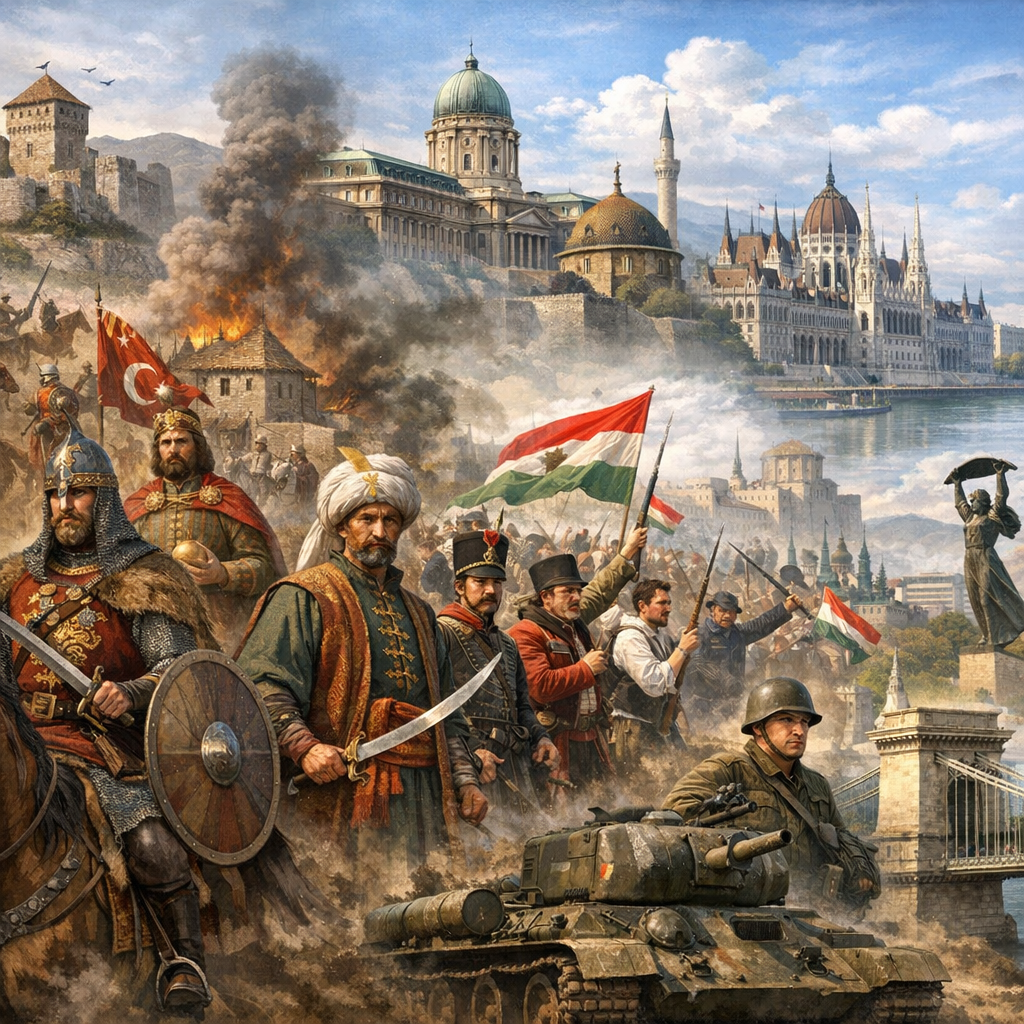
Hungary Through the Ages: From Medieval Kingdom to Modern Democracy
This course traces the history of Hungary from its early medieval foundations to the dramatic political changes of the 21st century. You will follow key turning points—conquests, empires, revolutions, and recent democratic challenges—to understand how Hungary’s past shapes its society and politics today.
The first lecture plays free — no account needed.
What you'll learn
- Students will be able to outline the migration and settlement of the Magyars into the Carpathian Basin.
- Students will understand how Christianization under Stephen I shaped Hungary’s political and cultural orientation toward Western Europe.
- Students will be able to describe how the Mongol invasion reshaped Hungary’s defensive and settlement patterns.
- Students will understand the main features of Hungary’s late medieval political order and its regional role in Central Europe.
- Students will be able to explain how the Battle of Mohács led to the tripartite division of Hungary.
- Students will understand how Ottoman and Habsburg rule affected Hungary’s political autonomy, religious landscape, and social structure.
- Students will be able to summarize the causes, key events, and outcomes of the 1848–1849 Hungarian Revolution.
- Students will understand the political structure of the Austro‑Hungarian Dual Monarchy and Hungary’s role within it.
- Students will be able to explain how World War I led to the collapse of the Habsburg Empire and transformed Hungary’s borders.
- Students will understand the significance of the Treaty of Trianon for Hungarian politics, society, and national identity.
Prerequisites
- Magyar conquest and settlement (9th–10th centuries)
- Saint Stephen I and Christianization
- Árpád dynasty and consolidation of the kingdom
- Mongol invasion of 1241–1242 and its impact
- Late medieval social and political structure
- Habsburg consolidation and anti‑Habsburg uprisings
Course Content
11 modules · 2h 45m total
From Steppe Riders to Christian Kingdom: The Birth of Hungary
A confederation of steppe warriors crosses into the Carpathian Basin and, within a century, becomes a Christian kingdom at the heart of Europe—discover how this unlikely transformation set the stage for a thousand years of Hungarian history.
Medieval Powerhouse: Golden Age, Mongol Invasion, and Late Medieval Hungary
Knights, kings, and catastrophic invasions collide as medieval Hungary rises as a regional power, only to be shaken by the Mongols and internal noble rivalries.
Between Crescent and Crown: Ottoman Conquest and Habsburg Rule
For centuries Hungary was split between Ottoman pashas and Habsburg emperors—step into a frontier world of religious conflict, shifting borders, and everyday life under two empires.
Reform, Revolution, and Compromise: The Long 19th Century
National poets, revolutionary crowds, and imperial armies dominate a century in which Hungary demands freedom, loses it, and then regains a share of power in a dual monarchy.
From Empire’s Collapse to Trianon: Hungary in World War I and Its Aftermath
The First World War shatters the Habsburg Empire, leaving Hungary drastically reduced in size and struggling to redefine itself amid revolutions, counter‑revolutions, and a traumatic peace treaty.
Authoritarianism and Catastrophe: Interwar Hungary and World War II
As Europe moves toward dictatorship and war, Hungary pursues territorial revision, aligns with Nazi Germany, and ultimately faces occupation, the Holocaust, and devastating defeat.
From Stalinism to 1956: Building and Breaking a People’s Republic
Soviet troops, show trials, and secret police define early communist Hungary—until a spontaneous uprising in 1956 briefly shakes the entire Eastern Bloc.
Goulash Communism and the Road to 1989
Behind the Iron Curtain, Hungary experiments with a softer, consumer‑friendly socialism that earns the nickname ‘goulash communism’ and quietly paves the way for a peaceful transition.
Democracy, Markets, and the EU: Hungary After 1989
Shock therapy economics, new political parties, and a path toward NATO and the European Union define a turbulent era of hope, hardship, and integration into the West.
Illiberal Turns: Orbán, Democratic Backsliding, and EU Tensions
A once‑liberal reformer returns to power and gradually reshapes Hungary into a model of ‘illiberal democracy,’ provoking clashes with Brussels and global debate over the future of democracy.
Hungary in the 2020s: Elections, Protests, and Rights Debates
From mass rallies and new opposition movements to controversial laws on LGBTQ rights and foreign influence, recent years have turned Hungary into a test case for European democracy.
Read the Textbook
Read every chapter for free, right here in your browser.
In this module, you will follow how a group of steppe riders became a Christian kingdom in less than a century.
Big picture timeline (relative to today, 2026): Around 895–900 (about 1,130 years ago): Magyar conquest of the Carpathian Basin. 10th century: Settling down and first contacts with Latin Christian Europe. 1000/1001: Stephen I crowned as king and begins systematic Christianization.
Who were the Magyars? A semi-nomadic, horse‑riding people from the Eurasian steppe. Spoke an Uralic language (related to Finnish and Estonian, not to Slavic or Germanic languages). Organized in a tribal confederation led by powerful chieftains.
Study Flashcards
Key concepts from this course as flashcard pairs.
From Steppe Riders to Christian Kingdom: The Birth of Hungary
Magyar conquest
The migration and military takeover by the Magyars of the Carpathian Basin around 895–900, creating the base for the later Hungarian kingdom.
Carpathian Basin
A large, fertile plain in Central Europe, surrounded by mountain ranges like the Carpathians and the Alps; the geographic core of medieval and modern Hungary.
Árpád dynasty
The ruling family descended from the chieftain Árpád, which provided Hungary’s rulers from the conquest era through the late Middle Ages, including Stephen I.
Christianization
The process of adopting Christianity as the dominant religion and organizing society around Christian institutions, laws, and beliefs.
Stephen I (Saint Stephen)
Ruler of Hungary c. 997–1038, crowned king around 1000/1001. He organized the kingdom on Christian principles and is regarded as Hungary’s first king and patron saint.
Vármegye (county)
A territorial-administrative unit in medieval Hungary, centered on a fortress and governed by a royal official (ispán), key to extending royal authority locally.
+2 more flashcards
Medieval Powerhouse: Golden Age, Mongol Invasion, and Late Medieval Hungary
Árpád dynasty
Ruling house of Hungary from the late 9th century until 1301, descended from the chieftain Árpád; it transformed the Magyar tribal confederation into a Christian kingdom and ruled until the male line died out.
Golden Bull of 1222
A key Hungarian royal charter issued by King Andrew II that confirmed noble rights, limited certain royal powers, and granted nobles a "right of resistance" if the king broke the law; often compared to England’s Magna Carta.
Mongol invasion of 1241–1242
A devastating attack by Mongol forces under Batu Khan and Subutai. They crushed the Hungarian army at Mohi, ravaged much of the kingdom, then withdrew in 1242, prompting major changes in defenses and settlement.
Béla IV
King of Hungary (r. 1235–1270) who ruled during the Mongol invasion and led post-invasion rebuilding. Because he promoted stone castles, walled towns, and repopulation, he is often called a "second founder" of the kingdom.
Angevin kings (Charles I and Louis I)
Rulers from a branch of the French Capetian dynasty. Charles I (r. 1308–1342) restored royal power and reformed mining and coinage; Louis I the Great (r. 1342–1382) expanded Hungary’s influence and presided over a "golden age."
Diet (in medieval Hungary)
The national assembly of estates (nobles, clergy, some towns) that discussed taxes, laws, and major political issues with the king, reflecting a negotiated balance of power between crown and elites.
+2 more flashcards
Between Crescent and Crown: Ottoman Conquest and Habsburg Rule
Battle of Mohács (1526)
A short, disastrous battle where the Hungarian army was crushed by the Ottomans, King Louis II died, and the political elite was decimated, leading to a succession crisis and eventual tripartite division.
Ottoman Hungary
Central and southern parts of historical Hungary ruled directly by the Ottoman Empire, with Buda as a provincial center, organized into vilayets and sanjaks.
Royal Hungary
Northwestern and northern regions of Hungary under Habsburg rule, where the Hungarian Diet survived but with reduced autonomy and strong Counter-Reformation influence.
Principality of Transylvania
Semi-independent state in eastern Hungary, usually an Ottoman vassal, with significant internal autonomy and relatively tolerant religious policies.
Tripartite division of Hungary
The long-lasting split of historical Hungary into Ottoman Hungary, Royal Hungary, and the Principality of Transylvania after the mid-1500s.
Jizya
A poll tax paid by non-Muslims in the Ottoman Empire, which allowed them to keep their religion and communal structures under imperial rule.
+4 more flashcards
Reform, Revolution, and Compromise: The Long 19th Century
Enlightenment
An intellectual movement stressing reason, individual rights, and reform of traditional institutions. In Hungary it inspired calls for legal equality, end of serfdom, and modernization.
National awakening
Period when a group develops strong national identity, often through language, literature, and history. In Hungary, Magyar, Slovak, Romanian, Croatian and other awakenings overlapped and sometimes clashed.
April Laws (1848)
Reforms passed by the Hungarian Diet that abolished serfdom, introduced legal equality, and granted internal self‑government under the Habsburg crown.
Neo‑absolutism
Centralized, authoritarian rule in the Habsburg Empire after 1849, with limited constitutional life and strong control from Vienna over Hungary.
Austro‑Hungarian Compromise (1867)
Agreement creating the Dual Monarchy of Austria‑Hungary: two equal states (Austria and Hungary) with separate parliaments but a common monarch and shared ministries for foreign affairs, war, and common finance.
Dual Monarchy
The political structure of Austria‑Hungary after 1867: a 'twin state' with Austria and Hungary as partners, each self‑governing internally but united under one ruler.
+1 more flashcards
From Empire’s Collapse to Trianon: Hungary in World War I and Its Aftermath
Dual Monarchy (Austria-Hungary)
A political system (1867–1918) where Austria and Hungary were separate states with their own parliaments but shared a monarch, army, and foreign policy.
Aster Revolution
A mostly peaceful revolution in Hungary in October 1918 that brought Mihály Károlyi to power and led to Hungary’s separation from Austria.
Hungarian Soviet Republic
A short-lived communist regime led by Béla Kun (March–August 1919) that tried to build a Soviet-style state in Hungary and defend its historic borders.
Miklós Horthy
Former admiral who became leader of the counter-revolutionary National Army and was appointed Regent of Hungary in 1920, ruling the kingdom without a king.
Treaty of Trianon
The 1920 peace treaty between Hungary and the Allied powers that greatly reduced Hungary’s territory and population after World War I.
Revisionism (interwar Hungary)
A political goal aiming to revise or overturn the Treaty of Trianon and recover lost territories with Hungarian populations.
+1 more flashcards
Authoritarianism and Catastrophe: Interwar Hungary and World War II
Horthy era
Period from 1920 to 1944 when Admiral Miklós Horthy served as Regent of Hungary, leading an authoritarian, nationalist regime that combined limited parliamentary life with strong executive power.
Revisionism (Hungarian context)
The political goal of revising the Treaty of Trianon by regaining territories lost after World War I, especially areas with large ethnic Hungarian populations.
Numerus Clausus (1920)
Hungarian law that limited the number of university students from certain groups, effectively targeting Jews; one of Europe’s first post‑WWI anti‑Jewish laws.
First and Second Vienna Awards
Arbitration decisions (1938 and 1940) by Germany and Italy that transferred territories from Czechoslovakia and Romania to Hungary, advancing Hungarian revisionist aims.
Anti‑Jewish Laws (1938–1941)
A series of Hungarian laws that restricted Jews’ access to professions, public life, and marriage with non‑Jews, using religious and racial definitions and aligning with Nazi ideology.
Operation Margarethe
Code name for Germany’s occupation of Hungary on 19 March 1944, which installed a pro‑German government and enabled rapid escalation of the Holocaust in Hungary.
+4 more flashcards
From Stalinism to 1956: Building and Breaking a People’s Republic
ÁVH (State Protection Authority)
Hungary's secret police under Stalinism. It monitored citizens, used informers, and carried out arrests, interrogations, and show trials to protect the communist regime.
Show trial
A staged political trial with a pre-decided verdict, used to send a political message and intimidate society. Defendants often gave forced confessions, as in the 1949 László Rajk trial.
Collectivization
The process of forcing peasants into collective or state farms, replacing private ownership with state- or cooperative-run agriculture. Often involved pressure, propaganda, and coercion.
Imre Nagy
Reform-minded communist leader and prime minister. Promoted the New Course after 1953 and led the reform government during the 1956 Revolution. Arrested and secretly executed in 1958.
János Kádár
Communist leader installed after the 1956 Revolution was crushed. His long rule combined initial repression with later economic reforms and limited freedoms, known as "Goulash Communism".
Warsaw Pact
A Soviet-led military alliance created in 1955, including Hungary and other Eastern Bloc states. Hungary's attempt to leave it in 1956 was a key reason for Soviet military intervention.
+2 more flashcards
Goulash Communism and the Road to 1989
Goulash communism
Nickname for Hungary’s softer form of socialism under János Kádár, combining one‑party rule with limited market reforms, modest personal freedoms, and a focus on consumer welfare.
New Economic Mechanism (NEM)
Economic reform launched in 1968 that gave enterprises more autonomy, introduced market‑like incentives, and allowed some private and cooperative activity within a socialist framework.
Samizdat
Underground, self‑published literature and journals that bypassed state censorship, used by dissidents to spread alternative ideas in the 1970s–1980s.
National Round Table Talks
Negotiations in 1989 between opposition groups and reform communists in Hungary that prepared the legal and political framework for free elections and multi‑party democracy.
Imre Nagy reburial (1989)
Public ceremony re‑interring the executed 1956 prime minister, which became a powerful symbol of breaking with the communist past and honoring the 1956 revolution.
Republic of Hungary (1989)
New official name adopted in autumn 1989, marking the end of the People’s Republic and signaling the shift to a democratic system.
Democracy, Markets, and the EU: Hungary After 1989
Shock therapy
A rapid shift from a planned to a market economy, including quick price liberalization, privatization, and opening to foreign trade and investment, often causing short-term social pain.
Privatization
The process of transferring ownership of state-owned enterprises to private owners, including individuals, companies, or foreign investors.
Round Table Talks (Hungary, 1989)
Negotiations between communist authorities and opposition groups that agreed on free elections, a revised constitution, and the basic rules of Hungary’s new democracy.
NATO accession (1999)
Hungary’s entry into the North Atlantic Treaty Organization in March 1999, aligning its security and defense policy with Western allies.
EU accession (2004)
Hungary’s entry into the European Union in 2004, gaining access to the single market, EU funds, and participation in EU decision-making.
Copenhagen criteria
EU rules set in 1993 that candidate countries must meet: stable democratic institutions, a functioning market economy, and the ability to adopt the EU’s laws and obligations.
+2 more flashcards
Illiberal Turns: Orbán, Democratic Backsliding, and EU Tensions
Illiberal democracy
A system that holds elections but weakens liberal elements such as independent courts, media freedom, and minority rights; Orbán uses this term positively for Hungary.
Hybrid regime
A political system combining democratic and authoritarian features, with elections and formal institutions but serious flaws in fairness, pluralism, and checks on power.
Media capture
A process where governments and allied business actors gain control over major media outlets, using ownership, regulation, and advertising to shape coverage.
Article 7 TEU
An EU treaty mechanism for responding to serious breaches of EU values by a member state, potentially leading to suspension of voting rights, though very hard to apply fully.
Rule-of-law conditionality
EU policy linking the disbursement of some EU funds to respect for rule-of-law standards, used since 2022 to freeze or condition parts of Hungary's funding.
Cardinal laws (Hungary)
Laws that require a two-thirds majority in parliament to change, used in Hungary to lock in key policies like tax and family rules beyond normal electoral alternation.
+2 more flashcards
Hungary in the 2020s: Elections, Protests, and Rights Debates
Fidesz
Hungary's dominant governing party in the 2010s and 2020s, led by Viktor Orbán. It describes its model as "illiberal democracy" and emphasizes national sovereignty, traditional values, and centralized control.
United for Hungary (2022)
An electoral alliance of most opposition parties in the 2022 parliamentary election, formed to challenge Fidesz. Despite uniting, it lost and Fidesz kept its two‑thirds majority.
Sovereignty Protection Office
A new authority created by Hungary's Sovereignty Protection Act (in force around 2023–2024) to investigate alleged foreign interference and funding in politics. Critics see it as a tool to pressure NGOs, media, and opposition actors.
EU Rule-of-Law Conditionality
An EU mechanism, in force since 2021, allowing the suspension of EU funds if rule‑of‑law problems in a member state threaten the EU budget. It has been applied in disputes with Hungary over corruption and judicial independence.
2021 Child Protection Law
A Hungarian law officially framed as child protection but including restrictions on presenting LGBTQ content to minors in schools and media. The EU argues it discriminates and violates fundamental rights.
Budapest Pride
An annual LGBTQ Pride march and festival in Hungary's capital. It continues under increasing political and rhetorical pressure and has become a symbol of rights and freedom of assembly.
+2 more flashcards
More in History
See all →
The Origin Story of the English Alphabet
Yhdysvaltain sisällissota: syyt, kulku ja seuraukset
Första världskriget för åk 8: Från skottet i Sarajevo till Versaillesfreden
Decisive Battles of the American Civil War

World War I: A Global War and Its Lasting Aftermath
