Skarp
Skarp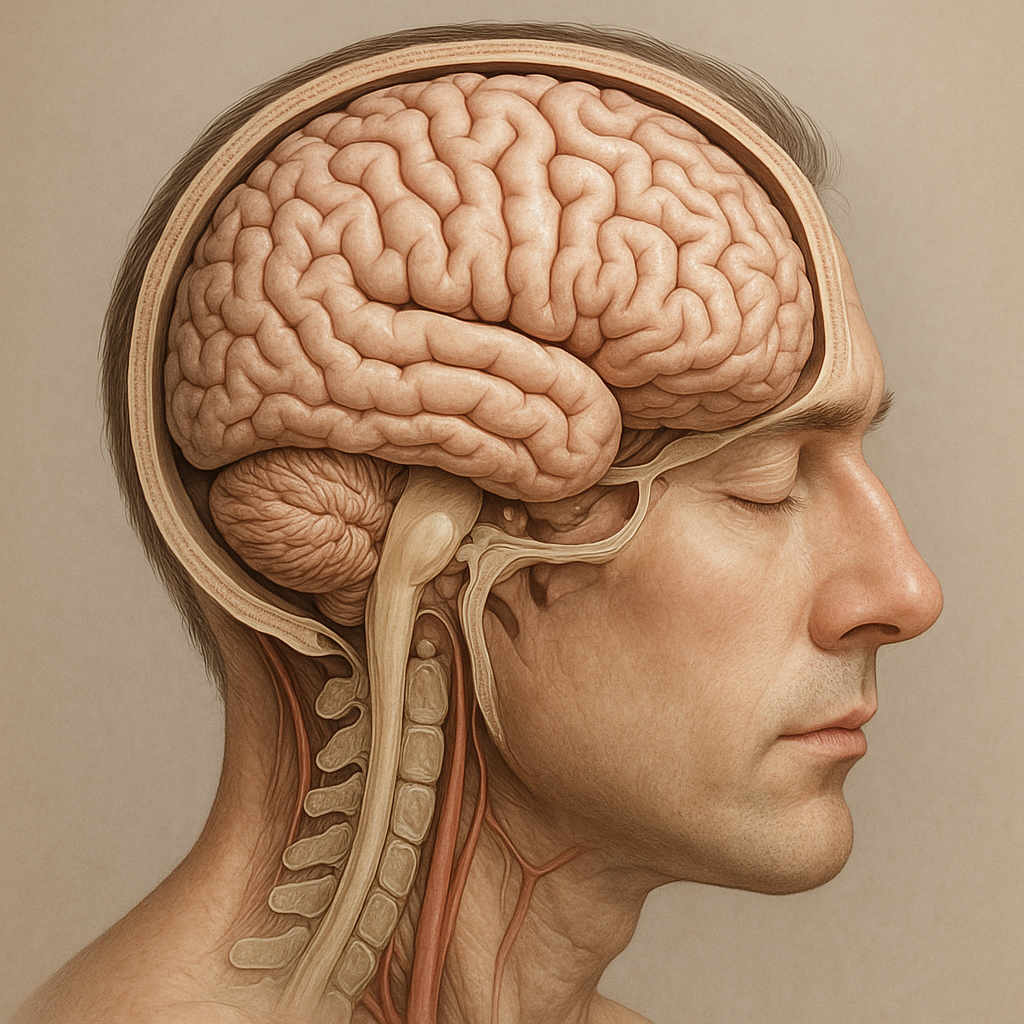
How the Human Brain Works: A Guided Tour of Your Mind
This course gives you a clear, structured introduction to how the human brain is built, how it works, and how it shapes thoughts, emotions, memory, and behavior. You will learn core brain structures, how neurons communicate, how the brain changes over time, and what current neuroscience says about learning, sleep, and mental health.
The first lecture plays free — no account needed.
What you'll learn
- Students will be able to identify the brain as part of the central nervous system and distinguish it from the peripheral nervous system.
- Students will be able to name and locate the cortex, cerebellum, and brainstem and describe one key function of each.
- Students will understand that both hemispheres of the brain work together and that the "left brain/right brain" idea is an oversimplification.
- Students will be able to label the main parts of a neuron and explain their roles.
- Students will be able to describe how an electrical signal (action potential) travels along a neuron.
- Students will understand how neurotransmitters cross synapses to pass messages between neurons.
- Students will recognize that complex thoughts and behaviors arise from networks of many neurons working together.
- Students will be able to locate the four major lobes of the cortex and match each to core functions (e.g., vision for occipital lobe).
- Students will understand the roles of primary sensory and motor areas in processing incoming information and controlling movement.
- Students will be able to explain what association areas are and why they are important for complex thinking.
Prerequisites
- Central nervous system vs. peripheral nervous system
- Major brain regions
- Major brain regions (cortex, cerebellum, brainstem)
- Basic neuron and synapse function
- Major brain lobes and their functions
- Basic neuron communication
Course Content
10 modules · 2h 30m total
Meet Your Brain: Big Picture Overview
Get a high-level tour of the human brain—what it is, why it matters, and how it connects to everything you think, feel, and do.
Inside the Brain: Neurons and How They Communicate
Zoom in to the microscopic level to see how neurons and synapses create electrical and chemical signals that power the brain.
Brain Map: Lobes and What They Do
Explore the cerebral cortex and its lobes to see how different regions specialize in vision, hearing, movement, planning, and more.
Sensing the World: Perception and the Brain
Learn how the brain turns light, sound, touch, taste, and smell into meaningful experiences—and why perception can be tricky.
Moving and Doing: Motor Control and Coordination
Discover how the brain plans and controls voluntary movement, balance, and coordination.
Learning, Memory, and a Changing Brain
Examine how the brain learns, stores memories, and changes physically through experience across the lifespan.
Feelings and Motivation: Emotion in the Brain
Look at how brain systems generate emotions, manage stress, and drive motivation and reward.
Attention, Decision-Making, and Consciousness
Explore higher-level brain functions that let you focus, make choices, and be aware of yourself and the world.
Sleep, Health, and Protecting Your Brain
Connect everyday habits like sleep, exercise, and nutrition to brain function, and get an overview of brain disorders.
How We Study the Brain: Tools and Future Directions
See how scientists investigate the brain today and what new discoveries might mean for the future.
Read the Textbook
Read every chapter for free, right here in your browser.
Your brain is your body's control center.
In about 15 minutes, you'll get a big-picture tour of: What the brain is and how it fits into your nervous system The three major brain regions: cortex, cerebellum, brainstem How the brain handles sensing, thinking, and acting What’s true (and what’s myth) about left brain vs. right brain
Quick mental picture Imagine: A cauliflower (the wrinkly top) → that’s your cortex A little cauliflower stuck at the back, underneath → that’s your cerebellum A thick stalk connecting the brain to your spine → that’s your brainstem
Study Flashcards
Key concepts from this course as flashcard pairs.
Meet Your Brain: Big Picture Overview
Central Nervous System (CNS)
The part of the nervous system made up of the **brain and spinal cord**; acts as the main control center for processing information and making decisions.
Peripheral Nervous System (PNS)
All the **nerves outside the brain and spinal cord**; carries information between the body and the CNS.
Cortex (Cerebral Cortex)
The **outer wrinkled layer** of the brain responsible for **thinking, planning, language, conscious perception, and voluntary movement**.
Cerebellum
The smaller, cauliflower-shaped structure at the **back and bottom** of the brain that helps with **coordination, balance, and fine-tuning movements**.
Brainstem
The **stalk-like** part of the brain that connects to the spinal cord and controls **basic life functions** like breathing, heart rate, and sleep–wake cycles.
Hemispheres
The two halves of the brain, **left and right**, which are connected and usually **work together**, even though some functions are more dominant on one side.
+1 more flashcards
Inside the Brain: Neurons and How They Communicate
Neuron
A specialized nerve cell that receives, processes, and transmits information using electrical and chemical signals.
Dendrite
Branch‑like extension of a neuron that receives signals from other neurons and sends them toward the cell body.
Cell body (soma)
The central part of the neuron containing the nucleus; integrates incoming signals and decides whether to fire an action potential.
Axon
A long projection that carries action potentials away from the cell body toward other neurons or muscles.
Myelin sheath
Fatty insulating layer around parts of the axon that speeds up action potential conduction.
Resting membrane potential
The stable, negative electrical charge inside a neuron when it is not firing, typically around −70 mV.
+6 more flashcards
Brain Map: Lobes and What They Do
Frontal lobe
Front part of the cortex, behind the forehead. Important for voluntary movement (primary motor cortex), planning, decision-making, self-control, and speech production (Broca’s area, usually left side).
Parietal lobe
Top and upper back part of the cortex. Processes touch and body sensations (primary somatosensory cortex) and supports body-and-space awareness and integrating senses for action.
Temporal lobe
Side of the cortex near the ears. Important for hearing (primary auditory cortex), understanding language (usually left side), memory (including hippocampus), and recognizing objects and faces.
Occipital lobe
Back of the cortex. Main cortical center for vision, including the primary visual cortex (V1) and surrounding visual association areas.
Primary motor cortex
Strip of cortex in the frontal lobe that sends commands to muscles for voluntary movement, organized roughly as a body map.
Primary somatosensory cortex
Strip of cortex in the parietal lobe that receives touch, pressure, temperature, pain, and body position information, also organized as a body map.
+4 more flashcards
Sensing the World: Perception and the Brain
Sensation
The process by which sensory receptors and nervous system detect and encode energy or chemicals from the environment (e.g., light, sound, pressure, molecules).
Perception
The process by which the brain organizes and interprets sensory information, turning raw signals into meaningful experiences (e.g., recognizing a face or a melody).
Transduction
Conversion of physical energy (light, sound, pressure, chemicals) into electrical signals in the nervous system by sensory receptors.
Primary sensory cortex
The first cortical area to receive input for a particular sense (e.g., primary visual cortex for vision, primary auditory cortex for hearing).
Thalamus
A relay and processing hub deep in the brain that routes most sensory information (except smell) to the appropriate cortical areas.
Multisensory integration
The brain’s process of combining information from more than one sense (e.g., sight and sound) to create a unified perception.
+2 more flashcards
Moving and Doing: Motor Control and Coordination
Primary motor cortex (M1)
A region in the frontal lobe (precentral gyrus) that sends direct commands to spinal motor neurons to initiate voluntary movements; organized as a motor homunculus.
Motor homunculus
A distorted map of the body on the motor cortex where body parts requiring fine control (hands, face) occupy larger cortical areas than those needing coarse control.
Cerebellum
A "little brain" at the back of the skull that coordinates movements, maintains balance and posture, and supports timing and error-based motor learning.
Basal ganglia
A group of deep brain nuclei (including striatum, globus pallidus, subthalamic nucleus, substantia nigra) that help select, initiate, stop, and scale movements and support habit learning.
Proprioception
The sense of the position and movement of your body parts, provided by receptors in muscles, tendons, and joints.
Error-based motor learning
A process, strongly involving the cerebellum, in which the brain compares intended with actual movement, uses the error to adjust commands, and gradually improves performance through practice.
+2 more flashcards
Learning, Memory, and a Changing Brain
Short-term (Working) Memory
The limited-capacity system that holds information for seconds to about a minute so you can use and manipulate it (e.g., remembering a phone number long enough to dial it).
Long-term Memory
Relatively durable storage of information over hours to a lifetime. Includes declarative (facts and events) and non-declarative (skills and habits) types.
Declarative Memory
Memory for facts and events that you can consciously recall and describe in words (semantic and episodic memory). Depends strongly on the hippocampus for new learning.
Procedural Memory
A type of non-declarative memory for skills and habits (e.g., riding a bike, typing). Often expressed through action rather than verbal explanation; relies on cerebellum and basal ganglia.
Hippocampus
A brain structure in the medial temporal lobe that is critical for forming new declarative memories by linking together different elements of an experience.
Neuroplasticity
The brain’s ability to change its structure and function by strengthening, weakening, or forming new connections between neurons in response to experience.
+4 more flashcards
Feelings and Motivation: Emotion in the Brain
Amygdala
An almond-shaped structure in the medial temporal lobe that rapidly evaluates the emotional importance (salience) of stimuli and helps trigger fast emotional and bodily responses, especially to potential threats.
Hippocampus
A curved structure in the medial temporal lobe that helps form new memories and provides context for emotional events, working closely with the amygdala and cortex.
Prefrontal cortex (PFC)
The front part of the frontal lobes involved in planning, decision-making, and emotion regulation. It exerts top-down control over limbic regions like the amygdala.
Reward pathway (mesolimbic dopamine system)
A network including the ventral tegmental area (VTA), nucleus accumbens, and prefrontal cortex that uses dopamine to support motivation, reward learning, and habit formation.
Dopamine (in reward learning)
A neurotransmitter that, among other roles, signals prediction errors in reward learning—comparing expected and actual outcomes and helping strengthen or weaken behaviors.
Stress response
The brain–body reaction to a challenge or threat, involving rapid sympathetic activation and a slower HPA axis response that releases cortisol.
+4 more flashcards
Attention, Decision-Making, and Consciousness
Attention
A limited brain process that selects some information for deeper processing while filtering out other input, often described as a mental spotlight.
Executive functions
Higher-level control processes (including working memory, inhibition, and cognitive flexibility) that support planning, self-control, and problem solving, mainly linked to the prefrontal cortex.
Working memory
The ability to hold and manipulate information in mind over short periods to guide current thinking and behavior.
Inhibitory control
The capacity to suppress automatic, impulsive, or habitual responses in favor of goal-directed actions.
Cognitive flexibility
The ability to switch between tasks, perspectives, or strategies when rules or demands change.
Risk–reward evaluation
The process of estimating potential gains and losses of different options, involving value, emotion, and control networks in the brain.
+2 more flashcards
Sleep, Health, and Protecting Your Brain
Non-REM Sleep (N1, N2, N3)
Sleep stages with generally slower brain activity than wakefulness. N1 is light sleep, N2 shows sleep spindles and K-complexes, and N3 is deep slow-wave sleep important for restoration and memory consolidation.
REM Sleep
Sleep stage with rapid eye movements, vivid dreams, and brain activity similar to wakefulness. Important for emotional processing and some types of memory.
Sleep Consolidation of Memory
The process by which the brain strengthens, reorganizes, and stabilizes memories during sleep, especially in N2/N3 and REM stages.
Emotion Regulation
The brain’s ability to manage and respond to emotional experiences, involving areas like the prefrontal cortex and amygdala.
Sleep Hygiene
Everyday habits and environmental factors that make it easier to fall asleep and stay asleep, such as a regular schedule, limiting caffeine, and having a calming bedtime routine.
Neurodegenerative Disease
A condition in which brain cells gradually become damaged or die over time, leading to problems with memory, movement, or thinking (e.g., Alzheimer’s disease).
How We Study the Brain: Tools and Future Directions
MRI (Magnetic Resonance Imaging)
A non‑invasive imaging method that creates detailed pictures of **brain structure** (what it looks like), widely used in medicine.
fMRI (functional MRI)
A method that measures changes in blood flow related to neural activity, showing **which brain areas are more active** during tasks.
EEG (Electroencephalography)
A technique that uses electrodes on the scalp to record the brain’s **electrical activity** with very high time resolution.
Animal study
Research using non‑human animals to test ideas about brain function, disease, or treatment that would be unsafe or impossible to test directly in humans.
Human case study
An in‑depth examination of one person (or a small group) with specific brain changes, linking brain structure or damage to behavior.
Brain–Computer Interface (BCI)
A system that records brain signals and translates them into commands to control external devices such as cursors, wheelchairs, or robotic arms.
+2 more flashcards
More in Science
See all →
Chemische Grundlagen für die Biotechnologie: Von Atomen zu Biomolekülen

Quantum Mechanics Mastery: From Foundations to Modern Frontiers

BIO 204: Fundamentals of Scientific Inquiry in the Biological Sciences
BCH 204 Essentials: Structure, Properties, and Functions of the 20 Amino Acids

Transcendent Architectures: Formal Models of Hebrew Letters, Sefirot, 72 Names & the 231 Gates