 Skarp
Skarp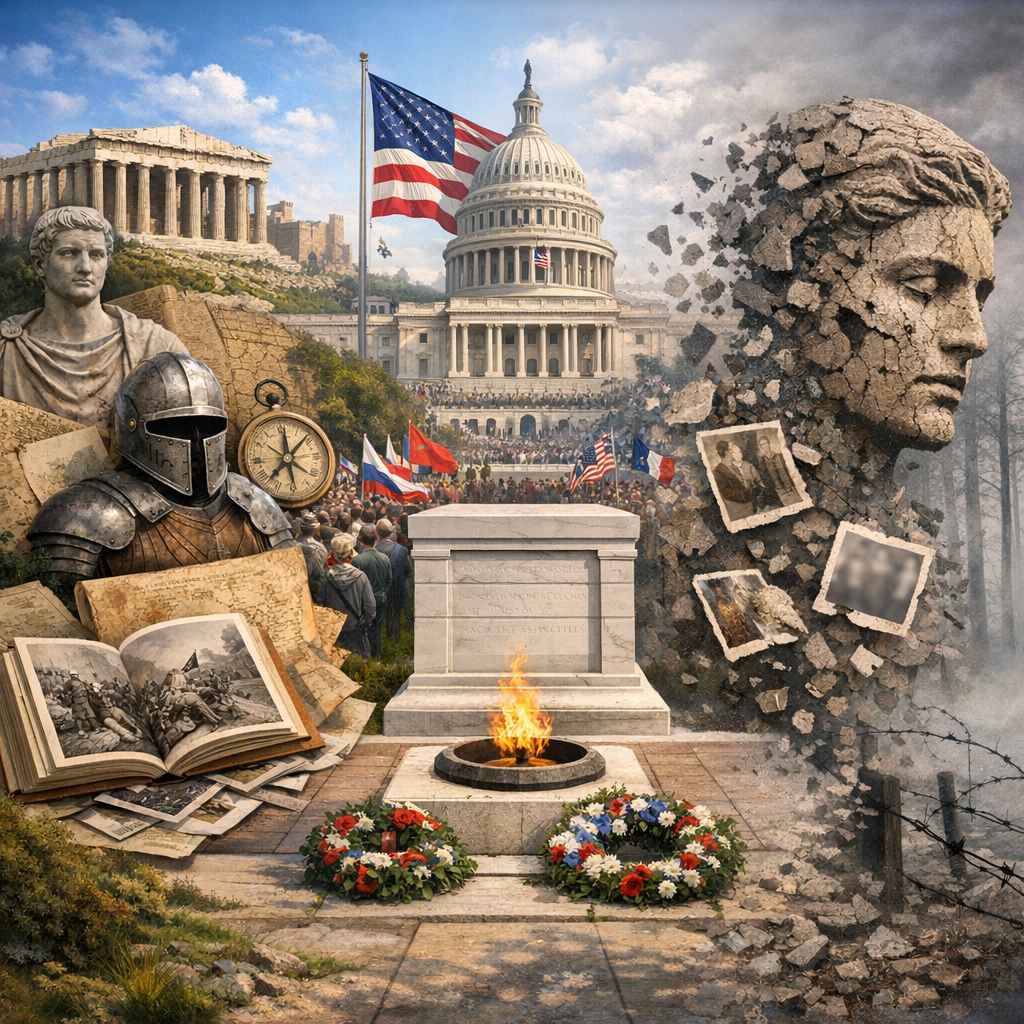
History, Memory, and Nation: How Remembering and Forgetting Shape Identity
This course explores how societies use historical memory to build national identity, and how choices about remembering or forgetting past events influence politics, law, and public space. Through theoretical frameworks and contemporary case studies—from memory laws to monument debates—you will analyze when remembering heals or divides, and when forgetting can be strategic or dangerous.
The first lecture plays free — no account needed.
What you'll learn
- Students will be able to distinguish between historical scholarship and collective memory and explain why this distinction matters for politics.
- Students will understand how national identities are constructed through selective narratives about the past.
- Students will be able to identify key sites and practices through which historical memory is produced (education, rituals, media, monuments).
- Students will be able to summarize key arguments about memory as a factor in national identity and political behavior.
- Students will understand how emotions like humiliation, resentment, and pride are tied to historical memory.
- Students will be able to explain how certain forms of official remembrance can simultaneously obscure other parts of the past.
- Students will be able to define political forgetting and distinguish it from natural fading of memory.
- Students will understand how amnesty and silence were used in Spain after Franco and how later laws of historical memory attempted to reverse this approach.
- Students will be able to evaluate arguments that some forgetting is necessary for social peace versus claims that it entrenches injustice.
- Students will be able to define memory laws and distinguish punitive from non-punitive forms.
Prerequisites
- difference between history and collective memory
- basic understanding of national identity
- collective memory and national narratives
- memory as political resource
- memory as variable in politics
- politics of forgetting and its critiques
Course Content
10 modules · 2h 30m total
Memory, History, and Nation: Setting the Stage
Introduce core concepts of historical memory and national identity, and distinguish between academic history and collective memory as social practice.
Theoretical Lenses: How Historical Memory Shapes Identity
Survey major theoretical approaches to the politics of memory and their explanations for how remembering and forgetting influence national identity and conflict.
Politics of Forgetting: Amnesties, Silences, and ‘Pacts of Oblivion’
Examine deliberate political strategies of forgetting—such as amnesty laws and official silences—and how they shape post-conflict identities.
Politics of Remembering: Memory Laws and Official Narratives
Investigate how states use law and official policy to enforce particular historical narratives, including criminalizing denial or alternative accounts.
Monuments, Statues, and the Battle for Public Space
Analyze contemporary struggles over monuments and memorials as conflicts over whose version of national history is honored or marginalized.
Colonialism, Slavery, and Decolonizing Memory
Explore how legacies of colonialism and slavery are remembered, contested, and reimagined, and how these struggles reshape national identities.
Transitional Justice: Truth Commissions and Competing Memories
Consider how truth commissions and other transitional justice mechanisms construct official narratives of past violence and shape collective memory.
Global Case Comparisons: Memory, Identity, and Foreign Policy
Compare how different states mobilize historical memory—especially wars and atrocities—to define national identity and guide foreign policy.
Digital Memory, AI, and the New Politics of Forgetting
Examine how digital technologies and AI transform collective memory, raising new questions about erasure, permanence, and asymmetries of remembering.
Normative Dilemmas: When Should Societies Remember or Forget?
Synthesize the course by evaluating ethical frameworks for deciding what to remember, what to forget, and who gets to decide, using real-world dilemmas.
Read the Textbook
Read every chapter for free, right here in your browser.
When people talk about a nation (like France, India, or the United States), they almost always talk about its past: founding moments (revolutions, independence days) heroes and villains victories and traumas (wars, genocides, colonization, civil conflicts)
These stories are not just about the past; they help answer questions like: Who are “we” as a nation? Who belongs and who doesn’t? What do we owe each other?
To understand this, we need to distinguish two key ideas: History – what professional historians do as a research discipline. Collective memory – how groups remember and use the past in everyday life and politics.
Study Flashcards
Key concepts from this course as flashcard pairs.
Memory, History, and Nation: Setting the Stage
Academic history
A discipline practiced by trained historians that uses critical methods, evidence, and debate to explain the past; open to revision when new evidence appears.
Collective memory
Shared understandings of the past held by a group (nation, community, movement), transmitted through stories, rituals, symbols, and emotions; often selective and identity-building.
National narrative
A broad, often simplified story about a nation’s origins, values, achievements, and traumas that helps define who 'we' are as a people.
Sites of memory (lieux de mémoire)
Places, symbols, texts, rituals, or media where collective memory is stored, performed, and contested (e.g., monuments, holidays, museums, flags, films).
Memory as political resource
The use of selective interpretations of the past to legitimize power, define who belongs, demand justice, or silence uncomfortable histories.
Memory laws
State laws that regulate how certain historical events may be described (e.g., banning denial of genocide or protecting a positive image of the nation’s past).
Theoretical Lenses: How Historical Memory Shapes Identity
Collective memory
Shared stories, symbols, and interpretations of the past that a group uses to define its identity and guide present behavior; selective and often emotionally charged.
Memory as a political variable
An approach that treats historical memory as a factor that can help explain political outcomes, such as nationalism, conflict, or reconciliation.
Cultural trauma
A process in which a group comes to see a past event as deeply damaging to its identity, shaping how it understands itself and its claims in the present.
Victimhood narrative
A story in which a group or nation portrays itself mainly as an innocent victim of others’ actions, often used to claim moral superiority or special rights.
Humiliation (in historical memory)
A collective feeling of being dishonored or degraded by past defeats, occupations, or injustices, which can fuel demands for dignity and revenge.
Remembering as forgetting
The idea that every act of public remembrance highlights some parts of the past while obscuring others, making forgetting an active part of memory politics.
+1 more flashcards
Politics of Forgetting: Amnesties, Silences, and ‘Pacts of Oblivion’
Political forgetting
Deliberate, organized efforts by states or political elites to limit what is remembered, discussed, or legally pursued about a violent or unjust past, often through laws, education, and control of archives.
Amnesty law
A legal measure that cancels or blocks criminal responsibility for certain past acts (often political crimes or human rights abuses), preventing or ending prosecutions.
Impunity
A situation where perpetrators of serious crimes are not held accountable—no effective investigation, prosecution, or punishment—often due to amnesties, weak institutions, or political protection.
Pact of forgetting (pacto del olvido)
The informal agreement among Spanish political elites during the post-Franco transition to avoid pursuing legal accountability or wide public debate about Civil War and dictatorship crimes, reinforced by the 1977 Amnesty Law.
Law of Historical Memory (Spain, 2007)
Spanish law (Law 52/2007) that condemned the Franco regime, offered symbolic reparations, supported exhumations, and promoted remembrance of victims, without repealing the 1977 Amnesty Law.
Democratic Memory Law (Spain, 2022)
Spanish law (Law 20/2022) that strengthened historical memory policies by declaring the Franco regime illegal, expanding victim recognition, making searches for the disappeared a state duty, and promoting education and research.
+1 more flashcards
Politics of Remembering: Memory Laws and Official Narratives
Memory laws
Laws or binding regulations through which a state promotes, protects, or imposes a particular interpretation of historical events, sometimes with criminal penalties and sometimes through commemorations and official narratives.
Punitive memory laws
Memory laws that attach legal sanctions (such as fines or imprisonment) to certain historical statements, such as denial, gross trivialization, or glorification of genocide or other serious crimes.
Non‑punitive (commemorative) memory laws
Memory laws that shape official memory without criminal penalties, for example by creating memorial days, defining official names for events, or setting educational and commemorative policies.
Holocaust denial laws
A subset of punitive memory laws that criminalize the denial, approval, or gross minimization of the Holocaust, often justified as a way to combat antisemitism and protect human dignity.
Institute of National Remembrance (IPN) law (Poland)
A Polish law originally adopted in 1998 that created the IPN to research and document Nazi and communist crimes; a 2018 amendment briefly added criminal penalties for falsely attributing Nazi crimes to the Polish nation or state, before those penalties were removed and replaced with civil provisions.
Official narrative
The version of history that a state promotes as legitimate or correct, often through school curricula, public commemorations, and sometimes through memory laws.
+1 more flashcards
Monuments, Statues, and the Battle for Public Space
Frozen narrative
A way of seeing monuments as stories about the past that have been fixed in physical form, often hiding conflict and presenting one version of history as natural and permanent.
Lost Cause myth
An interpretation of the American Civil War that portrays the Confederacy as noble and heroic, downplays or denies the central role of slavery, and idealizes the antebellum South; widely promoted through monuments, textbooks, and rituals.
Contextualization (of monuments)
Adding information—such as plaques, signs, or digital guides—to explain the full historical background and controversies around a monument, often including perspectives that were originally excluded.
Counter-monument
An artistic work that challenges or responds to an existing monument, often by undermining heroic narratives, highlighting victims, or encouraging critical reflection instead of passive admiration.
Heritage protection laws
Laws that limit or regulate changes to monuments, statues, and historic sites—sometimes used to preserve controversial monuments by making removal or alteration legally difficult.
Colonialism, Slavery, and Decolonizing Memory
Decolonizing memory
Efforts to challenge and transform dominant stories about the past—especially colonialism and slavery—by centering marginalized perspectives, questioning symbols, and changing institutions like schools and museums.
Postcolonial memory politics
The struggles in formerly colonizing and colonized societies over how colonial history is remembered, represented, and used in current political debates (e.g., about identity, citizenship, and reparations).
Rhodes Must Fall
A student‑led movement that began at the University of Cape Town in 2015 and spread to Oxford and elsewhere, challenging statues and institutional cultures that glorify Cecil Rhodes and wider colonial legacies.
Restitution / Repatriation
The process of returning cultural objects or human remains—often taken during colonial rule or war—to the communities or countries they came from, as a form of historical justice.
Mixed‑reality heritage
Using technologies like augmented reality (AR) or virtual reality (VR) to add new layers of information or experience to historical sites, often to surface hidden or marginalized histories.
Counter‑monument
An artwork or installation that challenges or complicates traditional monuments, often by highlighting victims, resisting glorification of power, or inviting active reflection instead of passive admiration.
Transitional Justice: Truth Commissions and Competing Memories
Transitional Justice
A set of processes and mechanisms used by societies moving away from mass violence or repression to address past abuses, recognize victims, and prevent future violations (e.g., trials, truth commissions, reparations, reforms, memorials).
Truth Commission
A temporary, officially mandated body that investigates patterns of serious human rights violations over a specific period, gathers testimonies, and produces a final report with findings and recommendations.
Official Memory
The dominant public narrative of the past promoted or endorsed by the state or major institutions, often reflected in school curricula, national memorial days, museums, and official speeches.
Grassroots Memory
Memories and interpretations of the past created from below by communities, survivors, families, and social movements, often expressed through local memorials, oral histories, art, and activism.
Reconciliation
A long-term process of rebuilding relationships and trust after violence or oppression, which may include acknowledgment of harm, justice, reparations, and changes in power relations.
Competing Memories
Situations where different groups in a society hold conflicting narratives about the same past events, often shaped by their positions as victims, perpetrators, bystanders, or beneficiaries.
Global Case Comparisons: Memory, Identity, and Foreign Policy
Collective memory
Shared understanding of the past held by a group or society, shaped by schools, media, rituals, and official narratives, not just by individual recollection.
National humiliation narrative
A story that emphasizes how the nation was humiliated or victimized by foreign powers, often used to justify strong sovereignty claims, military buildup, or revision of past agreements.
Heroic victory / liberation narrative
A narrative that highlights the nation’s role in defeating evil or liberating others, supporting pride, great-power ambitions, and claims to moral authority.
Victimhood narrative
A story that centers on the nation’s suffering and innocence, used to demand sympathy, protection, or special security guarantees from others.
Reconciliation narrative
An official story that acknowledges past crimes or injustices and uses them to build a new identity focused on responsibility, human rights, and peaceful cooperation.
Memory regime
The dominant way a state organizes, promotes, and polices public memory of the past, including laws, museums, school curricula, and acceptable interpretations.
+2 more flashcards
Digital Memory, AI, and the New Politics of Forgetting
Digital archive
A collection of digital records (texts, images, videos, logs) that can be stored, searched, and accessed over time, often at large scale and low cost.
Right to be forgotten / Right to erasure
A legal right (most fully developed in the EU’s GDPR Article 17) allowing individuals to request deletion or de-indexing of certain personal data under specific conditions, balanced against public interest and freedom of expression.
AI as infrastructure of memory
The idea that AI systems (search, recommendation, generative models, facial recognition) don’t just store data but actively organize, filter, and narrate what societies remember.
Memory power asymmetry
Unequal power over what is recorded, stored, and recalled—where some actors (states, platforms, corporations) can preserve and analyze vast digital traces, while others have limited control over how they are remembered.
Context collapse
When content created in one situation (time, audience, norms) appears in a very different context, often online, without the original cues that explained its meaning.
De-indexing
Removing or limiting specific links from search engine results (e.g., for a person’s name) without necessarily deleting the original content from the website where it is hosted.
Normative Dilemmas: When Should Societies Remember or Forget?
Normative dilemma
A conflict about what ought to be done, where important moral values (such as justice, peace, and dignity) pull in different directions and there is no obvious, cost-free solution.
Victim-centered approach
A way of designing memory policies that gives priority to the rights, voices, and dignity of victims and affected communities, often linked to human rights norms like the right to truth and reparations.
State-centered approach
A model in which the government and official institutions take the lead in defining and enforcing collective memory, for example through school curricula, national holidays, and memory laws.
Intergenerational responsibility
The idea that people today, even if they did not commit past abuses, have duties to acknowledge, repair, or prevent the continuation of injustices rooted in historical wrongs.
Memory laws
Legal rules that regulate how certain historical events may be publicly represented, often by criminalizing denial, glorification, or insult related to genocides, crimes against humanity, or state symbols.
Right to truth
A principle in international human rights practice that victims and societies have a right to know the truth about serious human rights violations, including the circumstances, perpetrators, and fate of victims.
More in History
See all →
The Origin Story of the English Alphabet
Yhdysvaltain sisällissota: syyt, kulku ja seuraukset
Första världskriget för åk 8: Från skottet i Sarajevo till Versaillesfreden
Decisive Battles of the American Civil War

World War I: A Global War and Its Lasting Aftermath
