Skarp
Skarp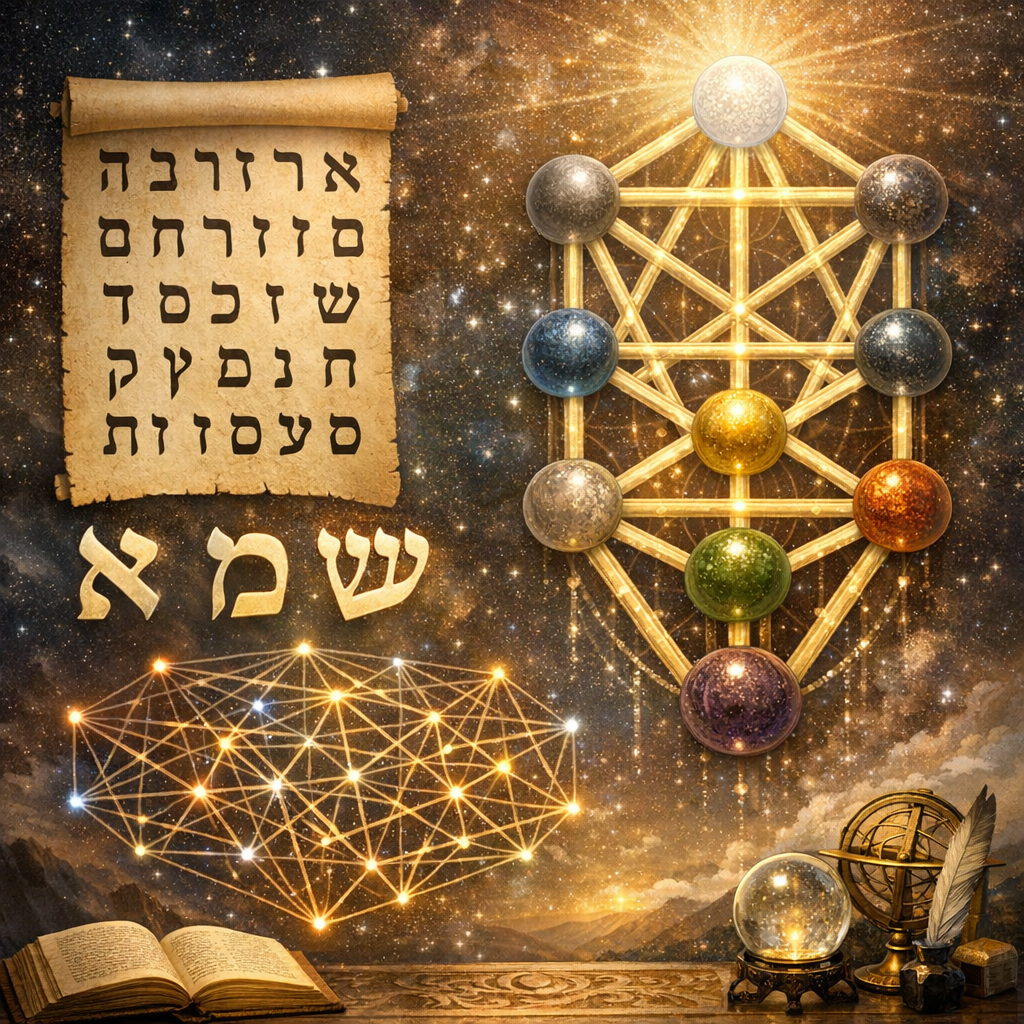
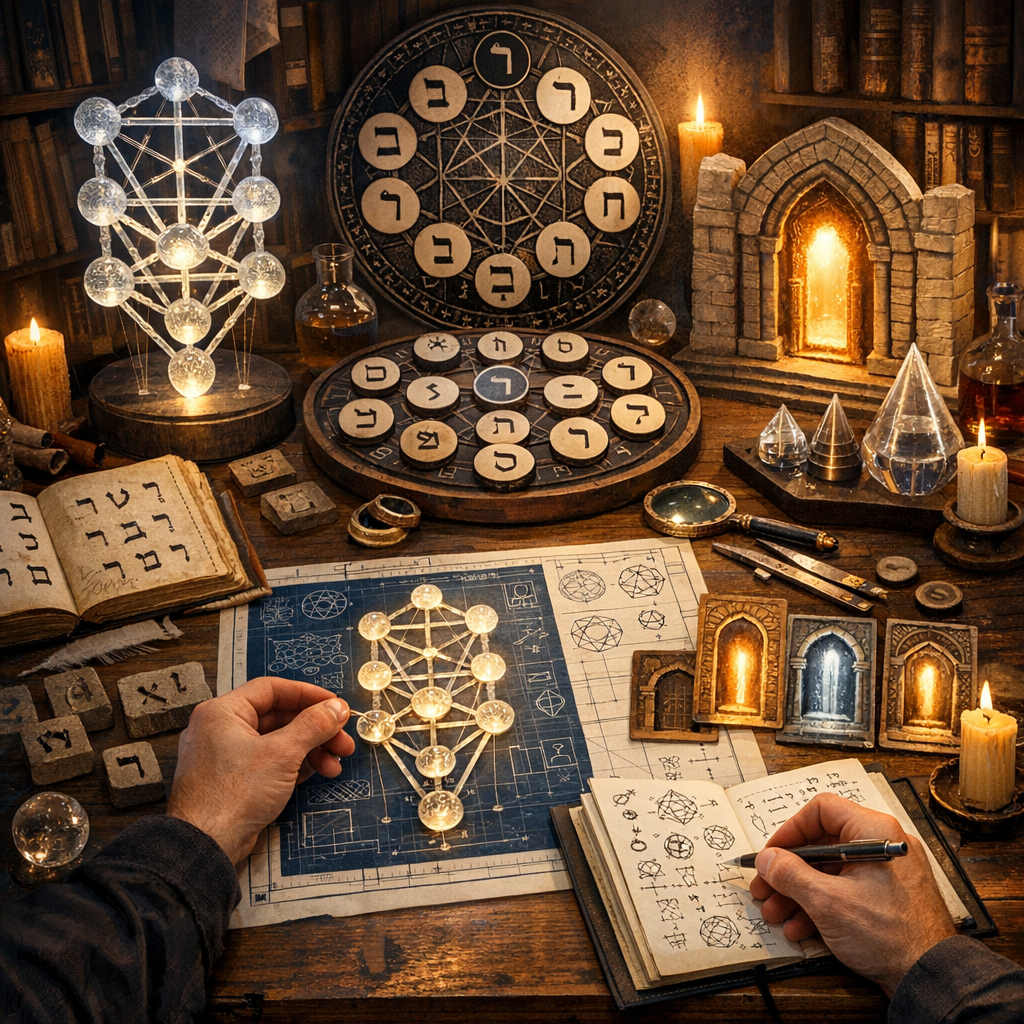
Hebrew Letters, Tree of Life, and the 231 Gates of Creation
This course guides you through the classical Kabbalistic map of reality: the ten sefirot of the Tree of Life, the twenty‑two Hebrew letters as channels of creative power, and the 231 Gates described in Sefer Yetzirah. You will weave these symbols into a coherent, grounded framework you can actually work with in contemplation and practice.
The first lecture plays free — no account needed.
What you'll learn
- Students will be able to summarize, in broad strokes, what Kabbalah is and how the Tree of Life, Hebrew letters, and Sefer Yetzirah fit together.
- Students will understand why these symbols are treated as a map of creation and consciousness rather than merely abstract metaphors.
- Students will be able to articulate at least three ethical guidelines for approaching Kabbalistic material in a grounded and respectful way.
- Students will be able to name the ten sefirot with their basic English meanings and roles.
- Students will understand the idea of emanation from Ein Sof into sefirot as a solution to how an infinite God relates to a finite world.
- Students will be able to give one concrete psychological or experiential example for at least three different sefirot.
- Students will be able to sketch a simplified Tree of Life showing the ten sefirot and three pillars.
- Students will understand how the arrangement of sefirot expresses tensions such as mercy–judgment and expansion–contraction.
- Students will be able to describe how movement along at least two specific paths can symbolize inner psychological or ethical shifts.
- Students will be able to recognize that in Sefer Yetzirah, the 22 Hebrew letters are treated as fundamental components of creation.
Prerequisites
- Kabbalah as a Jewish mystical framework
- Basic sense of the Tree of Life as a symbolic map
- Names and meanings of the ten sefirot
- Basic idea of emanation from Ein Sof
- Familiarity with the Tree of Life as a structure
- Awareness of Kabbalah’s emphasis on language and symbolism
Course Content
10 modules · 2h 30m total
A Living Map of Reality: Why Kabbalah Cares About Letters and Trees
Step into a worldview where language, number, and consciousness are woven into a single tapestry, and where a simple diagram of circles and lines claims to mirror the architecture of reality itself. Discover how the Tree of Life, the Hebrew alphabet, and the 231 Gates emerged as a radical attempt to describe how the Infinite becomes a world—and why engaging this material demands care and responsibility.
Ein Sof and the Ten Sefirot: From Infinite to Particular
Enter the Kabbalistic story of how an unknowable Infinite overflows into ten distinct modes of expression that shape every level of existence. Watch how these sefirot function at once as attributes of the Divine, patterns in the cosmos, and facets of your own inner life.
The Tree of Life Diagram: Pillars, Paths, and the Human Psyche
Look closely at the iconic Tree of Life diagram and see how its ten nodes and connecting lines form a three‑pillared architecture that mirrors body, mind, and soul. Trace how movement through this diagram becomes a map of inner development as much as a chart of the cosmos.
The Hebrew Alphabet as a Technology of Creation
Encounter the Hebrew letters not just as sounds on a page but as building blocks of existence, each carrying a distinct flavor of energy and meaning. See how Kabbalists treat the alphabet as a set of channels through which divine speech crystallizes into worlds.
Sefer Yetzirah: A Brief Tour of the Book of Formation
Open one of the earliest and strangest Jewish mystical texts, where numbers, letters, and directions replace mythic stories. Glimpse how Sefer Yetzirah imagines worlds being formed by counting, carving, and combining letters into the very fabric of time, space, and the human body.
The 231 Gates of Creation: Combinatorics as Mysticism
Step into the wheel of letters where every possible pair of the Hebrew alphabet becomes a ‘gate’ through which creative energy flows. See how a simple mathematical idea—connecting each letter to every other—turns into a mystical matrix of 231 signatures underlying beings in world, time, and soul.
Paths on the Tree: Linking Sefirot, Letters, and Gates
Watch the separate strands of sefirot, letters, and gates braid into a single working map as letters become paths between sefirot. Trace how different traditions assign letters to the 22 paths of the Tree of Life, and how the 231 Gates can be imagined as a dense web of relationships running through the whole structure.
Consciousness and Ethics: Working with Sefirot and Letters Responsibly
Turn from diagrams to inner life as you consider how these symbols act as mirrors for your own tendencies toward expansion, contraction, balance, and imbalance. Learn why traditional teachers insist on ethical grounding, humility, and psychological self‑knowledge before engaging deeply with Kabbalistic practices.
Practical Contemplation: Simple Practices with Letters, Sefirot, and Gates
Bring the theory to life through low‑risk contemplative exercises that let you ‘taste’ the Tree and the Gates from the inside. Experiment with visualizations, journaling prompts, and gentle meditations that anchor these lofty ideas in breath, attention, and daily experience.
Weaving the Map: Building Your Coherent Personal Framework
Gather the threads of sefirot, letters, and gates into a personalized map you can actually use, rather than a tangle of disconnected esoteric facts. Clarify what this material means for your own path, what you are and are not ready to do with it, and how you might continue in dialogue with living traditions and teachers.
Read the Textbook
Read every chapter for free, right here in your browser.
Kabbalah is a stream of Jewish mystical thought that explores how the Infinite (Ein Sof) relates to the finite world and human consciousness. It is not a separate religion, but a way of interpreting the Hebrew Bible, Jewish law, and ritual as expressions of a deeper, hidden structure of reality.
Historically, ideas later called "kabbalistic" begin appearing in late antiquity (around 1,500–1,700 years ago) in texts like Sefer Yetzirah (Book of Formation). Kabbalah as a more organized system emerges in southern France and Spain around the 12th–13th centuries, with classic works like the Zohar.
From roughly the 16th century onward, especially in Safed (in the Land of Israel), figures like Rabbi Isaac Luria (the Ari) develop a highly structured cosmology: how the Infinite "contracts" (tzimtzum), emanates worlds, and expresses itself through ten sefirot (divine attributes or channels).
Study Flashcards
Key concepts from this course as flashcard pairs.
A Living Map of Reality: Why Kabbalah Cares About Letters and Trees
Kabbalah
A Jewish mystical tradition that explores how the Infinite (Ein Sof) relates to the finite world and human consciousness, using symbols like sefirot, letters, and worlds.
Sefirot
Ten channels or attributes through which divine energy flows from Ein Sof into creation, often mapped on the Tree of Life from Keter to Malkhut.
Tree of Life
A diagram of the ten sefirot and the paths between them, read as a map of creation, the human soul, and spiritual practice.
Ein Sof
Literally "without end"; the Infinite aspect of God in Kabbalah, beyond form and description.
Hebrew Letters (22)
The consonants of the Hebrew alphabet, treated in Kabbalah as spiritual building blocks of creation, each with sound, shape, number, and qualities.
Sefer Yetzirah
An early Jewish mystical text (Book of Formation) that describes creation through ten sefirot and twenty-two letters, introducing the idea of 231 Gates.
+4 more flashcards
Ein Sof and the Ten Sefirot: From Infinite to Particular
Ein Sof
Literally "without end"; the Infinite Divine Reality beyond all attributes, unknowable in itself. The source from which the sefirot emanate.
Keter
Crown. Super‑conscious Divine will, the first hint of direction from Ein Sof toward creation.
Chokhmah
Wisdom. Flash of insight, raw creative idea; the initial spark of thought.
Binah
Understanding. Analysis and elaboration; turning a flash of insight into a developed concept.
Chesed
Loving‑kindness. Expansion, generosity, giving beyond obligation; Divine and human impulse to bestow.
Gevurah
Strength/Discipline. Limitation, judgment, boundaries, focus; the power to say no or hold a standard.
+5 more flashcards
The Tree of Life Diagram: Pillars, Paths, and the Human Psyche
Three pillars of the Tree of Life
Right: Pillar of Mercy/Expansion (Chokhmah, Chesed, Netzach). Left: Pillar of Judgment/Severity/Contraction (Binah, Gevurah, Hod). Middle: Pillar of Balance/Integration (Keter, Tiferet, Yesod, Malkhut).
Chesed vs. Gevurah (ethical tension)
Chesed is kindness, generosity, expansion; Gevurah is strength, boundary, contraction. Their horizontal tension represents the inner struggle between being too lenient and too strict.
Netzach–Hod path (psychological meaning)
Netzach is drive, endurance, victory; Hod is reflection, articulation, and communication. Moving along this path symbolizes tempering raw drive with thoughtful expression and listening.
Yesod–Malkhut relationship
Yesod (Foundation) channels and organizes energies as inner images, plans, and motivations. Malkhut (Kingship) is concrete manifestation. The path Yesod → Malkhut is the shift from inner vision to outer action.
Vertical vs. horizontal relationships on the Tree
Vertical links show flow from higher to lower levels (idea → emotion → action). Horizontal links show tension and balance between opposing qualities on right and left pillars.
The Hebrew Alphabet as a Technology of Creation
Sefer Yetzirah
An early Jewish mystical text (Book of Formation) that presents creation as unfolding through 10 sefirot and 22 Hebrew letters, treated as building blocks of existence.
Mother letters
The three letters א, מ, ש in Sefer Yetzirah. Associated with three elements (often air, water, fire) and with fundamental cosmic, yearly, and human structures.
Double letters
The seven letters ב, ג, ד, כ/ך, פ/ף, ר, ת. Called "double" because of dual pronunciations and their link to paired experiences, planets, and days of the week.
Simple letters
The twelve remaining letters (ה, ו, ז, ח, ט, י, ל, נ, ס, ע, צ, ק). Associated with zodiac signs, months of the year, and specific human functions or qualities.
32 paths of wisdom
A Sefer Yetzirah phrase describing the creative structure of reality as 10 sefirot plus 22 letters, forming 32 symbolic channels of divine expression.
Letters as creative units
The Kabbalistic idea that Hebrew letters are not just sounds but active channels or units through which divine speech crystallizes into worlds.
Sefer Yetzirah: A Brief Tour of the Book of Formation
32 paths of wisdom
The combined system of 10 sefirot and 22 Hebrew letters through which, according to Sefer Yetzirah, God forms all levels of reality.
Sefirot belimah
The 10 "sefirot of nothingness" in Sefer Yetzirah, understood as abstract numerical or dimensional principles rather than the fully developed personalities of later Kabbalah.
Olam–Shanah–Nefesh
The triad of world (space), year (time), and soul (living being). Sefer Yetzirah applies the same letter‑number patterns across all three.
Three mother letters
Alef, Mem, Shin. Treated as "mother" letters and associated with three basic elements (often air, water, fire) that map onto world, year, and soul.
Seven doubles
A group of seven Hebrew letters with two pronunciations. Linked to sevenfold structures such as the classical planets, days, and key bodily or psychological functions.
Twelve simples
The remaining 12 letters, associated with the 12 zodiac signs, 12 directions or boundaries in space, and 12 organs or faculties in the human being.
+1 more flashcards
The 231 Gates of Creation: Combinatorics as Mysticism
231 Gates
In Sefer Yetzirah, the set of all 2-letter combinations of the 22 Hebrew letters (unordered, no repeats), viewed as channels or paths of creative interaction.
Combinations (C(n, 2))
A way of counting how many ways to choose 2 items from n without regard to order and without repetition. The formula is n(n − 1) / 2.
Complete graph K_n
A graph where every pair of distinct vertices is connected by an edge. For K_22, the 22 vertices are letters and the 231 edges are the gates.
World, Year, Soul
A triad in Sefer Yetzirah: world (space), year (time), and soul (inner life). The 231 Gates are seen as structuring patterns across all three.
Gate (in this context)
A 2-letter pairing that acts as a basic relational unit or signature, potentially appearing in many words and symbolic associations.
Paths on the Tree: Linking Sefirot, Letters, and Gates
Path (on the Tree of Life)
A connecting line between two sefirot. In many Kabbalistic and Hermetic systems, each of the 22 paths is associated with one Hebrew letter and often with an element, planet, or zodiac sign.
Golden Dawn letter–path system
A highly influential Hermetic mapping that assigns the 3 Mother letters to horizontal paths (elements), 7 Double letters to vertical paths (planets), and 12 Simple letters to diagonal paths (zodiac signs).
231 Gates
All unordered pairs of the 22 Hebrew letters (22×21/2 = 231). Each pair is treated as a gate of creative interaction; when letters sit on paths, these pairs can be seen as interactions between different path-forces.
Sefer Yetzirah’s 3–7–12 structure
The division of the Hebrew letters into 3 Mothers, 7 Doubles, and 12 Simples. This pattern underlies many later systems that map letters to elements, planets, zodiac, and tree paths.
Conceptual overlay
A way of using a structure (like the 231 Gates) not as extra lines on a diagram but as a mental model for how different paths, letters, or sefirot can interact within the existing tree.
Consciousness and Ethics: Working with Sefirot and Letters Responsibly
Chesed (in this module’s psychological framing)
A tendency toward expansive giving, warmth, and saying yes; can become over-giving or people-pleasing when unbalanced.
Gevurah (in this module’s psychological framing)
A tendency toward strength, boundary, judgment, and saying no; can become harshness or rigid control when unbalanced.
Tiferet (in this module’s psychological framing)
The integrative, heart-centered capacity to balance Chesed and Gevurah, combining compassion with clarity and limits.
Ego-inflation
Using spiritual or mystical frameworks (like sefirot) to feel superior, special, or beyond ordinary ethical and relational obligations.
Projection
Attributing your own unacknowledged feelings or traits (such as anger or fear) to external forces, people, or abstract "energies".
Cultural appropriation (in Kabbalistic context)
Using Jewish sacred symbols and practices (letters, sefirot, divine names) without respect for their Jewish origins, meanings, and communities.
+1 more flashcards
Practical Contemplation: Simple Practices with Letters, Sefirot, and Gates
Sefirah (plural: sefirot)
A symbolic channel or mode of divine manifestation on the Tree of Life (e.g., Tiferet, Chesed, Gevurah), often used as a focus for contemplation on specific qualities like compassion or strength.
Letter contemplation
A short, structured practice that uses a single Hebrew letter’s form, sound, and associations as an anchor for attention, aimed at self‑observation rather than magical control.
Gate (in the 231 Gates sense)
An ordered pair of Hebrew letters treated here as a relationship between two attentional qualities, allowing practice that moves back and forth between them (e.g., Alef–Bet as space and structure).
Journaling for integration
Writing briefly after practice about what happened, how you felt, and what you need now, in order to track effects over time and maintain self‑care boundaries.
Non‑manipulative practice
A contemplative exercise directed toward your own clarity and ethical growth, which avoids attempts to influence or control other people’s choices or emotions.
Weaving the Map: Building Your Coherent Personal Framework
Sefirot
Ten emanations or modes of divine and psychological functioning in Kabbalah, often mapped as the Tree of Life (Keter through Malkhut).
Hebrew letters (22)
The consonantal letters of the Hebrew alphabet, treated in Kabbalah as spiritual building blocks with symbolic, numerical, and sonic qualities.
231 Gates
All possible 2‑letter combinations of the 22 Hebrew letters (22×21/2). Used in Sefer Yetzirah and later traditions to explore dynamic relationships between letters.
Personal framework
A concise, individualized map or outline that links sefirot, letters, and gates to your own experience, intentions, and ethical boundaries.
Contemplative study
Engaging with Kabbalistic symbols through reading, reflection, and meditation, without attempting ritual or magical manipulation.
Symbolic psychology
Using Kabbalistic structures (sefirot, letters, gates) as lenses for understanding inner life, emotions, and behavior patterns.
More in Arts & Culture
See all →
Introduction to Philosophy: Big Questions and Key Thinkers
Mastering The Wheel of Time: A Comprehensive Expert Course
Advanced Tarot: Archetypes, Symbolism, and the Narrative Web of the Arcana
Tarot Card Deep Dive: Symbolism, History, and Story Across the Arcana
Foundations of Tarot: History, Structure, and the Major Arcana Journey