Skarp
Skarp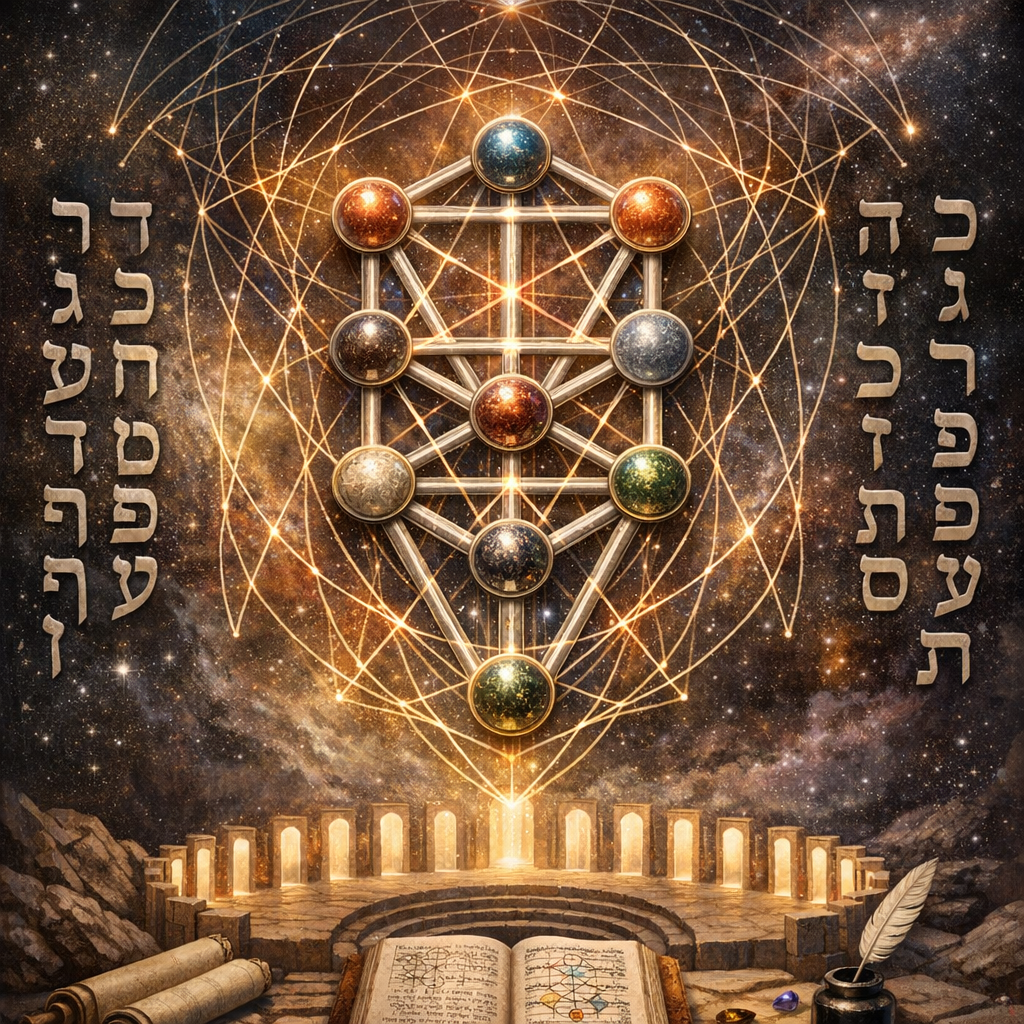
Hebrew Letters, Tree of Life, and the 231 Gates of Creation
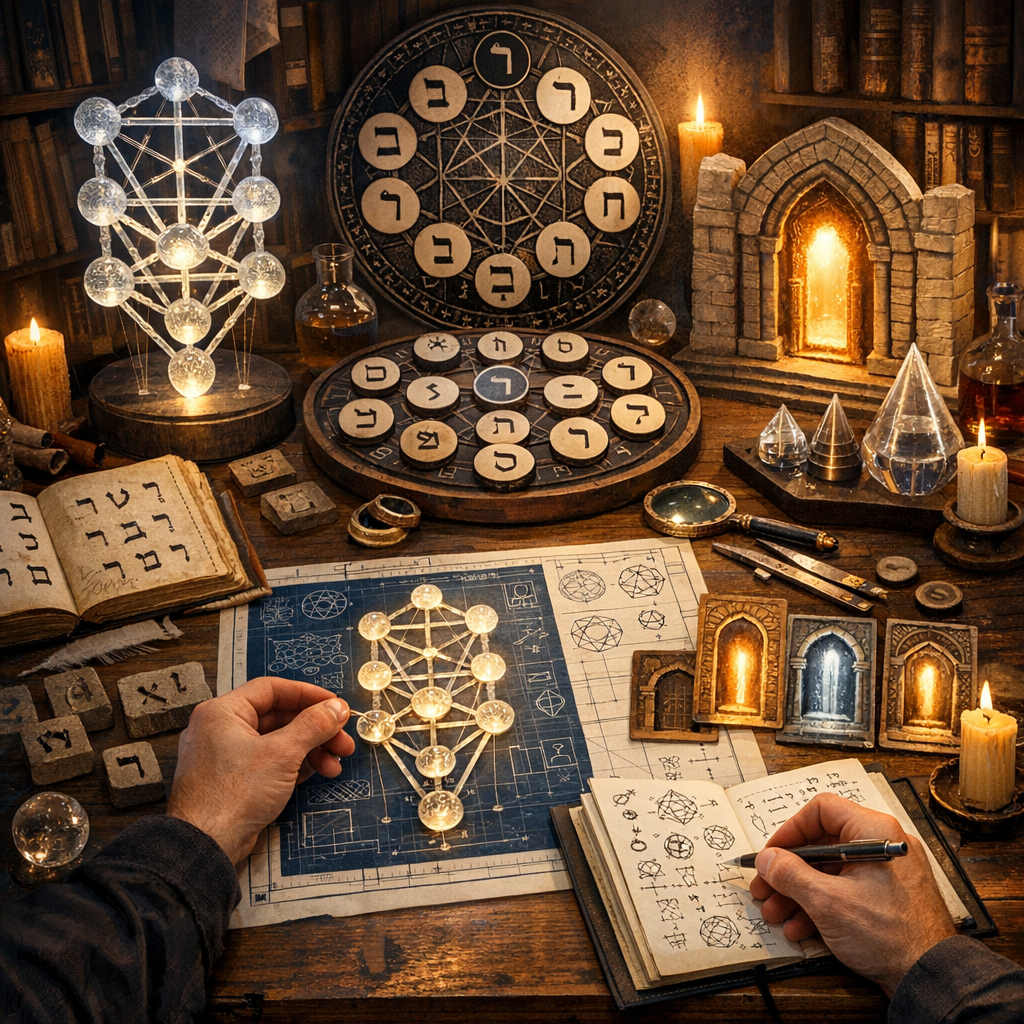
This course guides you through the mystical architecture of reality in classical Kabbalah: the 10 sefirot of the Tree of Life, the 22 Hebrew letters as creative channels, and the 231 gates described in Sefer Yetzirah. You will build a coherent map that links symbols, consciousness, and practice so you can work with these patterns in a grounded, responsible way.
The first lecture plays free — no account needed.
What you'll learn
- Students will be able to describe the Tree of Life as a system of 10 sefirot connected by 22 paths.
- Students will understand how the Tree of Life functions as a symbolic map of creation and consciousness.
- Students will be able to summarize the idea of the 32 paths of wisdom in Sefer Yetzirah.
- Students will understand the notion of multiple worlds or levels (Atzilut, Beriah, Yetzirah, Assiah) and how the Tree of Life fits within them.
- Students will be able to name and locate the 10 sefirot on the Tree of Life.
- Students will understand each sefirah as a distinct quality (e.g., wisdom, understanding, kindness, strength, beauty).
- Students will be able to explain how the sefirot relate to each other in triads and pillars.
- Students will understand how the sefirot correspond symbolically to aspects of human consciousness and behavior.
- Students will be able to list the 22 Hebrew letters and recognize them as foundational units in Sefer Yetzirah.
- Students will understand the division of letters into Mothers, Doubles, and Simples in Sefer Yetzirah.
Prerequisites
- Tree of Life as a diagram of 10 sefirot and 22 paths
- Names, positions, and basic meanings of the 10 sefirot
- Hebrew alphabet as 22 foundational letters
- Division of letters into Mothers, Doubles, and Simples
- Sefirot as channels of divine creative life force
- Definition of the 231 gates as pairwise combinations of the 22 letters
Course Content
10 modules · 2h 30m total
Mapping Reality: The Tree of Life and the Architecture of Creation
Step into a symbolic map where ten luminous nodes and twenty‑two paths claim to encode the structure of reality itself, from the highest divine light to everyday experience. Discover how mystics turned this diagram into a working blueprint for consciousness, ethics, and creative transformation.
Ten Sefirot: The Nodes of the Tree and the Building Blocks of Experience
Enter each of the ten sefirot as if they were facets of a single jewel, each reflecting a different mode of power, love, structure, and presence. Trace how these nodes mirror both the cosmos and the inner life, turning abstract theology into a living psychology.
Twenty‑Two Hebrew Letters: Channels of Creation and Paths Between Worlds
Move from static diagram to living alphabet as the 22 Hebrew letters emerge as energetic channels stitching the sefirot together. See how each letter is treated as a principle of form, sound, and number that shapes time, space, and the body.
Sefer Yetzirah: The Book of Creation and the Doctrine of the 231 Gates
Enter one of the oldest mystical blueprints of creation, where letters, numbers, and dimensions weave together into a terse, enigmatic text. Watch how a simple combinatorial insight—pairing every letter with every other—unfolds into the 231 gates said to underlie all forms.
From Number to Symbol: Combinatorics, Gematria, and Letter Substitution
Behind the mystical language of ‘gates’ and ‘paths’ lies a precise numerical skeleton of combinations, substitutions, and ciphers. See how simple arithmetic, gematria, and letter‑exchange systems become tools for reading reality as a coded text.
Paths of Power: Connecting the 10 Sefirot with the 22 Letter‑Paths
Watch the Tree of Life come alive as each letter‑path is seen not just as a line on a diagram, but as a mode of movement between states of consciousness. Trace how walking a path symbolically shifts you from one sefirah’s quality into another, like changing gears in the psyche.
Tzeruf and the 231 Gates: Techniques of Letter Permutation and Contemplation
Move from theory to inner practice as the abstract ‘gates’ become rhythmic permutations, visualizations, and focused contemplations. Experience how rotating pairs of letters can alter attention, feeling‑tone, and symbolic associations without losing your grounding.
As Above, So Below: Sefirot, Letters, and Correspondence with Body, Time, and Space
Let the Tree of Life step off the page and into your own body, calendar, and surroundings, as classical correspondences map sefirot and letters onto organs, senses, seasons, and directions. See how ‘man is a small world’ becomes a practical lens for self‑observation.
Working with the Matrix: Designing Personal Practices with Letters, Sefirot, and Gates
Gather the threads into a usable matrix as you learn to craft small, precise practices that align a life situation with a sefirah, a path, and a set of letter‑gates. Turn the vast combinatorial web into a focused ritual of attention, meaning, and intentional change.
Integration and Caution: Psychological Grounding and Long‑Term Study of the 231 Gates
Step back from the intricate lattice of sefirot, letters, and gates to assess what it is actually doing to your perception and choices. Clarify how to continue the work in a sustainable way that deepens insight without losing balance or critical thinking.
Read the Textbook
Read every chapter for free, right here in your browser.
In this module, you will explore the Tree of Life as a symbolic map of reality and consciousness.
The Tree of Life is a central diagram in Jewish mysticism (Kabbalah). It shows 10 sefirot (singular: sefirah) connected by 22 paths. Together, they form a kind of cosmic flowchart: from the most hidden divine source down to concrete, everyday experience.
Historically, ideas that feed into the Tree of Life appear in early mystical texts like Sefer Yetzirah (often dated between the 3rd–6th centuries CE). The fully developed diagram, however, takes shape much later in medieval Kabbalah and is still used today (as of 2026) in Jewish, Christian, and non‑religious mystical contexts.
Study Flashcards
Key concepts from this course as flashcard pairs.
Mapping Reality: The Tree of Life and the Architecture of Creation
Tree of Life
A central Kabbalistic diagram of 10 sefirot connected by 22 paths, used as a symbolic map of divine attributes, creation, and human consciousness.
Sefirot (singular: Sefirah)
Ten modes or attributes of divine expression, also understood as inner psychological and ethical qualities in humans.
32 Paths of Wisdom
A phrase from Sefer Yetzirah referring to 10 sefirot plus 22 Hebrew letters; later mapped to 10 sefirot and 22 paths on the Tree of Life.
Atzilut
The highest of the four worlds (Emanation), closest to the divine source; reality as pure, undivided qualities.
Beriah
The world of Creation: realm of ideas and archetypes, where clear concepts emerge before detailed form.
Yetzirah
The world of Formation: realm of forms, images, and emotions; patterns begin to take shape.
+4 more flashcards
Ten Sefirot: The Nodes of the Tree and the Building Blocks of Experience
Keter
Crown; top of the middle pillar. Symbolizes pure will, super-consciousness, and deep purpose beyond specific thoughts.
Chokhmah
Wisdom; upper right pillar. The flash of insight or creative spark, raw intuitive vision before analysis.
Binah
Understanding; upper left pillar. Analysis, structure, and discernment; turning insight into organized concepts and plans.
Chesed
Lovingkindness; middle right pillar. Generosity, expansion, open-hearted giving, the impulse to say "yes".
Gevurah
Strength / Judgment; middle left pillar. Boundaries, discipline, critique, the capacity to say "no" and protect what matters.
Tiferet
Beauty / Harmony; middle pillar at the heart. Balanced compassion, integrating Chesed and Gevurah into mature empathy.
+4 more flashcards
Twenty‑Two Hebrew Letters: Channels of Creation and Paths Between Worlds
Sefer Yetzirah
An early Jewish mystical text that treats the 22 Hebrew letters as building blocks of creation, dividing them into Three Mothers, Seven Doubles, and Twelve Simples.
Three Mother letters
Alef, Mem, Shin. In many readings they correspond to air, water, and fire and are seen as primordial generative principles.
Seven Double letters
Bet, Gimel, Dalet, Kaf, Pe, Resh, Tav. Called Double because they can have two pronunciations; often linked to seven classical planets and basic polarities.
Twelve Simple letters
He, Vav, Zayin, Chet, Tet, Yod, Lamed, Nun, Samekh, Ayin, Tzadi, Qof. Linked to twelve basic qualities and later to zodiac signs.
Gematria
A method that uses the numerical values of Hebrew letters to interpret words and phrases, treating letters as both sounds and numbers.
Tree of Life paths
The 22 connecting lines between the 10 sefirot, commonly labeled with the 22 Hebrew letters to represent channels of energy or transitions of consciousness.
+1 more flashcards
Sefer Yetzirah: The Book of Creation and the Doctrine of the 231 Gates
Sefer Yetzirah
An early Jewish mystical text (over ~1000 years old) that describes creation through 10 sefirot, 22 Hebrew letters, 32 paths of wisdom, and the 231 gates formed by letter combinations.
32 paths of wisdom
A formula in Sefer Yetzirah referring to 10 sefirot plus 22 letters. Together they function as a structural blueprint for creation.
231 gates
The complete set of unordered 2-letter combinations from the 22 Hebrew letters: C(22,2) = 231. Later traditions interpret these as channels of creation or consciousness.
Forward and backward permutations
In Sefer Yetzirah, the idea that letter pairs can be read in both directions (e.g., Alef–Bet and Bet–Alef), corresponding to ordered pairs and often given symbolic meanings by commentators.
Sefirot (in Sefer Yetzirah)
Ten numerical or dimensional principles (sefirot belimah) used to describe measures, directions, and boundaries of creation, later integrated into full Kabbalistic sefirot doctrine.
Combination vs. permutation
A combination is a selection of items where order does not matter (e.g., Alef–Bet = Bet–Alef); a permutation is an ordered selection where direction matters (Alef–Bet ≠ Bet–Alef).
+1 more flashcards
From Number to Symbol: Combinatorics, Gematria, and Letter Substitution
231 gates
In Sefer Yetzirah, the set of all pairwise connections among the 22 Hebrew letters. Mathematically, the 231 unordered pairs counted by C(22, 2).
Combination C(n, 2)
The number of unordered pairs from n distinct items: C(n, 2) = n(n − 1)/2.
Complete graph Kn
A graph where every pair of n vertices is connected by an edge. It has C(n, 2) edges. For n = 22, K22 has 231 edges.
Gematria (standard system)
A method assigning numerical values to Hebrew letters (1–9, 10–90, 100–400). A word’s value is the sum of its letters.
Atbash
A classic Hebrew letter-substitution system pairing the first and last letters of the alphabet, the second and second-to-last, and so on.
Simple substitution cipher
An encryption method where each letter is consistently replaced by another specific letter according to a fixed mapping.
+1 more flashcards
Paths of Power: Connecting the 10 Sefirot with the 22 Letter‑Paths
Sefirot
Ten core qualities or modes of consciousness on the Tree of Life (e.g., Chokhmah, Binah, Chesed). In this module they are treated as relatively stable inner states or “cities” on a map.
Paths
The 22 connecting lines between sefirot on the Tree of Life. Each path represents a possible transition or “route” from one state of consciousness to another.
Hebrew Letter (on a path)
A symbolic label for a path. The letter colors the style of movement between two sefirot (e.g., Alef as a breath-like shift from pure potential to first insight).
231 Gates
All possible pairs of the 22 Hebrew letters described in Sefer Yetzirah. A combinatorial universe of potential relationships, of which the 22 Tree paths are a structured subset.
Path‑work Meditation
A guided inner exercise where you imagine starting in one sefirah, traveling along a lettered path, and arriving in another sefirah, to practice a specific psychological shift.
Tzeruf and the 231 Gates: Techniques of Letter Permutation and Contemplation
Tzeruf
A contemplative and mystical practice of **letter permutation**, often associated with Sefer Yetzirah and later kabbalists, using systematic combinations of Hebrew letters to focus attention and explore consciousness.
231 Gates
The **231 unique unordered pairs** of the 22 Hebrew letters (22 choose 2). In Sefer Yetzirah, these pairs are described as gates through which creation is articulated; in practice, they can be used as structured foci for contemplation.
Forward and backward permutations
For a given gate AB, the two possible orders: **AB** and **BA**. Practitioners often explore subtle experiential differences between these directions while keeping the structure and timing controlled.
Time‑bounded practice
A key safety principle: limiting contemplative sessions to a **pre‑set, short duration** (for example, 3–10 minutes) to reduce the risk of over‑intensity, dissociation, or compulsive repetition.
Psychological safety in contemplative work
The practice of monitoring mood and stability, using grounding techniques, respecting personal limits, and being willing to pause or stop practices that increase distress or destabilization.
Breath‑letter coordination
Synchronizing gentle, regular breathing (such as a 4–4 rhythm) with the recitation or visualization of letter pairs, to create a **steady, calming structure** for attention.
As Above, So Below: Sefirot, Letters, and Correspondence with Body, Time, and Space
Microcosm
The idea that the human being is a "small world" reflecting patterns of the larger cosmos (macrocosm). Used in Kabbalah to justify mapping body, time, and space together.
Sefer Yetzirah
An early Jewish mystical text that organizes the 22 Hebrew letters into 3 Mothers, 7 Doubles, and 12 Simples, linking them to elements, planets, months, body parts, and senses.
3 Mothers, 7 Doubles, 12 Simples
The structural division of Hebrew letters in Sefer Yetzirah: 3 primal letters, 7 letters with double pronunciation, and 12 remaining letters, each group mapped to different cosmic and bodily levels.
Sefirot (as body map)
Ten emanations of divine qualities, symbolically mapped onto the human body (head, arms, torso, legs, etc.) and used as a framework for understanding aspects of the psyche.
Yesod
The ninth sefirah, associated with foundation, connection, and transmission. Bodily mapped to the genital area and linked to subconscious patterns and relational energy.
Symbolic correspondence
A non‑literal mapping between different domains (body, time, space, letters) used for meditation and self‑observation, not as scientific or anatomical fact.
Working with the Matrix: Designing Personal Practices with Letters, Sefirot, and Gates
Sefirot (in this module)
Symbolic qualities or modes of experience (e.g., Chesed, Gevurah, Tiferet) used as lenses to understand and rebalance specific life situations.
Path between sefirot
A directional relationship (e.g., Chesed → Gevurah) that describes the movement or shift you are cultivating in your practice.
Letter-gates (231 gates)
Pairs of Hebrew letters (like BM, MB) used for focused contemplation and tzeruf. In this module, you choose 1–2 gates and give them personal meanings tied to your intention.
Tzeruf (permutation)
The practice of combining and rotating letters or gates, often rhythmically with breath or visualization, to shift attention and symbolic associations.
Ethical framing of practice
Orienting your work toward alignment, clarity, and responsibility, avoiding attempts to coerce or dominate others. The focus is self-knowledge and wise action.
Yesod → Malkhut (example path)
A movement from inner patterns and subconscious tendencies (Yesod) toward concrete speech and action in the world (Malkhut).
Integration and Caution: Psychological Grounding and Long‑Term Study of the 231 Gates
231 Gates
The 231 unique pairings of the 22 Hebrew letters, each representing a dynamic relationship or vector between two letter-qualities.
Healthy engagement (with symbolic systems)
A flexible, curious use of symbols that supports stable functioning, ethical action, and can be paused without panic or compulsion.
Unhealthy engagement (with symbolic systems)
Compulsive, isolating, or anxiety-driven use of symbols that narrows life, fuels grandiosity, or replaces critical thinking and relationships.
Reality-testing questions
Questions such as: What observable facts support this? How would I explain it without esoteric language? Could there be a simpler explanation?
Ethical checkpoint
A pause before acting on symbolic insights to ask whether the action respects others' autonomy and would still seem appropriate without mystical framing.
Grounding ritual
A simple, repeatable practice (body scan, breathing, walking, journaling) that reconnects symbolic work to physical reality and everyday life.
More in Arts & Culture
See all →
Introduction to Philosophy: Big Questions and Key Thinkers
Mastering The Wheel of Time: A Comprehensive Expert Course
Advanced Tarot: Archetypes, Symbolism, and the Narrative Web of the Arcana
Tarot Card Deep Dive: Symbolism, History, and Story Across the Arcana
Foundations of Tarot: History, Structure, and the Major Arcana Journey