Skarp
Skarp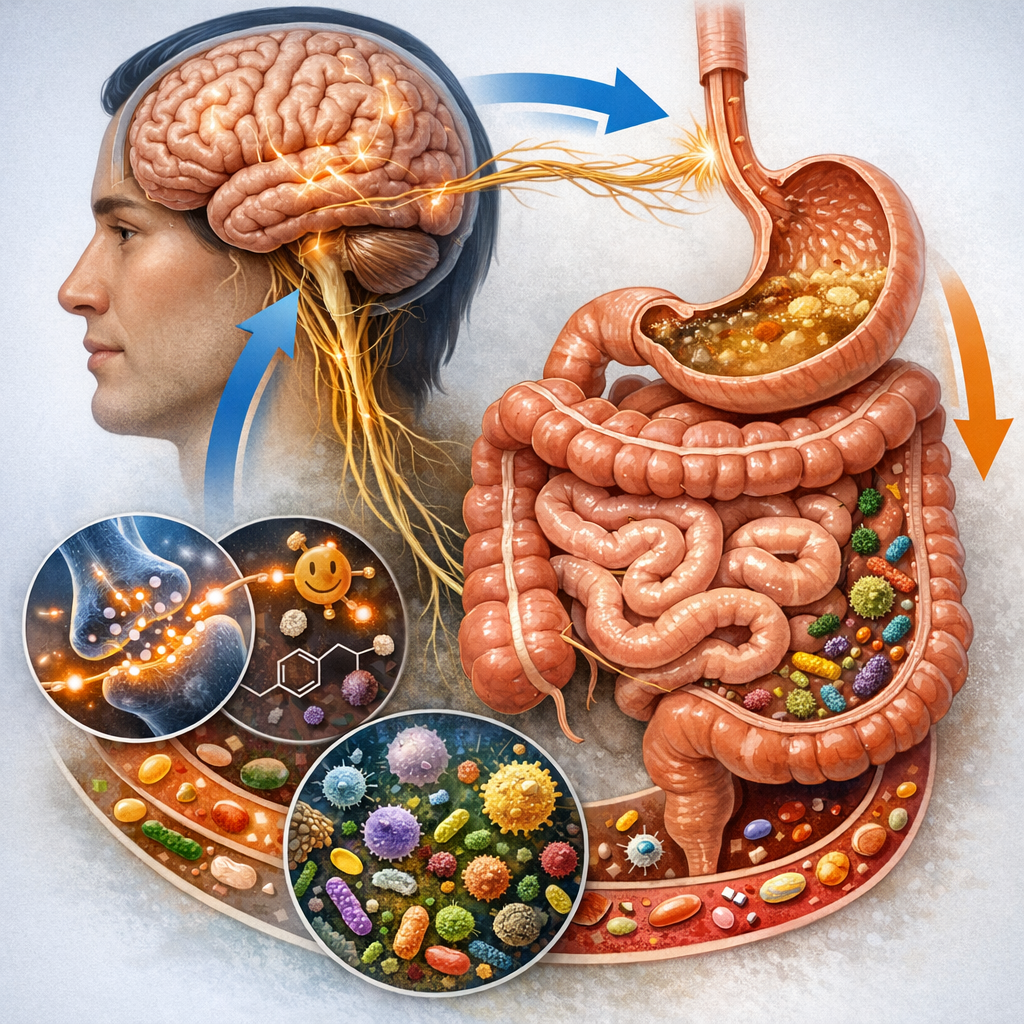
Gut-Brain Axis Essentials: How Your Digestion Shapes Your Mood and Mind
This course explores the surprising two-way communication between your digestive system and your brain. You will learn how the gut, microbiome, nerves, hormones, and immune system interact to influence stress, mood, cognition, and mental health—and what everyday choices may support a healthier gut-brain connection.
The first lecture plays free — no account needed.
What you'll learn
- Students will be able to define the gut-brain axis and describe it as a bidirectional communication system between the digestive tract and the brain.
- Students will understand the main systems involved (central nervous system, enteric nervous system, autonomic nervous system, HPA axis, immune system, and gut microbiota) and how they interact to maintain balance.
- Students will be able to explain the role of the enteric nervous system in controlling digestion independently yet in communication with the brain.
- Students will understand how the vagus nerve serves as a major pathway for gut-brain signaling, including its sensory (afferent) and motor (efferent) roles and relevance to stress, satiety, and emotional regulation.
- Students will be able to describe what the gut microbiome is and why microbial diversity is considered important for health.
- Students will understand how gut microbes communicate with the brain via metabolites, neural pathways (including the vagus nerve), and immune and endocrine signaling, with examples from recent research.
- Students will be able to explain that a large proportion of the body’s serotonin is produced in the gut and outline how this can influence both digestive and emotional processes.
- Students will understand how the HPA axis and stress hormones interact with gut function and the microbiome, contributing to anxiety- and depression-related symptoms.
- Students will be able to describe how immune cells in the gut and inflammatory molecules can send signals to the brain and influence mood and cognition.
- Students will understand current scientific views on intestinal barrier dysfunction and its hypothesized links to systemic inflammation and mental health, including limitations of existing evidence.
Prerequisites
- definition of gut-brain axis
- basic nervous system components from Module 1
- basic understanding of gut-brain axis from Module 1
- knowledge of gut microbiota from Module 3
- awareness of vagus nerve from Module 2
- basic gut-brain axis mechanisms from Modules 1–4
Course Content
8 modules · 2h total
Module 1: Meet Your Second Brain – The Gut-Brain Axis Overview
Introduce the gut-brain axis as a continuous, two-way communication network linking the digestive system and the brain, and why it matters for mood, stress, and overall mental health.
Module 2: Nerves in Your Belly – The Enteric Nervous System and Vagus Nerve
Explore the ‘second brain’ in your gut—the enteric nervous system—and the vagus nerve as a primary highway carrying signals between the gut and the brain.
Module 3: Microbiome 101 – Your Gut’s Invisible Community
Introduce the gut microbiota, how microbes live in the digestive tract, and the emerging science on how they influence brain function and behavior.
Module 4: Chemical Messengers – Neurotransmitters, Hormones, and the HPA Axis
Examine how chemical messengers like serotonin, GABA, and stress hormones connect gut activity to mood, anxiety, and cognitive function.
Module 5: Inflammation and Immunity – When the Gut Talks Through the Immune System
Explore how the immune system and inflammatory signals serve as another channel in the gut-brain dialogue, influencing mental health when gut balance is disturbed.
Module 6: Gut-Brain Axis in Mental Health – Depression, Anxiety, and Beyond
Connect the biology of the gut-brain axis to specific mental health conditions, focusing on depression, anxiety, and emerging links to cognition and neurodegeneration.
Module 7: Psychobiotics and Microbiome-Targeted Therapies – Promise and Caution
Introduce psychobiotics and other microbiome-focused strategies as potential tools for supporting mental health, highlighting what is known, what is experimental, and why high-quality evidence matters.
Module 8: Everyday Levers – Diet, Lifestyle, and Supporting a Healthy Gut-Brain Axis
Translate the science into practical, evidence-informed strategies related to diet, sleep, stress management, and physical activity that may support gut and mental health, while avoiding overhyped claims.
Read the Textbook
Read every chapter for free, right here in your browser.
When people say “trust your gut”, they’re not just being poetic.
Your digestive system and your brain are linked by a continuous, two-way communication network called the gut–brain axis.
Working definition (2026, widely used in current research): The gut–brain axis is the bidirectional communication system connecting the central nervous system (CNS) and the gastrointestinal tract, involving the enteric nervous system (ENS), autonomic nervous system (ANS), endocrine (hormone) system, immune system, and gut microbiota.
Study Flashcards
Key concepts from this course as flashcard pairs.
Module 1: Meet Your Second Brain – The Gut-Brain Axis Overview
Gut–Brain Axis
A **bidirectional communication network** linking the brain and the gastrointestinal tract, involving the CNS, ENS, ANS, endocrine system (including HPA axis), immune system, and gut microbiota.
Central Nervous System (CNS)
The **brain and spinal cord**. It processes information and coordinates responses, including signals to and from the gut.
Enteric Nervous System (ENS)
A dense network of neurons in the **walls of the digestive tract**, often called the “second brain,” capable of coordinating many digestive functions and communicating with the CNS.
Autonomic Nervous System (ANS)
The part of the nervous system that controls **automatic functions** like heart rate and digestion. Includes the **sympathetic** (fight or flight) and **parasympathetic** (rest and digest) branches.
Vagus Nerve
A major **parasympathetic nerve** connecting the brain to many organs, including the gut. It carries a large amount of **sensory information from the gut to the brain**.
HPA Axis
The **Hypothalamic–Pituitary–Adrenal axis**, a core **stress-response system** that leads to the release of cortisol and interacts with the gut–brain axis.
+4 more flashcards
Module 2: Nerves in Your Belly – The Enteric Nervous System and Vagus Nerve
Enteric Nervous System (ENS)
A large network of neurons embedded in the wall of the gastrointestinal tract that can control many aspects of digestion independently, while still communicating with the brain and spinal cord.
Vagus Nerve
The tenth cranial nerve (CN X) that carries mostly sensory (afferent) and some motor (efferent) signals between the brainstem and organs such as the heart, lungs, and digestive tract.
Afferent Fiber
A nerve fiber that carries sensory information from the body **toward** the central nervous system (arriving at the brain or spinal cord).
Efferent Fiber
A nerve fiber that carries motor or regulatory commands **away** from the central nervous system to organs and muscles (exiting the brain or spinal cord).
Vago-vagal Reflex
A reflex in which both the incoming sensory signal and the outgoing motor response travel via the vagus nerve, often used to coordinate digestive functions like stomach relaxation and secretion.
Vagal Tone
A measure of how active the vagus nerve is at rest; higher vagal tone is generally linked to better emotion regulation, stress resilience, and healthy digestion.
+1 more flashcards
Module 3: Microbiome 101 – Your Gut’s Invisible Community
Gut microbiota
The community of microorganisms (bacteria, viruses, fungi, archaea, etc.) that live in the digestive tract, especially the large intestine.
Gut microbiome
All the genetic material of the gut microbiota plus the environment they live in; often used more broadly to describe the whole microbial ecosystem in the gut.
Microbiome diversity
A measure of how many different microbial species are present (richness) and how evenly they are represented (evenness) in a community.
Short-chain fatty acids (SCFAs)
Small fatty acids (like acetate, propionate, and butyrate) produced when gut microbes ferment dietary fibers; they influence gut health, immunity, and brain-related pathways.
Microbiota–gut–brain axis
The two-way communication network connecting the gut microbiota, the digestive system, and the brain via neural, immune, endocrine, and metabolic pathways.
Vagus nerve
A major nerve connecting the brain with many organs, including the gut, carrying signals in both directions and playing a key role in gut–brain communication.
+4 more flashcards
Module 4: Chemical Messengers – Neurotransmitters, Hormones, and the HPA Axis
Serotonin (5‑HT)
A neurotransmitter involved in mood, gut motility, and pain sensitivity. About 90–95% of the body’s serotonin is produced in the gut by enterochromaffin cells.
GABA (gamma‑aminobutyric acid)
The main inhibitory neurotransmitter in the brain, acting like a brake on neural activity. Some gut microbes can produce GABA, which may influence gut–brain signaling.
HPA Axis
The hypothalamic–pituitary–adrenal axis, the body’s core stress response system. It controls the release of cortisol and links psychological stress to physical changes, including in the gut.
Cortisol
A steroid hormone released by the adrenal glands during stress. It raises blood sugar, alters immune function, and can change gut motility and microbiome composition, especially when elevated chronically.
Enteric Nervous System (ENS)
A network of neurons in the walls of the digestive tract, often called the “second brain.” It controls gut motility, secretion, and blood flow and communicates with the brain via the vagus nerve and spinal pathways.
Vagus Nerve
A major cranial nerve that carries two‑way signals between the brain and many organs, including the gut. It transmits information about gut state and can be influenced by neurotransmitters and hormones.
+2 more flashcards
Module 5: Inflammation and Immunity – When the Gut Talks Through the Immune System
Gut-Associated Lymphoid Tissue (GALT)
A large network of immune cells and tissues located in and around the gut, responsible for monitoring gut contents and mounting immune responses.
Cytokines
Small signaling proteins released by immune and other cells that coordinate inflammation and immune responses; examples include IL-1β, IL-6, and TNF-α.
Pro-inflammatory cytokines
Cytokines that amplify inflammation, such as IL-1β, IL-6, and TNF-α, often elevated in infections and sometimes in chronic conditions including some mood disorders.
Anti-inflammatory (regulatory) cytokines
Cytokines that reduce or control inflammation, such as IL-10 and TGF-β, helping to prevent excessive tissue damage.
Intestinal barrier
The combination of mucus, epithelial cells, tight junctions, and immune cells that separates gut contents from the body’s internal environment.
Intestinal permeability
How easily substances pass across the intestinal barrier; increased permeability is sometimes called “leaky gut” but is more precisely referred to as barrier dysfunction.
+2 more flashcards
Module 6: Gut-Brain Axis in Mental Health – Depression, Anxiety, and Beyond
Gut–brain axis
The bidirectional communication network connecting the gastrointestinal tract and the central nervous system, using neural, hormonal, immune, and metabolic pathways.
Microbiome
The collection of microorganisms (bacteria, viruses, fungi, etc.) and their genes living in a particular environment, such as the human gut.
Short-chain fatty acids (SCFAs)
Metabolites (e.g., acetate, propionate, butyrate) produced by gut bacteria when they ferment dietary fiber; they influence gut barrier integrity, immune function, and brain signaling.
HPA axis
The hypothalamic–pituitary–adrenal axis, a major stress-response system that controls cortisol release and interacts with gut and immune function.
Leaky gut (increased intestinal permeability)
A state where the intestinal barrier becomes more permeable, allowing more substances (e.g., bacterial components) to enter the bloodstream and potentially trigger immune responses.
Neuroinflammation
Inflammatory processes within the brain or spinal cord, often involving microglia and astrocytes, which can affect neuronal function and survival.
+2 more flashcards
Module 7: Psychobiotics and Microbiome-Targeted Therapies – Promise and Caution
Psychobiotic
A probiotic (or sometimes prebiotic/postbiotic) intervention that aims to benefit mental health by acting through the gut–brain axis; effects are strain-specific and currently supported by limited, mixed evidence.
Strain-specific effect
The idea that different genetic variants (strains) within the same bacterial species can have different biological and clinical effects, so results from one strain cannot automatically be applied to all others.
Prebiotic
A substrate (often a type of fiber) that is selectively used by host microorganisms, conferring a health benefit, for example by feeding beneficial gut bacteria that may influence brain function.
Fecal Microbiota Transplantation (FMT)
A procedure in which processed stool from a screened donor is transferred to a recipient to alter the gut microbiome; established for recurrent C. difficile infection, experimental for mental health.
Gut–brain axis
The bidirectional communication network linking the gut and the brain via neural, hormonal, immune, and metabolic pathways.
Adjunct treatment
A therapy used alongside standard treatments (such as medication or psychotherapy), not as a replacement, to potentially enhance overall outcomes.
Module 8: Everyday Levers – Diet, Lifestyle, and Supporting a Healthy Gut-Brain Axis
Dietary Pattern
The overall combination and regular habits of what you eat (e.g., Mediterranean-style, high-UPF), which often matters more for the gut–brain axis than any single food.
Fiber (Dietary Fiber)
Indigestible parts of plant foods that your gut microbes ferment, producing short-chain fatty acids that can influence gut and brain health.
Fermented Foods
Foods made by beneficial microbes (e.g., yogurt with live cultures, kefir, kimchi, sauerkraut, miso) that can introduce or support microbes and affect microbiota diversity.
Ultra-Processed Foods (UPFs)
Industrial food products high in additives, refined starches and sugars, and low in intact whole foods; high intake is linked with poorer physical and mental health outcomes.
Circadian Rhythm
Your internal 24-hour body clock that regulates sleep–wake cycles, hormones, and even gut microbial activity.
Vagus Nerve / Vagal Tone
A major nerve connecting the brain and many organs, including the gut. Vagal tone refers to how flexibly it can respond; higher tone is linked with better stress regulation and lower inflammation.
+2 more flashcards
More in Health & Wellness
See all →
Nutrition Basics: Building a Healthy, Balanced Diet

Foundations of Mental Health and Everyday Wellness

The Science of Sleep: Unlocking Restful Nights

Digital Resilience: Protecting Your Mental Well‑being in a Hyperconnected World