 Skarp
Skarp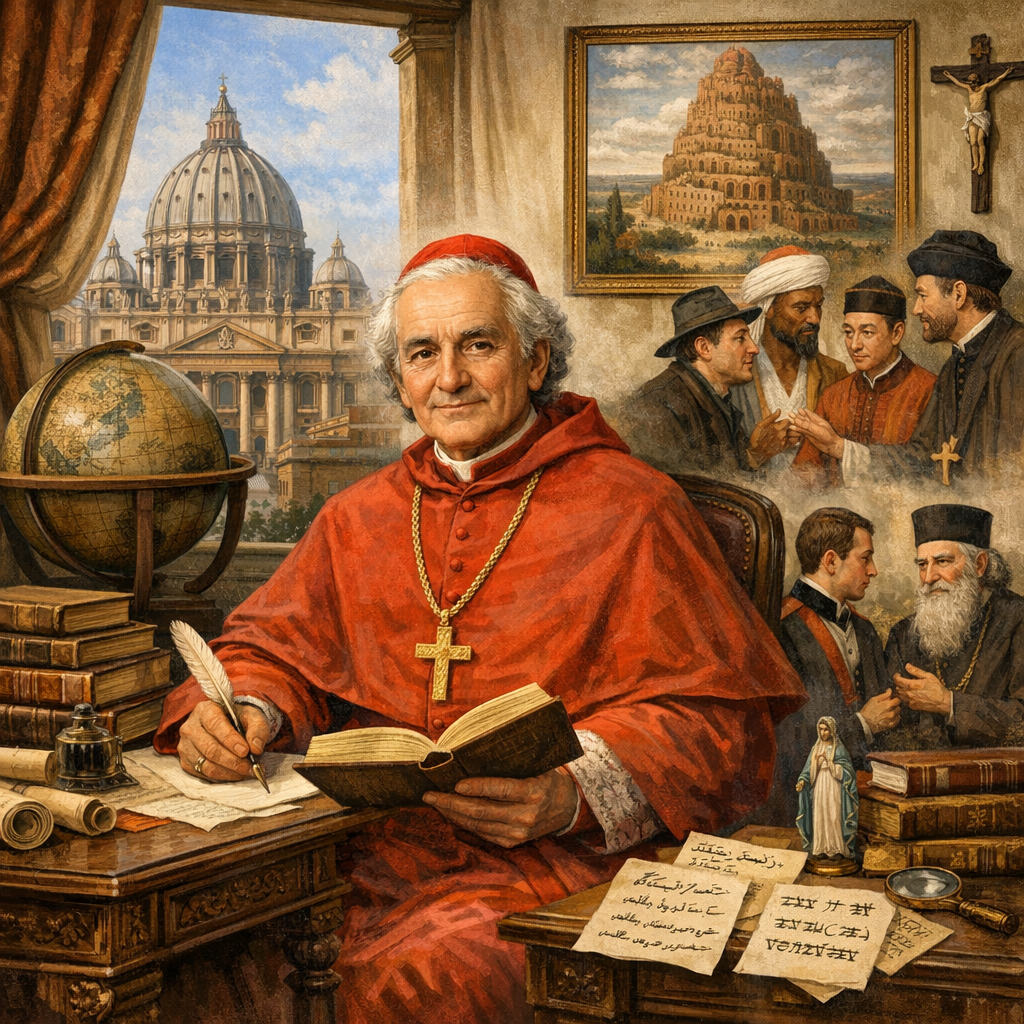
Giuseppe Mezzofanti: The Life and Legacy of a Hyperpolyglot Cardinal
This course explores the remarkable life of Giuseppe Mezzofanti, the 19th‑century Italian cardinal famed for his mastery of dozens of languages. You will examine his biography, the historical and religious context he lived in, the evidence for his linguistic abilities, and how his story shapes modern ideas about hyperpolyglots and language learning.
The first lecture plays free — no account needed.
What you'll learn
- Students will be able to summarize who Giuseppe Mezzofanti was and when he lived.
- Students will understand what the term “hyperpolyglot” means and how it is used today.
- Students will be able to describe, in broad terms, the range of languages Mezzofanti was said to know.
- Students will be able to explain why Mezzofanti is still discussed in modern language‑learning debates.
- Students will be able to outline the main stages of Mezzofanti’s life and career.
- Students will understand how political changes in Italy (e.g., the Cisalpine Republic) affected his academic path.
- Students will be able to explain how the Catholic Church and missionary work created opportunities for language contact.
- Students will connect Mezzofanti’s environment (libraries, scholars, visitors) to his language practice.
- Students will be able to identify key historical sources about Mezzofanti’s languages.
- Students will understand why different authors report different numbers of languages.
Prerequisites
- Basic understanding of who Mezzofanti was and the idea of a hyperpolyglot
- Overview of Mezzofanti’s life and the concept of hyperpolyglots
- Basic familiarity with Mezzofanti’s language repertoire and historical sources
- Knowledge of Mezzofanti’s life, roles, and reported language abilities
- Understanding of Mezzofanti’s church positions and his interactions with international visitors
- Knowledge of Mezzofanti’s reported abilities and basic ideas from modern cognitive research on language learning
Course Content
8 modules · 2h total
Introducing Giuseppe Mezzofanti and the World of Hyperpolyglots
An overview of who Giuseppe Mezzofanti was, why he is famous, and how his story fits into the broader idea of hyperpolyglots—people who speak many languages.
From Bologna to Rome: Mezzofanti’s Life and Times
A focused look at Mezzofanti’s life story, from his childhood in Bologna to his career in the Church and the Vatican, set against the political and cultural background of 18th–19th century Italy.
Counting Languages: Evidence for Mezzofanti’s Linguistic Repertoire
An examination of the different historical sources that list Mezzofanti’s languages and how historians evaluate these claims.
Inside the Mind of a Hyperpolyglot: Memory, Talent, and Technique
A look at what we can infer about Mezzofanti’s cognitive abilities and learning methods, and how these relate to modern research on memory and language learning.
Stories, Myths, and Skeptics: Evaluating Mezzofanti’s Legend
This module explores famous stories about Mezzofanti, the admiration he inspired, and the skepticism of modern scholars who question the more extreme claims.
Language, Religion, and Power: Mezzofanti in the Catholic Missionary Context
An exploration of how Mezzofanti’s linguistic skills intersected with the goals of the Catholic Church, especially missionary work and scholarship.
From Mezzofanti to Modern Hyperpolyglots
A comparison between Mezzofanti and contemporary hyperpolyglots, examining what has changed—and what has not—in how we understand extreme language learning.
Legacy and Lessons: What Mezzofanti Teaches Us About Language Learning
The final module synthesizes Mezzofanti’s life and legend into practical and conceptual lessons for how we think about language learning, talent, and human potential.
Read the Textbook
Read every chapter for free, right here in your browser.
In this module, you will explore one of the most famous language learners in history: Giuseppe Mezzofanti.
Who was he? Full name: Giuseppe Gasparo Mezzofanti Lived: 1774–1849 (about 75 years) Place: Born in Bologna, in what is now northern Italy Roles: Catholic priest, later cardinal, and legendary linguist
He became famous because many visitors to Rome claimed he could speak to almost anyone in their own language.
Study Flashcards
Key concepts from this course as flashcard pairs.
Introducing Giuseppe Mezzofanti and the World of Hyperpolyglots
Giuseppe Mezzofanti
An Italian Catholic cardinal and linguist (1774–1849), famous for reportedly knowing dozens of languages and speaking to visitors in their native tongues.
Polyglot
A person who knows and uses several languages. Often used for people who speak three or more languages.
Hyperpolyglot
A person who knows a very large number of languages. In modern usage, often defined as someone with functional ability in roughly 11–12 or more languages.
Functional level (in a language)
Being able to use a language for real communication—such as basic conversations, reading everyday texts, or dealing with common situations—even if not perfectly.
Historical evidence vs. legend
The difference between what can be supported by reliable documents or recordings and what might be exaggerated or based on stories.
19th century context
The time period when Mezzofanti lived, before audio/video recording, meaning his language skills are known mainly from written reports by other people.
From Bologna to Rome: Mezzofanti’s Life and Times
Giuseppe Mezzofanti
An Italian priest and hyperpolyglot (1774–1849) known for speaking and understanding an extraordinary number of languages, active in Bologna and later in Rome.
Papal States
Territories in central Italy ruled by the Pope until the 19th century; Bologna and Rome were both part of these states during Mezzofanti’s lifetime.
Piarists
A Catholic teaching order (Order of Poor Clerics Regular of the Mother of God of the Pious Schools) that educated Mezzofanti and exposed him to classical and foreign languages.
Cisalpine Republic
A French‑backed, secular republic in northern Italy (1797–1802) whose policies led to Mezzofanti losing his university post in Bologna.
Congregation for the Evangelization of Peoples (Propaganda Fide)
A Vatican department responsible for coordinating Catholic missions worldwide; it connected Mezzofanti with missionaries and texts in many languages.
Vatican Library
The Holy See’s main library, containing manuscripts and books in numerous languages; Mezzofanti worked there, using its collections to expand his linguistic knowledge.
+1 more flashcards
Counting Languages: Evidence for Mezzofanti’s Linguistic Repertoire
Charles William Russell’s 1858 biography
The most important primary source on Mezzofanti’s languages. Russell interviewed witnesses, collected documents, and grouped languages by **proficiency level**, not just total count.
Languages spoken with rare excellence
Russell’s top category: languages in which Mezzofanti repeatedly impressed native speakers in real conversations (e.g., Italian, Latin, Greek, French, English, German, Spanish).
Languages spoken fluently but less tested
Languages where evidence suggests fluent speech but with **fewer or weaker testimonies**. Still impressive, but not as strongly documented as the top group.
Anecdotal evidence
Individual stories or reports (often vivid and memorable). Useful as clues, but they must be checked for source reliability, bias, and detail before being treated as solid proof.
Systematic evidence
More organized and methodical information, such as categorized lists, multiple independent testimonies, or carefully documented interactions across different contexts.
Inflated language counts (e.g., 100+)
Very high numbers that usually come from vague or second‑hand reports, counting dialects separately, or ignoring proficiency levels. Modern scholars treat them as **legendary**, not strictly factual.
+1 more flashcards
Inside the Mind of a Hyperpolyglot: Memory, Talent, and Technique
Hyperpolyglot
A person who knows and uses an unusually large number of languages; there is no strict cut‑off, but it usually means far more than the 2–3 languages common in many bilingual communities.
Working memory
The short‑term mental system that holds and manipulates information for a few seconds while you use it, crucial for understanding sentences and producing speech in real time.
Phonological memory
A subtype of verbal memory that stores sequences of sounds (like words or non‑words), important for learning new vocabulary and imitating pronunciation.
Shadowing (in language learning)
A technique where you listen to speech in your target language and simultaneously repeat it, trying to match pronunciation, rhythm, and intonation as closely as possible.
Parallel texts
Two versions of the same text in different languages, placed side‑by‑side so learners can compare sentences and infer vocabulary and grammar patterns.
Language maintenance
The ongoing use and practice required to keep a language at a certain level of proficiency over time; without maintenance, skills typically weaken (‘rust’) or become passive.
+1 more flashcards
Stories, Myths, and Skeptics: Evaluating Mezzofanti’s Legend
Celebratory anecdote
A story told to praise or glorify someone, often focusing on dramatic or impressive moments (like Mezzofanti speaking many languages at a salon), and not always carefully checked for accuracy.
Romanticizing polyglots
The 19th‑century habit of treating language geniuses as almost magical figures, emphasizing their talent and mystery while downplaying limits or uncertainties.
Hyperpolyglot
A person who knows an unusually large number of languages. Modern usage often refers to people claiming 10, 20, or more languages, with debate about what counts as ‘knowing’ a language.
Historiography
The study of how history is written—how stories, sources, and interpretations change over time and how reputations (like Mezzofanti’s) are built and revised.
Evidence‑based claim
A statement that is clearly supported by identifiable sources (documents, testimonies, data) and can be checked, rather than simply repeated as legend.
Exaggeration of mastery
When reports describe someone as perfectly fluent or native‑like in many languages without solid proof, often due to excitement, admiration, or cultural expectations.
Language, Religion, and Power: Mezzofanti in the Catholic Missionary Context
Congregation de Propaganda Fide
The historical Roman institution (founded 1622) that coordinated Catholic missions in non‑Catholic regions; in Mezzofanti’s time it oversaw missionary strategy, training, and many language projects. Later renamed the Congregation for the Evangelization of Peoples and, since 2022, integrated into the Dicastery for Evangelization.
Dicastery for Evangelization
The current (as of 2026) Vatican dicastery responsible for missionary activity and evangelization, created by merging earlier bodies including the Congregation for the Evangelization of Peoples under the 2022 constitution *Praedicate Evangelium*.
Missionary linguistics
The study and documentation of languages carried out by missionaries (grammars, dictionaries, translations), often aimed at evangelization but also producing important linguistic knowledge.
Pastoral care
The spiritual and emotional care provided by religious leaders (such as priests) to individuals and communities, including guidance, counseling, and sacramental ministry like confession.
Bridge vs. tool of power (in language)
A way to describe how language can both connect people across cultures (bridge) and be used to influence, guide, or control them (tool of power), especially in religious and political contexts.
Confession (Catholic context)
A sacrament in which a person confesses sins to a priest and receives absolution; it depends heavily on precise language and trust, especially when done across language barriers.
From Mezzofanti to Modern Hyperpolyglots
Hyperpolyglot
A person with unusually high language breadth (often around 11+ languages at some functional level), as used in modern linguistic discussions; not an official clinical category.
Breadth vs. depth
Breadth refers to how many languages a person knows or uses; depth refers to how well they can use each language (speaking, understanding, reading, writing, and complexity of topics).
Language maintenance
The ongoing process of keeping a language active and usable over time through practice and exposure, preventing attrition (loss).
Attrition
The gradual loss of language ability when a language is not used regularly, affecting vocabulary, grammar, and fluency.
Catholic missionary context
The religious and institutional setting in which Mezzofanti learned many languages, where languages were tools for spreading Catholicism and studying religious texts.
Documented evidence
Observable or recorded proof of language ability (e.g., recordings, tests, written samples, or multiple independent witnesses), used to evaluate claims about hyperpolyglots.
Legacy and Lessons: What Mezzofanti Teaches Us About Language Learning
Hyperpolyglot
A person who has functional ability in an unusually large number of languages (often 6–10 or more), used in modern research to discuss extreme language learning, sometimes with Mezzofanti as a historical reference point.
Intensive Reading
A technique where you focus closely on a short text, rereading it several times to understand vocabulary, grammar, and structure in depth, rather than skimming many pages.
Shadowing (Listening & Mimicry)
A practice method where you listen to a native speaker and immediately repeat, copying their pronunciation, rhythm, and intonation as closely as possible.
Conversational Recycling
Reusing a set of familiar phrases and questions in many conversations to strengthen fluency and confidence in real-life interaction.
Environment (in language learning)
The social and physical context that shapes your exposure to languages—who you can talk to, what you can read or watch, and how often you encounter the language naturally.
Opportunity (in Mezzofanti’s case)
The specific roles and responsibilities he had within the Catholic Church that gave him repeated chances to meet speakers of many languages and practice with them.
+1 more flashcards
More in History
See all →
The Origin Story of the English Alphabet

Yhdysvaltain sisällissota: syyt, kulku ja seuraukset
Första världskriget för åk 8: Från skottet i Sarajevo till Versaillesfreden
Decisive Battles of the American Civil War

World War I: A Global War and Its Lasting Aftermath
