 Skarp
Skarp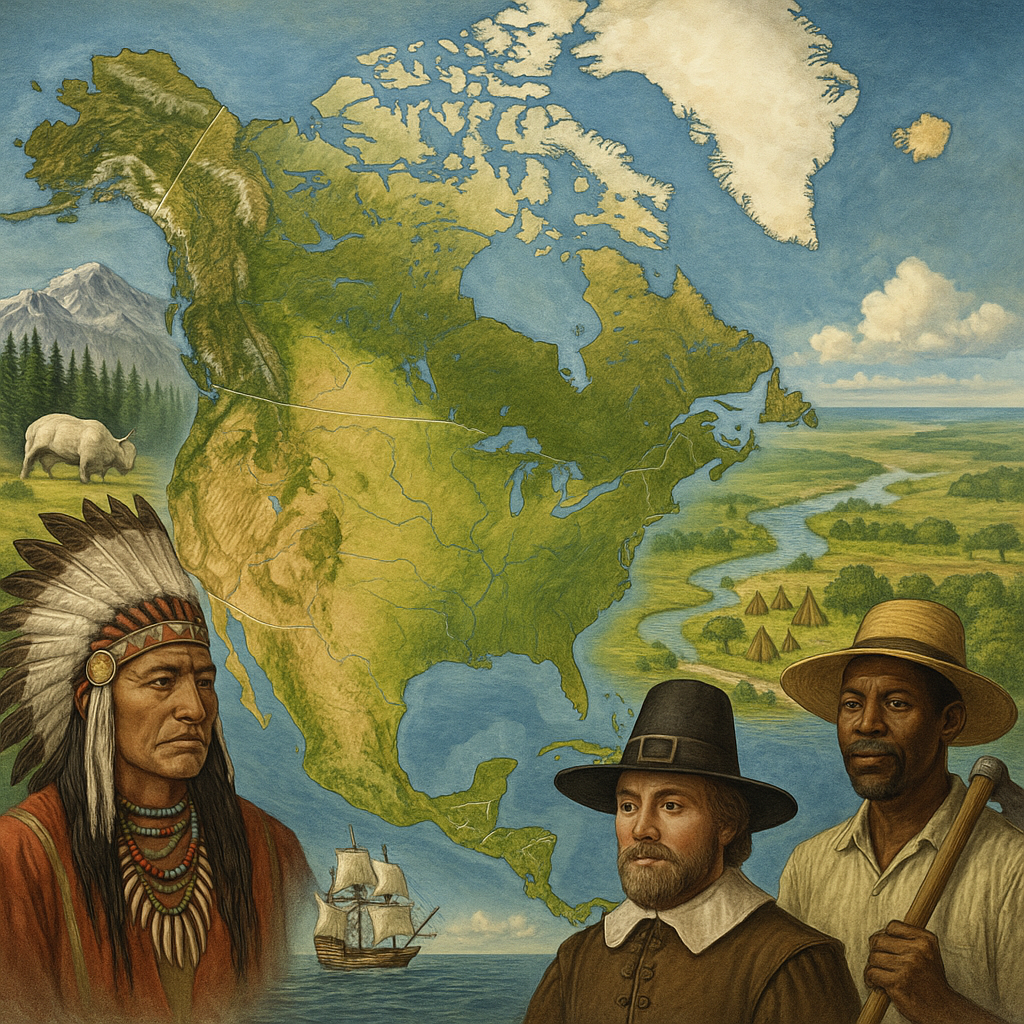
Foundations of U.S. History: Geography, Peoples, and Big Themes
This course introduces you to the physical and human geography of North America, the diversity of Indigenous peoples and cultural regions, and the major themes that shape U.S. history from pre‑contact to the present. You will also learn how historians think, how to use primary and secondary sources, and how to build a basic timeline framework to organize events over time.
The first lecture plays free — no account needed.
What you'll learn
- Students will be able to explain the difference between primary and secondary sources and give examples from U.S. history.
- Students will understand that historical accounts are interpretations based on evidence, not just lists of facts.
- Students will be able to sketch a simple, labeled timeline of major periods in U.S. history from pre‑contact to the present.
- Students will be able to describe the ideas of continuity and change over time.
- Students will be able to locate and label major physical features of North America such as the Rocky Mountains, Mississippi River, Great Plains, and Great Lakes.
- Students will understand how climate and natural resources influence where people settle and what economies develop.
- Students will be able to identify major U.S. geographic regions and describe at least one way geography has shaped historical development in each.
- Students will be able to connect physical geography to later themes of expansion, capitalism, and regional conflict.
- Students will be able to identify several major Indigenous cultural regions in North America and describe distinctive features of each.
- Students will understand that Indigenous peoples are diverse nations with their own languages, governments, and histories, not a single homogenous group.
Prerequisites
- Historical thinking and timelines from Module 1
- Basic North American geography from Module 2
- Indigenous cultural regions from Module 3
- Historical timelines from Module 1
- Colonization and early U.S. history from Module 4
- Basic understanding of early U.S. democracy from Module 5
Course Content
10 modules · 2h 15m total
How Historians Think: Evidence, Stories, and Time
Get oriented to what history is, how historians build stories about the past, and how timelines help us organize U.S. history from pre‑contact to the present.
Mapping North America: Land, Water, and Regions
Explore the physical geography of North America—mountains, rivers, climate zones—and how these features shape where people live, work, and move.
Indigenous North America: Nations, Regions, and Worldviews
Learn about the diversity of Indigenous nations in North America before and after European contact, focusing on major cultural regions and different ways of organizing society.
Contact, Colonization, and the Birth of a New World
Examine how European exploration and colonization transformed North America, focusing on encounters among Indigenous peoples, Europeans, and Africans.
Democracy and Its Limits: From Revolution to Reform
Trace the development of U.S. democracy from the Revolution and founding documents through key expansions and exclusions of political rights.
Expansion, Empire, and the Making of Borders
Investigate how the United States expanded across the continent, creating new borders and conflicts with Indigenous nations, neighboring countries, and within the U.S. itself.
Race, Slavery, and Inequality in U.S. History
Explore how race and slavery developed in North America and how systems of racial inequality evolved over time, alongside resistance and movements for freedom.
Capitalism, Work, and Everyday Life
Look at how capitalism developed in the United States, changing work, cities, technology, and everyday life from the 19th century to the present.
Reform, Protest, and Movements for Change
Study how people in the United States have organized to change laws, institutions, and culture, from abolition and women’s suffrage to labor, civil rights, and contemporary movements.
Putting It All Together: A Thematic Timeline of U.S. History
Synthesize what you’ve learned by building a thematic timeline that traces geography, peoples, and the big themes—democracy, expansion, race, capitalism, and reform—from pre‑contact to the present.
Read the Textbook
Read every chapter for free, right here in your browser.
History is more than a list of dates and names. It’s an interpretation of the past based on evidence.
Think of a historian as a kind of detective: The past = the crime scene (but it’s already over). Evidence = clues left behind (documents, objects, memories). Historical account = the detective’s report (a story that explains what probably happened and why).
Key ideas: We cannot see the past directly; it’s gone. We study traces that survived. We build stories (interpretations) that try to make sense of those traces.
Study Flashcards
Key concepts from this course as flashcard pairs.
How Historians Think: Evidence, Stories, and Time
History
The study of the past using evidence; historians build interpretations (stories and arguments) about what happened and why.
Primary Source
Evidence created during the time period being studied or by someone with direct experience of the events (e.g., letters, photos, artifacts, oral histories).
Secondary Source
A work created after the events, interpreting or explaining the past (e.g., textbooks, documentaries, scholarly articles).
Interpretation
A historian’s explanation or argument about the past, based on evidence and reasoning, not just a list of facts.
Timeline
A visual representation of time that shows when events or periods happened and how they relate to each other.
Periodization
The process of dividing history into meaningful periods based on patterns or themes (e.g., “Reconstruction,” “Cold War”).
+2 more flashcards
Mapping North America: Land, Water, and Regions
Rocky Mountains
A major mountain range in western North America, running from Canada through the western United States to New Mexico; tall, rugged peaks that strongly influence climate and movement.
Great Plains
A broad, mostly flat or gently rolling grassland region east of the Rockies, with fertile soils that support large‑scale farming and ranching.
Great Lakes
Five large freshwater lakes (Superior, Michigan, Huron, Erie, Ontario) on the U.S.–Canada border, forming the largest group of freshwater lakes by area and a major transportation and trade system.
Mississippi River
One of the world’s longest rivers, flowing from Minnesota to the Gulf of Mexico and forming the core of a major inland transportation network.
Climate zone
A region of Earth with similar long‑term weather patterns, such as temperature and precipitation, which influence ecosystems and human activities.
Humid subtropical
A climate with hot, humid summers and mild winters, found in the southeastern United States and parts of eastern Mexico; supports long growing seasons.
+4 more flashcards
Indigenous North America: Nations, Regions, and Worldviews
Indigenous
Original peoples of a place and their descendants. In North America, this includes many distinct nations such as Haudenosaunee, Diné, Haida, Cherokee, Lakota, and hundreds more.
Nation (in Indigenous context)
A political and cultural community with its own people, land relationships, government, and history. Many Indigenous nations are recognized as sovereign and have treaty relationships with states like the United States and Canada.
Cultural region
A geographic area where many Indigenous nations share some similar environments, economic practices, and cultural patterns, while still remaining distinct peoples.
Sovereignty
The right and power of a nation to govern itself. Indigenous sovereignty includes making laws, managing lands, and maintaining cultural and spiritual practices, even under colonial pressure.
Worldview
A way of understanding and relating to the world, including ideas about land, community, spirituality, time, and responsibility. Many Indigenous worldviews connect humans closely with land and other living beings.
Potlatch
A ceremonial gathering common among Pacific Northwest Coast nations that involves feasting, speeches, and gift‑giving, used to recognize important events, titles, and responsibilities.
+1 more flashcards
Contact, Colonization, and the Birth of a New World
Columbian Exchange
The large-scale transfer of plants, animals, people, diseases, and ideas between the Eastern and Western Hemispheres after 1492, reshaping environments and societies on multiple continents.
Encomienda System
A Spanish colonial labor system in which Spanish officials were granted control over Indigenous communities and could demand tribute and labor in exchange for supposed protection and Christian instruction.
Chattel Slavery
A form of slavery in which enslaved people are treated as property for life, and their enslaved status is inherited, as in most European colonies in the Americas.
Pueblo Revolt (1680)
An uprising of Pueblo peoples in present-day New Mexico that expelled Spanish colonizers for over a decade and challenged Spanish control and missionary efforts.
Racial Hierarchy
A ranking system that places people in different levels of power and status based on perceived racial categories, used in colonial societies to justify inequality and slavery.
Fur Trade
An economic system, especially important in French and Dutch colonies, in which European traders exchanged goods for animal furs from Indigenous trappers, shaping alliances and conflicts.
+2 more flashcards
Democracy and Its Limits: From Revolution to Reform
Democracy
A system of government in which power ultimately comes from the people, usually through voting and participation in decision-making.
Republic
A form of government where people elect representatives to make decisions on their behalf, rather than being ruled directly by a monarch.
Popular sovereignty
The idea that the authority of a government comes from the consent of the people it governs.
Suffrage
The right to vote in political elections.
Enfranchisement
The process of granting someone the right to vote or full political rights.
Disenfranchisement
Taking away or limiting someone’s right to vote, either by law or through practices that make voting difficult or dangerous.
+4 more flashcards
Expansion, Empire, and the Making of Borders
Manifest Destiny
A 19th-century belief, especially strong in the 1840s, that the United States was destined (by God, nature, or history) to expand across North America, used to justify territorial expansion and the displacement of Indigenous and Mexican communities.
Dispossession
The process of taking away people’s land, property, or rights. In this context, it refers to how Indigenous peoples and others lost land through treaties, war, removal, and legal manipulation.
Indian Removal Act (1830)
A U.S. law that authorized the federal government to negotiate treaties to move Indigenous nations east of the Mississippi River to lands in the west, leading to forced marches like the Trail of Tears.
Mexican–American War (1846–1848)
A conflict between the United States and Mexico, sparked by disputes over Texas and its southern border, that ended with the Treaty of Guadalupe Hidalgo and a massive land cession to the U.S.
Treaty of Guadalupe Hidalgo (1848)
The treaty that ended the Mexican–American War. Mexico ceded about half its territory to the U.S., and the U.S. promised (but often failed) to protect the rights and property of former Mexican citizens.
Annexation
The act of adding a territory to a country, often without full and equal consent from all people living there. Example: the annexation of Texas by the United States in 1845.
+2 more flashcards
Race, Slavery, and Inequality in U.S. History
Transatlantic slave trade
The system (1500s–1800s) in which European traders forcibly transported millions of Africans across the Atlantic to be enslaved in the Americas, including what became the United States.
Middle Passage
The deadly sea journey that enslaved Africans were forced to take from Africa to the Americas, marked by overcrowding, disease, violence, and high death rates.
Race (social construct)
A system of categorizing people based on perceived physical traits and ancestry, created and used by societies and governments to assign status, rights, and power—not a fixed biological reality.
Racial hierarchy
An arranged ranking of racial groups, often placing white people at the top and justifying unequal treatment and access to resources.
Abolition
The movement to end slavery, led by enslaved and free Black people and allies who used writing, organizing, escape networks, and political action.
Reconstruction
The period after the U.S. Civil War (roughly 1865–1877) when the federal government tried to rebuild the South, extend rights to formerly enslaved people, and redefine citizenship.
+4 more flashcards
Capitalism, Work, and Everyday Life
Capitalism
An economic system in which most businesses are privately owned, prices and production are influenced by markets, and people invest money (capital) to make profits.
Industrialization
The process of shifting from hand production and small workshops to machine‑based production in factories, often powered by new energy sources like steam or electricity.
Urbanization
The growth of cities as people move from rural areas to urban centers, often for jobs in industry or services.
Deindustrialization
The decline of industrial (especially manufacturing) activity in a region, often involving factory closures and job losses.
Globalization
The increasing connections and interdependence among countries through trade, investment, technology, and migration, affecting how and where goods and services are produced.
Labor union
An organization of workers formed to protect and advance their interests, such as better wages, hours, and working conditions, often through collective bargaining.
+2 more flashcards
Reform, Protest, and Movements for Change
Reform Movement
An organized effort to change laws, institutions, or cultural norms, usually around a specific problem (e.g., slavery, voting rights, labor conditions).
Abolition
The movement to end slavery; in the U.S., it led to the 13th Amendment in 1865, which ended legal slavery except as punishment for crime.
Suffrage
The right to vote in political elections; women’s suffrage movements in the U.S. helped win the 19th Amendment in 1920.
Nonviolent Direct Action
Protest tactics that confront injustice without physical violence, such as sit-ins, marches, and boycotts, used heavily in the Civil Rights Movement.
Collective Bargaining
Negotiation between an employer and a group of workers (often represented by a union) over wages, hours, and working conditions.
Backlash
Organized resistance or reaction against a reform movement or new rights, often trying to roll back or limit changes that were won.
+2 more flashcards
Putting It All Together: A Thematic Timeline of U.S. History
Thematic timeline
A timeline organized around recurring themes (like democracy, race, capitalism) across time, instead of just listing events in chronological order.
Continuity
Aspects of history that stay the same or change very slowly over time, even while other things shift around them.
Change over time
How and why specific ideas, institutions, or practices develop, transform, or decline as history moves forward.
Intersection of themes
The way different themes—such as race, capitalism, and expansion—shape each other in a given period or event.
Pre‑contact
The period before sustained European presence in the Americas, when diverse Indigenous nations governed and shaped the land.
Capitalism
An economic system in which most production and trade are privately owned and operated for profit, often involving wage labor and competitive markets.
+2 more flashcards