Skarp
Skarp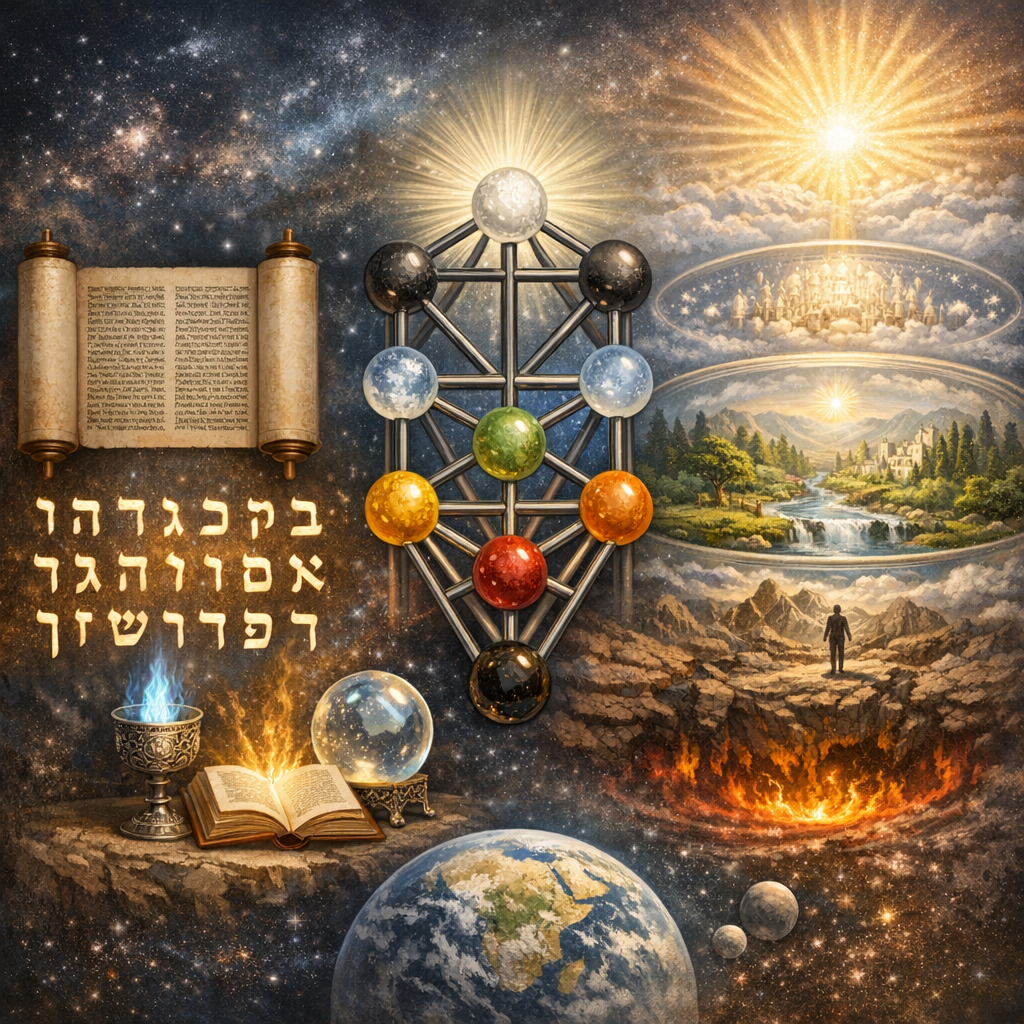
Foundations of Kabbalah: Hebrew Letters, Sefirot, and the Architecture of Creation
This course offers a structured, text-based introduction to classical Kabbalah as a symbolic map of reality. You will encounter the Hebrew letters as creative channels, the Tree of Life with its sefirot and paths, and the traditional frameworks of the 72 Names of God and the 231 Gates, grounded in historical sources and careful terminology so you can later pursue deeper study safely and responsibly.
The first lecture plays free — no account needed.
What you'll learn
- Students will be able to describe Kabbalah as a symbolic and interpretive tradition within Judaism rather than a stand‑alone religion or generic mysticism.
- Students will understand the broad historical timeline of Kabbalah from early Jewish mysticism through medieval and early modern developments.
- Students will be able to identify at least three foundational Kabbalistic texts and their approximate historical periods.
- Students will understand the difference between symbolic, psychological, and literal readings of Kabbalistic ideas.
- Students will be able to recognize the idea that, in classical Kabbalah, Hebrew letters are treated as channels or vessels of creative energy.
- Students will understand the basic names and order of the 22 Hebrew letters at a conceptual level, even without full language proficiency.
- Students will be able to summarize how texts like Sefer Yetzirah describe the role of letters in the formation of worlds, time, and the human form.
- Students will understand the difference between historical-symbolic letter doctrine and later popular or magical uses of letter combinations.
- Students will be able to list the ten sefirot in order and associate each with a core quality (e.g., wisdom, lovingkindness, strength).
- Students will understand the Tree of Life as a diagram representing relationships among the sefirot, not a literal map of physical space.
Prerequisites
- Definitions of Kabbalah and its historical context
- Awareness of Kabbalah as a symbolic rather than purely literal system
- Basic familiarity with Kabbalah as a symbolic system
- Conceptual understanding of Hebrew letters as creative symbols
- Names and basic qualities of the ten sefirot
- Conceptual understanding of the 22 Hebrew letters
Course Content
8 modules · 2h total
What Is Kabbalah? Maps, Myths, and Misconceptions
Step into the world of Kabbalah not as pop‑mysticism, but as a centuries‑old Jewish symbolic language for talking about God, creation, and consciousness. Discover how traditional sources frame Kabbalah and where it fits within broader Jewish thought and practice.
Sacred Language: Hebrew Letters as Building Blocks of Creation
Enter the alphabetic workshop where reality itself is imagined as woven from letters, sounds, and patterns. Meet the 22 Hebrew letters as more than script on a page: as archetypal channels through which divine energy is said to flow into the world.
The Tree of Life: Mapping the Ten Sefirot
Encounter the iconic Kabbalistic diagram that has fascinated mystics, philosophers, and artists for centuries. Trace how the ten sefirot sketch an inner architecture of divinity, creation, and the human soul in one unified map.
Paths Between Worlds: The 22 Connections on the Tree of Life
Look between the sefirot and you’ll find a web of connecting lines that hint at movement, transformation, and relationship. Discover how the 22 paths of the Tree of Life mirror the 22 letters and shape a dynamic map of spiritual process.
The 72 Names of God: From Exodus Verses to Mystical Framework
Behind three short verses in the book of Exodus, Kabbalists perceived a lattice of divine names and powers. Follow how these verses were transformed into the 72 Names of God and how later tradition situated them within the Tree of Life and personal practice.
The 231 Gates: Letter Permutations and the Architecture of Possibility
Imagine every letter shaking hands with every other, forming a network of potential meanings and worlds. Step into the concept of the 231 Gates and see how Sefer Yetzirah turns letter pairs into a map of relationships, oppositions, and creative tension.
Reading the Map Responsibly: Sources, Methods, and Safe Approaches
Beneath the allure of mystical diagrams lies a tradition that insists on ethics, grounding, and community. Learn how classical sources frame preparation and intention, and how modern students can approach Kabbalah with psychological, spiritual, and cultural care.
Putting It Together: Kabbalah as a Symbolic Map for Ongoing Study
Stand back from the details and see the whole tapestry: letters, sefirot, paths, names, and gates forming one interwoven map. Clarify how these pieces fit together and chart your next steps for deeper, historically grounded exploration.
Read the Textbook
Read every chapter for free, right here in your browser.
In this 15‑minute module, you will meet Kabbalah as part of Judaism, not as celebrity spirituality or a stand‑alone religion.
We will keep things simple, but also honest to real scholarship and traditional sources.
By the end, you should be able to: Describe Kabbalah as a symbolic and interpretive tradition within Judaism. Place Kabbalah on a broad historical timeline. Name at least three classic Kabbalistic texts and roughly when they appeared. Explain the difference between symbolic, psychological, and literal readings of Kabbalistic ideas.
Study Flashcards
Key concepts from this course as flashcard pairs.
What Is Kabbalah? Maps, Myths, and Misconceptions
Kabbalah (basic definition)
A Jewish tradition that uses symbols, stories, and diagrams to talk about God, creation, and the human soul in a deeper, often hidden way; a form of "received" esoteric Torah.
Sefirot
Ten symbolic modes or qualities of divine self‑expression; a map for understanding how the one God relates to the world and to human inner life.
Sefer Yetzirah
Early short text (about 3rd–7th centuries CE) teaching that God creates the world through 10 sefirot and 22 Hebrew letters, like building blocks of reality.
Sefer ha‑Bahir
Medieval text from late 12th‑century Provence with brief mystical teachings; helps shape the idea of sefirot as personal divine aspects.
Zohar
Major Kabbalistic work appearing in late 13th‑century Spain; a mystical Aramaic commentary on the Torah that becomes the central classic of Kabbalah.
Symbolic reading
Understanding Kabbalistic images (like the sefirot) as symbols or lenses for thinking about God and reality, rather than as literal cosmic machinery.
+1 more flashcards
Sacred Language: Hebrew Letters as Building Blocks of Creation
Hebrew alphabet (basic fact)
A set of **22 consonant letters** used for everyday Hebrew writing and, in Kabbalah, treated as symbolic building blocks of creation.
Gematria
A traditional system where **Hebrew letters double as numbers**. Words gain number values by adding letters, sometimes used symbolically to link ideas.
Sefer Yetzirah
An early Jewish mystical text ("Book of Formation") that describes creation through **22 letters** and **10 sefirot**, organizing letters as Mothers, Doubles, and Simples.
3 Mother letters
Aleph, Mem, Shin. In Sefer Yetzirah they are linked to **air, water, fire** and mapped onto cosmos, body, and inner life.
7 Double letters
Bet, Gimel, Dalet, Kaf, Pe, Resh, Tav. Called "double" because of **two pronunciations**; linked to **seven planets**, **seven days**, and **seven body openings**.
12 Simple letters
The remaining 12 letters, associated in Sefer Yetzirah with **12 zodiac signs**, **12 months**, and **12 body parts**.
+4 more flashcards
The Tree of Life: Mapping the Ten Sefirot
Keter
Meaning: Crown. Core quality: pure will, super-consciousness, divine intention. Position: top center, supernal level.
Chokhmah
Meaning: Wisdom. Core quality: flash of insight, creative spark. Position: upper right, intellectual level.
Binah
Meaning: Understanding. Core quality: analysis, structure, developing ideas. Position: upper left, intellectual level.
Chesed
Meaning: Lovingkindness. Core quality: generosity, expansion, giving. Position: right column, emotional level.
Gevurah
Meaning: Strength or Judgment. Core quality: boundaries, discipline, restraint. Position: left column, emotional level.
Tiferet
Meaning: Beauty or Harmony. Core quality: balance, compassion, integration of Chesed and Gevurah. Position: center column, emotional level.
+4 more flashcards
Paths Between Worlds: The 22 Connections on the Tree of Life
Sefirah (plural: sefirot)
A core quality or node on the Tree of Life, often shown as a circle. Represents an aspect of divine and human experience, like lovingkindness (Hesed) or wisdom (Hokhmah).
Path (on the Tree of Life)
A connecting line between two sefirot. Represents a process, movement, or relationship between qualities, not a separate sefirah.
22 Paths
In many systems, the total number of connections drawn between sefirot on the Tree. These are often linked to the 22 Hebrew letters.
32 Paths of Wisdom
A phrase from Sefer Yetzirah, commonly read as 10 sefirot plus 22 letter-paths. Influences many later Tree of Life diagrams.
Hebrew Letters on Paths
Many traditions assign the 22 Hebrew letters to the 22 paths. Exact mappings differ by school; letters act as symbolic labels for types of processes.
Golden Dawn Layout
A widely used modern Western esoteric Tree of Life pattern (late 19th century) that fixes 22 paths, each tied to a Hebrew letter, Tarot trump, and astrological symbol.
+1 more flashcards
The 72 Names of God: From Exodus Verses to Mystical Framework
Biblical source of the 72 Names
Three consecutive verses describing the crossing of the sea: Exodus 14:19–21, traditionally counted as 72 letters each in Hebrew.
Boustrophedon method
A reading pattern where verse 1 is written right-to-left, verse 2 left-to-right (reversed), verse 3 right-to-left, then letters are read vertically in columns to form triplets.
Triplet (in this context)
A three-letter Hebrew sequence derived from the Exodus verses; each of the 72 Names is one such triplet.
Symbolic-theological use
Using the 72 Names for meditation, prayer, and reflection on divine qualities and actions, emphasizing inner transformation rather than external control.
Magical/talismanic use
Writing or reciting the names as amulets or incantations for protection, healing, or influence; historically present but often debated and restricted.
Tree of Life (brief)
A Kabbalistic diagram of ten sefirot (divine attributes) and 22 paths; the 72 Names are sometimes seen as fine-grained expressions of these attributes.
+2 more flashcards
The 231 Gates: Letter Permutations and the Architecture of Possibility
Sefer Yetzirah
An early Jewish mystical text (Book of Formation) that describes creation through 10 sefirot, 22 letters, and their combinations.
Sefirot
In this context, ten basic numbers or qualities through which creation is structured; later shown as the 10 spheres on the Tree of Life.
231 Gates
All possible unordered pairs of the 22 Hebrew letters (22 choose 2 = 231), viewed as gates, channels, or relationships between letter-qualities.
Combinations (n choose 2)
A counting method for how many ways to choose 2 items from n without order: n(n − 1)/2. With n = 22, this gives 231.
Symbolic reading of letter pairs
Interpreting each pair of letters as a relationship, tension, or pathway between the qualities associated with those letters.
Link to the Tree of Life
Later Kabbalists relate the 22 letters to the 22 paths on the Tree of Life and see the 231 Gates as a deeper web of interactions behind the diagram.
Reading the Map Responsibly: Sources, Methods, and Safe Approaches
Textual-symbolic study
Learning about Kabbalistic ideas, names, and diagrams through texts, history, and analysis, without trying to use them as tools for magical control.
Contemplation
Gentle reflection on mystical ideas or symbols as metaphors for life, approached with humility and self-awareness.
Practical/magical techniques
Rituals or exercises that aim to cause changes in the world or mind using divine names, diagrams, or intense practices; traditionally restricted to advanced, supervised students.
Halakhic and communal grounding
The traditional expectation that Kabbalah is studied within Jewish law, regular practice, and community, rather than as a standalone system.
Psychological safety
Approaching study in ways that protect mental health: staying grounded, avoiding grandiosity, noticing distress, and seeking support when needed.
Responsible use of correspondences
Using symbolic links (like sefirot, letter pairs, or names) for study and ethical reflection, not as shortcuts to power or replacements for real-world help.
Putting It Together: Kabbalah as a Symbolic Map for Ongoing Study
231 Gates
All unique pairs of the 22 Hebrew letters, described in Sefer Yetzirah. Symbolize a network of potential relationships and meanings.
Sefirot
Ten channels or aspects of divine flow, often shown as nodes on the Tree of Life, from Keter (Crown) to Malkhut (Presence).
Tree of Life paths
The connecting lines between sefirot on Tree of Life diagrams, often associated with the 22 Hebrew letters.
72 Names of God
A traditional set of 72 three-letter combinations derived from Exodus 14:19–21, used symbolically and meditatively in some Kabbalistic sources.
Symbolic map
A set of linked symbols (letters, sefirot, paths, names, gates) used to think about reality, the soul, and practice, rather than a literal physical model.
Historically grounded study
An approach that asks which text, author, and period a diagram or teaching comes from, and compares claims with primary sources and scholarship.
More in Arts & Culture
See all →
Introduction to Philosophy: Big Questions and Key Thinkers

Mastering The Wheel of Time: A Comprehensive Expert Course
Advanced Tarot: Archetypes, Symbolism, and the Narrative Web of the Arcana
Tarot Card Deep Dive: Symbolism, History, and Story Across the Arcana
Foundations of Tarot: History, Structure, and the Major Arcana Journey