Skarp
Skarp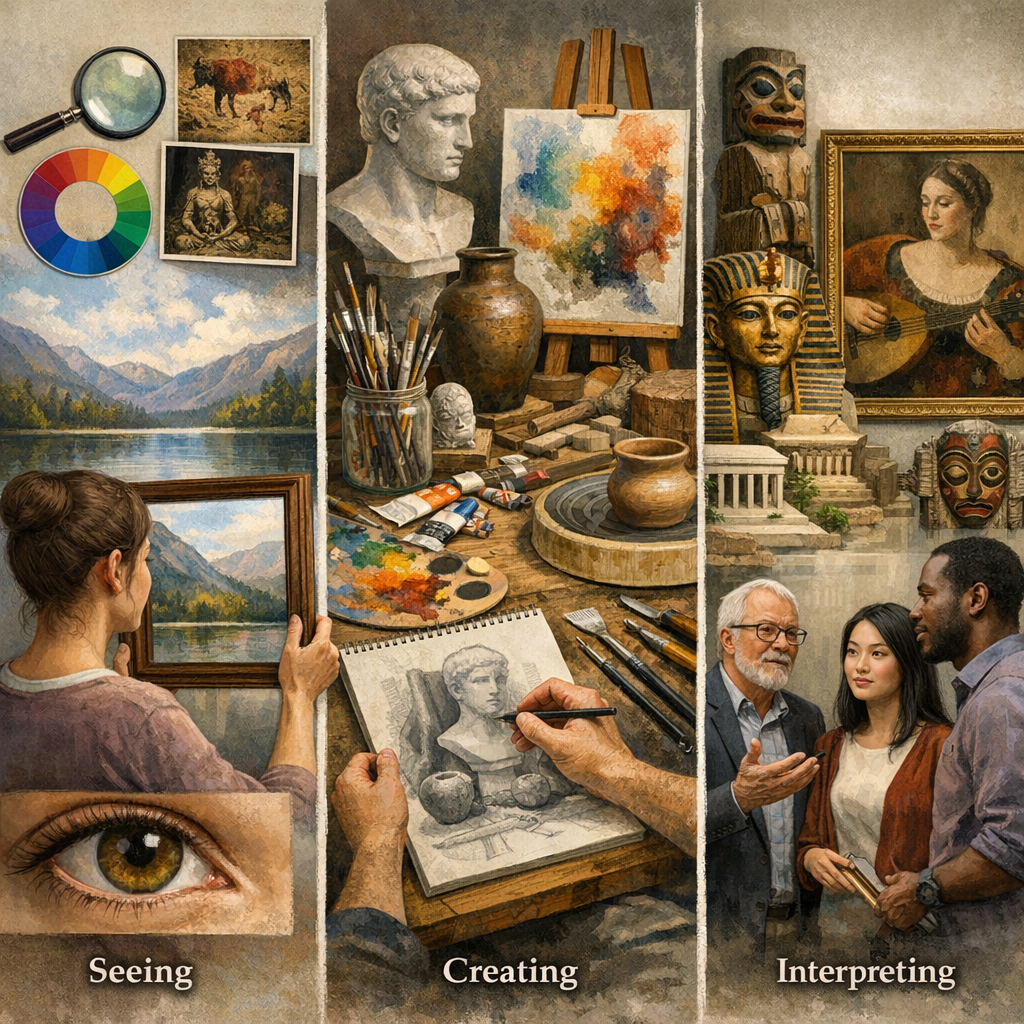
Foundations of General Arts: Seeing, Creating, and Interpreting
This course introduces core ideas that underpin the arts across history and cultures, from visual art and music to literature and performance. You will discover how artists work, how audiences interpret art, and how creative expression connects to society and everyday life.
The first lecture plays free — no account needed.
What you'll learn
- Students will be able to describe multiple purposes of art (expression, communication, ritual, entertainment, critique).
- Students will understand that art takes many forms across cultures and historical periods and resists a single fixed definition.
- Students will be able to identify at least four major artistic disciplines and give a simple example of each.
- Students will be able to name and briefly describe the main elements of visual art and principles of design.
- Students will understand how choices in color, line, and composition influence mood and meaning in an image.
- Students will be able to analyze a simple artwork or image by pointing out at least three elements or principles at work.
- Students will be able to identify core elements of music such as rhythm and melody in a short musical example.
- Students will understand basic literary elements and recognize them in a short story, poem, or excerpt.
- Students will be able to explain how pattern and repetition create expectations and emotional impact in music and literature.
- Students will be able to use a basic framework (describe, analyze, interpret) to respond to an artwork.
Prerequisites
- definitions and purposes of art
- major art forms
- elements of visual art and principles of design
- basic musical and literary elements
- basic understanding of art forms and elements
- interpretation and discussion of art
Course Content
8 modules · 2h total
What Is Art? From Cave Walls to Digital Screens
From ancient cave paintings to viral digital images, the idea of “art” keeps changing—yet something essential remains. This module opens the door to what counts as art, why humans keep making it, and how it shapes the way we see the world.
Seeing Like an Artist: The Building Blocks of Visual Art
A painting, poster, or photograph is more than just a pretty picture—it’s a carefully built structure of lines, colors, and shapes. This module reveals the hidden “grammar” of visual art that makes images feel calm, chaotic, powerful, or mysterious.
Sound and Story: The Basics of Music and Literary Arts
Songs that get stuck in your head and stories that you can’t put down both rely on patterns, rhythm, and structure. This module uncovers how music and writing use time, repetition, and surprise to move audiences.
Looking Deeper: How to Interpret and Talk About Art
Why does one person love a painting that another finds boring? This module introduces simple but powerful ways to look closely, ask better questions, and have richer conversations about any artwork you encounter.
Making Art: From First Idea to Finished Piece
Behind every artwork lies a trail of sketches, drafts, experiments, and mistakes. This module peeks behind the scenes of the creative process and invites you to think like a maker, not just a viewer.
Art, Identity, and Society: Whose Stories Get Told?
Murals on city walls, protest songs, and powerful novels all raise a deeper question: who gets to speak through art, and who is left out? This module explores how the arts reflect, challenge, and reshape societies.
New Frontiers: Digital, Interactive, and Global Arts Today
From video games and virtual reality to global streaming platforms, the arts are evolving faster than ever. This module looks at how technology and global connections are reshaping what art is and who can create it.
Your Personal Arts Toolkit: Building a Lifelong Relationship with Art
Whether you dream of creating art or simply enjoying it more deeply, this final module helps you assemble a personal toolkit—habits, questions, and simple practices—to keep the arts a meaningful part of your life.
Read the Textbook
Read every chapter for free, right here in your browser.
Art is one of the oldest things humans do, but it is also one of the hardest to define. People in different times and cultures have given different answers.
Today (as of 2026), most artists, historians, and philosophers agree on two key ideas: Art is made to do more than just be useful. It might still have a use (a decorated bowl can hold food), but it is also made to express, communicate, or mean something. Art depends on context. What counts as art can change depending on culture, time period, and where the object appears (for example, in a temple, a home, or a museum, or on a social media feed).
There is no single fixed definition that everyone accepts. Instead, people ask questions like: Who made it, and why? How is it used or experienced? Do people treat it as art (exhibit it, discuss it, study it, pay for it)?
Study Flashcards
Key concepts from this course as flashcard pairs.
What Is Art? From Cave Walls to Digital Screens
Art
A human way of making meaning using images, sounds, words, bodies, and digital tools; it goes beyond simple usefulness and depends partly on cultural and historical context.
Visual arts
Art forms you mainly see, such as painting, drawing, sculpture, photography, architecture, printmaking, installation, and video art.
Performance arts
Art forms that use the body in time and space, including theater, dance, performance art, and some circus and live comedy.
Digital art
Art that uses digital tools and networks, such as digital illustration, 3D modeling, VR or AR experiences, interactive websites, and some memes or viral videos.
Expression (purpose of art)
Using art to show inner feelings, moods, or personal experiences that may be hard to express in everyday language.
Communication (purpose of art)
Using art to send messages, stories, or information across time and place.
+4 more flashcards
Seeing Like an Artist: The Building Blocks of Visual Art
Element of Art
A basic visual building block used to create images, such as line, shape, color, texture, space, form, or value.
Principle of Design
A way of organizing and arranging elements of art, such as balance, contrast, emphasis, rhythm, or unity.
Line
A path made by a moving point. Lines can be straight, curved, thick, thin, or broken and can suggest movement or direction.
Value
How light or dark a color or area appears, ranging from white through many grays to black.
Emphasis / Focal Point
Emphasis is what stands out most in an artwork; the focal point is the specific area that first attracts the viewer's eye.
Balance
The way visual weight is distributed in an artwork, which can be symmetrical (mirror-like) or asymmetrical (different but still balanced).
+4 more flashcards
Sound and Story: The Basics of Music and Literary Arts
Rhythm
The pattern of beats and note lengths in time; includes tempo (speed) and how sounds are spaced.
Melody
A sequence of pitches (high and low notes) that forms a tune you can hum and remember.
Harmony
Different notes sounding at the same time, often as chords under a melody, creating stability or tension.
Dynamics
How loud or soft the music is, and how the volume changes over time.
Timbre
Tone color; the quality of a sound that lets you tell different voices or instruments apart.
Plot
The sequence of events in a story, usually moving from setup through conflict to some form of resolution.
+5 more flashcards
Looking Deeper: How to Interpret and Talk About Art
Interpretation
A reasoned explanation of what an artwork might mean or be doing, supported by evidence from the work and, when possible, from its context.
Formal analysis
Close attention to an artwork's visible or audible features (color, line, composition, rhythm, structure) without yet focusing on outside context.
Contextual analysis
Understanding an artwork by considering its time period, culture, location, artist's background, audience, and purpose.
Subjective response
Your personal feelings, memories, and associations that shape how you experience an artwork.
Composition
The way visual elements are arranged within an artwork, guiding where the viewer's eye goes and how the image feels overall.
Describe–Analyze–Interpret framework
A three-step method: first describe what you see or hear, then analyze how the parts work together, and finally interpret what the artwork might mean.
Making Art: From First Idea to Finished Piece
Creative process
A repeatable path from first idea to finished piece, often including inspiration, experimentation, revision, and presentation.
Inspiration
The stage where you notice and collect sparks for ideas from observation, emotion, and questions, then frame them into a workable concept.
Experimentation
A playful stage where you test multiple options (composition, style, medium, color) without committing to one final version yet.
Revision
The stage of improving and clarifying a chosen direction so the artwork better matches your idea and intended mood.
Presentation
Deciding how others will experience your work, including scale, format, context, sequence, and how you share it.
Medium
The material or technology used to create an artwork, such as pencil, paint, clay, digital drawing, photography, or video.
+2 more flashcards
Art, Identity, and Society: Whose Stories Get Told?
Social and political commentary (in art)
When an artwork responds to real-world issues, events, or power structures, either supporting them or questioning them.
Representation
Who appears in art and media, how they are shown, and whose perspectives are centered or ignored.
Public art
Art placed in spaces everyone can access, such as streets, parks, or transit stations, usually visible for free.
Community art
Art projects created with or by local residents, giving them a voice in how their stories and spaces are represented.
Status quo
The current way things are organized in society, including existing laws, norms, and power relationships.
Gentrification
A process where rising investment and rents in a neighborhood lead to the displacement of long-term, often lower-income residents.
+1 more flashcards
New Frontiers: Digital, Interactive, and Global Arts Today
Digital and media arts
Art forms that use digital tools or electronic media, such as digital photography, video, animation, games, VR/AR, and net‑based or social media art.
Globalization (in the arts)
The process where art, styles, and media move quickly across borders, leading to cross‑cultural influence, collaboration, and debate about power and representation.
Cross‑cultural influence
When artists and audiences from different cultures shape each other’s styles, stories, and techniques, often through global platforms and networks.
Cultural appropriation
Using elements of another culture without proper understanding, respect, or credit, especially when there is a power imbalance.
Online creative community
A group of people who connect mainly through digital platforms to share, discuss, and collaborate on creative work.
VR (Virtual Reality)
A fully digital environment that surrounds the user, usually through a headset, often used for immersive art, games, and simulations.
+1 more flashcards
Your Personal Arts Toolkit: Building a Lifelong Relationship with Art
Personal arts toolkit
A flexible set of small habits, questions, and tools that help you keep engaging with art in everyday life, as both audience and creator.
Aesthetic preferences
Your patterns of taste in art, such as energy level, complexity, and how close or far a work feels from your own life.
Micro-practice
A tiny, repeatable creative action (often 1–5 minutes) that builds skill and confidence without requiring big projects.
Audience engagement tool
A simple method (like the 3-question check-in or 10-word journal) that helps you respond to art more thoughtfully instead of just liking or skipping it.
Lifelong learning in the arts
An ongoing process of exploring, questioning, and experimenting with different art forms over time, adjusting your habits as your life and interests change.
More in Arts & Culture
See all →
Introduction to Philosophy: Big Questions and Key Thinkers
Mastering The Wheel of Time: A Comprehensive Expert Course
Advanced Tarot: Archetypes, Symbolism, and the Narrative Web of the Arcana
Tarot Card Deep Dive: Symbolism, History, and Story Across the Arcana
Foundations of Tarot: History, Structure, and the Major Arcana Journey