Skarp
Skarp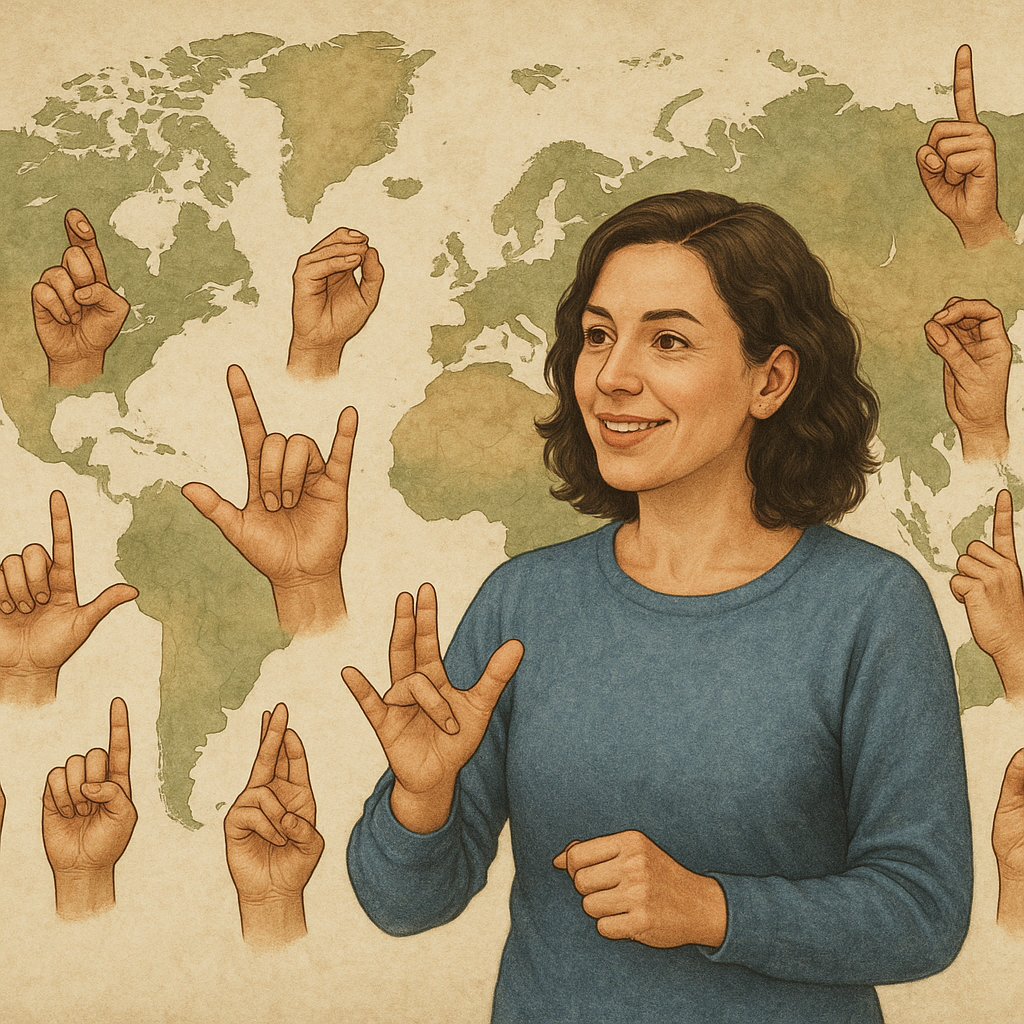
Exploring the World of Sign Languages: A Global Perspective
This course introduces the rich diversity of sign languages around the world, their linguistic features, cultural importance in Deaf communities, and their evolving legal and human-rights status. Learners will explore how different sign languages developed, how they relate (or don’t) to spoken languages, and how technology and policy are reshaping access for Deaf people globally.
The first lecture plays free — no account needed.
What you'll learn
- Students will be able to explain why sign languages are considered full natural languages, not just gestures.
- Students will understand the basic global scale of Deaf communities and sign language use (tens of millions of signers and hundreds of sign languages).
- Students will be able to distinguish between formal sign languages and informal gesture systems.
- Students will be able to describe why estimates of the number of sign languages range from about 150 documented to 300–400 or more.
- Students will understand that sign languages form families and are not universal, with examples such as French Sign Language influencing ASL and BANZSL linking BSL, Auslan, and NZSL.
- Students will be able to explain why sign language statistics are difficult to collect, including under-recognition and limited census data.
- Students will be able to identify key parameters that distinguish different signs (handshape, movement, location, orientation, facial expression).
- Students will understand how sign languages use three-dimensional space and facial grammar to encode meaning.
- Students will be able to summarize evidence that sign and spoken languages engage similar language areas in the brain, supporting the idea that they are equally complex.
- Students will be able to describe how sign language is central to many Deaf people’s cultural and personal identity.
Prerequisites
- sign languages as natural languages
- basic global scale of Deaf communities
- understanding of sign languages as full natural languages
- basic understanding of sign languages and their diversity
- awareness of global diversity of sign languages
- basic understanding of Deaf communities and culture
Course Content
9 modules · 2h 15m total
Seeing Language: What Are Sign Languages?
Introduce sign languages as natural human languages used by Deaf communities worldwide, highlighting how they differ from and relate to spoken languages.
A World of Signs: Diversity and Language Families
Explore how many sign languages exist, why the exact number is hard to know, and how sign languages form families and regional groupings.
Inside the Language: How Sign Languages Work
Examine core linguistic features of sign languages, including phonology, grammar, and the role of space and facial expressions.
Deaf Communities and Culture Around the Globe
Connect sign languages to Deaf cultures, identities, and community life in different parts of the world.
Histories and Origins: How Sign Languages Emerge
Trace the historical development of several major sign languages and how new sign languages can emerge in communities.
Rights and Recognition: Sign Languages and the Law
Examine how sign languages are being recognized in law and human-rights frameworks, and what this means for Deaf people worldwide.
Education and Access: Schools, Interpreters, and Inclusion
Investigate how Deaf and hard of hearing students around the world access education, and the role of sign language, interpreting, and policy.
Technology, Media, and the Future of Signing
Explore how technology and media are transforming sign language communication, documentation, and visibility on a global scale.
Global Case Studies: Comparing Sign Languages and Contexts
Synthesize learning through short case studies of sign languages and Deaf communities in different regions, highlighting similarities and differences.
Read the Textbook
Read every chapter for free, right here in your browser.
In about 15 minutes, you will: See why sign languages are full natural languages, not just “hand gestures.” Understand the idea of visual–gestural (sign) vs spoken–auditory (speech) language. Get a sense of the global scale of Deaf communities and sign language use. Learn to distinguish formal sign languages (like American Sign Language, ASL) from informal gesture systems (like baby signs or home signs).
Keep in mind throughout:
Key idea: Sign languages are languages that happen to be seen instead of heard.
Study Flashcards
Key concepts from this course as flashcard pairs.
Seeing Language: What Are Sign Languages?
Sign language (natural sign language)
A natural human language that uses the visual–gestural modality (hands, face, body, eyes) with its own grammar, vocabulary, and community of users, typically a Deaf community.
Visual–gestural modality
A way of expressing language using visible movements and positions of the body, hands, and face, perceived through the eyes, as in sign languages.
Spoken–auditory modality
A way of expressing language using the vocal tract to produce sound, perceived through the ears, as in spoken languages.
Home sign
A limited, family-specific gesture system created when a Deaf person has no access to a broader sign language community; useful but usually not a full language.
Baby sign
A small set of signs taught to hearing infants (often based on a sign language) to communicate basic needs before they can speak; not a full language.
Co-speech gesture
Spontaneous hand and body movements that accompany spoken language (like pointing or miming) but are not themselves a separate language.
+2 more flashcards
A World of Signs: Diversity and Language Families
Sign language (general idea)
A natural human language that uses the visual–manual modality (hands, face, body) instead of the vocal–auditory channel. Each sign language is tied to a community, not to a spoken language directly.
Sign languages (plural)
The many distinct visual–manual languages used by Deaf communities worldwide; they are not universal and are often mutually unintelligible.
Language family
A group of languages that share a common historical ancestor. In sign languages, examples include the French Sign lineage and the BANZSL family.
BANZSL
A sign language family that includes British Sign Language (BSL), Auslan (Australian Sign Language), and New Zealand Sign Language (NZSL).
French Sign Language (LSF) lineage
A group of sign languages historically influenced by LSF, including American Sign Language (ASL) and several sign languages in Francophone regions.
Indo‑Pakistani Sign Language (IPSL) cluster
A cluster of closely related sign varieties used across India, Pakistan, Bangladesh, and neighboring areas; sometimes treated as one language with strong regional variation.
+3 more flashcards
Inside the Language: How Sign Languages Work
Handshape
The configuration of the fingers and thumb in a sign (which are extended, bent, spread, etc.). A core phonological parameter in sign languages.
Location
Where a sign is produced in relation to the body or signing space (e.g., forehead, chin, chest, neutral space). Changing location can change meaning.
Movement
The path or type of motion in a sign (straight, circular, repeated, tapping, etc.). Movement often carries grammatical or lexical contrasts.
Orientation
The direction the palm and/or fingers face during a sign (up, down, toward signer, away, etc.). Orientation differences can distinguish signs.
Non-manual signals
Linguistic use of facial expressions, mouth shapes, eye gaze, head and body movements in sign languages. They mark grammar (questions, negation, topics) as well as affect.
Spatial reference (locus)
A specific location in signing space associated with a referent (person, object, idea). Later points or movements to that locus function like pronouns or agreement markers.
+3 more flashcards
Deaf Communities and Culture Around the Globe
deaf (lowercase)
Refers primarily to the audiological condition of having little or no functional hearing, without necessarily implying a particular cultural or linguistic identity.
Deaf (uppercase)
Refers to a cultural and linguistic identity centered on the use of a sign language and participation in a Deaf community.
Audism
Discrimination or prejudice based on hearing status, often privileging hearing and spoken language over deaf people and signed languages.
Village signing community
A small community where both deaf and hearing people use a local sign language in daily life, often due to hereditary deafness and close social ties.
Intersectionality
An approach that examines how different aspects of identity (such as deafness, race, gender, disability, class) overlap to shape people’s experiences and access to power.
DeafBlind
Describes people with combined hearing and vision differences, many of whom use tactile or close-range sign languages and have distinct cultural practices.
+1 more flashcards
Histories and Origins: How Sign Languages Emerge
Home sign
A gesture-based communication system developed by a Deaf person and their close hearing family when they have no access to an established sign language. Often systematic, but usually not a full language without a larger Deaf community.
Village sign language
A sign language that arises in a small community (often with high hereditary deafness) and is used by both Deaf and many hearing residents, independent of national sign languages.
BANZSL
A sign language family including British Sign Language (BSL), Australian Sign Language (Auslan), and New Zealand Sign Language (NZSL), which share a common historical origin.
Nicaraguan Sign Language (NSL)
A relatively new sign language that emerged in Nicaragua from the late 1970s onward, when Deaf children from different backgrounds came together in new schools and created a shared language.
Language contact
A situation in which users of different languages interact regularly, leading to borrowing, mixing, and sometimes the creation of new languages (as with ASL’s mix of LSF and local signs).
Oralism
An educational approach that emphasizes speech and lip-reading and historically discouraged or banned the use of sign languages in Deaf education.
+1 more flashcards
Rights and Recognition: Sign Languages and the Law
CRPD (Convention on the Rights of Persons with Disabilities)
A UN human-rights treaty (in force since 2008) that requires states to ensure full and equal enjoyment of all human rights by persons with disabilities, explicitly recognizing sign languages as languages and stressing accessibility, education, and participation.
Legal recognition of a sign language
When a state formally acknowledges a sign language in its laws or constitution, often creating obligations to use, promote, and provide access to that language in areas like education, public services, and media.
Constitutional recognition
Recognition of a language (including a sign language) in a country’s constitution, usually giving it high symbolic status and forming a strong legal basis for demanding practical measures.
Accessibility (in the CRPD sense)
The obligation to remove barriers so that persons with disabilities can access the physical environment, transportation, information, communications (including sign languages), and services on an equal basis with others.
International Week of the Deaf (IWD)
An annual global event in the last full week of September, led by the World Federation of the Deaf, highlighting Deaf rights and sign languages through campaigns, events, and advocacy.
“No Human Rights Without Sign Language Rights”
A slogan used by Deaf advocates to stress that without access to sign languages, Deaf people cannot fully enjoy many other human rights, such as education, health, and political participation.
Education and Access: Schools, Interpreters, and Inclusion
Oralist Education
An approach that focuses on teaching Deaf students to use spoken language and lipreading, often discouraging or banning sign language in the classroom.
Sign Bilingual Education
A model where a natural sign language is used as a primary language of instruction, and the majority written (and sometimes spoken) language is taught as a second language.
Total Communication
An approach that encourages using any and all modes of communication (speech, signs, gestures, pictures), but often lacks a clear, consistent language policy and can weaken full access to either language.
Mainstreaming with Interpreters
Placing Deaf students in regular schools with hearing peers and providing access through qualified sign language interpreters, captioning, or other accommodations.
Qualified Interpreter
A professional who is fluent in both the sign language and the spoken/written language, trained in interpreting (often with certification), and bound by a code of ethics.
Deaf Teachers
Educators who are Deaf themselves, often native signers and cultural role models, who can provide strong sign language input and understand Deaf students' experiences.
+2 more flashcards
Technology, Media, and the Future of Signing
Sign language recognition
The process where AI systems detect and label signs (often as glosses) from video, usually within a specific sign language and domain.
Sign language translation
Using computational methods to translate between a sign language and a spoken/written language, often sign-to-text or text-to-avatar; currently limited in scope and accuracy.
Corpus (sign language corpus)
A large, organized collection of sign language video data with annotations (e.g., glosses, translations, metadata) used for research, dictionaries, and technology development.
International Sign (IS)
A contact variety used in international Deaf spaces (e.g., WFD, UN events). It is not a full replacement for national sign languages but helps cross-border communication.
Deaf leadership
Meaningful control and decision-making power held by Deaf people in projects that affect their languages and lives, from design to governance.
Context-aware translation
Translation systems that consider full sentences, discourse, and non-manual features (like facial expressions and body posture), not just isolated signs.
Global Case Studies: Comparing Sign Languages and Contexts
American Sign Language (ASL)
A natural sign language used primarily in the United States and parts of Canada; highly visible, widely taught in schools and universities, and commonly seen in media, though not declared by a single federal law as the official national sign language.
Indo-Pakistani Sign Language (IPSL)
A large sign language (often referred to locally as Indian Sign Language or Pakistan Sign Language) used by Deaf communities across parts of South Asia. It has millions of users but uneven legal recognition, educational support, and interpreter infrastructure across countries.
Azerbaijani Sign Language (AzSL)
The sign language used by Deaf communities in Azerbaijan, influenced historically by Russian Sign Language but with local features. As of 2026, it is under-recognized, under-documented, and lacks strong formal status in national law.
World Federation of the Deaf (WFD)
A global organization founded in 1951 that represents national Deaf associations, advocates for sign language rights and Deaf people’s human rights, and works closely with the United Nations, especially around the Convention on the Rights of Persons with Disabilities (CRPD).
International Week of the Deaf (IWD)
An annual global event, usually held in the last full week of September, organized by the WFD and national Deaf associations. It highlights Deaf culture, sign language rights, and advocacy through public events, campaigns, and community activities.
Under-recognized sign language
A sign language that is actively used by a community but has limited legal recognition, few educational resources, weak interpreter infrastructure, and little documentation or public visibility (e.g., Azerbaijani Sign Language).
+1 more flashcards
More in Arts & Culture
See all →
Introduction to Philosophy: Big Questions and Key Thinkers

Mastering The Wheel of Time: A Comprehensive Expert Course
Advanced Tarot: Archetypes, Symbolism, and the Narrative Web of the Arcana

Tarot Card Deep Dive: Symbolism, History, and Story Across the Arcana
Foundations of Tarot: History, Structure, and the Major Arcana Journey