Skarp
Skarp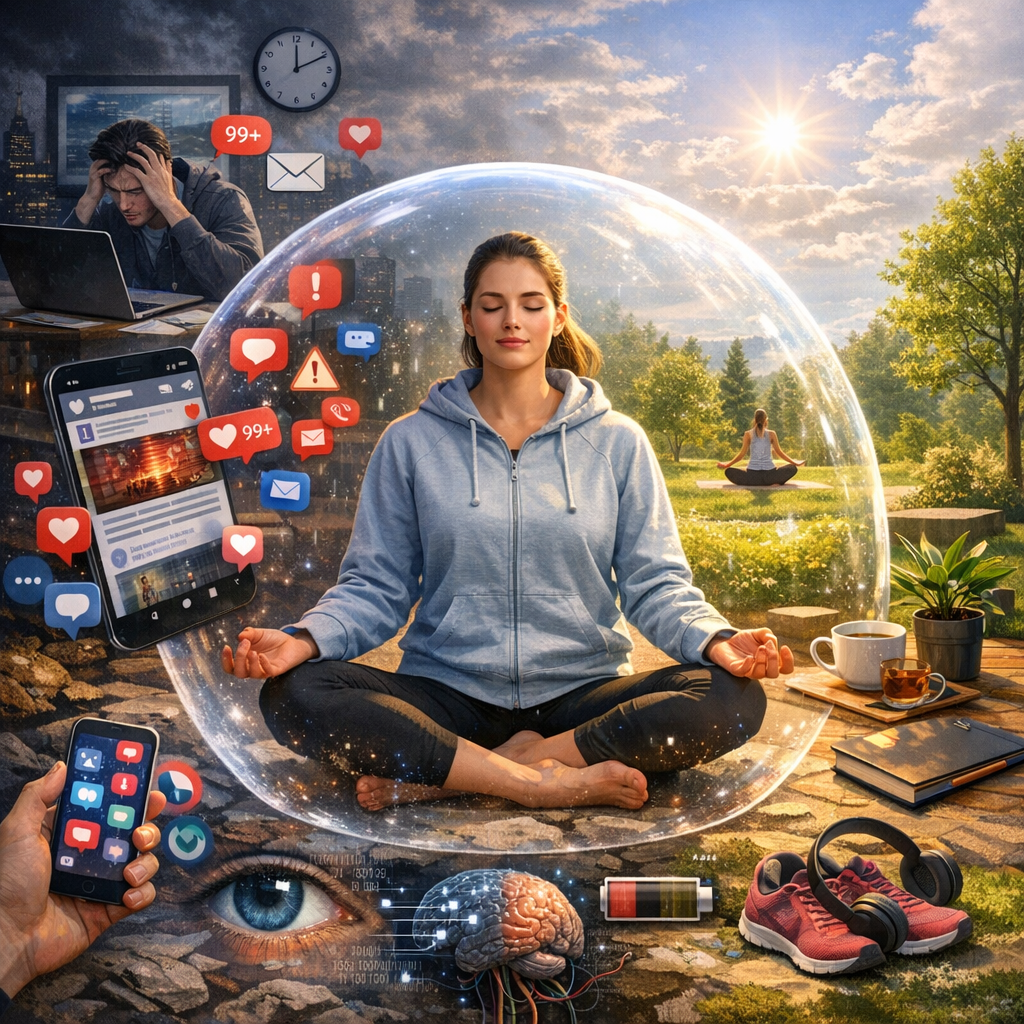
Digital Resilience: Protecting Your Mental Well‑being in a Hyperconnected World
This course helps you understand how today’s always‑online, smartphone‑driven world affects your mind and mood, and gives you practical tools to build resilience. You will learn evidence‑based strategies to manage screen time, navigate social media, use digital tools wisely, and protect your mental health in everyday life.
The first lecture plays free — no account needed.
What you'll learn
- Students will be able to explain the concepts of resilience and digital resilience in their own words.
- Students will understand key ways that smartphone and social media use are linked to stress, anxiety, and depression, especially in adolescents, based on recent research and public health advisories.
- Students will be able to track and categorize their own digital activities (e.g., social media, entertainment, study, communication) over a typical day.
- Students will understand common emotional and situational triggers behind problematic smartphone use, such as boredom and stress, and how these relate to well-being.
- Students will be able to describe how high daily social media use (for example, more than around three hours per day) is associated with increased risk of anxiety and depression in adolescents, according to recent large‑scale studies and public health reports.
- Students will understand how late‑night screen use and constant connectivity can disrupt sleep and attention, and why this matters for mood and school or work performance.
- Students will be able to explain how features like endless feeds and curated images can intensify social comparison and negatively affect body image, especially among teens.
- Students will understand practical strategies to reduce harmful comparison online, such as curating feeds, limiting appearance‑focused content, and following accounts that promote realistic and diverse representations.
- Students will be able to design a simple digital boundary plan that includes at least one phone‑free time and one phone‑free place in their daily routine.
- Students will understand how small reductions in problematic use (for example, reducing passive scrolling or late‑night use) can improve sleep, focus, and mood, as shown in recent intervention studies.
Prerequisites
- definition of digital resilience
- basic understanding of how digital use affects mental health
- awareness of personal digital habits
- basic understanding of stress and mood
- understanding of how social media affects mental health
- awareness of personal social media use patterns
Course Content
8 modules · 2h total
Module 1: What Is Digital Resilience?
Define digital resilience and explore how constant connectivity, smartphones, and social media shape stress, mood, and well‑being today.
Module 2: Mapping Your Digital Life
Take stock of your own digital habits and identify patterns in how, when, and why you use devices, apps, and platforms.
Module 3: Stress, Mood, and the Online World
Connect your digital habits to stress, sleep, attention, and mood, drawing on up‑to‑date research about youth mental health in the digital age.
Module 4: Social Media, Comparison, and Body Image
Examine how social media design, algorithms, and image‑focused content can fuel comparison, body dissatisfaction, and low self‑esteem—and what you can do about it.
Module 5: Boundaries, Breaks, and Healthy Screen Time
Learn concrete techniques to set healthy boundaries with devices and apps, including time limits, phone‑free spaces, and mindful use.
Module 6: Coping Skills for Online Stress and Cyberbullying
Build emotional and practical coping strategies for dealing with online conflict, cyberbullying, hate content, and distressing material.
Module 7: Using Digital Tools to Support Mental Health
Explore evidence‑informed digital mental health tools—such as apps, online programs, and AI‑based interventions—and how to choose and use them safely.
Module 8: Designing Your Personal Digital Resilience Plan
Bring everything together by creating a personalized, realistic plan to protect and strengthen your mental well‑being in the digital age.
Read the Textbook
Read every chapter for free, right here in your browser.
When people talk about resilience, they usually mean:
The ability to cope, adapt, and recover from stress, challenges, or setbacks.
You already use resilience when you: Bounce back after a bad grade Keep going after a sports injury Repair a friendship after an argument
Study Flashcards
Key concepts from this course as flashcard pairs.
Module 1: What Is Digital Resilience?
Resilience
The ability to cope, adapt, and recover from stress, challenges, or setbacks in life.
Digital resilience
The ability to recognize, manage, and recover from challenges in the online world while using technology in ways that support your goals, relationships, and mental health.
Risk factor (digital)
A feature of your online life that increases the chance of mental health problems, such as cyberbullying, late-night scrolling, or constant social comparison.
Protective factor (digital)
A feature of your online life that reduces the chance of mental health problems or helps you cope better, such as supportive online friendships, good sleep habits, or curating your feed.
Social comparison
Comparing your own life, body, or achievements to what you see other people posting online, often leading to lower self-esteem or negative mood.
FOMO (Fear of Missing Out)
Anxiety that others are having rewarding experiences without you, often triggered by seeing posts or stories of events you’re not at.
+1 more flashcards
Module 2: Mapping Your Digital Life
Digital habit mapping
A simple way to track **when, where, and why** you use devices, plus how you feel before and after, so you can spot patterns in your digital life.
Trigger (for device use)
Any cue that makes you reach for a device—such as boredom, stress, notifications, habit, or social pressure.
Problematic use
Device or app use that is **unplanned**, hard to stop, or leaves you feeling worse and interferes with sleep, school, or relationships.
Screen time
The total amount of time your screen is active over a period (usually per day), often broken down by apps or categories.
App categories
Groups of apps by main purpose (e.g., Social, Entertainment, Study/Education, Productivity, Utility, Games) used to understand how your time is divided.
Inertia (in digital use)
Continuing to scroll, watch, or play simply because you already started, even when you didn’t plan to stay on that long.
Module 3: Stress, Mood, and the Online World
Stress
The body and brain’s response to a challenge or demand; can be helpful in the short term but harmful if intense or long‑lasting.
Perceived stress
How stressed you feel about a situation, based on how you interpret it (your thoughts, beliefs, and meaning you give it).
High social media use (for this module)
Roughly 3 or more hours per day on social media, which large‑scale studies link to higher risk of anxiety and depression in many adolescents.
Sleep disruption
Problems with falling asleep, staying asleep, or getting enough sleep, often worsened by late‑night screen light, stimulating content, and notifications.
Attention (focus)
Your ability to direct and maintain mental effort on a task; can be weakened by frequent task‑switching and constant notifications.
Digital resilience
Your ability to adapt, recover, and stay mentally healthy while using digital technologies, including managing stress, mood, and attention online.
Module 4: Social Media, Comparison, and Body Image
Social comparison
The automatic process of evaluating yourself by comparing to others. On social media, this often means comparing your real life and body to others’ highlight reels.
Highlight reel
The carefully selected, edited, and often filtered parts of someone’s life that they share online, which hide most of the boring or difficult moments.
Upward comparison
Comparing yourself to people you see as ‘better’ in some way (e.g., more attractive, fitter, more popular). Can motivate you sometimes but often lowers mood and body satisfaction.
Recommendation algorithm
A system used by platforms like TikTok, Instagram, and YouTube to decide what content to show you, usually based on what gets the most engagement and what you’ve interacted with before.
Body image
How you see, think about, and feel about your body, including your size, shape, and appearance.
Self-esteem
Your overall sense of self‑worth or value as a person (how much you feel you matter and are ‘enough’).
+2 more flashcards
Module 5: Boundaries, Breaks, and Healthy Screen Time
Digital boundaries
Self‑chosen rules for **when, where, and why** you use digital devices and apps, designed to protect your time, energy, and mental health.
Time boundary
A rule about **when** and **how long** you use devices (e.g., no phone 30 minutes before bed, or a 1‑hour daily limit for a specific app).
Place boundary
A rule about **where** you do or do not use devices (e.g., bed or dinner table is phone‑free).
Purpose boundary
A rule about **why** you open an app or device (e.g., “I use Instagram to message friends, not to scroll Explore for an hour”).
Autopilot scrolling
Mindless, often longer scrolling done out of habit, not choice, where you lose track of time and don’t get much benefit.
Micro‑break
A short, intentional, usually offline break (30 seconds–5 minutes) that helps your brain reset, like stretching or deep breathing.
+2 more flashcards
Module 6: Coping Skills for Online Stress and Cyberbullying
Cyberbullying
Repeated, intentional harm done through digital devices (messages, posts, games, etc.), often with a power imbalance (e.g., group vs. one person).
Online harassment
Aggressive or threatening behavior online that can be one‑time or repeated, and may come from people you know or strangers.
Hate content / hate speech
Content that attacks or demeans people based on protected characteristics like race, ethnicity, religion, disability, gender, sexual orientation, or gender identity.
Emotion‑focused coping
Strategies that help you manage your **feelings** about a situation (like grounding, breathing, or reframing thoughts), even if the situation itself hasn’t changed yet.
Cognitive reframing
Noticing unhelpful thoughts (e.g., “everyone hates me”) and replacing them with more accurate, kinder thoughts (e.g., “some people are being mean, but not everyone”).
Grounding technique
A way to bring your attention back to the present moment using your senses (like 5–4–3–2–1) so your body feels safer and your mind can think more clearly.
+2 more flashcards
Module 7: Using Digital Tools to Support Mental Health
Digital Mental Health Intervention (DMHI)
Any technology‑based program or tool (such as an app, website, chatbot, or telehealth platform) designed to improve mental health or well‑being.
Evidence‑based techniques
Strategies that come from scientific research or established therapies, such as CBT, mindfulness, behavioral activation, or problem‑solving therapy.
Mood tracking
Regularly recording your mood, stress, or related factors (like sleep) over time, often using scales or emojis, to notice patterns and triggers.
Privacy policy
A document that explains what data an app or website collects, how it is used, who it is shared with, how it is stored, and how you can delete it.
AI‑based mental health tool
A digital tool that uses artificial intelligence (for example, a chatbot or assistant) to respond to users, provide information, or guide simple coping exercises. It is not a human and not a replacement for professional or emergency care.
Stigma
Negative stereotypes or shame around mental health or getting support, which can make people hesitate to use helpful tools or ask for help.
Module 8: Designing Your Personal Digital Resilience Plan
Digital resilience
Your ability to stay mentally healthy, adapt, and recover when facing challenges, stress, or harm in digital spaces (like social media, gaming, or messaging).
SMART goal
A goal that is Specific, Measurable, Achievable, Relevant, and Time‑bound—making it clear and trackable.
Self‑monitoring
Regularly tracking your own behavior (like screen time or app use) and how it affects your mood, so you can see patterns and adjust.
Habit stacking
A strategy where you attach a new habit to an existing one (e.g., after brushing your teeth, you put your phone on Do Not Disturb).
Digital wellbeing tools
Features built into devices and apps (like Screen Time, Digital Wellbeing, app timers, and Do Not Disturb) that help you manage how and when you use technology.
Coping plan (If–Then plan)
A short written plan that says what you will do in specific stressful situations (e.g., "If I see cyberbullying, then I will screenshot, block, and tell a trusted adult").
More in Health & Wellness
See all →
Nutrition Basics: Building a Healthy, Balanced Diet

Gut-Brain Axis Essentials: How Your Digestion Shapes Your Mood and Mind

Foundations of Mental Health and Everyday Wellness
The Science of Sleep: Unlocking Restful Nights