Skarp
Skarp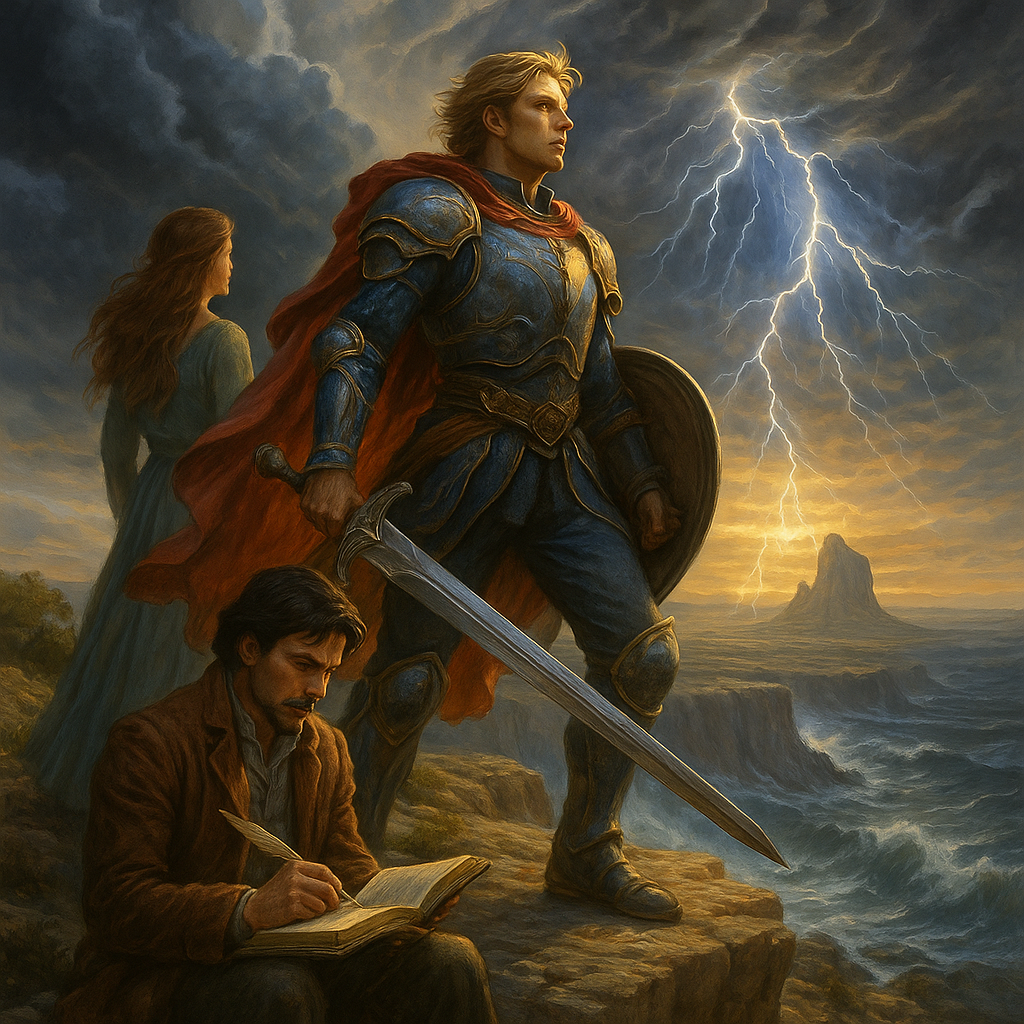
Deep Dive into The Stormlight Archive
This course guides you through the world, characters, magic, and themes of Brandon Sanderson’s The Stormlight Archive, including the first five novels and key novellas. You will learn how the series fits into the wider Cosmere and how to read it critically for deeper appreciation.
The first lecture plays free — no account needed.
What you'll learn
- Students will be able to list the currently published Stormlight Archive novels and novellas in order and identify that ten books are planned in two arcs.
- Students will understand how The Stormlight Archive fits within the broader Cosmere timeline and why Sanderson is pausing between book 5 and book 6.
- Students will be able to describe how highstorms and stormlight define Roshar’s environment and influence technology and warfare.
- Students will understand the basic ecological adaptations of Rosharan life and how these support the series’ themes and plot devices.
- Students will be able to distinguish between humans, Singers, and major spren categories and summarize their historical tensions.
- Students will understand how Nahel bonds and forms of power reflect identity, trauma, and cultural memory.
- Students will be able to identify the major Orders of Knights Radiant, their associated Surges, and the role of oaths and Ideals.
- Students will understand how Heralds and Shardblades/Shardplate relate to the history of Desolations and the series’ central mysteries.
- Students will be able to summarize the main plotlines and character journeys in The Way of Kings and Words of Radiance and explain how they interlock.
- Students will understand how Sanderson uses flashbacks and interludes to pace reveals and broaden the world beyond the primary cast.
Prerequisites
- Publication history and reading order
- Relationship to the wider Cosmere
- Roshar’s supercontinent and regions
- Highstorms and stormlight
- Spren types and Nahel bonds
- Humans vs. Singers history and conflict
Course Content
13 modules · 3h total
Orientation to The Stormlight Archive and the Cosmere
Get a high-level overview of The Stormlight Archive, its place in Sanderson’s Cosmere, and the current state of the series (five main books plus novellas, ten planned).
Roshar: Geography, Ecology, and Highstorms
Explore Roshar as a setting: its supercontinent, highstorm-driven ecology, and how environment shapes cultures, warfare, and daily life.
Humans, Singers, and Spren: Peoples of Roshar
Dive into the main sentient groups on Roshar—humans, Singers (Parshendi, parshmen, Listeners), and spren—and how their histories and perspectives drive conflict.
Knights Radiant, Heralds, and the Magic of Surgebinding
Analyze the structure of the Knights Radiant, the Heralds, and the mechanics of Surgebinding and related magic systems.
From The Way of Kings to Words of Radiance: Foundations of the Saga
Examine the narrative focus and character arcs of the first two novels, The Way of Kings and Words of Radiance, and how they establish the core cast and conflicts.
Oathbringer and Rhythm of War: Escalation, War, and Revelation
Analyze how Oathbringer and Rhythm of War deepen the series’ politics, magic, and philosophy, including Dalinar’s past, the Singers’ perspectives, and the evolving war.
Wind and Truth and the Completion of Arc One
Focus on the fifth novel, Wind and Truth, as the capstone of the first five-book arc, including Szeth’s flashbacks and how it recontextualizes earlier books.
Side Stories: Edgedancer, Dawnshard, and Related Cosmere Tales
Survey the novellas and key crossovers—Edgedancer, Dawnshard, and relevant Cosmere works like The Sunlit Man—to understand their role in the saga.
Trauma, Mental Health, and Ethics in The Stormlight Archive
Examine how the series portrays depression, PTSD, addiction, and moral dilemmas, and how these shape Radiant oaths and character decisions.
Politics, Religion, and Social Structures on Roshar
Analyze Alethi, Vorin, and other cultural systems—gender roles, class, religion, and institutions—and how they evolve across the five books.
Structure, Foreshadowing, and Narrative Technique
Study Sanderson’s craft: multi-POV structure, interludes, epigraphs, in-world documents, and long-term foreshadowing over thousands of pages.
Cosmere Mechanics and Cross-Series Connections
Connect Stormlight-specific magic and lore to Cosmere-wide concepts—Shards, Investiture, worldhopping—and speculate responsibly about future implications.
Reading Strategies and Projecting the Second Arc
Develop strategies for engaging with very long, complex novels and synthesize what the completed first arc suggests about the ten-year time jump and books 6–10.
Read the Textbook
Read every chapter for free, right here in your browser.
The Stormlight Archive (TSA) is Brandon Sanderson’s flagship epic fantasy series set on the planet Roshar, within his larger interconnected universe called the Cosmere.
Key structural facts (as of early 2026): Planned length: 10 main novels Structure: Two 5-book arcs Arc 1: Books 1–5 (mostly about the "front five" protagonists) Arc 2: Books 6–10 (the "back five", later in-world timeline) A time jump separates the arcs (in-world years, not centuries) Current status: 5 main novels published (Arc 1 complete) Several novellas and short works that tie in Sanderson is deliberately pausing TSA before starting Book 6 to: Finish other Cosmere series (especially Mistborn Era 3) Let the in-world timeline of other series catch up to Roshar’s timeline
Think of TSA as the central epic of the Cosmere, structurally similar to how The Lord of the Rings functions for Middle-earth, but with much tighter integration into a multi-planet, multi-magic-system universe.
Study Flashcards
Key concepts from this course as flashcard pairs.
Orientation to The Stormlight Archive and the Cosmere
Stormlight Archive – Planned Structure
A 10-book epic split into **two 5-book arcs** (front five and back five) with a **time jump** between Books 5 and 6.
Cosmere
Brandon Sanderson’s **shared universe** of interconnected fantasy worlds, unified by common metaphysics (Shards, Realms, Investiture).
Shards of Adonalsium
Sixteen fragments of a primordial power, each with a distinct **Intent** (e.g., Honor, Cultivation, Odium). They shape magic and history on various planets.
Investiture
The fundamental magical energy in the Cosmere. On Roshar, **Stormlight** is a primary form of Investiture used by Knights Radiant.
Canonical Stormlight Novellas
**"Edgedancer"** (between *Words of Radiance* and *Oathbringer*) and **"Dawnshard"** (between *Oathbringer* and *Rhythm of War*). Both are canon and important.
Time Jump (TSA)
A planned **multi-year in-world gap** between Books 5 and 6 that allows character, technological, and geopolitical development off-page and aligns Roshar with the broader Cosmere timeline.
+1 more flashcards
Roshar: Geography, Ecology, and Highstorms
Highstorm
A massive, Investiture-charged storm system that regularly sweeps from east to west across Roshar, bringing extreme winds, rain, crem, and Stormlight. Central climatic and magical driver of Rosharan life.
Stormlight
A form of Investiture carried by highstorms and stored in gemstones. Functions as a versatile energy source for Surgebinding, fabrials, Shardplate, and other magical/technological systems.
Crem
A mineral-rich slurry deposited by highstorms that hardens into stone-like layers. Over time, it builds new rock surfaces and shapes Roshar’s substrate, especially in the east.
Supercontinent (Roshar)
The single massive landmass dominating Roshar’s surface, with a cymatic-like, fractal coastline. Its configuration channels and modulates highstorms, creating strong east–west environmental gradients.
Shattered Plains
A region of fractured plateaus and deep chasms in eastern Roshar, formed by past cataclysmic events. It is a major war theatre and showcases extreme interactions between geography, storms, and warfare.
Spren
Cognitive manifestations of ideas, forces, or emotions on Roshar. They interact with the physical world and ecology, forming symbioses with flora, fauna, and sentient beings, and mediating many magical effects.
+2 more flashcards
Humans, Singers, and Spren: Peoples of Roshar
Singers
Roshar’s native sapient species, attuned to Rhythms and capable of changing physical and cognitive configuration via forms obtained through spren bonds.
Parshmen
Singers forced into slaveform—spren bonds severed or suppressed—resulting in dramatically reduced cognition and agency; used as a slave caste by humans for centuries.
Listeners / Parshendi
A group of singers who rejected forms of power and human control, preserving a limited set of forms and oral histories; known to humans as Parshendi, they play a central role early in the series.
Forms of power
Odium-aligned singer forms granted through bonding Voidspren or similar entities, often via the Everstorm; grant enhanced abilities but typically intensify aggression or destructive tendencies.
Spren
Splinters of Shards (primarily Honor and Cultivation) manifesting as semi-physical entities tied to concepts, emotions, or natural phenomena; range from mindless to fully sapient.
Radiant spren
Sapient spren capable of forming a Nahel bond with mortals, producing Knights Radiant and granting Surgebinding; include honorspren, Cryptics, inkspren, highspren, and others.
+4 more flashcards
Knights Radiant, Heralds, and the Magic of Surgebinding
Nahel bond
A deep spiritual and cognitive bond between a human (or singer) and a sapient spren that grants Surgebinding powers, governed by oaths/Ideals and capable of growth or catastrophic failure.
Surgebinding
The Rosharan magic system that manipulates ten fundamental Surges (forces/principles) through Stormlight, accessed via Honorblades or, more commonly, via Nahel bonds between mortals and spren.
Honorblade
A splinter of Honor’s power shaped into a Blade that grants Surgebinding directly without a spren bond, less efficient with Stormlight and not governed by personal Ideals.
Shardblade (dead)
A weapon formed from a spren whose Nahel bond was betrayed; manifests as a metal Blade summoned in about ten heartbeats, linked to a deadeye spren in Shadesmar.
Shardplate
Invested armor associated with Knights Radiant, likely formed from lesser spren; grants enhanced protection and strength and can be either living (connected to an active bond) or functionally dead.
Heralds
Ten supernaturally empowered individuals who formed the Oathpact with Honor to contain the Fused and Desolations, each originally bearing an Honorblade and representing an archetype later mirrored by a Radiant Order.
+4 more flashcards
From The Way of Kings to Words of Radiance: Foundations of the Saga
Shattered Plains
A fractured plateau region on Roshar that serves as the primary military theater in The Way of Kings and much of Words of Radiance, where Alethi Highprinces wage a protracted gemheart war against the Parshendi. Structurally, it concentrates political, economic, and military conflicts in one highly constrained environment.
Bridge Four
Kaladin’s bridge crew, initially a disposable assault unit forced to carry bridges under enemy fire. Over WoK and WoR, it becomes a tightly bonded group that embodies themes of found family, leadership, and social mobility, and serves as a testbed for Kaladin’s evolving ideals.
Flashback Character (per Stormlight book)
The single POV whose past is explored in depth through recurring flashback chapters in a given book (Kaladin in WoK, Shallan in WoR). This spine provides controlled revelation of formative trauma and choices that reframe present-day actions.
Interludes
Short, often geographically and narratively detached chapters placed between parts of the books. They introduce side characters and distant locations, broaden worldbuilding, and seed future plotlines, especially concerning Szeth, the Listeners, and other non-Alethi perspectives.
Alethi Politics (in WoK–WoR)
The network of rivalries and alliances among Alethi Highprinces and the monarchy, centered on gemheart competition, reputation, and interpretations of the Codes and Vorin ethics. Dalinar’s reformist vision clashes with more traditional, glory- and profit-driven models represented by figures like Sadeas.
Lightweaving (as used by Shallan)
A Surgebinding ability that manipulates light and perception to create illusions. In WoK–WoR it functions both as a magic system and as a metaphor for Shallan’s control over memory, identity, and the stories she tells herself and others.
+1 more flashcards
Oathbringer and Rhythm of War: Escalation, War, and Revelation
Bondsmith
An Order of Knights Radiant whose members (e.g., Dalinar) manipulate Spiritual Connections and can bind people, spren, and even Shardic power together, making them uniquely influential in both politics and Realmatics.
Fused
Ancient Singer souls bound to Odium, functionally immortal by reincarnating into new Singer bodies, each type mirroring a Surge and serving as an anti-Radiant force in the war.
Forms (of the Singers)
States of being adopted by Singers by bonding specific spren in highstorms, altering their physical shape, cognition, emotions, and social roles (e.g., dullform, warform, envoyform, Forms of Power).
Fabrial
A device that harnesses spren trapped in gemstones to produce repeatable magical effects; by Rhythm of War, fabrials are treated as a systematizable technology driving an arms race.
Anti-Light
An inverted form of Invested Light (e.g., anti-Voidlight, anti-Stormlight) created through specific rhythms and Intent, capable of annihilating corresponding Investiture at a fundamental level.
Arms Race (in the Rosharan context)
The escalating cycle in which humans and Odium’s forces develop increasingly sophisticated uses of Surges, fabrials, and Lights to counter each other, raising both power and risk.
+1 more flashcards
Wind and Truth and the Completion of Arc One
Truthless (in Szeth’s context)
A culturally and theologically loaded status imposed on Szeth by Shin authorities, presented as a curse or exile for asserting a forbidden "truth." In Arc One, it functions as both a personal identity and a mechanism of social control, whose real meaning is clarified by Szeth’s flashbacks in *Wind and Truth*.
Recontextualization (literary sense)
A narrative technique where later information (e.g., Szeth’s flashbacks) does not change earlier events but changes how the reader interprets their causes, motives, and moral weight.
Arc-One Capstone
The fifth book, *Wind and Truth*, which concludes the primary conflicts and character arcs introduced in books 1–4, reveals hidden structural information, and sets up conditions for the ten-year time jump and the second five-book arc.
Conflict Matrix
An analytic tool organizing conflicts along axes (personal, political, metaphysical, moral-philosophical) and characters, used to track which tensions are resolved, transformed, or extended into later arcs.
Epistemic Injustice (applied to Szeth)
The idea that Szeth may be punished not for being wrong but for speaking or embodying unwelcome truths, highlighting how power structures can weaponize the label of "truth" or "heresy" to control dissent.
Side Stories: Edgedancer, Dawnshard, and Related Cosmere Tales
Edgedancer (novella)
A Stormlight Archive novella set between Words of Radiance and Oathbringer, focusing on Lift and Nale in Yeddaw; it bridges character development and Herald lore into Oathbringer.
Dawnshard (novella)
A post-Oathbringer, pre-Rhythm of War novella featuring Rysn on an expedition to Akinah, revealing the existence and nature of Dawnshards—primal Commands that helped Shatter Adonalsium.
The Sunlit Man
A 2023 Cosmere novel following Sigzil (Nomad) in the far future, illustrating the long-term consequences of Stormlight-era oaths and Dawnshard-level power across planets.
Dawnshard (lore term)
A powerful Command-level Invested entity or construct that can bind or alter any creature; historically used in the Shattering of Adonalsium and extremely dangerous in mortal hands.
Sleepless (Dysian Aimians)
A hive-mind species composed of hordelings; they guard dangerous secrets like the Dawnshard on Akinah and act as cosmic risk managers in the Cosmere.
Edgedancer (Order of Knights Radiant)
An order of Radiants associated with the Surges of Abrasion and Progression, whose Ideals emphasize remembering and caring for the forgotten; Lift is a notable member.
+2 more flashcards
Trauma, Mental Health, and Ethics in The Stormlight Archive
Major Depressive Disorder (MDD)
A mood disorder characterized by persistent low mood and/or loss of interest, with cognitive, physical, and emotional symptoms (e.g., guilt, sleep/appetite changes, suicidal ideation). In the series, Kaladin exemplifies many features, though framed through a fantasy lens.
Post-Traumatic Stress Disorder (PTSD)
A trauma-related condition involving intrusive memories, avoidance, negative mood/cognition changes, and hyperarousal. Kaladin, Dalinar, and Szeth show PTSD-like patterns after repeated combat and moral injury.
Dissociation
A disruption in the normal integration of consciousness, memory, identity, or perception. Shallan’s personas (Shallan/Veil/Radiant) illustrate complex dissociation and identity fragmentation used as a coping strategy.
Moral Injury
Psychological and spiritual distress resulting from perpetrating, witnessing, or failing to prevent acts that violate one’s core moral beliefs. Szeth’s massacres and Dalinar’s Blackthorn past are prime examples.
Radiant Oaths
Magically binding commitments tied to each Order’s ideals (e.g., protection for Windrunners, self-truths for Lightweavers). They function as both power-gating mechanisms and frameworks for ethical and psychological growth.
Addiction (Substance Use Disorder)
A pattern of substance use leading to significant impairment or distress, marked by loss of control, risky use, and continued use despite harm. Dalinar’s alcohol use before his turn toward honor fits this pattern.
+2 more flashcards
Politics, Religion, and Social Structures on Roshar
Vorinism
The dominant religion in much of eastern Roshar, centered on the Almighty (Honor), the Heralds, and a war to reclaim the Tranquiline Halls; it structures gender roles, class, and knowledge control via the ardentia.
Safehand
A culturally mandated covered hand worn by Vorin women, symbolizing modesty and reinforcing gender norms that separate 'feminine' literacy and scholarship from overt physical labor.
Highprince
A semi-autonomous Alethi warlord-noble who commands armies and territory under a nominal king, often competing with other highprinces for power and prestige.
Fused
Ancient Singer cognitive shadows granted immortality by Odium, who possess living Singers and form a warrior-elite ruling class in Singer societies after the Everstorm.
Knights Radiant
Orders of Surgebinders who bond spren and swear Ideals that combine moral, spiritual, and political commitments; they form a transnational, quasi-religious military institution.
Coalition of Monarchs
The multi-national alliance led largely by Dalinar that unites various Rosharan states against Odium, blending political, military, and religious motivations.
+1 more flashcards
Structure, Foreshadowing, and Narrative Technique
Part Structure (in a Stormlight book)
A five-movement macro-organization of each novel. Each Part clusters specific POVs and themes, building toward converging climaxes in Part 5. Parts are Sanderson’s primary unit of large-scale pacing and thematic development.
POV Rotation
The deliberate sequencing and repetition of point-of-view characters across chapters and Parts to control information flow, thematic focus, and reader identification over the series.
Interlude
Short, often one-off or infrequent POV chapters placed between Parts, used to expand the world, seed long-range plot elements, adjust pacing, and introduce perspectives the main cast cannot access.
Epigraph
A brief in-world text (e.g., letters, scholarly notes, prophetic fragments) placed at the start of chapters. It provides exposition, raises mysteries, and offers thematic commentary while remaining diegetic and often biased.
In-World Document (e.g., Diagram, letters, notebooks)
Any text that exists within the fictional world and is presented to the reader (often as epigraphs). These documents convey lore and meta-plot while reflecting the worldview, biases, and limits of their in-world authors.
Long-Range Foreshadowing
The planting of hints—factual, emotional, or thematic—whose payoff occurs books later. In Stormlight, this often involves repeated, varied signals across POVs, interludes, and epigraphs, culminating in major revelations by book 5.
+2 more flashcards
Cosmere Mechanics and Cross-Series Connections
Shard
One of 16 vast fragments of Adonalsium’s power, each with a guiding Intent (e.g., Honor, Cultivation, Odium). Shards shape magic systems and planetary histories across the Cosmere.
Investiture
The fundamental magical substance/energy of the Cosmere. On Roshar, it appears most visibly as Stormlight; on other worlds, as Breaths, mists, Dor, etc.
Nahel Bond
A mutual, spiritually binding relationship between a sapient spren and a mortal, granting Surgebinding powers and shaping both partners’ Identity and personality.
Perpendicularity
A region of extremely dense Investiture that connects the Physical and Cognitive Realms, allowing worldhopping. Examples include Honor’s and Cultivation’s perpendicularities on Roshar.
Ghostbloods
A cross-world secret organization, led by Thaidakar (Kelsier), focused on acquiring and controlling Investiture resources. Active both on Roshar and Scadrial.
Hoid
A pre-Shattering worldhopper who appears in most Cosmere works. On Roshar, he serves as Wit, collects multiple forms of Investiture, and pursues a long-term, partially hidden agenda.
+4 more flashcards
Reading Strategies and Projecting the Second Arc
Active Reading System
A deliberate, structured set of practices (notes, timelines, character sheets, synthesis passes) that externalizes memory and analysis, allowing you to track complex narratives over years instead of relying on recall alone.
Macro-Question (Arc-Level)
A high-level, thematic question that unifies many smaller plot or character questions (e.g., 'How do societies ethically integrate superhuman power?') and often spans multiple books or arcs.
Flashback Anchor
A character whose life history forms the backbone of a book’s flashback structure, shaping not just character development but also the thematic and historical lens through which the series’ events are interpreted.
Evidence-Based Projection
A forward-looking hypothesis about future books that is explicitly grounded in on-page textual evidence, clear reasoning, and awareness of structural patterns, rather than in spoilers or unexamined assumptions.
Ten-Year Gap (Structural Function)
A designed temporal break between arcs that allows for off-screen development, reconfiguration of power structures, and thematic shifts, turning the gap itself into a mystery whose contents future books reveal.
Multi-Layered Timeline Tracking
A technique that maintains separate but interlinked timelines for world events, individual character lives, and broader cosmere/meta events, enabling you to see how micro and macro developments interact across books.
More in Arts & Culture
See all →
Introduction to Philosophy: Big Questions and Key Thinkers
Mastering The Wheel of Time: A Comprehensive Expert Course
Advanced Tarot: Archetypes, Symbolism, and the Narrative Web of the Arcana
Tarot Card Deep Dive: Symbolism, History, and Story Across the Arcana
Foundations of Tarot: History, Structure, and the Major Arcana Journey