Skarp
Skarp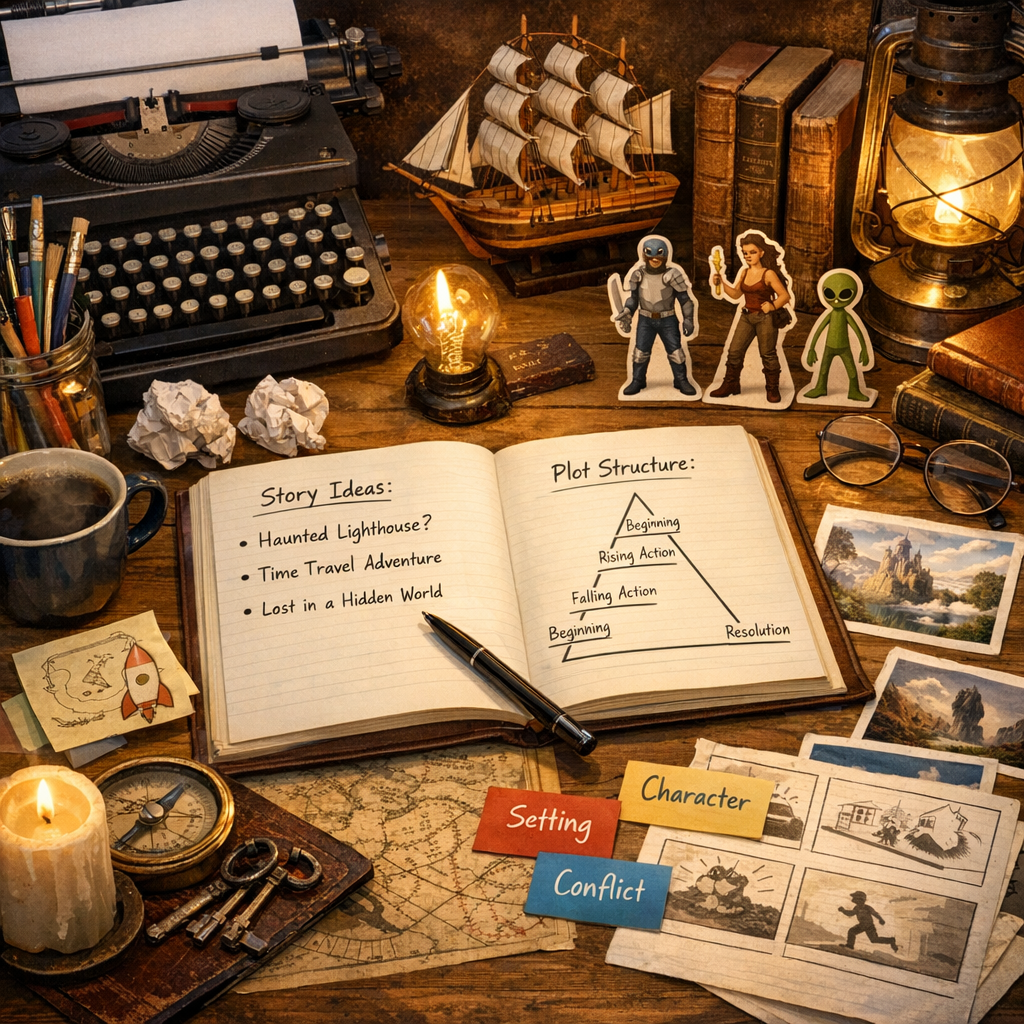
Crafting Stories: Foundations of Creative Writing and Narrative Structure
This course guides you through the essentials of storytelling, from generating ideas and building characters to shaping plots, scenes, and themes. You will practice short, focused writing exercises that help you create engaging, well-structured stories in your own voice.
The first lecture plays free — no account needed.
What you'll learn
- Students will be able to distinguish between a loose idea and a focused story premise.
- Students will be able to formulate a clear central question that drives a story.
- Students will be able to describe a simple protagonist, their goal, and the main obstacle in 2–3 sentences.
- Students will be able to choose an appropriate scope for a short narrative.
- Students will be able to outline a simple story using beginning, middle, and end.
- Students will understand the purpose of an inciting incident in launching a story.
- Students will be able to identify the climax and resolution in short example texts.
- Students will be able to sketch a three-act outline for their own story idea.
- Students will be able to define a protagonist’s external goal and internal need.
- Students will understand the difference between internal and external conflict.
Prerequisites
- Story idea generation and premise
- Central dramatic question
- Story premise and central question
- Basic narrative structure
- Story premise and core characters
- Character creation
Course Content
9 modules · 2h 15m total
Finding Your Story: Ideas, Premise, and Core Question
Learn how to turn loose ideas into a clear story premise and guiding question that will shape your narrative from start to finish.
Shaping the Journey: Basic Narrative Structure
Explore how stories are built with a beginning, middle, and end, and how the three-act structure helps you organize events and tension.
Bringing People to Life: Characters, Wants, and Change
Discover how to create believable characters with clear desires, conflicts, and growth that keep readers emotionally invested.
Where and How It Happens: Setting, World, and Mood
Learn to use setting and world details to create mood, support the plot, and reveal aspects of character without long descriptions.
Who Tells the Tale: Point of View and Narrative Voice
Examine different points of view and discover how narrative voice shapes the reader’s experience of your story.
Scene by Scene: Conflict, Tension, and Pacing
Focus on building individual scenes that move the story forward, maintain tension, and control the reader’s sense of time.
Talking on the Page: Dialogue, Subtext, and Action Beats
Practice writing dialogue that sounds natural, reveals character, and advances the story while using subtext and action beats effectively.
What It All Means: Theme, Symbolism, and Resonance
Explore how to weave deeper meaning into your stories through theme, recurring images, and symbolic details without becoming heavy-handed.
From Draft to Polished Piece: Revision Strategies
Learn a practical, step-by-step approach to revising your story for structure, clarity, style, and impact, including how to use feedback effectively.
Read the Textbook
Read every chapter for free, right here in your browser.
Before you write scenes, you need to know what story you’re actually telling.
In this module you’ll learn to: Tell the difference between a story seed and a story premise Shape a central dramatic question that guides your story Describe a protagonist, goal, and obstacle in 2–3 sentences Choose a small, focused scope that fits a short story
Think of this as building a lens: Idea/seed = a handful of sand (interesting, but shapeless) Premise = a glass lens (shaped, focused) Central question = what you point the lens at
Study Flashcards
Key concepts from this course as flashcard pairs.
Finding Your Story: Ideas, Premise, and Core Question
Story Seed
A loose idea or fragment (image, situation, theme, feeling) that is interesting but not yet a full story. Example: “A city where it never stops raining.”
Story Premise
A focused setup that includes a protagonist, a goal, and a main obstacle. Example: “In a city where it never stops raining, a street cleaner must clear a blocked storm drain before midnight or the whole district will flood.”
Central Dramatic Question
The main story-sized question your narrative is built around, usually involving the protagonist’s goal and the stakes. Example: “Will the sisters find the will before the lawyer arrives?”
Protagonist
The main character whose goal and decisions drive the story. The central dramatic question is usually about them.
Goal
What the protagonist wants to achieve in the story right now (short-term, concrete, and specific).
Obstacle
The main thing that makes the protagonist’s goal difficult—can be external (a storm, a rival) or internal (fear, guilt).
+1 more flashcards
Shaping the Journey: Basic Narrative Structure
Beginning (Act I – Setup)
The opening of the story where you introduce the world, characters, and status quo, and plant the seeds of the main problem. Often includes the inciting incident and ends with a push into Act II.
Middle (Act II – Confrontation)
The longest section of the story, where the character faces rising obstacles and stakes. Conflicts deepen, and the character often reaches a low point before moving toward the climax.
End (Act III – Resolution)
The final section of the story, including the climax (decisive confrontation) and the resolution (showing the new normal and the character’s change).
Three-Act Structure
A common narrative framework dividing a story into Act I (Setup), Act II (Confrontation), and Act III (Resolution), aligning with beginning, middle, and end.
Inciting Incident
An early story event that disrupts the character’s normal life and launches the main plot, directly connecting to the core question of the story.
Climax
The most intense, decisive moment of the story when the main character confronts the central problem and the answer to the core question becomes clear.
+2 more flashcards
Bringing People to Life: Characters, Wants, and Change
Protagonist
The main character whose choices drive the story and whose journey the audience follows most closely.
Antagonist
The primary force (person, system, situation, or inner struggle) that opposes the protagonist’s goal and creates obstacles.
External goal (want)
A visible, concrete objective the character is trying to achieve—something you could film, like winning a contest or escaping danger.
Internal need
The deeper emotional or psychological growth the character must undergo, often tied to a false belief they hold.
Flaw
A character’s harmful trait or false belief that creates problems and blocks their internal need.
External conflict
Struggle between the character and outside forces: other people, society, nature, or technology.
+2 more flashcards
Where and How It Happens: Setting, World, and Mood
Setting
The time, place, and physical environment of a story **in a specific scene**—including details that affect what characters can do and how they feel.
Worldbuilding
The process of creating the larger world around your story (its rules, culture, technology, history) and revealing it through scenes, not big info-dumps.
Mood / Atmosphere
The emotional feeling or tone of a scene (e.g., tense, cozy, eerie), created by details of setting, language choices, and character reactions.
Sensory Details
Specific descriptions using the five senses—sight, sound, smell, touch, taste—to help readers experience the setting instead of just being told about it.
Info-dump
A large block of explanation about the world or backstory that stops the story’s movement. Usually better broken up and woven into action and dialogue.
Who Tells the Tale: Point of View and Narrative Voice
Point of View (POV)
The **position** from which a story is told—who is telling it and through what grammatical person (first, second, third) and scope (limited, omniscient).
First Person
A point of view that uses **I / me / my**; the narrator is a character inside the story, and we see only what this character experiences and thinks.
Third Person Limited
A point of view that uses **he / she / they**, but stays close to **one character’s** inner thoughts and experiences at a time.
Third Person Omniscient
A point of view using **he / she / they** where the narrator is **all-knowing**, able to enter multiple characters’ minds and provide broader commentary.
Narrative Voice
The overall **sound** of the storytelling: the narrator’s personality, tone, word choice, and attitude toward characters and events.
Narrative Distance
How **close or far** the narration feels from a character’s inner life—from deep inside their thoughts (close) to a more external, observing stance (distant).
+2 more flashcards
Scene by Scene: Conflict, Tension, and Pacing
Scene Goal
What the main character wants to achieve in a specific scene, stated in one clear sentence (e.g., “In this scene, Lila wants to convince the judge to taste her dish again.”).
Scene Outcome
What actually changes by the end of the scene—how the situation is different from the start (e.g., a new problem, a decision, a shift in power).
Conflict (Scene Level)
Opposition that blocks or complicates the character’s goal in a scene: another character, the environment, internal doubts, or a system.
Tension
The reader’s feeling of uncertainty, worry, or anticipation about what will happen next, often created through questions, stakes, and delayed information.
Pacing
How fast or slow the story feels to the reader, controlled by how much narrative space and detail you give to events.
Expanding a Moment
Slowing the pacing by adding detail, internal thoughts, and smaller actions to stretch time and highlight importance.
+1 more flashcards
Talking on the Page: Dialogue, Subtext, and Action Beats
Purposeful dialogue
Dialogue that reveals character, advances the story, or builds conflict/tension, instead of empty small talk or filler.
Subtext
The meaning and emotion underneath the spoken words—what characters imply, avoid, or hide rather than say directly.
Action beat
A short description of what a character does around their dialogue, used to show emotion, clarify who is speaking, and control pacing.
Dialogue tag
A phrase that identifies the speaker (e.g., "she said," "he asked"). Often combined with punctuation to attach it to the spoken line.
On-the-nose dialogue
Dialogue that states emotions or information too directly, leaving little room for subtext or reader inference.
What It All Means: Theme, Symbolism, and Resonance
Theme
The deeper idea or question a story explores, shown through patterns in character choices, conflicts, and outcomes (not usually stated as a rule).
Moral
A direct lesson or rule of behavior that can be stated as advice (e.g., “You should always be honest”). Common in fables and didactic stories.
Message
The position or claim the story seems to support by the end, based on who is rewarded or punished and what ultimately works or fails.
Symbol
An object, image, or detail that stands for more than itself, carrying extra meaning connected to the story’s theme.
Motif
A recurring element (image, object, phrase, situation) that appears multiple times and helps build pattern and meaning.
On-the-nose writing
Writing that states exactly what characters feel, think, or what the theme is, instead of letting readers infer through action and detail.
+2 more flashcards
From Draft to Polished Piece: Revision Strategies
Big-picture (structural) revision
Working on the story’s overall shape: plot, pacing, character arcs, conflict, theme, and scene order. You might cut or add scenes, move events, or change motivations.
Line-level (sentence-level) editing
Focusing on how the story is written at the level of sentences and words: clarity, rhythm, word choice, grammar, and style.
Arc (character arc)
The internal journey a character takes from the beginning to the end of the story (e.g., fearful → courageous, closed-off → open).
Hook (story opening)
The combination of situation, voice, and question that grabs the reader’s attention in the first lines or paragraphs.
Beat (story beat)
A small unit of story action or emotional shift—often a single moment where something changes in the scene.
More in Arts & Culture
See all →
Introduction to Philosophy: Big Questions and Key Thinkers
Mastering The Wheel of Time: A Comprehensive Expert Course
Advanced Tarot: Archetypes, Symbolism, and the Narrative Web of the Arcana
Tarot Card Deep Dive: Symbolism, History, and Story Across the Arcana
Foundations of Tarot: History, Structure, and the Major Arcana Journey