Skarp
Skarp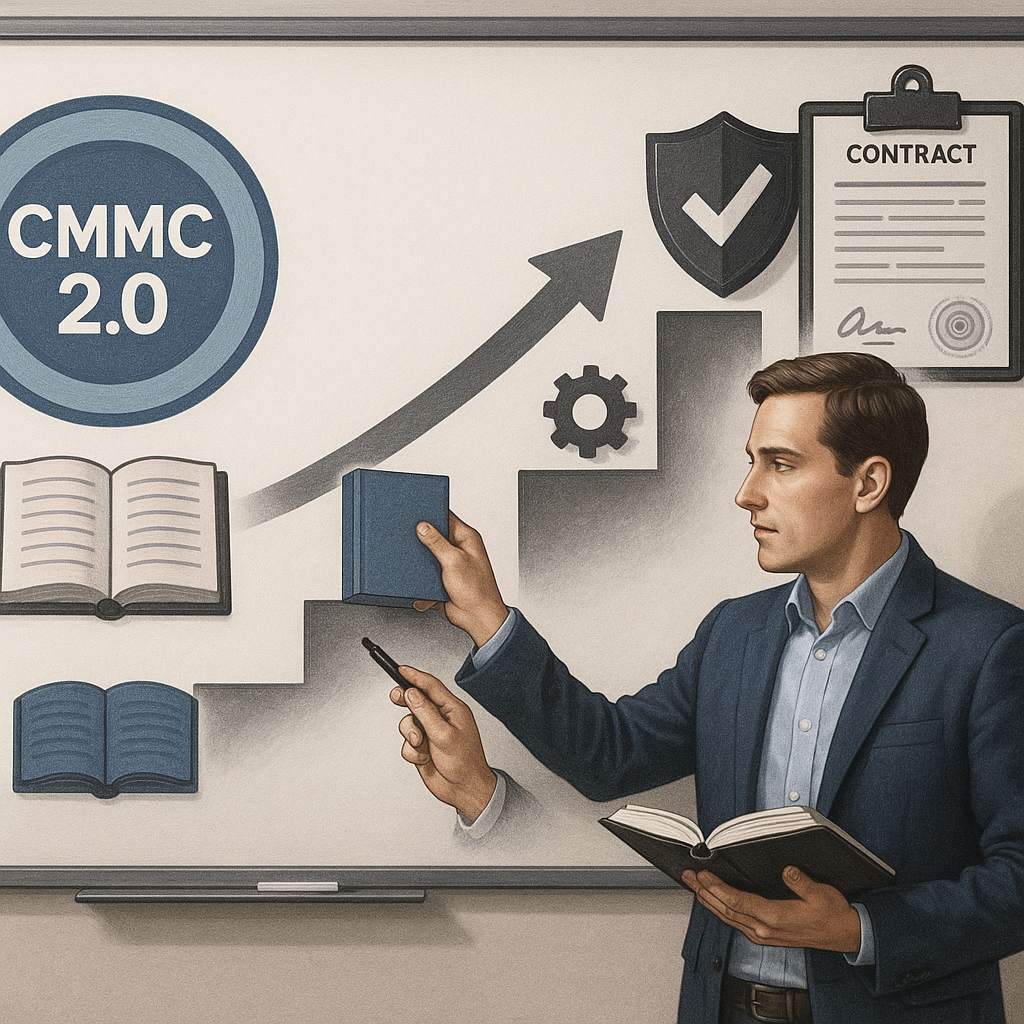
CMMC 2.0 Expert Path: From Framework Basics to Contract-Ready Compliance
This course takes you from a solid understanding of the CMMC 2.0 framework through to expert-level readiness for leading CMMC implementations and assessments. You will learn the latest rules, levels, and timelines, how CMMC maps to NIST 800-171/172, and how to design, implement, and maintain a compliant cybersecurity program that stands up to DoD scrutiny.
The first lecture plays free — no account needed.
What you'll learn
- Students will be able to explain the purpose and evolution of CMMC from 1.0 to 2.0.
- Students will understand how 32 CFR Part 170 and 48 CFR/DFARS clauses (e.g., 252.204-7021, 252.204-7025) make CMMC enforceable in contracts as of November 10, 2025.
- Students will be able to identify which types of organizations (primes, subcontractors, MSPs/IT providers) must comply with CMMC.
- Students will be able to describe the control expectations and typical contractor profiles for CMMC Levels 1, 2, and 3.
- Students will understand when Level 1 self-assessments, Level 2 self vs third-party assessments, and Level 3 DIBCAC-led assessments are required.
- Students will be able to determine an appropriate target CMMC level based on the type and sensitivity of data handled in a contract.
- Students will be able to summarize the key dates for Phase 1–4 of CMMC implementation (2025–2028) and what each phase requires at Levels 1–3.
- Students will understand how CMMC requirements appear in solicitations and how they affect eligibility to bid or renew contracts.
- Students will be able to outline a high-level timeline for an organization to reach and maintain the required CMMC level ahead of Phase 2 and beyond.
- Students will be able to explain how CMMC Level 2 aligns with the 110 controls in NIST SP 800-171.
Prerequisites
- CMMC 2.0 goals and history
- Regulatory basis: 32 CFR and 48 CFR
- CMMC 2.0 levels and assessment models
- CMMC 2.0 levels and data types
- Basic familiarity with security control frameworks
- Mapping CMMC to NIST SP 800-171 and 800-172
Course Content
14 modules · 3h 20m total
Module 1: CMMC 2.0 in Context – Why It Exists and Who It Affects
Introduce the CMMC 2.0 program, its purpose in protecting the Defense Industrial Base, and the regulatory framework that now makes CMMC mandatory in DoD contracts.
Module 2: CMMC 2.0 Levels, Data Types, and Assessment Models
Dive into the three CMMC 2.0 levels, the distinction between FCI and CUI, and how assessment requirements differ across levels and contract types.
Module 3: The CMMC 2.0 Rollout Timeline and Contract Strategy
Analyze the four-phase rollout of CMMC starting November 10, 2025, and what each phase means for bidding, renewals, and long-term contract strategy.
Module 4: Mapping CMMC to NIST SP 800-171 and 800-172
Connect CMMC 2.0 requirements to the underlying NIST standards, with emphasis on NIST SP 800-171 for Level 2 and selected NIST SP 800-172 controls for Level 3.
Module 5: CMMC Domains and Core Control Families
Survey the major CMMC/NIST 800-171 domains (e.g., Access Control, Incident Response, Configuration Management) and how they work together to protect FCI and CUI.
Module 6: Scoping, Asset Classification, and Boundary Definition
Learn how to correctly scope your CMMC environment, classify assets, and define assessment boundaries to focus efforts and avoid over- or under-scoping.
Module 7: Level 1 and Level 2 Self-Assessments and Scoring
Explore how to conduct CMMC self-assessments, calculate scores aligned with NIST 800-171, and report results as required under DFARS and CMMC rules.
Module 8: Third-Party and DIBCAC Assessments – What Experts Need to Know
Examine the structure and expectations of third-party C3PAO assessments for Level 2 and DIBCAC-led assessments for Level 3, including preparation and common pitfalls.
Module 9: Designing Technical and Procedural Controls for CMMC Level 2
Translate CMMC/NIST 800-171 requirements into practical technical and procedural controls across identity, protection, detection, response, and recovery functions.
Module 10: Level 3 Enhancements and Advanced Threat Protection
Focus on the additional NIST 800-172-derived requirements at CMMC Level 3 that address advanced persistent threats and high-value programs.
Module 11: POA&Ms, Conditional Certification, and Remediation Strategy
Learn how Plans of Action & Milestones (POA&Ms) work under CMMC 2.0, including what can and cannot be deferred, timelines, and how to manage remediation efficiently.
Module 12: Governance, Evidence Management, and Continuous Compliance
Establish a governance model, documentation practices, and continuous monitoring process to maintain CMMC compliance over the full contract lifecycle.
Module 13: Supply Chain, Flow-Down, and Working with Service Providers
Address how CMMC requirements flow down to subcontractors and managed service providers, and how to manage shared responsibility and contractual risk.
Module 14: Building a CMMC Roadmap, Budget, and Business Case
Pull everything together into a realistic multi-year roadmap, including cost estimates, staffing, tooling, and the business case for CMMC as revenue protection.
Read the Textbook
Read every chapter for free, right here in your browser.
Big Picture: Why Did DoD Create CMMC?
The Cybersecurity Maturity Model Certification (CMMC) program exists because the U.S. Department of Defense (DoD) concluded that voluntary and self-attested cybersecurity in the Defense Industrial Base (DIB) was not sufficient.
Over the last 10–15 years, the DIB has been a prime target for: Nation‑state espionage (e.g., theft of weapons system designs, logistics data) Intellectual property theft from defense contractors and their suppliers Supply chain attacks via small subcontractors and managed service providers (MSPs)
Study Flashcards
Key concepts from this course as flashcard pairs.
Module 1: CMMC 2.0 in Context – Why It Exists and Who It Affects
CMMC 2.0
The current version of the Cybersecurity Maturity Model Certification program, with 3 levels (1–3), aligned primarily with NIST SP 800‑171 and 800‑172, and made enforceable through 32 CFR Part 170 and DFARS clauses.
Defense Industrial Base (DIB)
The worldwide industrial complex of businesses and organizations that provide products and services to meet U.S. defense requirements, including primes, subcontractors, and many service providers.
FCI (Federal Contract Information)
Information provided by or generated for the government under a contract to develop or deliver a product or service to the government, not intended for public release. CMMC Level 1 focuses on protecting FCI.
CUI (Controlled Unclassified Information)
Information that requires safeguarding or dissemination controls under U.S. law, regulation, or government‑wide policy, but is not classified. CMMC Level 2 focuses on protecting CUI.
32 CFR Part 170
The DoD regulation that formally establishes the CMMC program, defines its levels and governance, and directs its integration into the acquisition system.
DFARS 252.204‑7021
The DFARS contract clause titled Cybersecurity Maturity Model Certification Requirements that obligates contractors to achieve and maintain a specified CMMC level and to flow down requirements to applicable subcontractors.
+4 more flashcards
Module 2: CMMC 2.0 Levels, Data Types, and Assessment Models
Federal Contract Information (FCI)
Information, not intended for public release, provided by or generated for the Government under a contract to develop or deliver a product or service to the Government. It excludes public information and simple transactional data. Primarily drives CMMC Level 1 requirements.
Controlled Unclassified Information (CUI)
Unclassified information that requires safeguarding or dissemination controls pursuant to law, regulation, or government-wide policy. In the DoD context, its protection is aligned with NIST SP 800-171 and primarily drives CMMC Level 2 and 3 requirements.
CMMC Level 1
The basic safeguarding level focused on protecting FCI, aligned with the 17 requirements of FAR 52.204-21. Uses annual self-assessments and is intended for contractors handling FCI only.
CMMC Level 2
The primary level for protecting CUI, aligned with the 110 requirements of NIST SP 800-171. Uses annual self-assessments for non-prioritized CUI and C3PAO-led assessments every 3 years for prioritized CUI programs.
CMMC Level 3
An advanced level for high-value CUI and organizations facing APT-level threats. Builds on Level 2 and adds selected NIST SP 800-172 requirements. Assessed by DIBCAC or other DoD teams, typically every 3 years.
C3PAO (Certified Third-Party Assessment Organization)
An independent organization authorized by the DoD to perform CMMC Level 2 assessments for prioritized CUI programs. Issues certifications valid for a defined period (typically 3 years).
+4 more flashcards
Module 3: The CMMC 2.0 Rollout Timeline and Contract Strategy
Phase 1 (starting 10 Nov 2025)
Initial rollout phase where CMMC clauses appear in a limited set of new solicitations, primarily requiring self-assessments (especially for Level 1 and some Level 2) as eligibility gates.
Phase 2
Ramp-up phase where more solicitations require CMMC, and third-party (C3PAO) assessments become common for Level 2 (and some Level 3) contracts.
Phase 3
Broad incorporation phase where CMMC requirements appear in most new awards involving FCI or CUI, with certification often required at proposal submission.
Phase 4 (Steady State)
Mature phase where CMMC is fully embedded in DFARS; relevant DoD contracts routinely include CMMC requirements, and maintaining certification becomes a normal ongoing obligation.
Go/No-Go Requirement
A mandatory condition in a solicitation (such as possessing a specific CMMC level by a set date) that must be met to be considered for award.
C3PAO
CMMC Third-Party Assessment Organization authorized to perform official CMMC assessments for Levels 2 and, in some cases, Level 3.
+2 more flashcards
Module 4: Mapping CMMC to NIST SP 800-171 and 800-172
NIST SP 800-171 Rev. 2
A NIST Special Publication specifying 110 security requirements for protecting Controlled Unclassified Information (CUI) in non-federal systems and organizations; it forms the technical baseline for CMMC 2.0 Level 2.
NIST SP 800-172
A NIST Special Publication that defines enhanced security requirements, layered on top of 800-171, to protect CUI in systems subject to Advanced Persistent Threats (APTs); CMMC Level 3 adopts a selected subset of these requirements.
CMMC 2.0 Level 2
The CMMC maturity level that aligns with the full set of 110 requirements in NIST SP 800-171 Rev. 2, focused on protecting CUI with assessed and documented controls.
CMMC 2.0 Level 3
The highest CMMC 2.0 level, which includes all Level 2 requirements (800-171) plus a selected subset of enhanced requirements from NIST SP 800-172 to address APT-level threats.
NIST Cybersecurity Framework (CSF)
A high-level, risk-based framework organized around the functions Identify, Protect, Detect, Respond, and Recover; 800-171 and 800-172 can be viewed as detailed control catalogs implementing CSF outcomes for CUI environments.
APT (Advanced Persistent Threat)
A highly capable, well-resourced adversary that conducts long-term, targeted cyber campaigns; 800-172 and CMMC Level 3 are explicitly designed to enhance resilience against APTs.
+1 more flashcards
Module 5: CMMC Domains and Core Control Families
Access Control (AC)
Controls **who/what can access which systems and data** and under what conditions; enforces least privilege and separation of duties for CUI.
Identification & Authentication (IA)
Ensures that users, processes, and devices are **uniquely identified and strongly authenticated** (e.g., MFA) before granting access.
Audit & Accountability (AU)
Provides **logging and traceability** of user and system actions to support monitoring, investigations, and accountability.
Configuration Management (CM)
Establishes and maintains **secure baselines and controlled change processes**, preventing unauthorized or ad hoc modifications.
Incident Response (IR)
Defines how the organization **prepares for, detects, analyzes, contains, eradicates, and recovers** from security incidents.
System & Communications Protection (SC)
Protects **data in transit** and enforces secure **network boundaries and segmentation**, including use of cryptography.
+2 more flashcards
Module 6: Scoping, Asset Classification, and Boundary Definition
CUI Asset
Any system, device, or application that directly processes, stores, or transmits Controlled Unclassified Information (CUI). Always in scope for CMMC Level 2.
Security Protection Asset (SPA)
An asset that provides security functions or services (e.g., firewall, IdP, SIEM, EDR console) to CUI assets or the CUI environment. Always in scope.
Contractor Risk Managed Asset (CRMA)
A contractor-managed asset that can access or affect the CUI environment but does not itself store CUI. In scope for risk-based treatment and justification.
Specialized Asset
OT, IoT, IIoT, lab, or test systems with specialized functions that may interact with CUI or influence its protection. Often require case-by-case scoping decisions.
System Boundary
The set of components (hardware, software, networks, people, processes) that collectively deliver a function and share a common security policy, defining what is inside vs. outside the assessed CUI environment.
CUI Enclave
A logically or physically segmented environment where all CUI processing, storage, and transmission is concentrated to simplify security controls and limit CMMC scope.
+1 more flashcards
Module 7: Level 1 and Level 2 Self-Assessments and Scoring
CMMC Level 1 Self-Assessment
An annual, evidence-based review of the 17 basic cyber hygiene practices applicable to systems handling Federal Contract Information (FCI), typically performed internally and affirmed by a senior official.
CMMC Level 2 Self-Assessment
A NIST SP 800-171–aligned Basic Assessment covering 110 security requirements for systems handling CUI, resulting in a scored outcome that must be reported to SPRS under DFARS 252.204-7019.
NIST SP 800-171 DoD Assessment Methodology
The scoring approach used by DoD to evaluate implementation of NIST SP 800-171 requirements, starting at 110 points and subtracting weighted values for each requirement not fully implemented.
SPRS (Supplier Performance Risk System)
The DoD system of record where contractors must submit their NIST SP 800-171 assessment scores and related data, used by acquisition officials to evaluate cyber risk.
POA&M (Plan of Action and Milestones)
A documented plan describing how an organization will remediate a specific security gap, including required tasks, responsible parties, and target completion dates.
Annual Affirmation
A yearly attestation by a senior company official that required CMMC/DFARS self-assessments have been completed and that reported scores and implementation statuses are accurate.
+2 more flashcards
Module 8: Third-Party and DIBCAC Assessments – What Experts Need to Know
C3PAO (Certified Third-Party Assessor Organization)
An accredited independent organization authorized to perform **CMMC Level 2 third-party assessments**, following the CMMC Assessment Process (CAP) and reporting results into the DoD/CMMC ecosystem.
DIBCAC (Defense Industrial Base Cybersecurity Assessment Center)
A DoD entity that conducts **DoD-led cybersecurity assessments** of Defense Industrial Base contractors, including **CMMC Level 3** and some high-priority Level 2 and NIST SP 800-171 assessments.
Assessment Lifecycle
The structured phases of an external assessment: **planning & scoping**, **fieldwork (evidence collection and testing)**, **findings & scoring**, and **remediation/POA&Ms & final determination**.
Mis-Scoping
An error in defining the assessment boundary, such as excluding systems or services that process, store, or transmit CUI (e.g., shared email, identity, or backup services). A leading cause of assessment disruption.
Evidence Triad (Docs–Screens–Ops)
A practical way to think about assessment evidence: **documents** (policies, SSPs), **screenshots/demonstrations** (configurations, dashboards), and **operational artifacts** (tickets, logs, incident reports). Strong assessments show all three.
POA&M (Plan of Action & Milestones)
A formal plan documenting how and when specific security deficiencies will be remediated. Under CMMC, only certain **non-critical** gaps may be temporarily accepted as POA&Ms, subject to time and risk constraints.
+1 more flashcards
Module 9: Designing Technical and Procedural Controls for CMMC Level 2
Role-Based Access Control (RBAC)
An access control approach where permissions are assigned to roles (e.g., CUI_Engineer), and users are assigned to those roles, rather than directly to permissions. Simplifies least privilege and reviews.
Configuration Baseline
A documented, standard set of secure configuration settings (often based on CIS Benchmarks or DISA STIGs) applied consistently to systems handling CUI.
SIEM (Security Information and Event Management)
A centralized system that collects, correlates, and analyzes security logs from multiple sources to support detection and response to security events.
3-2-1 Backup Rule
Maintain at least 3 copies of data, on 2 different media types, with at least 1 copy stored offsite or logically separated, to support resilient recovery.
Shared Responsibility Matrix
A document mapping each security requirement (e.g., NIST 800-171 controls) to responsibilities of the cloud provider vs. the customer, used to clarify and evidence control coverage.
Policy vs. Procedure
Policy states high-level intent and mandatory requirements; procedure provides detailed, step-by-step instructions on how to implement those requirements operationally.
+1 more flashcards
Module 10: Level 3 Enhancements and Advanced Threat Protection
Advanced Persistent Threat (APT)
A highly capable, well-resourced adversary (often state-sponsored) that conducts long-term, stealthy campaigns to gain and maintain access to targeted systems, typically for strategic or military advantage.
NIST SP 800-172
NIST Special Publication that defines enhanced security requirements for protecting CUI from advanced persistent threats; CMMC Level 3 adopts a prioritized subset of these requirements on top of NIST 800-171.
Risk-Adaptive Access Control
An access control approach that dynamically adjusts decisions based on contextual risk signals (e.g., device health, location, behavior anomalies) rather than static roles alone.
Threat Hunting
A proactive, hypothesis-driven process where analysts search across telemetry (endpoint, network, identity, cloud) to discover previously undetected threats, especially those associated with APT behavior.
Privileged Access Workstation (PAW)
A hardened, isolated workstation used exclusively for administrative or other high-privilege tasks, designed to reduce the risk that compromised user devices can be used to escalate privileges.
Micro-Segmentation
A security architecture practice that applies fine-grained segmentation (often at the workload or application level) to limit lateral movement and contain breaches within small zones.
Module 11: POA&Ms, Conditional Certification, and Remediation Strategy
Plan of Action & Milestones (POA&M)
A formal, time-bound record of specific security gaps, planned remediation actions, milestones, owners, and deadlines. Under CMMC 2.0 it is a tightly controlled exception mechanism, not a general backlog.
Conditional Certification
A CMMC certification status granted when an organization meets the minimum score and implements all non-deferrable controls but still has a limited number of eligible gaps on approved POA&Ms with strict closure deadlines.
Non-deferrable Control
A practice that must be fully implemented at the time of assessment and cannot be placed on a POA&M, typically including core identity, boundary, cryptographic, logging, incident response controls, and the SSP itself.
POA&M Score Cap
The maximum cumulative negative score (from unimplemented practices placed on POA&Ms) that DoD allows while still permitting certification with conditions. Exceeding this cap disqualifies the use of POA&Ms for certification.
Compensating Control
A temporary measure that reduces risk associated with a gap while the primary control is being implemented, documented in the POA&M to show how residual risk is managed during the remediation window.
System Security Plan (SSP)
A comprehensive document describing how an organization implements each required security requirement (e.g., NIST 800-171). It must be current and accurate before CMMC assessment and is not eligible for POA&M deferral.
Module 12: Governance, Evidence Management, and Continuous Compliance
Governance (in CMMC context)
The set of roles, responsibilities, decision-making structures, and oversight mechanisms that ensure CMMC controls are defined, implemented, and maintained over time for systems handling CUI.
System Security Plan (SSP)
A formal document describing the system boundary, environment of operation, implementation of each required control (e.g., NIST SP 800-171 Rev. 3), and the relationships with other systems and environments.
Evidence Management
The processes and tools used to collect, organize, store, and maintain artifacts that demonstrate CMMC control implementation and ongoing effectiveness (e.g., policies, logs, screenshots, reports).
Continuous Monitoring
An ongoing process to maintain situational awareness of security controls, vulnerabilities, configuration changes, and incidents, enabling timely risk decisions and updates to SSP, POA&Ms, and attestations.
Material Change (for CMMC)
A change that significantly affects the CUI environment, control implementation, or risk posture—such as adding a new CUI system or re-architecting the CUI boundary—often requiring SSP updates and possible DoD notification.
POA&M (Plan of Actions and Milestones)
A documented plan that identifies security weaknesses, the corrective actions needed, resources required, and scheduled completion dates; used under CMMC 2.0 with specific limits on what can remain open.
Module 13: Supply Chain, Flow-Down, and Working with Service Providers
Flow-down
The contractual process by which a prime contractor passes applicable clauses and requirements (e.g., DFARS 252.204-7012, CMMC level obligations) to subcontractors and lower-tier suppliers that handle FCI or CUI.
Managed Service Provider (MSP)
A third-party company that remotely manages a customer’s IT infrastructure and end-user systems, often responsible for day-to-day operations such as patching, backups, and user support.
Managed Security Service Provider (MSSP)
A specialized service provider that delivers outsourced monitoring and management of security devices and systems (e.g., SIEM, EDR, IDS/IPS), often with 24/7 threat detection and incident response capabilities.
Shared Responsibility Model
A documented allocation of which security controls are implemented and operated by the customer, by the service provider (MSP/MSSP/cloud), or jointly, often used for cloud and managed services.
FedRAMP
The Federal Risk and Authorization Management Program, a U.S. government-wide program that standardizes security assessment, authorization, and continuous monitoring for cloud products and services. FedRAMP Moderate/High authorizations are often used as evidence of strong controls for CUI-relevant services.
Lower-tier subcontractor
A subcontractor hired by another subcontractor (not the prime) that may still handle FCI or CUI and therefore may require flow-down of DFARS and CMMC-related clauses.
Module 14: Building a CMMC Roadmap, Budget, and Business Case
Total Cost of Ownership (TCO) for CMMC
The full multi‑year cost of achieving and maintaining CMMC compliance, including technology, assessments, staffing, training, facilities, and opportunity costs—not just the formal assessment fee.
Plan of Actions & Milestones (POA&M)
A documented plan outlining how and when an organization will remediate identified security or compliance gaps, including resources, timelines, and milestones.
C3PAO
Certified Third‑Party Assessment Organization authorized by the Cyber AB to perform official CMMC assessments for organizations seeking certification (especially Level 2).
Enclave Architecture (for CUI)
A design approach that isolates systems and users handling CUI into a segmented, tightly controlled environment to reduce scope and cost of compliance.
Revenue Protection Framing
A business case approach that positions CMMC investment as necessary to protect current and future revenue streams, particularly DoD contracts, rather than as a discretionary cost.
More in Technology
See all →
Defending at Machine Speed: AI-Accelerated Vulnerability Management

Reading the EU Cloud and AI Development Act

Operationalizing the NIST AI RMF and Generative AI Profile in Practice

CIPP/E Exam Prep: Mastering European Data Protection Law and the GDPR
ITIL 4 Foundation Exam Prep: Complete Syllabus, Exam-Focused