Skarp
Skarp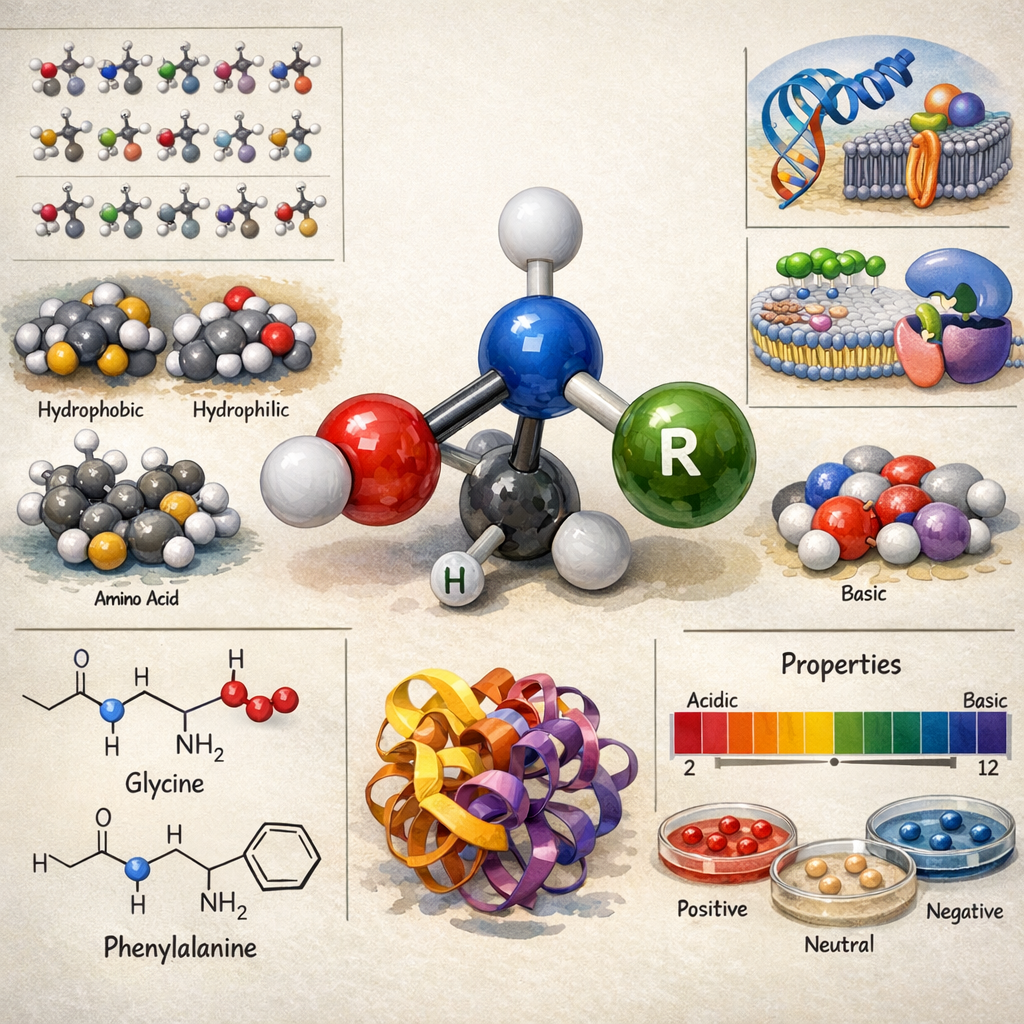
BCH 204 Essentials: Structure, Properties, and Functions of the 20 Amino Acids
A focused, exam-oriented biochemistry course on the 20 standard amino acids, emphasizing how their structures and chemical properties determine protein behavior and metabolic roles. You will build a solid mental map of each amino acid, master codes, pKa and charge, polarity, and essentiality, and practice with quizzes and BCH 204–style problems.
The first lecture plays free — no account needed.
What you'll learn
- Students will be able to sketch the generic amino acid structure and label the alpha carbon, amino group, carboxyl group, hydrogen, and side chain (R group).
- Students will understand the concept of zwitterions and explain why amino acids exist as dipolar ions near physiological pH.
- Students will be able to list the 20 standard amino acids and group them at a high level (nonpolar, polar, aromatic, charged).
- Students will be able to match each amino acid’s full name with its three-letter and one-letter codes from memory.
- Students will understand how to classify each amino acid as nonpolar, polar uncharged, aromatic, acidic, or basic.
- Students will be able to apply at least two mnemonic strategies to recall codes and categories quickly during exams.
- Students will be able to draw or recognize the side-chain structures of nonpolar and aromatic amino acids.
- Students will understand how hydrophobic side chains contribute to protein folding and core stability.
- Students will be able to predict where nonpolar and aromatic residues are likely to be found in a folded protein (interior vs surface).
- Students will be able to draw or recognize the side-chain structures of polar, acidic, and basic amino acids.
Prerequisites
- General structure of amino acids
- Overview of the 20 standard amino acids
- Amino acid codes and basic classifications
- Nonpolar and aromatic amino acid properties
- Basic understanding of hydrogen bonding and electrostatics
- Structures of amino acid side chains
Course Content
12 modules · 2h 45m total
Meeting the 20 Amino Acids: Your Biochemistry Alphabet
Imagine proteins as long sentences and amino acids as the 20-letter alphabet that writes every biological story; this module introduces you to each ‘letter’ and how they fit into the bigger picture of BCH 204.
Codes and Categories: Turning Names into Instant Recognition
Instead of staring blankly at exam tables of amino acids, turn them into instantly recognizable friends by cracking their one-letter and three-letter codes and broad property groups.
Side Chains in Focus I: Nonpolar and Aromatic Amino Acids
Dive into the hydrophobic core of proteins by getting to know the nonpolar and aromatic amino acids that drive folding and stabilize structures from the inside out.
Side Chains in Focus II: Polar, Acidic, and Basic Amino Acids
Shift from the protein core to its reactive surface, where polar, acidic, and basic side chains control solubility, hydrogen bonding, and charge-based interactions.
pKa, Charge, and pH: Predicting Ionization Like a Pro
Instead of memorizing random numbers, learn how pKa values, pH, and Henderson–Hasselbalch thinking let you predict the charge of any amino acid or peptide on an exam.
Isoelectric Points and Charge Calculations: From Concept to Exam Problems
Turn abstract pI definitions into a practical toolkit for calculating isoelectric points and net charges on amino acids and short peptides under exam pressure.
Essential vs Non-Essential: Nutritional and Metabolic Perspectives
Look beyond structures to see which amino acids your body can’t live without making, and how this shapes diet, metabolism, and clinical relevance.
Amino Acids in Protein Structure: From Primary Sequence to 3D Shape
Watch how the chemical personalities of amino acids dictate whether a protein forms helices, sheets, or turns, and how single substitutions can reshape an entire structure.
Special Roles and Signature Amino Acids in Metabolism and Catalysis
Zoom in on the ‘celebrity’ amino acids—like histidine, cysteine, and serine—that star in enzyme active sites, redox chemistry, and one-carbon metabolism.
Memorization Playbook: Mnemonics, Grouping, and Visual Memory for All 20
Trade brute-force memorization for a smart system of visual maps, stories, and groupings that lock all 20 amino acids and their properties into long-term memory.
BCH 204 Exam Drills: Structures, Codes, and Quick-Fire Classifications
Put your knowledge under timed pressure with rapid-fire drills on structures, codes, and classifications that mirror the toughest ID questions on BCH 204 exams.
Problem-Solving Workshop: pH, pI, and Charge-Based Exam Questions
Tackle the pH and pI problems that often derail students—by breaking them into clear, repeatable steps you can rely on during real BCH 204 exams.
Read the Textbook
Read every chapter for free, right here in your browser.
In BCH 204, amino acids are your basic "letters" for writing protein "sentences". Every protein in your body is built from the same 20 standard alpha-amino acids. Once you recognize their common structure and how they behave at physiological pH, the rest of biochemistry becomes much easier to follow.
In this module, you will: See the generic structure shared by all alpha-amino acids Understand zwitterions and why amino acids are dipolar at physiological pH (~7.4) Meet the 20 standard amino acids and sort them into functional groups
As of today (mid-2026), biochemistry still focuses on these 20 as the standard set, even though you may hear about non-standard or genetically encoded additions like selenocysteine (Sec, the 21st amino acid) and pyrrolysine (Pyl). For BCH 204, your core alphabet is the classic 20.
Study Flashcards
Key concepts from this course as flashcard pairs.
Meeting the 20 Amino Acids: Your Biochemistry Alphabet
Generic structure: Name the four groups attached to the alpha carbon in a standard amino acid.
1) Amino group (usually NH3+ at physiological pH) 2) Carboxyl group (usually COO- at physiological pH) 3) Hydrogen atom (H) 4) Side chain (R group)
Define "zwitterion" in the context of amino acids.
A zwitterion is a form of an amino acid that carries both a positive and a negative charge on different atoms but has an overall net charge of zero (e.g., NH3+ and COO- at pH ~7.4).
Which amino acid is the only non-chiral standard amino acid and why?
Glycine, because its side chain is just a hydrogen atom, so the alpha carbon is bonded to two identical groups (H), making it achiral.
List the positively charged (basic) amino acids at physiological pH.
Lysine (Lys, K), Arginine (Arg, R), Histidine (His, H – often partially protonated near pH 7.4).
List the negatively charged (acidic) amino acids at physiological pH.
Aspartate (Asp, D) and Glutamate (Glu, E).
Name the aromatic amino acids.
Phenylalanine (Phe, F), Tyrosine (Tyr, Y), and Tryptophan (Trp, W).
+2 more flashcards
Codes and Categories: Turning Names into Instant Recognition
Glycine
Gly, G – Nonpolar (hydrophobic)
Alanine
Ala, A – Nonpolar (hydrophobic)
Valine
Val, V – Nonpolar (hydrophobic)
Leucine
Leu, L – Nonpolar (hydrophobic)
Isoleucine
Ile, I – Nonpolar (hydrophobic)
Methionine
Met, M – Nonpolar (hydrophobic)
+14 more flashcards
Side Chains in Focus I: Nonpolar and Aromatic Amino Acids
Glycine (Gly, G)
Side chain: H. Smallest amino acid, achiral, very flexible. Common in tight turns and where backbone needs high flexibility.
Alanine (Ala, A)
Side chain: CH3. Simple, moderately hydrophobic methyl group. Often used as a neutral substitution in mutagenesis studies.
Valine (Val, V)
Side chain: CH(CH3)2 (isopropyl). Branched at the β-carbon. Hydrophobic and commonly found in protein cores and β-sheets.
Leucine (Leu, L)
Side chain: CH2-CH(CH3)2. Very common, strongly hydrophobic. Frequently buried in protein cores and α-helices.
Isoleucine (Ile, I)
Side chain: CH(CH3)-CH2-CH3. Hydrophobic, branched with two chiral centers. Often found in hydrophobic cores.
Methionine (Met, M)
Side chain: CH2-CH2-S-CH3 (thioether). Behaves largely nonpolar. Common in cores; encoded by the start codon AUG in translation.
+6 more flashcards
Side Chains in Focus II: Polar, Acidic, and Basic Amino Acids
Serine (Ser, S): side chain and class?
Side chain: -CH2-OH. Class: polar uncharged (alcohol). Can donate and accept hydrogen bonds; common on protein surfaces.
Threonine (Thr, T): key structural feature?
Side chain: -CH(OH)-CH3. Polar uncharged alcohol with a chiral beta carbon. Forms hydrogen bonds and is often involved in recognition and phosphorylation.
Asparagine (Asn, N) vs Glutamine (Gln, Q): main difference?
Both are polar uncharged amides. Asn: -CH2-CONH2 (shorter). Gln: -CH2-CH2-CONH2 (one extra CH2).
Cysteine (Cys, C): special property?
Side chain: -CH2-SH (thiol). Can form disulfide bonds (-S-S-) with another Cys under oxidizing conditions, stabilizing protein structure.
Aspartate (Asp, D): charge and side chain at pH 7?
Side chain: -CH2-COO−. Typically deprotonated and negatively charged at physiological pH; acidic amino acid.
Glutamate (Glu, E): mnemonic vs Asp?
Side chain: -CH2-CH2-COO− (longer than Asp). Mnemonic: "Glu is Greater" (one extra CH2) than Asp.
+4 more flashcards
pKa, Charge, and pH: Predicting Ionization Like a Pro
Rule: pH vs pKa and Protonation
If pH < pKa, the group is mostly protonated. If pH > pKa, the group is mostly deprotonated. At pH ≈ pKa, both forms are present in similar amounts.
Acidic Group Charge Pattern
Acidic groups (COOH, SH, phenolic OH): protonated form is neutral (0), deprotonated form carries −1 charge.
Basic Group Charge Pattern
Basic groups (NH3+, imidazole, guanidinium): protonated form carries +1 charge, deprotonated form is neutral (0).
Typical pKa: α-Carboxyl
α-carboxyl group pKa is around 2. At physiological pH (~7.4) it is mostly deprotonated, carrying −1 charge.
Typical pKa: α-Amino
α-amino group pKa is around 9. At physiological pH (~7.4) it is mostly protonated, carrying +1 charge.
Side Chain pKa: Asp and Glu
Asp and Glu side chain carboxyl pKa values are about 3.9–4.2. At pH 7 they are deprotonated and carry −1 each.
+4 more flashcards
Isoelectric Points and Charge Calculations: From Concept to Exam Problems
Isoelectric point (pI)
The pH at which a molecule has zero net charge; positive and negative charges balance, though individual groups may still be charged.
pI formula for amino acids with only two ionizable groups
For amino acids without ionizable side chains: pI = (pKa of α-COOH + pKa of α-NH3+) / 2.
Acidic side-chain amino acids: which pKa’s to average for pI?
For Asp and Glu, the neutral form lies between the two lowest pKa values, so pI ≈ average of pKaα-COOH and pKa of the side-chain COOH.
Basic side-chain amino acids: which pKa’s to average for pI?
For Lys and Arg (and often His), the neutral form lies between the two highest pKa values, so pI ≈ average of pKaα-NH3+ and pKa of the basic side chain.
Charge rule for acidic groups (COOH, phenol, thiol)
pH << pKa → protonated, charge 0; pH >> pKa → deprotonated, charge −1.
Charge rule for basic groups (NH3+, imidazolium, guanidinium)
pH << pKa → protonated, charge +1; pH >> pKa → deprotonated, charge 0.
+2 more flashcards
Essential vs Non-Essential: Nutritional and Metabolic Perspectives
Define an essential amino acid.
An amino acid that **cannot be synthesized in sufficient amounts by the human body** and therefore **must be obtained from the diet** under normal physiological conditions.
List the 9 essential amino acids for healthy adult humans.
**Histidine, Isoleucine, Leucine, Lysine, Methionine, Phenylalanine, Threonine, Tryptophan, Valine.**
Define a conditionally essential amino acid.
An amino acid that is usually synthesized endogenously, but whose **biosynthesis becomes insufficient** in certain conditions (e.g., prematurity, trauma, sepsis, metabolic disease), making **dietary intake necessary**.
Give two examples of conditionally essential amino acids and when they become essential.
**Arginine** – essential in infants and during severe stress or trauma. **Tyrosine** – essential in phenylketonuria (PKU) because conversion from phenylalanine is impaired. (Also: cysteine when methionine is low; glutamine in critical illness.)
What is the main difference between PDCAAS and DIAAS?
**PDCAAS** uses fecal digestibility of total protein and truncates scores at 1.0. **DIAAS** uses ileal digestibility of individual essential amino acids and does **not** truncate scores, giving a more accurate measure of protein quality.
Why are branched-chain amino acids (Leu, Ile, Val) essential?
Humans **lack the enzymes** required to synthesize their branched carbon skeletons from central metabolic intermediates, so these amino acids must come from the diet.
Amino Acids in Protein Structure: From Primary Sequence to 3D Shape
Primary structure
The linear sequence of amino acids in a polypeptide chain, from N-terminus to C-terminus.
Secondary structure
Local, regularly repeating backbone conformations such as α-helices, β-sheets, and β-turns, stabilized mainly by backbone hydrogen bonds.
α-helix
A right-handed helical secondary structure where each C=O of residue i hydrogen bonds to N–H of residue i+4; side chains project outward.
β-sheet
A secondary structure formed by β-strands aligned side-by-side, with backbone hydrogen bonds between strands; side chains alternate above and below the sheet.
β-turn
A tight turn (often 4 residues long) that reverses the direction of the polypeptide chain, commonly enriched in Pro and Gly.
Ramachandran plot
A plot of allowed φ and ψ backbone angles for amino acid residues, showing preferred regions corresponding to helices and sheets.
+2 more flashcards
Special Roles and Signature Amino Acids in Metabolism and Catalysis
Histidine (His)
Imidazole side chain with pKa near physiological pH; excellent general acid/base; key in catalytic triads and proton shuttling.
Serine (Ser)
Alcohol side chain; can be activated to a strong nucleophile in serine proteases; common phosphorylation site in signaling.
Cysteine (Cys)
Thiol side chain; forms thiolate nucleophiles, disulfide bonds, and redox switches; central in cysteine proteases and structural disulfides.
Methionine (Met)
Thioether side chain; initiating amino acid in translation; precursor of S-adenosylmethionine (SAM); can be reversibly oxidized to sulfoxide.
Glutamate (Glu)
Carboxylate side chain; major collector and donor of amino groups via transamination; substrate for glutamate dehydrogenase; precursor of glutamine and GABA.
Aspartate (Asp)
Carboxylate side chain; nitrogen donor in urea cycle and nucleotide synthesis; part of catalytic triads; involved in malate–aspartate shuttle.
+2 more flashcards
Memorization Playbook: Mnemonics, Grouping, and Visual Memory for All 20
List the 5 main property groups used to chunk the 20 amino acids.
1) Nonpolar, aliphatic (hydrophobic) 2) Aromatic 3) Polar, uncharged 4) Positively charged (basic) 5) Negatively charged (acidic)
Mnemonic for nonpolar, aliphatic amino acids (G, A, V, L, I, M, P).
"Grandma Always Visits London In May, Period."
Which amino acids are aromatic, and what is their mnemonic?
Phe (F), Tyr (Y), Trp (W). Mnemonic: "Fragrant Yellow Wine."
Name the positively charged amino acids and their 1-letter codes.
Lysine (K), Arginine (R), Histidine (H). Mnemonic: "Knights Ride Horses."
Which amino acids are negatively charged at physiological pH?
Aspartate (Asp, D) and Glutamate (Glu, E). Mnemonic: "Deadly Enemies."
Pair these: Aspartate vs Glutamate. Which is longer?
Glutamate (E) has one extra CH2 compared to Aspartate (D). Think: E for "Extra" methylene.
+4 more flashcards
BCH 204 Exam Drills: Structures, Codes, and Quick-Fire Classifications
Side chain: CH2-COO- at pH 7. Name, 3-letter, 1-letter, classification?
Aspartate (Asp, D). Acidic, negatively charged at pH 7, polar.
Side chain: CH2-CH2-COO- at pH 7. Name, 3-letter, 1-letter?
Glutamate (Glu, E). Acidic, negatively charged at pH 7, polar.
Side chain: CH2-CONH2. Name, 3-letter, 1-letter?
Asparagine (Asn, N). Polar, uncharged.
Side chain: CH2-CH2-CONH2. Name, 3-letter, 1-letter?
Glutamine (Gln, Q). Polar, uncharged.
Side chain: CH2-OH. Name, 3-letter, 1-letter?
Serine (Ser, S). Polar, uncharged; can be phosphorylated.
Side chain: CH(OH)-CH3. Name, 3-letter, 1-letter?
Threonine (Thr, T). Polar, uncharged; can be phosphorylated.
+11 more flashcards
Problem-Solving Workshop: pH, pI, and Charge-Based Exam Questions
Rule: pH vs pKa and protonation
If pH < pKa, the group is mostly protonated. If pH > pKa, the group is mostly deprotonated. Around pH = pKa, it is about 50/50.
Charge of acidic group when protonated vs deprotonated
Acidic group (e.g., COOH): protonated form is neutral (0); deprotonated form (COO−) carries −1 charge.
Charge of basic group when protonated vs deprotonated
Basic group (e.g., NH3+, Lys, Arg, His): protonated form is +1; deprotonated form is neutral (0).
pI formula: amino acid without ionizable side chain
pI ≈ (pKa of α-COOH + pKa of α-NH3+) / 2.
pI formula: acidic amino acid (Asp, Glu)
pI ≈ average of the two acidic pKa values: pKa of α-COOH and pKa of side-chain COOH.
pI formula: basic amino acid (Lys, Arg, His)
pI ≈ average of the two basic pKa values: pKa of α-NH3+ and pKa of the basic side chain.
+4 more flashcards
More in Science
See all →
Chemische Grundlagen für die Biotechnologie: Von Atomen zu Biomolekülen
Quantum Mechanics Mastery: From Foundations to Modern Frontiers
How the Human Brain Works: A Guided Tour of Your Mind
BIO 204: Fundamentals of Scientific Inquiry in the Biological Sciences
Transcendent Architectures: Formal Models of Hebrew Letters, Sefirot, 72 Names & the 231 Gates