 Skarp
Skarp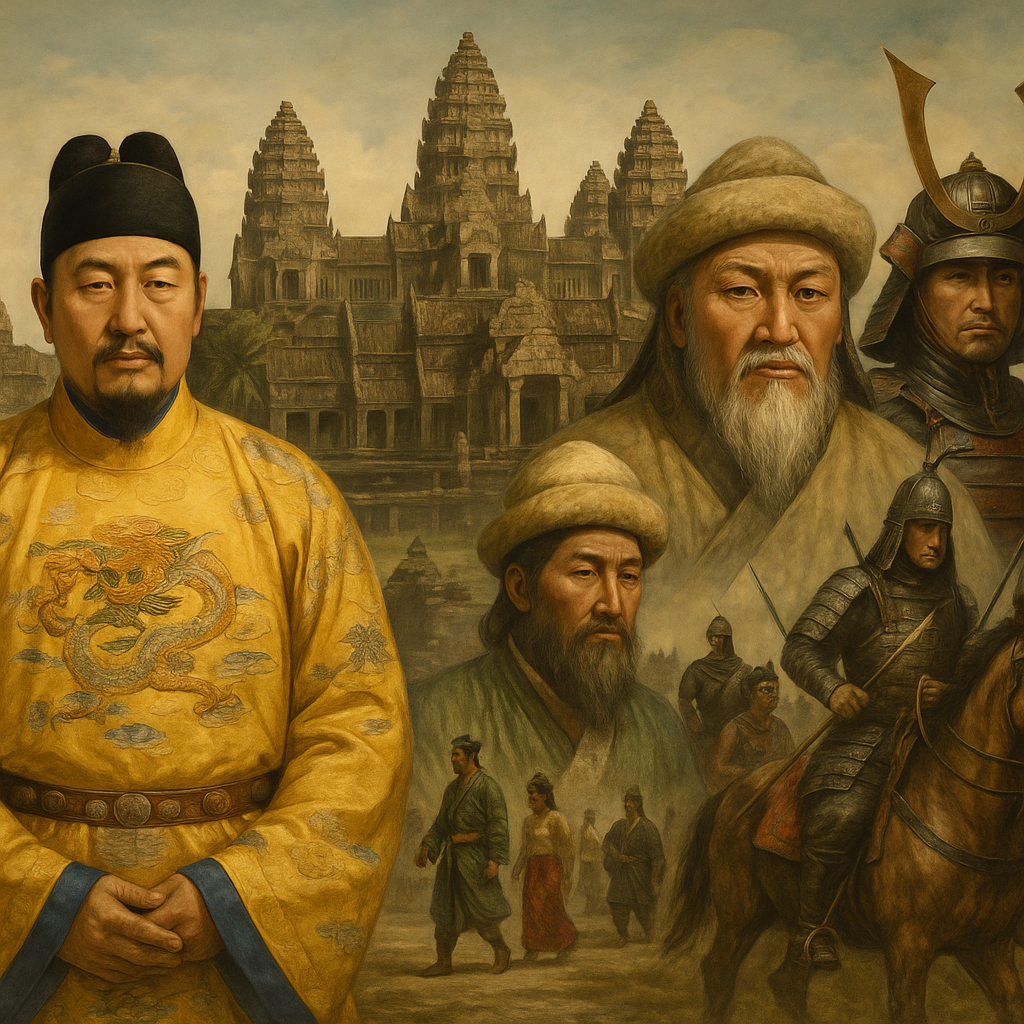
Asian Dynasties: Power, Culture, and Legacy
This course explores how major Asian empires gained and used power, shaped culture, and left legacies that still influence the modern world. You will compare political systems, religions, trade networks, and cultural achievements across South, East, and Central Asia from ancient to early modern times.
The first lecture plays free — no account needed.
What you'll learn
- Students will be able to locate at least five major Asian empires on a map and place them on a broad historical timeline.
- Students will understand the difference between an empire and a ruling dynasty and explain why both matter for historical analysis.
- Students will be able to articulate guiding questions about how empires gain power, shape culture, and leave legacies.
- Students will be able to describe at least two different ideological justifications for imperial rule in Asia (e.g., Mandate of Heaven in China, divine kingship in South Asia).
- Students will understand the role of bureaucracy and exams in stabilizing dynastic power, especially in imperial China.
- Students will be able to compare centralized and decentralized models of governance in Asian empires.
- Students will be able to summarize how the Maurya Empire expanded and how Ashoka’s embrace of Buddhism shaped its policies and legacy.
- Students will understand why the Gupta period is often called a "classical" age in Indian history, citing examples in art, science, and religion.
- Students will be able to explain how imperial patronage influenced the spread of Buddhism and the development of Hindu traditions.
- Students will be able to identify key features of Han, Tang, and Song governance, including the civil service exam system and Confucian ideology.
Prerequisites
- Geographic regions of Asia (East, South, Southeast, Central, West Asia)
- Timeline of major Asian empires and dynasties
- Empire vs. dynasty: basic definitions
- Power, culture, and legacy as analytical lenses
- Mandate of Heaven and other legitimacy ideologies
- Bureaucracy and merit-based administration
Course Content
11 modules · 2h 45m total
Mapping Asian Empires: Time, Space, and Big Questions
Introduce the major Asian dynasties and empires, locate them in time and space, and frame the key questions about power, culture, and legacy that will guide the course.
Foundations of Power: Legitimacy, Bureaucracy, and Rule
Examine how Asian dynasties justified their rule and organized their states, focusing on ideas of legitimacy and the structures that made large empires governable.
Early South Asian Empires: Maurya and Gupta as Cultural Catalysts
Explore the Maurya and Gupta empires in South Asia as early examples of large-scale imperial power and as engines of religious and cultural change.
Imperial China I: Han, Tang, and Song – Statecraft and Society
Investigate how successive Chinese dynasties built enduring political and social structures, and how their innovations shaped East Asia and beyond.
Conquest and Connectivity: Mongol Empire and Yuan China
Analyze the Mongol Empire as a transcontinental power that reshaped Eurasian connections, with a focus on its rule over China as the Yuan dynasty.
Islamic Empires in South and West Asia: Safavid, Ottoman, and Mughal Connections
Compare the Safavid, Ottoman, and Mughal empires as early modern Islamic powers, with special attention to the Mughal Empire in South Asia and its cultural synthesis.
Japan and Korea: Samurai States, Shogunates, and Confucian Orders
Examine how dynastic and military rule developed in Japan and Korea, and how they adapted and transformed Chinese models of governance and culture.
Trade, Cities, and Everyday Life in Asian Empires
Shift focus from rulers to subjects by exploring trade networks, cities, and daily life under Asian dynasties, highlighting how ordinary people experienced imperial rule.
Decline and Transformation: Why Dynasties Fall
Investigate common patterns in the decline and collapse of Asian dynasties, and how new powers and forms of rule emerged from their remains.
Empires, Colonialism, and Nationalism: Asian Dynasties in the Modern Age
Connect the history of Asian dynasties to the rise of European colonialism, anti-colonial nationalism, and modern states across Asia.
Comparing Legacies: How Asian Dynasties Shape Our World Today
Synthesize the course by comparing the long-term legacies of different Asian dynasties in law, culture, religion, and international relations.
Read the Textbook
Read every chapter for free, right here in your browser.
Before we talk about empires, we need to get our mental map of Asia clear.
In this course, we will use five big geographic regions: East Asia Modern examples: China, Japan, Korea, Taiwan, Mongolia Key empires/dynasties: Han, Tang, Song, Yuan, Ming, Qing (China); various Japanese shogunates and the Tokugawa shogunate South Asia Modern examples: India, Pakistan, Bangladesh, Nepal, Sri Lanka, Bhutan, Maldives Key empires/dynasties: Maurya, Gupta, Delhi Sultanate, Mughal Empire, Maratha Confederacy Southeast Asia Modern examples: Myanmar, Thailand, Laos, Cambodia, Vietnam, Malaysia, Singapore, Indonesia, Philippines, Brunei, Timor-Leste Key empires/dynasties: Srivijaya, Majapahit, Khmer Empire (Angkor), Dai Viet dynasties Central Asia Modern examples: Kazakhstan, Kyrgyzstan, Tajikistan, Turkmenistan, Uzbekistan, plus parts of western China and Afghanistan Key empires/dynasties: Various steppe confederations (Xiongnu, Göktürks), Mongol Empire, Timurid Empire West Asia (often called the Middle East in English) Modern examples: Turkey, Iran, Iraq, Syria, Saudi Arabia, and neighbors Key empires/dynasties: Achaemenid Empire, Parthian and Sasanian Empires, various Caliphates, Safavid Empire, Ottoman Empire (straddling Europe and Asia)
🧠 Big idea: These regions are modern labels, not ancient ones. Historical actors did not say, “We are building a Southeast Asi
Study Flashcards
Key concepts from this course as flashcard pairs.
Mapping Asian Empires: Time, Space, and Big Questions
Empire
A large political unit that rules over multiple peoples, cultures, or regions, usually with unequal power between a dominant core and subject areas; often expansionist.
Dynasty
A line of rulers from the same family; refers to *who* rules, not necessarily how large or diverse the state is.
East Asia
Region including modern China, Japan, Korea, Taiwan, and Mongolia; home to dynasties like Han, Tang, Song, Ming, and Qing.
South Asia
Region including modern India, Pakistan, Bangladesh, Nepal, Sri Lanka, Bhutan, and Maldives; home to the Maurya, Gupta, Delhi Sultanate, and Mughal empires.
Southeast Asia
Region including Myanmar, Thailand, Laos, Cambodia, Vietnam, Malaysia, Singapore, Indonesia, Philippines, Brunei, and Timor-Leste; home to Srivijaya, Majapahit, and Khmer (Angkor) empires.
Central Asia
Region including Kazakhstan, Kyrgyzstan, Tajikistan, Turkmenistan, Uzbekistan, and parts of western China and Afghanistan; heartland of steppe confederations and the Mongol Empire.
+4 more flashcards
Foundations of Power: Legitimacy, Bureaucracy, and Rule
Legitimacy
The belief that a ruler or government has the **right to rule**, making its power seem proper and acceptable rather than just based on force.
Mandate of Heaven
A Chinese idea that **Heaven grants and can withdraw** the right to rule based on the ruler’s **virtue and ability to maintain order**; disasters and rebellions can signal a lost mandate.
Divine kingship (South Asia)
A form of legitimacy in which the king is seen as a **representative, servant, or manifestation of a deity**, and as the **upholder of dharma** (cosmic and moral order).
Bureaucracy
A system of **offices, officials, and rules** that carries out government functions such as tax collection, law enforcement, and record-keeping.
Civil service examinations (China)
Competitive exams, especially from the Sui/Tang periods onward, used to select officials (in theory by **merit**) based on their knowledge of **Confucian classics**.
Arthashastra
An ancient Indian treatise on **statecraft, economy, and military strategy**, traditionally linked to Kautilya/Chanakya; emphasizes **realist and sometimes ruthless** methods to strengthen the state.
+3 more flashcards
Early South Asian Empires: Maurya and Gupta as Cultural Catalysts
Maurya Empire
An early large empire in South Asia (c. 322–185 BCE) founded by Chandragupta Maurya. It unified much of the subcontinent and is especially known for Ashoka’s rule and his promotion of Buddhist-inspired dharma.
Ashoka
Mauryan emperor (r. c. 268–232 BCE) who, after the bloody Kalinga War, embraced Buddhist principles and promoted moral governance through edicts carved on pillars and rocks across his empire.
Dharma (in Ashoka’s context)
A broad concept of moral law and right conduct promoted by Ashoka, influenced by Buddhism but also including general ethical rules like non-violence, respect, and generosity.
Gupta Empire
A powerful dynasty in northern India (c. 320–550 CE) known for patronizing Brahmanical/Hindu traditions, Sanskrit literature, and advances in art, mathematics, and astronomy. Often described as a 'classical age' of Indian culture.
Imperial patronage
Support given by rulers to religious institutions, artists, scholars, and builders (through land grants, money, or protection), which can greatly shape which religions and cultural forms grow and spread.
Religious pluralism
The coexistence of multiple religious traditions in the same society. In Maurya and Gupta times, Buddhism, Jainism, and Brahmanical/Hindu traditions all existed and interacted.
+2 more flashcards
Imperial China I: Han, Tang, and Song – Statecraft and Society
Mandate of Heaven
A Chinese political and religious doctrine stating that Heaven grants the right to rule to a just and moral emperor, and can withdraw that mandate if the ruler becomes corrupt or ineffective.
Confucianism (in the state context)
A philosophy emphasizing hierarchy, moral behavior, and proper relationships; used by Chinese dynasties as an official ideology to shape education, bureaucracy, and expectations of rulers and officials.
Imperial Examination System
A system of competitive exams, based mainly on Confucian texts, used to select government officials. It began in earlier forms under the Han, expanded under the Tang, and became central under the Song.
Tang Cosmopolitanism
The openness of Tang China, especially in cities like Chang’an, to foreign peoples, religions, goods, and ideas through Silk Road trade and diplomatic contacts.
Silk Roads
A network of overland and maritime trade routes connecting East Asia with Central Asia, the Middle East, and beyond, carrying goods, religions, technologies, and cultural influences.
Song Commercial Revolution
A term historians use for the major expansion of markets, money use, trade, and urbanization in Song China, supported by agricultural growth and technological innovation.
+4 more flashcards
Conquest and Connectivity: Mongol Empire and Yuan China
Mongol Empire
A transcontinental empire founded by Chinggis (Genghis) Khan in the early 1200s that stretched from East Asia to Eastern Europe and created unprecedented connections across Eurasia.
Chinggis (Genghis) Khan
The founder of the Mongol Empire, who unified Mongol tribes around 1206 and began rapid conquests using highly organized cavalry and innovative tactics.
Kublai Khan
Grandson of Chinggis Khan who completed the conquest of the Southern Song and founded the Yuan dynasty in China in 1271, ruling as a Chinese-style emperor.
Yuan Dynasty
The dynasty that ruled China from 1271 to 1368 under Mongol leadership, combining Chinese imperial institutions with a multi-ethnic, hierarchical system that favored Mongols and Central/West Asians.
Pax Mongolica
A term historians use for the relative peace and stability across much of Eurasia during the 13th and early 14th centuries under Mongol rule, which facilitated long-distance trade and travel.
Yam System
The Mongol relay station network that provided fresh horses, supplies, and lodging for messengers and officials, enabling rapid communication across the empire.
+4 more flashcards
Islamic Empires in South and West Asia: Safavid, Ottoman, and Mughal Connections
Gunpowder Empire
A state that uses firearms (cannons, muskets) as a central part of its military power and expansion, especially in the early modern period (e.g., Ottoman, Safavid, Mughal).
Janissaries
Elite Ottoman infantry corps originally made up of Christian boys taken through devshirme, converted to Islam, and trained as professional soldiers loyal to the sultan.
Qizilbash
Turkic tribal warriors who formed the early military backbone of the Safavid Empire and supported its Shi’a identity.
Mansabdari System
Mughal ranking and administrative system where officials (mansabdars) were given a numerical rank and paid mainly through temporary land revenue assignments (jagirs) in exchange for military and administrative service.
Zamindar
Local landholder or chief in Mughal India who collected taxes from peasants and passed a portion to the state, acting as an intermediary between villagers and the imperial government.
Sulh-i kull
A principle associated with Akbar meaning 'universal peace'; the idea that the state should treat all loyal subjects fairly, regardless of religion.
+4 more flashcards
Japan and Korea: Samurai States, Shogunates, and Confucian Orders
Heian period
Japanese era (794–1185) centered on the imperial court at Heian-kyō (Kyoto), known for refined aristocratic culture and strong Chinese cultural influence.
Samurai
Warrior class in Japan who served lords (daimyo) and shoguns; key political and military elite, especially from the Kamakura through Tokugawa periods.
Shogun
Military ruler of Japan who held actual political power while the emperor remained a symbolic and ritual figure.
Tokugawa shogunate
Japanese military government (1603–1868) based in Edo, characterized by samurai rule, strict social hierarchy, and tightly controlled foreign contact.
Sankin kōtai (alternate attendance)
Tokugawa policy requiring daimyo to spend alternating years in Edo and their home domains, helping the shogun control regional lords.
Joseon dynasty
Korean dynasty (1392–1897) that built a highly Confucian state with civil service exams, yangban scholar-officials, and the creation of the hangul alphabet.
+4 more flashcards
Trade, Cities, and Everyday Life in Asian Empires
Silk Roads
A network of overland trade routes connecting East Asia, Central Asia, and West Asia (and beyond), along which goods, people, and ideas moved between roughly 200 BCE and 1700 CE.
Indian Ocean trade network
A system of maritime routes linking East Africa, the Arabian Peninsula, South Asia, Southeast Asia, and East Asia, using seasonal monsoon winds to move goods and people.
Caravanserai
A roadside inn along overland trade routes (especially in Central and West Asia) where merchants and caravans could rest, store goods, and find protection.
Urban center
A city that serves as a hub for administration, trade, religion, and culture, attracting diverse populations and activities.
Social hierarchy
A ranked structure of social groups (such as elites, scholars, merchants, peasants, and enslaved people) that organizes power, status, and privilege in a society.
Patriarchy
A social system in which men hold primary power in political leadership, moral authority, social privilege, and control of property, often limiting women’s rights and public roles.
+2 more flashcards
Decline and Transformation: Why Dynasties Fall
Continuity through change
The idea that even when a dynasty collapses, many institutions, cultural practices, and social structures continue under new rulers or in new forms.
Mandate of Heaven (China)
A traditional Chinese belief that Heaven grants the right to rule to a just emperor; disasters, famines, and rebellions are seen as signs that the mandate has been withdrawn, justifying a new dynasty.
Bureaucratic continuity
When administrative systems (tax records, exams, provincial divisions) survive regime change and are reused or adapted by the next rulers.
Regionalization of power
A process where central authority weakens and power shifts to regional elites, warlords, or local states that may later become independent polities.
Dynastic cycle (traditional model)
A historical pattern often used for Chinese history: a new dynasty rises, prospers, declines due to corruption and disasters, and is replaced by another dynasty. Modern historians see this as a simplification but still useful as a starting framework.
Empires, Colonialism, and Nationalism: Asian Dynasties in the Modern Age
Unequal treaties
Treaties imposed on Asian states (like Qing China) by stronger powers after military defeat, giving foreigners special rights (e.g., extraterritoriality, trade privileges) and weakening local sovereignty.
Spheres of influence
Regions within a formally independent state where a foreign power has strong economic or political control, without full colonial annexation (e.g., late Qing China, Persia/Iran).
British Raj
The period of direct British Crown rule in India (1858–1947) that followed the end of East India Company rule and the formal abolition of the Mughal Empire.
Anti-colonial nationalism
Political movements that sought to end foreign colonial rule and create independent nation-states, often by reinterpreting dynastic and imperial histories to build a sense of shared national identity.
Dynastic legitimacy
The idea that a ruling family has the right to rule, based on tradition, religion, conquest, or claims of maintaining order and harmony.
National identity
A shared sense of belonging to a nation, often built through stories about a common history, culture, language, and territory—sometimes drawing on or reshaping dynastic pasts.
Comparing Legacies: How Asian Dynasties Shape Our World Today
Dynastic legacy
The long-term impact of a dynasty’s institutions, culture, borders, and ideas on later societies, including what is preserved, adapted, or contested.
Imperial examination system
A system, especially developed in imperial China and adopted in Korea and Vietnam, that selected officials through written exams on classical texts; it influenced modern civil service exams worldwide.
Zamindari
A system in Mughal and later colonial India where local landholders collected revenue from peasants; its patterns affected modern land ownership and rural power relations.
Cultural pluralism
A situation where multiple cultural or religious traditions coexist within a society or state, often managed or shaped by imperial policies.
Contested history
A past event or period that different groups interpret in conflicting ways for present-day political, cultural, or identity reasons.
Heritage
Monuments, texts, practices, and memories from the past that are preserved, celebrated, or sometimes fought over in the present.